Busan Is Growing Westward as Its Waste Infrastructure Stays Put
Busan’s proposed Saenggok incinerator has moved from 800 to 500 tons a day. The change reveals a larger problem of capacity, aging infrastructure and western urban growth.

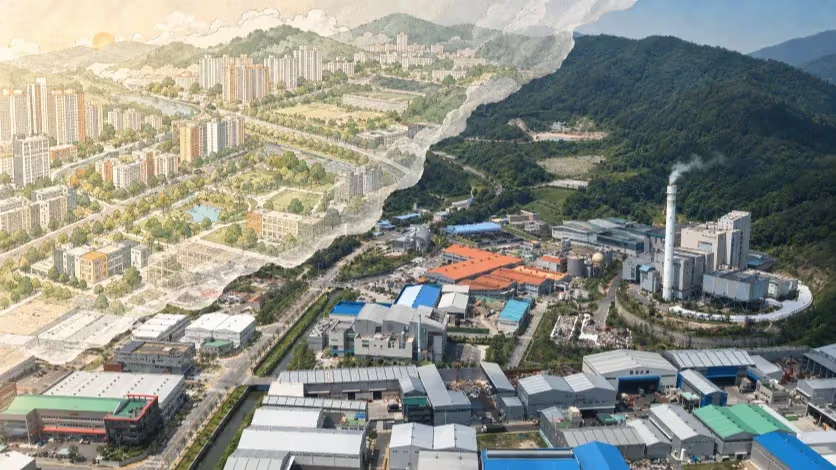
Busan’s 2025 plan called for an 800-ton-a-day incinerator at Saenggok. The project now being presented is for 500 tons, reopening a larger question about how much waste-treatment capacity the city can actually rely on as older infrastructure, new landfill rules and western expansion converge.
In 1996, while Busan was developing Myeongji as a new residential district, a city council member asked why an area expected to house about 50,000 people needed an incinerator capable of burning 400 tons of waste a day. The head of the city’s construction agency replied that one 200-ton line could handle waste generated within Myeongji. A second line had been added so that waste from outside the development could also be burned there, and officials said financial constraints meant the city expected to use nearly all of the planned 400-ton capacity rather than keep half of it permanently idle as reserve.
Council members were already asking what those additional tons would mean on the ground, including the truck traffic associated with moving waste into the district. Busan needed somewhere to process material that crossed neighborhood boundaries, while the effects of providing that metropolitan service would be concentrated around the facility that received it. Myeongji was being built as a residential district and assigned a wider waste-treatment role at the same time.
Three decades later, Busan is making another large waste-infrastructure decision in the same western part of the city. A September 2025 construction plan specified an 800-ton-a-day incinerator at the Saenggok resource-circulation complex. The project being presented in September 2026 is for 500 tons a day, with total costs of 456.2 billion won and completion targeted for 2033.
The public documents reviewed for this article establish both capacities but do not yet provide one calculation that carries the project from 800 tons to 500 using the same assumptions from beginning to end. Busan has said it will make releasable administrative memoranda and review documents from the planning process available to residents. Until those records connect the two versions, the 300-ton difference cannot by itself establish whether the new plan reflects lower expected waste volumes, a different treatment mix, revised assumptions about existing plants or some combination of those changes.
What 500 Tons Actually Means
Busan reported an average of 2,505 tons of municipal waste a day in 2024. The city classified 621 tons as food waste, 613 tons as recyclables and 1,271 tons as general waste, with disposal and treatment spread across Saenggok landfill, the Myeongji and Haeundae incinerators, Busan E&E’s fuelization operation and separate food-waste facilities. The 2,505-ton figure describes material entering several pathways rather than a single flow headed toward an incinerator.
Food waste leaves through a dedicated treatment system, recyclables can be recovered, and parts of the remaining waste can pass through preprocessing or fuel production before final disposal. Incineration transforms another portion of the material but does not remove it from the waste chain, because ash and other residues still require treatment or landfill. Tonnages attached to different facilities can therefore describe different materials or successive stages of the same material rather than separate quantities that can simply be added together.
Changes upstream alter what eventually reaches a furnace. Waste prevention, reuse and successful recycling can reduce the amount requiring downstream treatment, while changes in product composition can change the characteristics of what remains. A large incinerator built for decades of service has to fit a waste stream that may change considerably during its operating life.
The 800-ton and 500-ton plans consequently require a common accounting boundary before either can be evaluated. That account would identify what material the earlier plan expected to send to Saenggok, what the current plan expects the smaller facility to receive, and which other facilities or treatment routes are expected to handle the difference. Without those definitions, the lower number is neither evidence that Busan lacks enough capacity nor proof that the city has successfully reduced the amount it needs to burn.
Capacity Disappears in Operation
Myeongji also shows why a plant’s original rating cannot be treated as a permanent measure of what the city can process. The facility was planned as two 200-ton lines in the 1990s, while Busan currently lists it at 340 tons a day, divided between two 170-ton lines. The two figures come from different stages in the plant’s history, but they are enough to separate original project capacity from the operating capacity recorded decades later.
Daily operation removes capacity in less permanent ways. In July 2019, damage to a waste-heat boiler forced Myeongji to shut one of its two furnaces for emergency repairs, and Busan temporarily sent waste from six affected districts to Saenggok landfill while looking for room at Busan E&E. Later that year, the city again adjusted delivery areas among Haeundae, Myeongji and Busan E&E as waste inventories accumulated and older equipment constrained operations.
Busan’s own description of the system at the end of 2019 was explicitly interconnected. The city said Haeundae, Myeongji and Busan E&E were operated by adjusting waste-delivery areas among the three when regular maintenance, emergency repair or seasonal conditions increased inventories, with Saenggok landfill available when other circumstances required it. Rated capacity was only one part of the city’s ability to keep collecting waste.
A spare furnace is not the only way to absorb a disruption. Storage, preprocessing, alternative treatment, private capacity and changes in delivery routes can also create time when a major plant is unavailable, although the legal, environmental and financial consequences differ. Earlier reliance on direct landfill supplied another buffer in Busan, but that particular route is about to become more constrained.
A proposed 500-ton plant therefore adds less certainty than the headline figure appears to provide. Annual reliability depends on how often the new facility is actually available, which older facilities remain in service at the same time and where displaced waste can go when one of them stops. The amount Busan can depend on is the capacity left after those operating constraints are applied.
The Old System Has to Carry the Transition
National disposal rules change before the proposed Saenggok facility is scheduled to open. From January 1, 2030, regions outside the Seoul metropolitan area are subject to restrictions on directly landfilling household waste in standard garbage bags without prior recycling or incineration. Residues generated after recycling or incineration can still be landfilled, so the rule does not require every ton of municipal waste to be burned, but it reduces one route that cities have used for untreated residual waste.
The current Saenggok schedule places completion in 2033. Recycling, existing incinerators, fuelization and other treatment routes will continue operating between the regulatory change and the new plant, so the dates do not establish a three-year shortage. They do require Busan’s older treatment network to remain dependable after one form of fallback becomes more restricted and before the replacement facility is available.
Myeongji sits directly inside that transition. An older facility expected eventually to leave the network becomes more important when the replacement takes longer to arrive, and additional years of operation bring maintenance and remaining service life into the metropolitan treatment calculation. Writing 340 tons into a table does not establish that the equipment can provide those tons continuously through the transition.
Waste reduction can relieve part of the pressure by lowering the quantity that reaches final treatment. The opposite risk emerges if a city builds fixed thermal capacity around waste volumes that later fall because prevention, separation and recycling succeed. Enough capacity has to remain available when an aging plant shuts for repair, without making decades of high residual-waste throughput an assumption built into the system.
The transition is therefore an operating problem before it is a construction project. Existing plants have to remain usable, alternative routes have to survive tighter disposal rules, and reductions upstream have to be counted alongside capacity downstream. Saenggok enters that sequence in 2033 rather than beginning it.
Western Busan Carries a Metropolitan Function
Myeongji’s wider role did not end with the planning discussions of the 1990s. Busan currently lists the 340-ton plant as receiving waste from 13 districts on a rotating basis, with six districts assigned during one half of the year and seven during the other. A facility located in Gangseo-gu remains part of the disposal system for households spread across much of Busan.
Western Busan continued to develop around that infrastructure. Myeongji expanded, while Eco Delta City extended new residential and economic development through Myeongji-dong, Gangdong-dong and neighboring areas of Gangseo-gu. Busan was still offering land there in 2026 for detached housing, neighborhood commerce, logistics, research and industrial-support uses, evidence that the district’s transformation is continuing rather than belonging to an earlier development cycle.
Saenggok occupies a different but related history. The wider resource-circulation area includes the landfill, sewage-sludge treatment, recycling facilities, food-waste treatment, landfill-gas generation and waste fuelization and power infrastructure. The landfill itself dates to 1996 and covered 748,000 square meters, with an average 532 tons a day recorded as being landfilled in 2024.
The proposed incinerator would be built on land made available through the relocation of Saenggok village. As of September 2026, 133 of the 162 households covered by the relocation program had moved, while Busan said it intended to complete the remaining household moves by the end of the year. A settlement shaped by decades beside waste infrastructure is therefore being dismantled at the same time that residents of newer western developments are opposing another large treatment facility on the vacated land.
Neither sequence supports a simple claim about who arrived first. Existing treatment facilities preceded much of today’s western development, while Busan has also continued assigning new metropolitan waste functions to the same broader geography as housing, research, logistics and industry expand around them. Waste infrastructure and urban development have moved on different planning clocks but increasingly occupy the same territory.
A landfill or incinerator can remain fixed for decades while the meaning of the surrounding land changes repeatedly. Apartment districts can grow, commercial uses can appear and transport networks can reduce effective distance without the facility itself moving. Infrastructure once associated with the metropolitan edge can consequently find itself embedded in a new growth corridor.
Local opposition has to be read inside that history rather than reduced to an argument over whether residents accept the necessity of waste treatment. Truck movements, odor, emissions, the concentration of existing facilities and the chronology of public participation are different questions with different evidence, and none is established merely because a resident raises it. The physical requirement to process residual waste is equally real, because moving a facility redistributes the burden without making the material disappear.
Myeongji provides a particularly concrete measure of that distribution. The plant was planned partly for waste generated beyond the new district and today receives material from 13 Busan districts, while the physical facility remains in one part of Gangseo-gu. Metropolitan use and local burden have been connected there for three decades.
Calling the resulting conflict NIMBY compresses too much history into one label. It does not establish that local opposition is necessarily justified, nor that every claimed environmental risk is supported by measurement. It also does not explain why a service used across a large city can repeatedly create concentrated physical costs in the communities that host its infrastructure.
What Other Cities Count
Tokyo, Singapore and Vienna organize waste infrastructure differently because their geography, governance and utility systems differ. None offers a configuration that Busan can simply import. Their systems are useful here because each makes a different part of treatment capacity visible.
Tokyo’s 23 wards manage intermediate treatment through a shared authority operating multiple incineration plants, and its public waste reports follow combustible waste through incineration, energy recovery, ash treatment and final disposal rather than ending the account at the furnace. Individual facilities sit inside a larger portfolio whose plants can be maintained and replaced over time. Busan already uses a smaller form of network operation when it redirects waste among Myeongji, Haeundae and Busan E&E; the comparison is less about plant count than about accounting for what remains available when one asset is not.
Singapore draws the boundary around material flows more explicitly. The Tuas Integrated Waste Management Facility separately identifies daily capacities of 5,800 tons for incinerable waste, 250 tons for household recyclables, 400 tons for source-separated food waste and 800 tons for dewatered sludge, even though the processes share one integrated complex. Co-location does not turn different streams into a single treatment number.
Vienna adds a different resource when incineration is interrupted: time. Its Pfaffenau waste logistics center normally processes about 480 tons a day, but during maintenance or outages at thermal-treatment plants it can handle as much as 2,600 tons and temporarily store up to 44,000 compacted bales for later treatment. The buffer adds no furnace capacity, yet it keeps incoming waste manageable while unavailable equipment returns to service.
Those cities arrive at different physical systems, but all three force capacity planning beyond a single plant rating. Waste has to be identified by type, available facilities have to be distinguished from facilities temporarily offline, and displaced material needs a destination when the normal route fails. Busan already operates parts of those logics; the unresolved issue is whether its current plans put them into the same annual account.
The Numbers Need One Account
Busan already publishes many of the pieces needed to reconstruct its waste system. Municipal statistics describe how much household waste is generated and how it is divided, the city lists the stated capacities and delivery areas of major facilities, and past operating notices document occasions when waste has been redirected because equipment or storage was unavailable. Official and current project records now also contain both an 800-ton and a 500-ton version of Saenggok.
A reproducible account would connect those pieces with the same definitions. Material diverted through food treatment, recycling or other processes would leave the flow before residual waste is calculated; treatment capacity would reflect actual availability where it differs from a project rating; maintenance and retirement assumptions would be explicit; and an outage would have an identified destination for displaced waste. Ash and other residues would remain in the calculation until their final treatment or disposal.
Such an account would also show how the older network carries Busan through 2030 and toward the planned Saenggok opening in 2033. It would not determine where the new incinerator should be built, because a technically sufficient treatment system can still concentrate its physical costs in one area while another siting arrangement would carry its own land, transport and operating consequences. In western Busan, the two questions are difficult to separate because metropolitan waste functions and the city’s changing development frontier have repeatedly occupied the same geography.
In 1996, Busan planned a second 200-ton line at Myeongji partly for waste expected to arrive from beyond the residential district under construction. Thirty years later, the older plant still takes waste from across much of Busan while another major treatment facility is planned farther west, in a district that the city continues to develop for housing and economic activity. The 300 tons between the 2025 plan and the current project sit inside that longer history, alongside the aging facilities, changing disposal rules and communities that carry the physical consequences of metropolitan consumption. Busan has published many of the numbers separately; the capacity plan they are supposed to describe is not yet visible in the same form.
Continue this reporting
Reporting on the same issue
Related coverage selected from the article's desk, topics and newsroom relationships.
 NewsAug 17, 2026
What South Korea’s 87% Drop in Aquaculture Heat Losses Really Measures
South Korea reported an 87 percent drop in aquaculture losses from high water...
 NewsAug 2, 2026
The City Built on Tomorrow’s Buyers
Busan’s apartment-led growth delivered housing and urban renewal at extraordi...
 NewsJun 28, 2026
Europe’s Heatwave Tests Net Zero in a Less Predictable Climate
Carbon targets remain essential, but extreme heat is exposing a harder test f...
More from the author
More from this byline
Stay with the same line of reporting through more work from this byline.
Editorial Record
Corrections, sourcing notes and newsroom disclosures remain part of the published record. View Newsroom Notes →
Reader Signal
Community readWhat did this report leave you with?
Choose the signal that best reflects your reading. Select it again to remove it.
One response per article
No response selected
A moderated conversation about the reporting.
One-level replies and newsroom moderation keep the conversation anchored to this article.
Discussion Status
Open
Please sign in to join the discussion.
Newsletter
Weekly reporting and context from Busan and Korea.