After the Expo, Busan Is Negotiating a Different North Port
South Korea’s maritime ministry has moved to Busan, but North Port’s investment boundaries are changing. We trace the Expo bid, airport timetable and unresolved links to the old city.

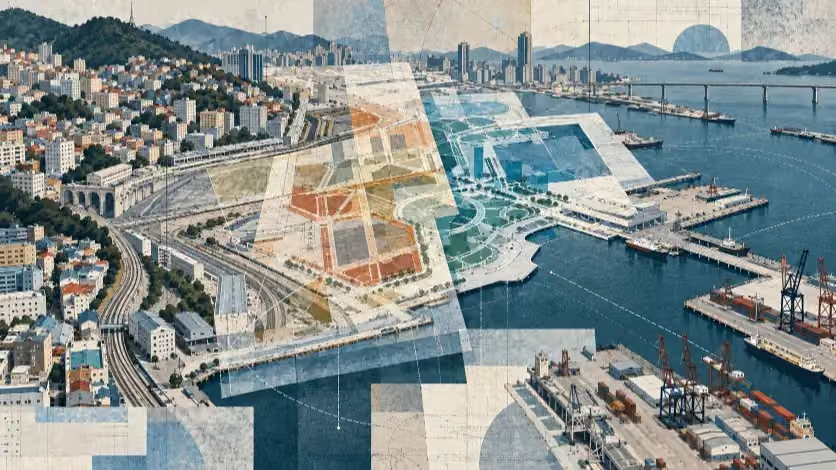
South Korea's maritime ministry has moved to Busan, public agencies have gained new ways to develop the waterfront, and a revised investment model is taking shape. But the financial boundaries of that model are not the same as the urban connections promised during the city's failed Expo campaign. A review of the bid, the airport and two phases of port redevelopment shows how the decisions now being made differ from the commitments once presented together.
In August 2026, South Korea's Ministry of Oceans and Fisheries chose a site at Busan's North Port for its permanent headquarters. The ministry was already operating from temporary offices in the city, having relocated from Sejong the previous December. Its new building, intended for completion by 2030, would stand in the first phase of a waterfront redevelopment long associated with Busan's ambition to become an international maritime center. The decision gave a defined public institution a place in a development whose commercial land had proved difficult to sell. Unlike a proposed convention, a ministry's relocation had already changed where national maritime policy was administered.
Less than a month later, a different part of the waterfront appeared in the Busan Metropolitan Council. Lee Sang-uk, a lawmaker representing neighborhoods behind the port, warned that a corridor intended to connect the Sujeong hillside to the second phase of redevelopment could be left outside the revised scheme as investors sought a financially workable project. He urged the city to put contributions to the old urban districts into the eventual implementation agreement. He was describing a risk to a plan, not announcing that the corridor had been formally abandoned. The warning nevertheless concerned the same stretch of city that had once been presented as an important beneficiary of Busan's campaign to host World Expo 2030.
The two announcements belong to different projects. The ministry's site is in North Port Phase 1; the negotiations over rail land, investment returns and the Sujeong corridor concern Phase 2. Conflating them would make the headquarters appear to solve a financing problem it has not been shown to solve. Treating them as unrelated would miss how the port is being reorganized: a national ministry and its proposed cluster bring new administrative demand to one area, while the agencies responsible for another area are reconsidering which costs and land can fit inside an investment agreement. The common question is no longer whether Busan can assemble a persuasive image of a future waterfront. It is how national administration, land development, remaining port operations, railway infrastructure and the older city are being assigned to institutions capable of delivering them.
That question was obscured when so much of Busan's development program was given a single event date. The Expo campaign helped coordinate otherwise slow-moving national and local projects, but it also made progress on different kinds of undertakings appear interchangeable. A host-city election, a reclaimed runway, a port land sale and a pedestrian route through an inhabited hillside are not advanced or evaluated through the same process. The record since Busan's defeat in November 2023 is more revealing when those processes are separated and then examined where they meet.
The corridor that belonged to an exhibition
In April 2022, Park Hyung-joon's administration issued an unusually detailed public defense of the Sujeong corridor. It described a scheme linking Sujeongsan's sports park and hillside neighborhoods to the land expected to form much of the Expo site within North Port Phase 2. The city proposed widening Sujeong-ro from approximately 10–14 meters to 40, creating a green pedestrian and road corridor on the slope, improving older low-rise residential areas and extending a pedestrian connection across the major road and public-space barriers toward the reclaimed waterfront. Officials argued that the corridor would overcome poor pedestrian access to rail stations, inadequate local roads and a shortage of parking and public facilities. It would also spread the expected gains from the Expo into the old city rather than concentrate them at the docks.
There was a concrete planning dispute behind the announcement. The city opposed a proposed private residential complex near the entrance to the corridor, arguing that a project involving municipal acquisition of public land followed by private development could obstruct the broader plan. Because the second-phase port proposal was still undergoing preliminary appraisal, Busan acknowledged it lacked an effective basis for restricting development on the corridor and asked the district government to exercise restraint. Officials contemplated a fast-track form of publicly led housing and neighborhood redevelopment, but also acknowledged that private land, compensation and funding would make the scheme difficult. The Expo was therefore more than a branding device in this instance. Its proposed site and deadline were invoked to assemble the legal and financial momentum for a specific piece of urban restructuring.
Yet even this apparently public-minded proposal contained choices that deserved scrutiny independently of the event. Widening an inhabited street to 40 meters can improve movement and create public space, but it can also require land acquisition, demolition, changes in commercial frontage and the relocation of residents or businesses. A green route on a steep slope may improve a journey that is currently awkward, though its usefulness depends on gradients, crossings, destinations and maintenance. The city's 2022 statement identified real obstacles to mobility without providing a completed compensation program or measured account of who would gain and who might be displaced. Those were matters to be negotiated, not benefits automatically conferred by drawing a continuous line from the hill to the water.
By July 2026, the institutional problem had moved from the corridor's design to the investment perimeter of Phase 2. Busan Urban Corporation president Shin Chang-ho told a council committee that the original development area had been too broad and that incorporating railway facilities had made it difficult for public investors to meet their internal financial thresholds. Recalculating a scheme more closely focused on port-side land, with certain railway-related areas removed, had produced a profitability index that allowed discussions to resume. The prospective participants were still negotiating their shares. The testimony did not establish that every railway project had been cancelled or that Sujeong had formally been removed; it established that the financial case being discussed was not the same as the broad, unified geography previously promoted to the public.
When Lee raised Sujeong's possible exclusion in September, the underlying tension had thus become traceable across four years of records. In 2022, Busan wanted the corridor inside a national port-and-Expo program partly because separate municipal action would be difficult. In 2026, investors were trying to define a narrower project they could support, while a local representative sought enforceable provision for older neighborhoods. Whether the corridor ultimately belongs inside Phase 2 or a separate program could be a sensible administrative choice. But the two arrangements would not have the same risk allocation. The first could make the consortium directly responsible for a city connection; the second would require another budget, legal instrument and construction schedule. That difference needs to be visible in the agreement, not left to the interpretation of a master-plan illustration.
What the Expo audit can establish
The Expo was decided on November 28, 2023, when Riyadh won 119 votes, Busan 29 and Rome 17 in the first ballot of the Bureau International des Expositions. The result showed a substantial shortfall in diplomatic support. It did not demonstrate that the city lost because of a particular slogan, local promotional expenditure or airport timetable. Member states made their choices within an international competition shaped by bilateral relationships, campaign strategies and the other bids. The government and city had also carried out actual overseas diplomacy; Park participated in missions to African countries. An account reducing the entire effort to domestic advertising would be as incomplete as one equating the completion of campaign activities with electoral success.
The official record contains a more precise problem of policy intelligence. In its January 2024 self-evaluation, the foreign ministry gave the Expo task an overall C while awarding ten out of ten for the effort to implement its planned activities. Evaluators credited the campaign's diplomatic contacts and cooperation but criticized its understanding of rival countries' support and the expected voting balance. One suggested that estimating likely votes, however difficult, would have been a more informative indicator of progress than counting approaches made to foreign counterparts. The result was a mismatch between an administratively demonstrable output—the planned contacts had taken place—and the outcome the operation was assembled to secure. The evaluation was written after the vote, and its criticisms do not prove that no internal country-by-country forecasts existed before it.
The account widened in November 2025, when Busan and central government departments jointly released a roughly 309-page white paper on the campaign. The city's announcement described ten years of planning, organization, BIE procedures, external negotiations and lessons. 부산CBS, which reported on its contents, described the paper as acknowledging a flawed reading of support, late engagement compared with competitors and decision-making arrangements that made timely responses difficult. Its reporting also attributed to the white paper concern about excessive optimism communicated from the presidential office. Those are consequential descriptions of an official retrospective, but the white paper's complete text and underlying internal estimates have not been independently audited for this article. The reported assessment therefore cannot establish what the president or any particular official privately knew at a specific time.
A separate examination by Busan MBC raised a different issue: how the government documented the campaign after it was lost. The broadcaster reported that, of approximately 308 pages in the version it reviewed, 103 were appendices and photographs, while the evaluation and lessons occupied 21 pages. It said the budget discussion provided institution-level and annual totals rather than an itemized account of expenditure. Page counts alone do not measure analytical quality, and a public white paper may legitimately preserve operational history. But those proportions matter when the document is offered as the principal public account of an expensive national and municipal campaign. A retrospective can preserve the story of what agencies did while leaving the relationship between forecasts, decision-makers, costs and corrective action largely inaccessible to outside examination.
That is a more substantial basis for scrutiny than dividing the total budget by Busan's 29 votes. A useful financial audit would separate the ministries, city, national bid committee and private participants, distinguish public expenditure from in-kind contributions and infrastructure investments, and compare the purpose and approval of material spending categories with the evidence available when decisions were made. A useful strategic audit would reconstruct the dates on which credible information about competitors arrived, who saw it and which decisions changed as a result. The published self-evaluation and reports on the white paper support examination of those questions. They do not yet supply the original spending ledger or the pre-election forecasts needed to answer them fully.
The political responsibility is likewise distributed. Park's administration chose to make the bid a central municipal undertaking and is accountable for the priorities, city expenditure and claims it advanced. The central government directed much of the international diplomacy, while BIE member states made the final voting decisions. The campaign also generated national attention, interagency cooperation and contacts whose potential value should be assessed rather than presumed worthless. A defeat does not erase those activities; nor do they substitute for an accurate public explanation of why the government continued to describe a competitive bid when the eventual support gap was so large.
The airport date that reached the contract
The Gadeok Island airport offers a firmer demonstration of how an Expo-related political objective altered a government project. It had a transport rationale before the bid, backed by a 2021 special law and a 2022 study that contemplated opening in June 2035. In March 2023, the transport ministry announced a strategy to bring that date forward to December 2029 so the airport could serve an Expo in 2030. The move required reconsidering an entirely offshore configuration in favor of a land-and-sea layout that would allow terminal construction and marine reclamation to run in parallel. Engineers identified potential time savings, but their advice rested on work sequencing, ground treatment, major equipment and unusually close coordination—not a guarantee of delivery.
The question of what would happen if Busan lost was raised at the March briefing. Officials said they believed their accelerated plan was achievable and deferred the hypothetical result to the November vote. Busan lost, yet the ministry issued its December 29 basic plan with the 2029 opening target intact. Finance consultations and an aviation-policy review had taken place in the intervening weeks. The records examined here establish those procedures but do not disclose whether the project date was specifically reassessed after the Expo defeat or which alternative schedule was considered. An airport without the Expo might still justify early completion; it does not follow that one particular date was the necessary expression of that objective.
The difference acquired contractual meaning in 2024. The initial site-formation tender contemplated roughly 72 months, and the instructions described early aggregate production and offshore ground-improvement works designed to fit the promised opening. Its first round attracted no bids. Three subsequent rounds produced only a Hyundai-led consortium rather than the competition required for an award; meanwhile the ministry relaxed restrictions on consortium membership and extended the construction allowance to 84 months. It proposed opening with the eastern runway-essential site complete while other site works continued. The National Assembly Budget Office pointed out that full site formation could then extend past 2032, creating a material distinction between initial airport operation and completion of the contracted works.
The next negotiation exposed the difference between a schedule the state wanted to procure and one a builder would accept. Hyundai proposed 108 months for the marine works; the ministry rejected a basic design incompatible with the 84-month terms. After the negotiation failed in 2025, Busan City continued to advocate the shorter allowance, while the Gadeokdo New Airport Construction Authority discussed a preliminary 111-month assessment. The authority's figure was not a final adopted schedule. In November, the ministry chose 106 months and a 2035 opening goal after further technical review. These different durations arose from different institutional positions and assumptions; without the underlying critical-path schedules, they cannot be treated as interchangeable engineering measurements. Nor can the 22-month increase alone account for the much larger change in the opening year, given failed procurement and work not included in the site-formation package.
The revised project had made measurable progress by September 2026, when a Daewoo Engineering & Construction-led consortium's basic design passed review. Its contract price and marine constructability, however, were still subject to work. In October, industry reporting described a request for approximately 620 billion won in precontract price escalation above the government's 2025 site-work procurement estimate of about 10.7 trillion won. That sum was a contractor demand, not an approved cost or a quantified consequence of Expo acceleration. Ground-improvement tests also identified resistance and equipment problems in some harder offshore zones. The reported 89 percent ordinary and 11 percent harder work zones refer to planned treatment areas, not the success or failure rate of 90 tests. Revised equipment and further trials were proposed. A passing basic-design review and a final demonstration of safe ground performance remain different milestones.
The original campaign therefore left a documented policy trail without furnishing a neat cost-of-failure calculation. Speed influenced the airport layout, the construction sequence and terms offered to the market. Government agencies subsequently revised those terms after the market and engineering reviews did not produce an executable contract under the earlier schedule. Other factors—marine soil, price escalation and contractor risk—have independent histories. Treating every later expense or delay as an Expo loss would obscure precisely which decisions can be audited.
A port still working, a waterfront still waiting
The North Port does not present the same sequence as the airport. Its redevelopment is taking place beside an operating shipping system whose functions have been shifting toward Busan New Port for years. In the city's 2024 cargo statistics, North Port still handled approximately 6.52 million twenty-foot-equivalent units, or 26.7 percent of the port's container traffic; the New Port handled about 17.88 million, or 73.2 percent. Those figures refer to the North Port and New Port operational categories for 2024, not to the exact parcels inside Phase 2, and they cannot substitute for a current terminal-by-terminal inventory. They do establish that writing about the entire northern harbor as abandoned land would be wrong. Redevelopment, terminal relocation, rail operations and port employment have to coexist across a staged transition.
The first phase demonstrates the gains and the financial limits of that transition. Public investment has already formed roads, bridges, parks and waterfront spaces, and the Busan Port Authority has developed land intended for sale or other uses. Yet a September 2025 National Assembly Budget Office assessment identified a structural recovery problem. The overall Phase 1 project was put at about 2.99 trillion won, of which the port authority was responsible for roughly 2.32 trillion. Only a minority of the reclaimed and developed area could be sold commercially, because much of it served public or port functions. As of the report's underlying 2025 figures, about 45 percent of the approximately 300,000 square meters available for sale had been sold, and the landmark area had failed to secure a developer through two successive competitions. The unsold percentage describes that period, not an independently established October 2026 inventory.
That asymmetry is important for any claim that a new public developer can easily revive the waterfront. A park, bridge or promenade contributes to the city's value, but it does not necessarily yield a cash return to the authority that financed it. When sales of the limited commercial plots stall, the recovery of past investment slows. The budget office warned that an extended delay could pressure the authority's finances and affect the next phase's appeal to investors. The issue is not proof that public space was a mistake; it is the financing problem created when public benefits and the repayment sources for the institutions building them occupy different parts of the project.
The maritime ministry's relocation changes one condition of that model. In December 2025, it began operations from temporary offices in Busan's Dong-gu district; its May 2026 announcement reported that 859 employees had moved. In August, the ministry chose a permanent headquarters site in the Phase 1 maritime-cluster area for a building planned by 2030. The headquarters location is not identical to the separately marketed landmark parcel. A national agency's physical presence can create continuing demand for offices and supporting services, give maritime firms more frequent access to policymakers and make some previously speculative development proposals easier to define. Those possible effects depend on what organizations actually locate there and on the cost, access and operation of the buildings. The ministry's move is an observed administrative change; it is not, by itself, measured proof of new private employment or higher productivity across Busan.
The government is trying to create a larger ecosystem around that move. Its maritime policy program includes a proposed industrial and administrative cluster, a 100 billion won scale-up fund, and institutional coordination across Busan, Ulsan and South Gyeongsang. It has also cited corporate relocation decisions and legislation to establish a specialized maritime and international commercial court. Each item has a different maturity: a ministry with staff at work, a future headquarters parcel, a fund to be assembled, businesses announcing or completing relocation steps, and institutions that still require implementation before they can deliver services. Grouping them under the phrase 'maritime capital' does not make their outcomes simultaneous. Nor does the ministry's own claim of increased business sales after relocation demonstrate that the move caused the increase without comparable controls for other economic changes.
A separate legal shift may prove especially important to the port authority. On September 3, 2026, the National Assembly passed an amendment allowing port authorities and other public bodies a larger role in developing buildings and other facilities above redeveloped port land, rather than relying on private parties to acquire prepared sites and construct the buildings themselves. The government described the measure as a response to the gap between preparing land and securing its subsequent use. That gap had been exposed by North Port's unsold plots. But legal authorization is only the first step. Public institutions taking on upper-level development may exchange the uncertainty of finding a buyer for the long-term costs of constructing, leasing, maintaining and operating buildings. Project-specific investment approval, financing terms and the eventual tenants will determine whether the change improves the public balance sheet. As of October 28, the law's passage did not amount to approval of a particular North Port building or a completed financial rescue of the landmark parcel.
Where the costs move in Phase 2
The second phase follows a different financial path. The 2022 preliminary feasibility assessment covered a development area of approximately 2.29 million square meters, incorporating port areas, railway land and parts of the neighborhoods behind the waterfront. Its benefit-cost ratio was 0.88 and its analytic hierarchy process score 0.561, sufficient for advancement under the public appraisal system. This was an assessment of a proposed public project, not a guarantee that every consortium member could recover its investment. The redevelopment would require several institutions—Busan City, the port authority, the Korea Land and Housing Corporation, Korail and Busan Urban Corporation—to agree what they were financing and what returns they could expect.
By October 2025, the National Assembly Budget Office calculated that the projected cost had risen from about 4.06 trillion won at preliminary appraisal to 4.76 trillion, reflecting updated costs and assumptions. Investors had not agreed on the full plan. The maritime ministry nonetheless included a proposed one billion won for designs of an underpass, a road bridge and a pedestrian deck, prompting a warning from budget analysts that the work might have to be redesigned if the underlying land and transport scheme changed. The allocation was a proposal, not proof that the sum had been spent or wasted. The warning concerned sequencing: infrastructure intended to tie together a redevelopment cannot be designed with confidence while the development's boundaries and transport arrangements remain unsettled.
The subsequent profitability discussions offered one way forward. In July 2026, the president of Busan Urban Corporation explained to the city council that excluding some railway-related land had made a revised port-side investment more acceptable. Contemporary reporting also identified changed assumptions about tram expenditure, national property and a separate railway development initiative. These explanations are not interchangeable or additive: the original financial model and the revised parcel-by-parcel assumptions have not been obtained. A higher profitability index may reflect a real reduction in project risk or a transfer of costly functions outside the investment perimeter. The public benefit-cost ratio and the revised investor profitability index have different purposes and cannot be compared as if they measured the same return.
A separate railway redevelopment pilot, selected in February 2025 for the Busan Station–Busanjin Station corridor, could provide a legitimate route for resolving some of those excluded works. The concept involves rearranging rail functions and using new structures and land development, not placing every operating rail line underground. Its preliminary cost estimate and time horizon are distinct from those of Phase 2. A transfer of responsibility between programs might enable specialized institutions to do work they are better equipped to manage. It might equally produce delays at the point where their construction schedules need to meet. Without matching maps, itemized financial plans and written agreements, it is impossible to distinguish those outcomes by simply observing that an investor's profitability index improved.
The Sujeong corridor gives this accounting question a recognizable place in the old city. In 2022, the city defended its inclusion as a way to connect hillside residents to the port and to bring new public facilities into older residential districts. In September 2026, a council member was warning that the development and its community benefits needed protection as investors reconsidered project scope. The two statements were made under different political administrations and economic conditions, and the corridor has not been verified as finally excluded. Still, they expose an issue that neither a new ministry headquarters in Phase 1 nor an improved investor index in Phase 2 resolves automatically: if a pedestrian connection, widened road or neighborhood project lies beyond the revised investable area, who is required to construct it, acquire the land and provide for residents affected by the work?
This is not an argument that every part of the 2022 corridor should be built exactly as originally drawn. The earlier proposal's scale could impose costs on the people it was intended to benefit, and a smaller or differently routed connection might provide better access with less displacement. The point is that such choices should be made from updated engineering, transport and social evidence. A project may become financially easier to undertake when difficult components are removed, while becoming less comprehensive as a response to the city's needs. Conversely, a carefully funded railway program and a revised corridor could improve the outcome. The implementation agreement and its companion public budgets, rather than the promotional master plan or the investor index alone, are where these alternatives can be distinguished.
A new policy without an old deadline
By October 2026, responsibility for the waterfront and the airport spanned several political periods. Park's administration had made Expo readiness, the airport's early opening and a connected North Port part of its municipal program. National ministries authorized the airport's construction conditions and directed much of the diplomacy; public corporations evaluated their own capital exposures. The current national government has relocated the maritime ministry and supported changes to public-development powers. Busan's current administration, under Mayor Jeon Jae-soo, is discussing the port's future use and coordinating with institutions that retain separate legal responsibilities. The historical record of one administration cannot settle the present merits of decisions that later governments and enterprises still have to make.
The new mayor has also revived an event-oriented vocabulary, announcing a bid for the 2028 G20 summit and discussing a multipurpose dome at the North Port. South Korea is due to chair the G20 in 2028; the selection of a host city and financing of any proposed venue are separate matters. A summit is not an Expo, and its required facilities and international selection process cannot be assumed to have the same costs or consequences. The historical comparison is useful only in the narrower administrative sense: before tying land, transport or public capital to a fixed occasion, authorities can specify which facilities have independent demand, what a cancellation or failed bid would change, and which expenditures would remain justified without the event. Those tests cannot be satisfied by announcing another international ambition.
The maritime ministry's arrival gives Busan a policy instrument that did not exist in the city during the Expo vote. It can improve coordination between the agencies regulating the maritime economy and the port where much of that economy operates. But the physical port, the land-owning port authority, railway operators, municipal planning departments and prospective developers do not become one financial institution because they now share a metropolitan location. The new law broadens options for public construction, while also making the quality of investment decisions more consequential. An agency that can now build a waterfront office or public facility must still explain the source of its repayment and the public service it will deliver.
A credible evaluation of the policy transition would therefore use several connected records rather than a single headline project total. Phase 1's land-sales and future public-building program would show what the port authority is now being asked to finance; Phase 2's original and revised maps would show which rail and neighborhood obligations remain inside its contract; transport plans would demonstrate how those programs join the working harbor to the older city. Outcomes for residents would have to be measured in actual access, displacement, use and employment, not assumed from the name of a new cluster. Such evidence could support a favorable assessment of the restructuring if work is funded and coordinated. It could also reveal costs that have merely moved from one agency's proposed contract to another's future budget.
The immediate unresolved decision is unusually specific. In the original Sujeong plan, Busan's public argument for including an inhabited hillside in port redevelopment was that development gains should extend beyond the waterfront. In the current Phase 2 negotiations, the investor perimeter is being altered while those connections are still being discussed. The ministry's permanent headquarters has a designated site, and public agencies have a new legal route to develop buildings in Phase 1. There is not yet a comparably documented answer in the material reviewed here for the Sujeong connection: its final boundary, the responsible builder, the compensation terms and the source of funds. The revised implementation agreement will show whether the purpose that justified including the corridor in 2022 survived the financial restructuring of 2026—or whether the city has chosen and funded a different means of achieving it.
Continue this reporting
Reporting on the same issue
Related coverage selected from the article's desk, topics and newsroom relationships.
 NewsOct 4, 2026
Zelensky, South Korea and the Limits of Wartime Pressure
South Korea says Kyiv broke a confidentiality understanding when Zelensky rev...
 NewsSep 1, 2026
What Lee Jae Myung Thinks a Minister Can Fix
President Lee Jae Myung says reform should be judged by results rather than c...
 NewsAug 21, 2026
The Korean Peninsula Trump Is Returning To
Another Trump-Kim summit would unfold on a peninsula where North Korea is har...
More from the author
More from this byline
Stay with the same line of reporting through more work from this byline.
 NewsOct 26, 2026
What It Took to Feed Busan
 NewsOct 21, 2026
What a Small Mackerel Is Worth
Reader Signal
Community readWhat did this report leave you with?
Choose the signal that best reflects your reading. Select it again to remove it.
One response per article
No response selected
A moderated conversation about the reporting.
One-level replies and newsroom moderation keep the conversation anchored to this article.
Discussion Status
Open
Please sign in to join the discussion.
Newsletter
Weekly reporting and context from Busan and Korea.