What It Took to Feed Busan
Busan’s food history stretches from river-clam vendors and wartime rice markets to factory lunchboxes, milmyeon, fish cake, pork soup and cafés. The meals that shaped the city were made by traders, cooks, families and workers—not just its famous restaurants.

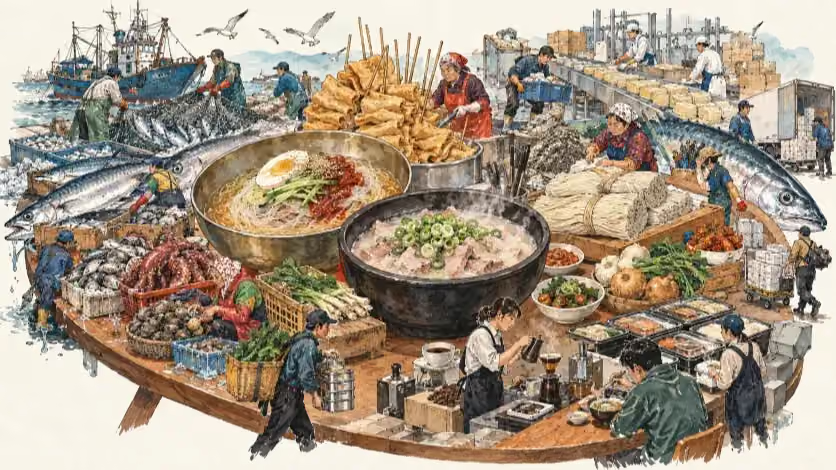
From wartime rice markets and factory lunchboxes to milmyeon, fish cake, pork soup and coffee, the city’s food history extends far beyond its famous dishes.
On July 14, 1950, rice was becoming cheaper at Bupyeong Market in Busan. Less than three weeks into the Korean War, supplies were arriving from other regions, and the government had released rice from its reserves. The next day, Minju Sinbo printed the market's prices for rationed and privately traded rice, along with barley, beans, wheat, flour, salt and other provisions. There was more grain to buy, and the price of the principal staple had fallen. For some households, neither change meant they could afford to keep it.
The paper reported that some of the poorest recipients of government rice were selling what remained of an earlier allotment to raise money for the July distribution. Food already brought home was returning to the market so that another ration could be purchased. The report did not say how widespread this was. It did, however, expose a peculiarity of the emergency: the same rice could appear as evidence of better supply and as a measure of the buyer's desperation. A separate report days earlier had described neighborhood organizations demanding dues or security fees before handing out coupons needed to purchase government rice, a practice city officials criticized. The contents of a household's bowl depended on transport and harvests, but also on cash, public rules and the work required to turn a ration into dinner.
The crisis unfolded in a city that had been trading food and almost everything else before the war began. On May 21, San'eop Sinmun reported approximately 1,300 stalls working in 61 trades at Gukje Market, amid a dispute over a possible clearance of street vendors. These were figures reported at the time, not an audited census. The article traced the market's post-liberation expansion to Koreans returning from Japan, China and elsewhere, who needed places to sell goods and earn a living. Their shops and stalls were already part of Busan's economy when the next wave of displaced people began arriving.
A wartime price list and a dispute over stalls do not, on their own, explain a city's cuisine. They do locate food in the lives of the people who traded it, prepared it and struggled to purchase it. Busan's best-known dishes would later acquire histories involving migration, factory labor, processing and the widening reach of restaurant businesses. Those histories began within a much older landscape of farms, rivers, fishing grounds and markets, only some of which fell inside the city's boundaries at any given time.
Before the famous dishes
An October 1918 postcard depicts Bupyeong's public market under a long roof, people gathered along the street outside. Its publisher, Busan's Ojukdang Bookstore, was preserving the sight of a recognizable institution rather than the record of a particular purchase. The market had developed as an organized retail space in 1910 and received public-market status in 1915 under Japanese colonial rule. More than thirty years before the rice-price report, the building occupied a place in a city already reshaped by the trade and authority of an imperial port.
Not every market operated under the same rules or history. Dongnae had a tradition of periodic trade recorded in eighteenth-century sources; a five-day schedule remained part of its commercial life before later reorganization as a permanent market. Grain and vegetables came through different arrangements from marine products, and the districts now joined together as Busan were not always part of the same administrative city. Gupo and Sasang entered Busan in 1963, agricultural areas in the lower Nakdong estuary in 1978, and Gijang in 1995. To call an older food 'Busan's' is therefore to invoke a place whose political boundaries have changed around its fields, waterways and businesses.
Colonial-period accounts of Bupyeong's trade include rice and other grains, vegetables, fruit, fish and seaweed among the goods sold there. Those lists put land produce beside seafood in the economy of a city usually pictured through its harbor. They also show the limits of a trading record: a fish sold in a market could be cooked at home, served in a shop or resold, and a sack of grain could travel onward without feeding anyone nearby. Busan's role in moving food through Korea and beyond cannot be substituted for a record of what its residents actually ate.
Rice was subject to a separate machinery of contracts and control. Busan merchants had pressed for a formal exchange from around the turn of the twentieth century; one finally opened in 1932 as colonial authorities reorganized grain markets. Historian Kim Min-hwa traces its narrowing activities under tighter Japanese controls. Trading was suspended in 1938, and the exchange was dissolved in 1939. The institution connected the port to the agricultural economy and to imperial regulation. Its transactions belonged to the history of food, even though its records cannot tell us which families had rice in their cooking pots.
The lower Nakdong offered another way of earning a living from food. In municipal accounts of the former clam trade, men gathered freshwater clams in waters around Eomgung and Hadan while women cooked jaecheopguk, a small-clam soup, to carry and sell across the city's passes. The histories name the routes through Gudeok and Daeti. Busan's Fishing Village Folk Museum has preserved objects and oral accounts concerning gatherers, vendors and restaurants. Unlike a grain exchange, this trade put the cooked dish into motion. The person carrying the soup had already made a meal of the river's catch before meeting the customer.
What survives of that work is uneven. A museum can preserve the equipment and memories of clam vendors; a restaurant can continue to serve soup under the same name. Neither fact tells us where every present-day clam was harvested or how the old trade compares in scale with modern distribution. Its history nevertheless broadens the cast of a food story that might otherwise belong to merchants and factory owners. Harvesting, cleaning, cooking and carrying were distinct kinds of expertise, performed by people who did not necessarily own the market stall or restaurant where the food was ultimately eaten.
Cooking in a city of arrivals
In footage shot by the U.S. Army Signal Corps on September 18, 1950, refugees in Busan appear in the surviving museum catalog carrying cooking pots to collect water; rice is being prepared in a camp. The National Museum of Korean Contemporary History describes these activities as part of a film that also records an inspection of living and medical facilities. The camera was present for an official visit, not an inquiry into the diets of all displaced families. Still, the scene belongs beside the market price list. Grain had to be made edible, and for people without settled homes the water, utensils and place required to cook could be as consequential as the ration itself.
Historian Gong Mi-hee estimates that Busan's population reached roughly 850,000 in 1951, as refugees crowded into temporary shelters, rooms and hillside dwellings. Relief took different forms. Gong reports that authorities first provided prepared rice balls to some arrivals and later used an allowance described as three hop of grain and 50 won for side dishes per person each day. The figures come from research on relief policy; they do not establish what every household received or managed to eat. There was a material distinction between issuing cooked food and distributing grain to people who might have to find their own fuel, water and equipment.
The Korean YWCA's account of its work in wartime Busan describes women cooking and distributing milk porridge to refugees. A later account identifies barley and powdered milk among its ingredients. Those details do not reveal the number of portions made, but the choice of food is revealing. Relief supplies could be incorporated into a familiar preparation only through organized cooking. The same organization taught agricultural and handicraft skills to girls without family support and vocational skills to war widows, recording the wider labor of securing a livelihood in a city overwhelmed by arrivals. The soup pot, not only the relief ledger, belonged to its response.
Some cooking practices outlasted the emergency by becoming businesses. People displaced from northern Korea brought the skills and expectations of cold-noodle making to Busan. The account most often given for milmyeon—cold noodles made with wheat flour and starch—connects the difficulty of obtaining buckwheat with the wheat flour distributed as postwar relief. That explanation describes a process rather than an inventor. A family associated with Naeho Naengmyeon in Uam-dong dates its sale of wheat-based noodles to 1959; other Busan noodle shops developed their own approaches later. A household adaptation, the opening of a restaurant and a city's eventual attachment to a dish are not necessarily the same event.
The noodles themselves resist a simple story of replacing one flour with another. In a 2019 interview, descendants of the Naeho family described a dough of seven parts wheat flour to three parts sweet-potato starch, set against a beef-stock broth using bones and cuts of meat. Seasoned skate was among the toppings. That was the family's recipe as reported in 2019, not a surviving recipe sheet from 1959. Texture, broth and garnishes carried elements of the cold-noodle traditions the family had brought south. Other milmyeon businesses settled on sweeter, sharper or spicier broths and different mixtures of flour and starch. The food became recognizably Busan through a history of restaurant variation, not a formula fixed at the moment of displacement.
Markets still served established residents as well as newcomers; public kitchens, rented rooms and family shelters presented different possibilities for preparing food. The war was not a shared culinary experience with a single outcome. In one setting, provisions had to be eaten immediately; in another, an inherited craft was adapted for paying customers. As employment and industrial production expanded, those different arrangements for eating found new places in the city. The factory did not replace the household kitchen so much as give its work a different timetable.
A lunch arrives at the factory gate
In the 1960s, employees at some of Busan's rubber-shoe factories ate food brought from home. Workers interviewed for a 2017 Kookje Shinmun and Busan Storytelling Association project recalled lunches left at factory guardhouses. Containers were marked with the name and department of the person who would eat them. Family members sometimes delivered the food, and younger employees collected it near midday and carried it to the workrooms. The account concerns particular workplaces and memories; there is no basis for assuming that every plant operated this way. The detail of a name written on a lunch container nevertheless places a household kitchen inside Busan's industrial history.
Former Dongyang Rubber employee Kim Yeong-sik recalled being paid according to the number of shoes he finished. In a workplace where output determined wages, time away from the bench had a cost. Around 11:30 a.m., according to the collected memories, junior workers made the rounds with lunchboxes labeled for colleagues in different departments. The report does not identify the meals inside or every person who prepared them. What it does describe is a daily transfer of work: someone shopped and cooked, someone brought food to the gate, and someone else made sure it reached the worker. A factory could rely on these activities without organizing them as company catering.
The same workers remembered buying steamed buns at Choryang Market when they were hungry after their shifts. A bun on the journey home was not a substitute for every meal but a convenient purchase at a specific hour. The stories locate food businesses within working routines—when labor ended, when a person could afford to stop and what could be carried onto the bus. Markets and small shops mattered without being the only places industrial workers ate.
The factories themselves were spread across an expanding city. Shoe manufacturing was established in neighborhoods including Choryang and Gaya before Sasang developed into a larger industrial district in the late 1960s and 1970s. Shifting work and residence patterns shaped the customers available to food sellers. But the lunchbox stories come from particular factories, not from a single representative 'Sasang worker,' and the later history of Sasang's restaurants cannot be laid over them without matching dates and witnesses.
Agriculture also remained within the region's working life. Yun Hui-su began a diary in 1954 in Daecheon, a farming village in what is now Hwamyeong-dong. Researchers Yang Heung-sook and Kong Yoon-kyung describe women in the village growing and selling produce while undertaking domestic and community responsibilities; a related study describes later changes to kitchens, wells and sanitation. Their material is not a menu diary, and it cannot reveal what the factory workers in Choryang packed for lunch. It does, however, preserve a neighboring history of labor: food was still being cultivated and marketed by households at the very time other households were organizing their days around industrial wages.
The factory wage record and the village diary cannot be folded into one typical Busan family. Their differences matter. Industrialization brought new forms of paid work, but food continued to pass through homes, markets, farm plots, street stalls and company gates. Some of those routes were shortened or replaced as businesses grew. Others persisted beside new factories and increasingly varied restaurant districts. For food processors, the separation between the place of manufacture and the place of sale became an opportunity of its own.
When production moved beyond the market
In a 2010 account, Busan's municipal magazine found two familiar fish-cake shops still selling at Bupyeong Market even though their factories had moved. Hwanggong Eomuk's plant was in Gimhae; Mido Eomuk's was in the Jangnim industrial area. The report describes the businesses at that date, not their verified locations today. It also shows how a market could keep its place in a food's commercial identity after losing the production work once performed there. The counter remained recognizable while the factory belonged to another part of the urban economy.
Eomuk is made by processing fish flesh into a paste, mixing and seasoning it, then shaping and cooking the product. The industry brought together skills, equipment and distribution, including techniques influenced by Japanese food businesses during the colonial period and developed further by Korean manufacturers after liberation. A piece prepared for immediate sale and a packaged product supplied to distant retailers required different handling. Space for machines, the movement of ingredients and the preservation of finished goods became part of the business. What customers bought in the market increasingly depended on work they could no longer see from the stall.
Fish did not need to be caught in Busan's waters for a processor based there to make a product associated with the city. Equally, a factory producing in Busan could sell far beyond it. The local identity of fish cake came to rest on several elements: processors' know-how, the history of the makers, the markets where customers encountered the product, and the name attached to it. How much raw fish or prepared surimi individual manufacturers now buy from each source remains a separate empirical question. The history of the industry does not answer it automatically.
In Gupo, dried noodles took advantage of a different physical property: they could be made in one place, bundled and stored, then sold or cooked somewhere else. The district's river and railway connections helped shape its manufacturing history. By the late 1980s, the name on the package had become valuable enough to bring a dispute before South Korea's Supreme Court. On September 26, 1989, the justices ruled that Gupo Guksu, used in the case as an ordinary indication that noodles were produced in Gupo, could not be monopolized as the trademark claimed under the law then applicable. The court pointed to the fact that the parties were producing and selling noodles in that district; it did not decide which factory's recipe was superior or certify the authenticity of every noodle carrying the name. The decision overturned an earlier ruling and sent the case back for reconsideration.
A market counter and a geographic name could each preserve something of a food's past when its manufacture, ingredients or buyers changed. The fish-cake workshops' move opened distance between production and retail; the Gupo dispute showed a place-name shared by several producers entering the legal machinery of commerce. Neither story is a measure of household consumption. Together, they explain why the making of a regional food might continue in forms that a photograph of an old shop cannot show.
The city that eats today
At Eomgung's agricultural wholesale market, the published timetable starts vegetable auctions at 2 a.m. and fruit auctions at 4. Other wholesale markets and fisheries follow their own schedules, linking producers, carriers, merchants and shops long before most customers sit down to eat. These places are rarely the center of a city's account of its cuisine. Their hours nevertheless reveal how much routine organization remains behind the apparent simplicity of buying food for dinner.
On a different stage, a familiar restaurant meal becomes a way of presenting Busan to outsiders. In 2026, the city and its tourism organization ran a pork-soup restaurant nomination and voting campaign, followed by events where customers could compare food from participating establishments. Its organizers reported thousands of recommendations and votes. The campaign used an existing restaurant culture to invite exploration of neighborhoods and differences between cooks. It was a promotion and a public choice exercise, not a survey of the meals residents ate during the week.
Pork soup, dwaeji gukbap, was a working meal long before it became an object of municipal celebration. Its origins have attracted rival explanations involving markets, migration and the meat trade, which Busan Ilbo explored in its 2019 reporting; the city's own heritage account does not identify an uncontested inventor. There is no need to resolve the entire dish into a single wartime creation story to recognize its place in Busan's restaurant life. Its familiarity grew through businesses offering hot meals to repeat customers, even as individual recipes and dining habits varied. The festival expressed that accumulated attachment in a new setting rather than creating the attachment by itself.
Other foods acquire less public attention while remaining part of local life. A packed lunch, fish bought to cook at home, a bowl served beside a market or a meal eaten in a school cafeteria can be important without advertising itself as a regional specialty. The city's 2026 Taste of Busan guide names 146 restaurants and also introduces chefs, ingredient producers and established food streets. It serves diners and visitors seeking places to go; it was not designed as a household consumption survey. The distance between a list of restaurants and the full experience of feeding a city is not a defect that one more list could repair. It is a difference in what the records are meant to capture.
Coffee has another place in that history. In wartime Gwangbok-dong, dabang were among the spaces where writers and artists met. Music cafés and listening rooms later gave customers places to share time with recordings and one another. The contemporary espresso bar and large roastery do not reproduce those rooms exactly. Still, Busan's commercial culture of meeting over a drink has a history of its own, running alongside its market food and restaurants rather than following them as the city's next culinary age.
The scale of the newer business is striking. A 2026 government study counted 9,182 active businesses in Busan's café category in 2024, compared with 3,071 in 2015. The category also covers other nonalcoholic beverage shops. In 2025, people aged forty and above accounted for 68.6 percent of the category's recorded domestic-card spending, a share of money spent rather than customers counted. The study also recorded 1,470 closures against 1,375 openings in 2024, and a three-year survival rate of 43.7 percent. More café businesses and heavier spending do not necessarily mean easier work for the people running them. Nor do those figures tell us whether any particular café serves mostly neighbors or visitors.
Coffee beans may enter through Busan's port while the firms importing them, the roasters processing them and the cafés pouring the drinks are based in different places. Food manufacturing, selling and consumption have never had to share a single address. The city's old markets, noodle makers, fish processors, soup restaurants and cafés reveal changing forms of that separation—and also the places where customers remain attached to the people preparing and serving their food.
The city has become better at recording restaurant openings, processing businesses, auction prices and card purchases than the hours of work required to make and share a meal. This is partly a feature of the sources that survive: market reports count goods, business records describe firms, and a city guide chooses destinations. The women carrying clam soup, relatives delivering lunchboxes and volunteers cooking for refugees enter those records only intermittently. Their work was no less necessary because it was less often measured.
In July 1950, a newspaper recorded rice moving out of homes and back into a market because some families needed money for another ration. In memories of the factories a decade later, cooked meals traveled in the opposite direction, from homes to a guardhouse where they were sorted and carried to employees. Between those journeys, Busan changed its industries, its population and the reach of its food businesses. The dishes by which the city is now known grew within those changing arrangements. They are part of its culinary history, though never the whole of it.
Continue this reporting
Reporting on the same issue
Related coverage selected from the article's desk, topics and newsroom relationships.
 NewsApr 4, 2026
Why Alcohol Is Losing Ground Among Young Adults in South Korea
South Korea’s younger adults are not simply turning away from alcohol. They a...
 NewsJan 11, 2026
The Return of Poetry in the Age of AI
Generative AI has standardized language and accelerated communication. Poetry...
 NewsSep 29, 2025
Reading Korean: Why Hangul Fluency Hides a Growing Literacy Crisis
Korean students read Hangul with ease yet struggle with meaning. COVID widene...
More from the author
More from this byline
Stay with the same line of reporting through more work from this byline.
 NewsOct 21, 2026
What a Small Mackerel Is Worth

Reader Signal
Community readWhat did this report leave you with?
Choose the signal that best reflects your reading. Select it again to remove it.
One response per article
No response selected
A moderated conversation about the reporting.
One-level replies and newsroom moderation keep the conversation anchored to this article.
Discussion Status
Open
Please sign in to join the discussion.
Newsletter
Weekly reporting and context from Busan and Korea.