Where Busan’s Patients Go—and What Its Hospitals Can Provide
Busan is expanding university hospital capacity as cancer patients travel for specialist care. Our analysis follows treatment routes, funding and health outcomes.

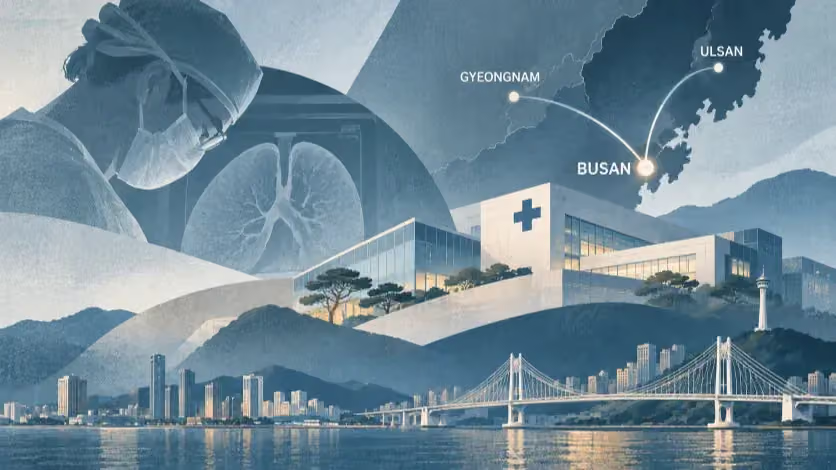
Busan's hospitals serve different populations and kinds of illness, even as patients travel to other regions for specialized care. Cancer research, cross-border emergency services and the proposed 2027 health budget expose the limits of judging a medical system by hospital size or how many patients stay within city limits.
In a national study of lung-cancer surgery, 36 percent of Busan residents who underwent an operation in 2019 received it at a hospital in Seoul, Incheon or Gyeonggi Province. The city is now preparing for one of the largest changes to its medical infrastructure in years: a redevelopment of Pusan National University Hospital expected to cost around 700 billion won, alongside a proposed national budget that would channel more support to regional specialist services. The patient records are historical, and they say nothing by themselves about the project's likely success. They do show why deciding what kind of treatment a region should provide is more demanding than deciding where to construct a hospital.
Busan's overall health-insurance figures appear to tell a different story. In a parliamentary budget analysis reproducing 2024 insurance statistics, an indicator of residents' use of medical providers within the city stood at 90.1 percent. A separate indicator of incoming use by patients from other regions stood at 25.2 percent. The two published indicators use different denominators and were reported for broad healthcare utilization, not successful completion of complex treatment. Neither percentage establishes how many people received all the care they required in Busan. Routine visits and the search for advanced cancer care belong to markedly different parts of medical practice.
The medical journeys also run in more than one direction. A child requiring emergency care may cross from Busan into neighboring South Gyeongsang Province; a patient with cancer may travel to a capital-region hospital for surgery and receive subsequent care nearer home. Visitors from abroad, meanwhile, are increasingly counted in Busan's outpatient medical industry. These journeys involve distinct clinical decisions, types of institution and sources of payment. Aggregating them into a single measure of how many patients a city attracts or retains obscures the medical work behind each number.
In his November 2 budget address, President Lee Jae-myung said his government would support regional national university hospitals and allow local governments to design responses to gaps in medical care. The hospital redevelopment had already passed a preliminary feasibility review in August. One decision concerns a building program extending to 2036; the other proposes financing for hospital capabilities and local services beginning much sooner. Their value for patients depends on the work each institution can actually undertake and on how hospitals arrange the care that takes place before and after a specialized treatment.
The treatment behind a patient's destination
The 2026 lung-cancer study did not simply compare Seoul hospitals with the rest of the country. Researchers linked the national cancer registry with insurance records for adults diagnosed between 2012 and 2019, identifying 27,482 surgical patients who lived outside the capital region. Among Busan residents in its geographic table, the proportion undergoing their initial lung-cancer operation at a capital-region hospital rose from 32.6 percent in 2012 to 36.0 percent in 2019. The remaining patients had operations somewhere in the noncapital regions, not necessarily inside Busan.
The study's most consequential finding was that the relationship between hospital location and survival depended on disease stage. For patients with localized lung cancer, the researchers did not identify a statistically significant adjusted difference in all-cause mortality between capital-region and noncapital hospitals. For selected patients with regional or more advanced disease, some adjusted mortality comparisons favored capital-region treatment. These were national associations among people who received surgery, not estimates of the performance of Busan's individual hospitals. The researchers could not fully account for why patients chose particular institutions, how fit they were for treatment or the clinical resources of each treating hospital.
One operation also tells only part of the clinical story. A patient may require diagnosis and staging, surgery, radiotherapy, systemic drugs, management of complications and years of surveillance. Different institutions can be appropriate for different stages of that sequence. A well-equipped regional surgical team may handle an early tumor while a patient with more complex disease needs coordinated specialist services or access to a clinical trial. Counting either journey outside the city as an identical loss of local healthcare would obscure the distinction.
The ability to travel is not evenly distributed. In the study's 2017–2019 national analysis of noncapital residents, those in the highest income quintile had 4.357 times the adjusted odds of undergoing lung-cancer surgery in the capital region compared with the separate below-poverty reference group. That is an odds ratio, not a probability ratio, and it cannot be transferred to Busan residents alone. But the strong association indicates that treatment destination is shaped partly by the resources available to patients, not only by what hospitals offer. A policy aimed solely at reducing transfers could leave those differences intact.
Another national analysis, published in September 2026, studied 303,443 selected surgical patients with six major cancers diagnosed between 2012 and 2020. Out-of-region initial treatment was associated with higher medical expenditure and increased odds of starting treatment after a 30-day threshold, alongside lower adjusted all-cause mortality. Among patients who visited multiple institutions before treatment, the association with delayed treatment was particularly pronounced. Some of those visits may have been appropriate referrals or second opinions, and treatment selection complicates any claim that distance caused a survival difference. The two recent studies draw on overlapping national data systems and periods; agreement between them is not an independent replication in separate populations.
A separate survey adds a behavioral explanation. In a 2025 published study using hypothetical cancer-treatment scenarios, 581 respondents were analyzed; 63.5 percent indicated that they would consider seeking lung-cancer surgery in Seoul. Those who felt reassured by the care available in their own region were less inclined to choose Seoul, after adjustment for measured distance, local hospital resources and personal characteristics. These were stated preferences, not the treatment decisions of actual Busan patients. Still, the result suggests that investments in equipment and specialists must be understood alongside what patients and referring doctors believe a hospital is capable of doing.
These findings complicate the usual discussion of regional patient retention. Some cross-regional care may provide access to expertise worth the journey; other movement may reflect missing local capacity, perceived differences in quality or a referral process that leaves patients arranging too many steps themselves. The practical distinction is between an appropriate clinical transfer and an avoidable burden imposed by the way care is organized. Aggregate migration statistics cannot distinguish them.
A hospital network larger than the city
Busan is already part of a medical service area extending into Ulsan and South Gyeongsang Province. At Yangsan Pusan National University Hospital, the pediatric emergency center recorded 8,438 attendances in the first nine months of 2026, according to figures supplied by the hospital during an October parliamentary inspection. Of those, 3,892 were attributed to Busan residents, compared with 3,417 from South Gyeongsang and 877 from Ulsan. The totals describe visits rather than verified distinct children, and they do not report case severity or clinical outcomes. They do establish that a specialized emergency service outside Busan's boundary receives substantial demand from within it.
Yangsan's role also illustrates how public administration differs from clinical geography. South Korea's 2026 responsible medical institution guidance lists the hospital as a local responsible institution for the Gimhae service area, covering Gimhae, Miryang and Yangsan. Gyeongsang National University Hospital is the regional responsible institution for South Gyeongsang Province; Pusan National University Hospital holds that role in Busan. The distinction matters for programs that finance regional coordination and advanced facilities. During the October inspection, Yangsan hospital officials sought broader eligibility for equipment and infrastructure support in view of the patients they serve across provincial lines. The ministry acknowledged the institution's role but did not announce a change of designation.
The distinction is not equivalent to exclusion from public support. The 2026 ministry guidance gives local responsible institutions their own healthcare cooperation program, with a standardized project budget. Separate advanced-care equipment and facility programs are designed for regional responsible institutions. The hospital's official category therefore affects which part of the budget can finance its clinical work. A pediatric emergency service with patients arriving from three jurisdictions need not perform the province-wide coordinating role assigned to a regional responsible institution; it may nevertheless require facilities and staff that a cooperation grant alone is not designed to purchase. It does not establish that a particular grant was denied or that patients suffered harm because of the designation.
Existing cooperation in Busan involves more than university hospitals. A municipal budget record names Pusan National University Hospital as the regional institution and Busan Medical Center as its local counterpart in a public-healthcare cooperation project running from 2026 through 2030. The stated total project cost is 5.65 billion won, shared equally between national and municipal funding. The planned work includes serious emergency transfers, discharge support, rehabilitation, infection control and coordination among institutions. It is a multiyear plan, not a record that every listed service has been delivered to every eligible patient.
The practical handoff between providers is especially important after acute treatment. Busan Medical Center identifies university and other specialist hospitals as cooperating institutions, while Pusan National University Hospital operates a referral and return-care service. At the national level, a restructuring program for tertiary hospitals has increased the reported number of specialist referrals and return transfers, although changes in payment and reporting rules may contribute to the increase. The fact that a patient has been referred or returned does not show whether the next appointment occurred on time, the receiving clinician obtained the necessary records or treatment continued without an interruption.
A separate support network begins where some cancer treatment ends. The National Cancer Center's 2024 annual report recorded 1,015 reported program users and 160 standardized and locally designed sessions at the Busan cancer-survivorship center based at the university hospital. The center also described links with district health offices and neighborhood health centers. Those are activities for people dealing with the physical, psychological and social effects of cancer treatment, not a count of formal medical return referrals or evidence that the program improved survival. The distinction matters because managing a cancer after surgery, supporting rehabilitation and responding to an emergency may all require different institutions even for one patient.
The documented institutions already occupy different places in a treatment sequence. Busan Medical Center can coordinate a transfer, a tertiary unit can provide more demanding treatment, and community programs can assist patients after an acute episode. Their published descriptions show that the network has organizational components. They offer far less evidence about completed transfers, delayed appointments or the specialists available when a patient arrives. Those operational records would determine whether a formal network actually supplies a continuous course of care.
The capacity a new building can provide
The largest physical investment now planned is at Pusan National University Hospital itself. Its proposed Regional Comprehensive Global Hub Medical Center cleared a government preliminary feasibility review on August 26. The project would redevelop the S building and reorganize parts of the main campus, providing space for an integrated cancer care center, pediatric and geriatric services, rehabilitation, education, research and an international patient center. Completion is targeted for 2036. The review's approval is neither a completed building nor confirmation of its final annual financing schedule.
An original 2024 project proposal placed the cost at 706.47 billion won, including a proposed 334.49 billion won in public funding and 371.98 billion won to be borne by the hospital. Those figures describe the applicant's plan at the time it entered feasibility assessment; they should not be treated as money already transferred, or added to a national hospital support program without checking the accounts. The project itself responds to documented aging and constrained hospital space, but its eventual clinical value will depend on what services operate in the expanded facilities.
The distinction between floor area and deliverable care became visible during the medical workforce disruption of 2024. Ministry of Health and Welfare figures supplied to a lawmaker show that the Busan hospital performed 22,417 operations in 2023, 13,669 in 2024 and 13,991 in 2025. Its recorded bed occupancy declined from 70.3 percent in 2023 to 56.9 percent in 2025. Hospital representatives cited shortages including anesthesia staffing; local reporting described an interim recovery in occupancy during 2026. These are hospital-wide indicators affected by the nationwide conflict over medical workforce policy and other operating conditions, not a count of lost cancer operations or a permanent forecast of capacity.
An operating room with no available anesthesia team will not add to surgical capacity. Nor can an oncology ward deliver all the therapies its patients need without trained clinicians, diagnostic support and places to manage complications. The hospital's reported recovery in 2026 matters because the baseline may change substantially before any part of the new campus opens. The number of staffed rooms, the type of surgery performed and the time between diagnosis and treatment would provide more specific evidence of expanded capacity than a comparison of building area or total beds.
The proposal's own performance categories reveal the range of its ambitions. It includes reductions in out-of-region patient use, pediatric outcomes, rehabilitation and geriatric activity, training and international patient volumes. The targets are not interchangeable. Some count movements or service volume; others concern clinical results. More local care could be valuable if it represents specialist treatment newly available without an avoidable journey. An increase in visits at an international outpatient center, by contrast, measures a different service. A single institution can pursue both objectives, but the number of patients it keeps nearby and the number it attracts from abroad measure different clinical and economic activity.
Health outcomes have a wider geography
The medical needs of Busan residents can also be examined through death records, provided that population outcomes are not confused with the performance of individual hospitals. The National Cancer Center's report issued in October 2026 gives Busan's 2024 age-standardized treatable cancer mortality as 15.7 deaths per 100,000 residents under age 75, compared with 14.2 nationally and 13.7 in Seoul. The measure uses the 2020 registered population as its standard. Busan's rate has declined over the longer period examined in the report, even though it remains above the two comparators in that year.
The same report places Busan's preventable cancer mortality at 39.9 deaths per 100,000 in 2024, compared with 36.6 nationally and 32.1 in Seoul, for the same age range and standardization. The preventable category includes lung cancer and several other causes; the treatable-cancer grouping concerns different conditions for which timely healthcare can potentially avert death. Neither is a survival statistic for patients selected to undergo lung-cancer surgery. The records incorporate years of exposure to disease risks, screening, diagnosis, treatment and other circumstances affecting residents, wherever they received care.
The two mortality categories also draw a boundary around hospital-centered investment. Early detection and adequate cancer treatment are central to the conditions classified as treatable. The preventable group reaches further upstream, where smoking, other exposures, vaccination and screening influence the likelihood of disease and death. A city can modernize a cancer center while still needing effective prevention and primary care in the neighborhoods its patients come from. The investment choices serve different functions, and the statistics capture different parts of their possible effects.
This distinction becomes more important when health policy is described as regional self-sufficiency. A resident who receives a technically successful operation outside Busan remains part of Busan's population mortality statistics. A local hospital's activity includes patients who may live in another province. Measuring what a hospital produces, where a resident receives treatment and how residents' health changes requires different datasets and different judgments. A figure can be accurate in its own domain and misleading when made to stand for another.
The international patient market
Busan also has a growing market for patients arriving from abroad. The Busan Economic Promotion Agency, drawing on Korea Health Industry Development Institute statistics, reported 75,879 registered foreign patients for 2025, compared with 30,165 in 2024. It described a heavy concentration in dermatology, which accounted for 67.1 percent in the agency's specialty breakdown, with plastic surgery another reported category. The original specialty-level counting rules have not been independently reconciled with the city's total, so the percentage should not be converted into a precise number of unique dermatology patients.
There is a legal as well as clinical boundary around these figures. The foreign-patient attraction registry covers a defined group and excludes national health insurance beneficiaries and certain people resident in Korea. A foreign national receiving language assistance at a university hospital is not necessarily counted as an attracted overseas patient. Nor is an outpatient cosmetic procedure interchangeable with major surgery, pediatric emergency care or rehabilitation. Those services differ in staffing, facilities, payment and follow-up.
The citywide growth figure cannot establish that foreign visitors have diverted resources from residents or that their spending has financed better essential care. It describes an expanding market, substantially associated with elective outpatient services, while the hospital redevelopment would include an international patient center alongside specialist care for residents. The organizational overlap is documented; the clinical and financial overlap is not. Establishing either would require provider-level records showing patient case mix, shared staff and facilities, the cost of services and what revenue is reinvested. Until then, international care belongs in the analysis as a distinct service economy rather than as evidence of the health system's success or failure.
The hospital's original plan makes that separation particularly important. Foreign-patient attraction and regional patient retention appear as different goals within the same proposed investment. Their progress can both affect a hospital's finances and development, but an increase in one will not automatically improve the other. An international center may help build specialist capacity if its work and revenues support shared clinical services; it may also operate mainly in a market separated from insured local care. The figures currently available do not establish which pattern will dominate.
The budget now before the National Assembly
The national government's proposed 2027 budget sets the next phase of this system's financing. The new regional essential healthcare special account is presented as 1.2614 trillion won, but the government's detailed plan identifies 892.5 billion won transferred from existing programs and 368.9 billion won in newly programmed activities. The account's headline total is therefore not an equivalent amount of new healthcare spending. The amounts are proposed nationwide allocations, subject to parliamentary consideration, not confirmed awards to Busan.
The Ministry of Health and Welfare proposes 255.1 billion won to strengthen clinical capacity and cooperation among 17 regional responsible institutions, including national university hospitals. A separate 360.5 billion won program would allow provincial and metropolitan governments to develop projects addressing locally identified medical gaps. The government also describes support for specialist recruitment and retention, facilities and advanced equipment. These program categories overlap in their beneficiaries or accounting; their headline figures cannot simply be added together as a new sum for a particular institution.
In September, the minister responsible for planning and budgeting visited Pusan National University Hospital as part of consultations on the proposed 2027 healthcare investments. Support for the medical center was discussed, but that visit did not determine the hospital's construction appropriation or a year-by-year cost-sharing agreement. The president's November 2 address reiterated the government's plans to strengthen regional university hospitals and locally designed care. The policy intention is clearer than the eventual distribution among individual hospitals, clinicians and communities.
That distribution can change the nature of regional healthcare. Investment in a specialist oncology team is different from purchasing a building; support for a pediatric emergency center serving three jurisdictions raises questions of clinical function and cost sharing; a program that makes referral records and follow-up work across providers supplies capacity that no single hospital can provide. Local governments may address service gaps outside tertiary centers, while designated regional hospitals concentrate on work requiring advanced facilities and staff. For the new account to support a continuous treatment pathway, its hospital and locally designed programs would need to reach patients at the different stages of that pathway, including referrals across provincial borders.
The government's financing system now has to account for several kinds of reach. A specialist hospital can serve patients who live beyond the province assigned to its administrators. A resident can receive a major operation in Seoul and remain dependent on Busan providers for diagnosis, rehabilitation or subsequent treatment. A growing number of international outpatient visits can raise the city's medical-market totals without expanding access to emergency surgery or complex oncology. Each activity appears in a different administrative record, even when patients draw on parts of the same hospital network.
The proposed 2027 spending can be traced through those records, but the eventual clinical result will require more precise measures: which hospitals gain staffed specialty services, which patients are referred to them, how promptly treatment begins, and which institutions take responsibility afterward. In Yangsan, the reported pediatric emergency caseload already crosses three provincial jurisdictions. In the lung-cancer cohort, the choice to leave a home region varied with stage and income. Those are different clinical circumstances, yet they expose the same limitation in judging a city's medical system by its boundary. A regional service can function beyond it, and a local system can remain incomplete within it.
Pusan National University Hospital's rebuilding program is scheduled to continue until 2036. Decisions about specialist staffing, funding eligibility and the flow of patients between institutions are already being made. They will determine which parts of Busan's medical capacity can change before the new buildings are ready—and whether the eventual investment adds treatment that patients actually need.
Continue this reporting
Reporting on the same issue
Related coverage selected from the article's desk, topics and newsroom relationships.
 NewsOct 27, 2026
Where Busan’s New Density Meets the Old City
Busan’s Beomil and Munhyeon districts are gaining homes and financial offices...
 NewsOct 25, 2026
The Long Bill for Busan’s Apartment City
Busan has about 958,000 apartments even as its population declines. Elevators...
 NewsOct 23, 2026
Busan’s Twelve-Year School Account Faces a Test Beyond Access
Busan’s PENZ promises one school account for 12 years, while BeAT brings AI t...
More from the author
More from this byline
Stay with the same line of reporting through more work from this byline.
- NewsOct 23, 2026
Busan’s Twelve-Year School Account Faces a Test Beyond Access
 NewsOct 14, 2026
What Became of Busan’s University Streets?
Reader Signal
Community readWhat did this report leave you with?
Choose the signal that best reflects your reading. Select it again to remove it.
One response per article
No response selected
A moderated conversation about the reporting.
One-level replies and newsroom moderation keep the conversation anchored to this article.
Discussion Status
Open
Please sign in to join the discussion.
Newsletter
Weekly reporting and context from Busan and Korea.