When a Shrinking City Has to Build Schools Again
Busan is losing children overall, yet Eco Delta City is adding them fast enough to require new school capacity. Following where families moved — and what happened to the schools they left behind — reveals why a shrinking city can still face a rising infrastructure bill.

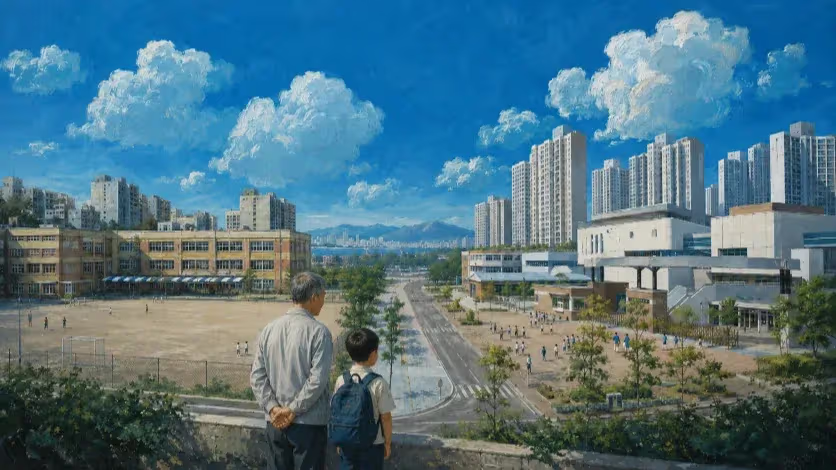
Busan is losing children overall, yet some of its fastest-growing neighborhoods are demanding new classrooms. Following the families who moved, the forecasts used to count their children and the money required to rebuild school capacity reveals a less familiar cost of demographic decline.
In 2017, Daejeo Jungang Elementary School had 39 students, the remaining enrollment of a school in western Busan where older agricultural and low-density settlements had been losing children for years. By February 2018, after more than seven decades of operation, the school had closed, following a demographic trajectory that was becoming familiar across South Korea as smaller birth cohorts entered the education system and institutions built for a larger population began to outlive the communities that had sustained them.
Seven years later, Daejeo Jungang reopened several kilometers away inside Busan Eco Delta City, where large apartment developments along the Nakdong River were receiving families at a pace that bore little resemblance to the conditions around its former campus. The new school began the 2025 academic year with 368 students, enrollment rose rapidly during its first year, and by March 2026 it was serving 1,207 students in 48 classes. The reversal did not reflect a recovery in Busan’s child population, which continued to contract during the same period, but a rapid change in where families with children were concentrated.
The school’s history exposes a problem that citywide enrollment totals tend to hide. When families change where they live, housing has to be translated into an expected number of pupils before apartments are fully occupied; those pupils are counted against the remaining capacity of nearby schools; shortages eventually require classrooms, additions or entirely new campuses; and school buildings left behind elsewhere continue to occupy land and absorb public money even after the population around them has thinned.
Daejeo Jungang places both sides of that adjustment under one institutional name. Educational capacity ceased to be viable at one address and, within less than a decade, had to be recreated on a much larger scale elsewhere. The fiscal problem begins in the difference between the speed of those two movements: households can reorganize themselves through the housing market relatively quickly, while classrooms, school sites and the public capital accumulated around them remain attached to place.
Measuring the Redistribution
Busan remained a net-outmigration city in 2025, losing 12,181 residents through domestic migration, with the strongest losses concentrated among people in their twenties and thirties. Gangseo-gu moved against that citywide direction, recording a net migration gain of 7,105 residents.
The origin-and-destination records make the nature of that growth clearer. A Breeze in Busan calculation using the official KOSIS district-to-district migration series finds that 11,798 people moved into Gangseo from Busan’s other 15 districts and counties during 2025 while 5,551 moved in the opposite direction, producing a net intra-city gain of 6,247. That internal exchange accounts for roughly 88 percent of Gangseo’s total net migration gain, placing a numerical boundary around a process that broad district statistics could only imply: most of Gangseo’s net population growth in 2025 came from redistribution within Busan rather than from a large net influx from the rest of Korea. KOSIS publishes district origin-and-destination flows as part of its domestic migration series.
The exchange with Saha-gu was particularly large, leaving Gangseo with a net gain of about 1,945 residents from that district alone. The figure does not establish that those residents moved specifically into Eco Delta City, nor does it identify the previous address of any child now attending a Gangseo school, but it replaces a weaker inference based on opposite population trends with directly observed movement between the two districts.
The spatial concentration became even more pronounced as development continued in 2026. Ministry of the Interior and Safety resident-registration data show Gangseo’s population rising from 146,843 in July 2025 to 154,119 in July 2026, an increase of 7,276. Over the same period, Gangdong-dong, the administrative neighborhood containing much of Eco Delta City, increased from 12,598 to 21,265 residents, adding 8,667 people — more than Gangseo as a whole. The arithmetic means that the rest of the district collectively lost population while growth in Gangdong was strong enough to conceal that contraction in the district total. The ministry publishes resident-registration population monthly at the administrative-dong level.
The children were even more concentrated. Calculations from the ministry’s single-year age files show that between July 2025 and July 2026, the increase in young children and school-age residents inside Gangdong exceeded the corresponding increase across Gangseo as a whole, implying declines across the remainder of the district. The result matters because a district that appears to be gaining children in aggregate can simultaneously contain older communities whose local school base is continuing to contract.
Household structure points in the same direction. Most of the households added in Gangdong during the period contained two or more people rather than consisting of single residents, while children and adults in their thirties and forties came to occupy unusually large shares of the local population. The neighborhood’s average age fell sharply as Eco Delta housing was occupied, reaching the mid-thirties by July 2026 against a Busan-wide average of 48.0.
The evidence establishes several layers of the movement without requiring them to be collapsed into a claim the public data cannot support. District-to-district migration records show that most of Gangseo’s net gain in 2025 came from elsewhere inside Busan. Administrative-dong records show that subsequent growth inside Gangseo was heavily concentrated in Gangdong and that children, family-age adults and multi-person households were central to the change. The monthly KOSIS database, however, publishes district origin-destination flows and district age migration through different tables rather than providing a current district-origin × district-destination × age matrix, so the data do not justify assigning Gangdong’s children to particular Busan districts of origin.
The distinction becomes more important in 2026 because Busan’s broader migration pattern has begun to change at the margins. The city still lost 1,508 residents in the first quarter and 2,596 in the second, but people under 10 and teenagers recorded net inflows in the first quarter, while the second-quarter statistics again showed net inflow among those in their teens and younger even as every adult age group remained a net outflow. Busan also posted a positive first-quarter migration balance within the southeast region before part of that gain reversed in the second quarter.
Internal redistribution and genuine external attraction can therefore coexist. In 2025, movement within Busan explained most of Gangseo’s net gain; by 2026, the city as a whole was recording positive migration among children despite continuing to lose residents overall. A development can begin by reallocating households already inside the city and later attract or retain families who might otherwise live elsewhere, making its demographic contribution something that has to be measured repeatedly rather than assigned a permanent label.
For schools, however, both kinds of arrival create an immediate local obligation. A child arriving from Saha-gu and a child arriving from South Gyeongsang each require educational capacity near their new home, but the metropolitan balance is different because the first move may leave public capacity surrounding the family’s former address while the second enlarges Busan’s population base. That difference between redistributing demand and adding demand becomes important once housing enters the school-planning system.
How Housing Claims School Capacity
School planning has to precede the migration data that eventually reveal who occupied a development, because classroom capacity often has to be decided before the residents themselves have arrived. Busan addresses that timing problem through a student yield rate, which translates planned housing into an estimate of the number of pupils likely to be generated by the development.
Busan Metropolitan Council records show how much that conversion can vary. Education officials described an average rate of roughly 0.19 during a 2024 council examination, while separate housing developments associated with the same school had been assigned rates of 0.19, 0.23 and 0.25, with housing type, tenure, unit size and other project characteristics cited as reasons for the differences.
Across 2,000 housing units, those assumptions produce 380, 460 and 500 expected pupils. The 120-student gap between the lowest and highest estimates can represent several elementary classes and, depending on existing conditions, can change whether a nearby school is considered capable of absorbing a development.
The institutional effect is more important than the decimal itself because the projected pupils do not remain descriptive statistics. Council discussions show that housing projects are evaluated against school capacity already expected to be consumed by developments considered earlier, so projected students attached to one project can reduce the room available to projects arriving later. Once incorporated into formal consultation, a forecast becomes a claim on future public capacity.
That sequence gives forecasting error consequences beyond an inaccurate enrollment prediction. Underestimation can leave schools adding modular classrooms, expanding buildings or changing attendance zones after households have already arrived, when land and design options are more constrained. Overestimation can reserve capacity for pupils who arrive in smaller numbers, leave floor area underused and affect later housing consultations while the anticipated demand remains embedded in planning.
A yield rate cannot eliminate that uncertainty because student generation is not a stable physical attribute of an apartment. It depends on which households can afford and choose the housing, the mix of unit sizes and tenures, the ages of their children, the timing of occupancy and the stage of the neighborhood’s residential life cycle. Gangdong’s rapid transformation illustrates one end of that distribution: thousands of residents, including large numbers of children and family-age adults, were added in a compressed period. A mature apartment district can move in the opposite direction as its first cohort ages and younger households cease to replace it at the same rate.
The Busan Metropolitan City Office of Education has continued to subject the methodology to formal review, including policy research in consecutive years aimed at verifying student-yield assumptions and improving student-placement decisions. Repeated studies do not demonstrate that the earlier model was fundamentally wrong, but they do show that the education authority itself treats the conversion from housing units to future pupils as a planning problem requiring continued verification.
The stronger response to uncertainty may therefore be institutional rather than merely statistical. Historical forecast errors can be incorporated as ranges, housing types with volatile demographic profiles can be modeled under several scenarios, and schools in rapidly developing areas can be designed so that space required during a temporary elementary-school peak can later be adapted for childcare, libraries, community education or other uses.
Such flexibility matters because the useful life of a school building is considerably longer than the peak of a single residential cohort. The central problem is not simply how accurately Busan predicts the first wave of children entering a development, but how much permanent capital the city commits to a demand profile that may change substantially before the building itself approaches the end of its economic life.
When Public Capital Has to Be Built Again
Daejeo Jungang provides an unusually clear view of what happens once demographic demand has become physical infrastructure.
The old school closed in February 2018 after enrollment had fallen to 39 students. A public-data record derived from education-property information lists the former Daejeo Jungang site — 18,559 square meters of land and 3,597 square meters of buildings — as having been transferred through land acquisition in 2019 for approximately ₩12.2 billion.
The campus planned for Eco Delta was conceived on an entirely different scale. The 2022 design competition for the project then known as Eco 5 Elementary School specified a 14,040-square-meter site, up to 13,246 square meters of floor area, 43 classes and a planned enrollment of 1,313 students. The design-stage estimated construction budget was ₩32.31 billion, with a separate design-services budget of about ₩1.17 billion.
Those figures should not be subtracted to produce a supposed ₩20 billion cost of “moving” the school. They do not share the same accounting scope. The ₩12.2 billion figure represents value associated with the former land and buildings, while ₩32.31 billion was an estimated construction budget prepared during design, not a final all-in figure for every component required to open and operate the new campus. School projects are divided among building, mechanical, electrical, communications, fire-protection, design, supervision, equipment and other contracts, so a defensible net relocation cost would require those accounts to be reconciled on a common basis.
The inability to collapse the records into a single dramatic number is itself informative. A city can recover value from a school site whose original use has disappeared, yet that recovered asset is not equivalent to a functioning school at the destination. Land, classrooms, specialist rooms, kitchens, gymnasiums, mechanical systems, outdoor facilities and safe access have to exist where the children now live, regardless of how much value was recovered where they used to live.
A metropolitan accounting of demographic redistribution would therefore contain at least three different balances: the value recovered from capacity no longer required at the origin, the replacement capital needed at the destination, and transitional expenses generated when pupils arrive faster than permanent facilities can respond. These costs can be separated by agency, contract and fiscal year even though they originate in the same underlying shift in residential demand.
The existence of those costs does not imply that the new Daejeo Jungang was an unnecessary investment. The school’s 1,207 students in March 2026 demonstrate that the local need was substantial. The economically relevant question begins earlier, with the housing and migration pattern that determines whether children can use educational capacity the public sector already owns or require a new set of buildings beyond its practical reach.
Gangseo’s migration record and Gangdong’s subsequent demographic transformation make that question concrete without requiring the origin of every pupil to be known. Most of Gangseo’s net migration growth in 2025 came from elsewhere inside Busan, while the neighborhood containing Eco Delta subsequently gained children and family households at a rate that exceeded the district-wide increase. The education system can therefore acquire a major new capacity obligation in one location before the cost of capacity around the origins of internal migrants has disappeared.
Daejeo Jungang compresses the imbalance into the history of one institution. Its name could be carried from a small school that no longer had enough pupils to a campus serving more than a thousand children, while the physical capital accumulated at the former location had to be disposed of and a new physical system assembled where demand had reappeared.
Why Enrollment Falls Faster Than Cost
Schools that remain open reveal a second source of fiscal rigidity because operating costs do not decline in proportion to enrollment.
Busan’s 2026 school-account guidelines divide basic operating support into school-level, class-level and student-level components. For an elementary school with six or fewer classes, the school-level amount is ₩187.825 million before student enrollment is considered; each elementary class adds ₩2.42 million, while small urban elementary schools receive ₩240,000 per pupil compared with ₩120,000 for a standard school. The guidelines define an urban elementary school with 240 students or fewer as small for this allocation.
Under that formula, an illustrative six-class small urban elementary school with 120 students receives about ₩231.1 million in the relevant basic operating allocation. If enrollment falls to 60 while the school still operates six classes, the allocation becomes about ₩216.7 million.
Enrollment has fallen by half; this portion of operating support has fallen by only 6.2 percent.
The resulting amount per pupil rises from approximately ₩1.93 million to ₩3.61 million, but that increase cannot be interpreted as a direct measure of educational inefficiency. The calculation excludes teacher salaries, major capital expenditure and numerous other accounts, while important physical costs remain attached to the school itself. A building does not lose half its roof, corridors, heating system, inspection requirements or custodial burden because half as many children now use it.
Part of the cost may also represent a deliberate educational choice. Falling enrollment can be absorbed through smaller classes rather than through immediate elimination of teaching capacity, improving conditions for the remaining students while limiting fiscal savings. Elsewhere, a small school may continue to operate because consolidation would create unreasonable travel, safety or access burdens; another low-enrollment school surrounded by nearby alternatives may present a stronger case for reuse or consolidation. Per-pupil expenditure alone cannot distinguish among those situations.
Busan is therefore absorbing demographic contraction through several channels simultaneously. Some schools experience smaller cohorts as smaller classes, some retain minimum institutional and building costs because local access must be preserved, and some carry genuinely underused capacity. At the same time, neighborhoods such as Gangdong require new educational capital because the children remaining in the metropolitan system have become concentrated beyond the practical reach of older schools.
The relationship between enrollment and expenditure is consequently better understood as a cost elasticity than as a per-pupil rule. A 10 percent reduction in students will produce a 10 percent reduction in expenditure only if classes, staffing commitments, buildings and network obligations can also be reduced at the same pace. In a metropolitan system containing both small declining schools and rapidly expanding new campuses, that condition is unlikely to hold uniformly.
The issue acquired national significance on August 24, 2026, when the Ministry of Education placed an amendment to the Local Education Finance Grant Act on legislative notice. The proposal would replace the existing automatic linkage to portions of national tax revenue with a calculation based on the previous year’s grant together with changes in gross domestic product and the school-age population, while requiring the central government to compensate the difference if the calculated amount fell below the preceding year’s grant. The ministry argues that the current tax-linked system fails to reflect changes such as falling school-age population and exposes local education finance to fluctuations in national tax receipts.
The policy question is not whether the number of students should matter to education finance; it plainly does. The harder question is how much expenditure can actually fall when enrollment declines after class organization, school accessibility, fixed building costs and the spatial relocation of demand are included.
Busan offers an unusually useful setting in which to test that relationship because several different cost responses coexist inside one education system. A large established school can absorb smaller cohorts through lower class sizes, a geographically necessary small school may retain much of its minimum cost, another building may contain capacity that can reasonably be consolidated, and a new residential district can require major capital investment during the same period.
The illustrative six-class calculation demonstrates the mechanism but does not measure the full system. A stronger empirical test would link settled school accounts to enrollment, number of classes, floor area, building age and school type across Busan, allowing the actual cost curve to be estimated at different school sizes. Such an analysis would show how much demographic decline can realistically be converted into savings and how much remains embedded in educational quality, access and inherited infrastructure.
The Urban Balance Sheet
School finance begins upstream of the education office because the location of future classrooms is shaped first by decisions about housing, redevelopment and the geography of urban growth.
Busan’s official planning strategy already acknowledges demographic contraction. The 2040 Busan Urban Master Plan reorganizes the city around ten functionally specialized urban cores and emphasizes living-area planning, while Busan’s broader planning framework incorporates the 15-minute-city concept as a way of bringing everyday services and infrastructure closer to residents.
That policy landscape makes it inaccurate to frame Busan’s choices as a simple contest between new towns and an abandoned older city. The municipality is simultaneously pursuing redevelopment, station-area intensification, neighborhood regeneration and large-scale expansion in western Busan. Older urban areas can also be expensive to renew: obsolete utilities, fragmented land ownership and aging buildings can require substantial public and private investment before those neighborhoods become competitive for younger households again.
The more useful distinction concerns how much existing public capacity each form of development can use and how much it requires the city to create again.
Housing that introduces families near schools, transit and community facilities with available capacity can raise the utilization of assets financed by earlier generations. Housing that concentrates the same number of families in an area beyond the practical reach of those facilities may require additional schools and services even when the development is desirable for other reasons. If much of the new population has moved from elsewhere inside Busan, the city can also remain responsible for infrastructure around the neighborhoods those households left.
Gangseo demonstrates why project-level population growth alone is insufficient to evaluate the result. The district recorded a strong net migration gain in 2025, but roughly 88 percent of that gain came from net exchange with the rest of Busan. By the following year, Gangdong was adding more residents and children than the district-wide total because other parts of Gangseo were moving in the opposite direction. A district map colored simply as “growth” would conceal the simultaneous contraction occurring inside it.
The 2026 migration data add a necessary qualification. Busan was still losing population overall, yet children and teenagers were recording net inflows, meaning that new family districts may also be attracting or retaining people who would otherwise live outside the city. The fiscal contribution of a development can therefore change as it matures, and the proportion of internal migrants, external arrivals and households retained from potential out-migration should be measured rather than assumed.
For a shrinking city, that leads to a more demanding standard for evaluating housing growth. Unit completions and population recorded within a development boundary remain important, but they do not reveal whether the project enlarges Busan’s resident base, shifts existing residents across the city, makes productive use of schools and transport already built, or requires a new layer of infrastructure while older capacity remains in service elsewhere.
The same test should apply to regeneration. Housing built inside the established city is not automatically efficient if younger households will not live there, just as a new district is not inherently inefficient when it attracts population or economic activity that Busan would otherwise lose. The relevant variables are the demographic yield of the housing, the infrastructure already within reach and the amount of additional public capital required to serve the households who actually arrive.
Schools make those relationships unusually visible because families with children require geographically accessible service immediately and because the assets created in response are expected to remain useful for decades. Private businesses can enter and leave a neighborhood relatively quickly as demand changes; school sites and buildings record earlier population distributions long after the housing market has moved on.
Busan’s compact-city ambitions can therefore be evaluated through a practical fiscal question: does new housing allow the city to use more of the public capacity it already owns, or does it require Busan to recreate that capacity somewhere else? The answer cannot decide the value of a development by itself, but it should be part of the development balance sheet in a metropolis where the population available to support both old and new infrastructure is becoming smaller.
The Cost Lies Between the Two Maps
Daejeo Jungang closed with 39 students and reopened seven years later in a district where enrollment soon exceeded 1,200. The sequence appears contradictory only when Busan is treated as a single demographic unit whose school system should contract in direct proportion to its declining child population.
The city is instead moving through several demographic processes at once. Its population is shrinking overall, younger cohorts entering the school system are becoming smaller, some children are arriving from outside Busan, and a much larger volume of internal residential movement is redistributing families across neighborhoods whose public infrastructure was built around earlier patterns of settlement.
Housing converts those movements into geography. Student-yield calculations convert planned housing into expected enrollment. School-placement decisions convert forecasts into claims on capacity. Public finance absorbs whatever remains when the population distribution produced by the housing market no longer matches the distribution of schools inherited from the past.
Where existing capacity can be reused, fewer children may eventually reduce expenditure or improve educational conditions through smaller classes. Where households move beyond the reach of that capacity, the same demographic decline can leave the city maintaining buildings in one place while financing new classrooms in another.
The old Daejeo Jungang property returned roughly ₩12.2 billion in recorded asset value, while the replacement campus entered design with an estimated construction budget exceeding ₩32 billion; those figures cannot responsibly be converted into a single net relocation cost because their accounting scopes differ. The inability to make that subtraction cleanly underscores the larger problem rather than obscuring it: retiring a school asset where demand has disappeared is not financially equivalent to recreating an educational service where families have reassembled.
Nor does falling enrollment immediately release enough operating money to solve the problem elsewhere. Busan’s own allocation formula shows how strongly school-level and class-level costs can persist after student numbers fall, while new housing continues to create concentrated demand in other parts of the same metropolitan network.
The fiscal challenge of demographic decline therefore lies between two maps: the geography of schools, land and public facilities accumulated around where previous generations lived, and the geography now being produced as a smaller population reorganizes itself through housing and employment choices.
A shrinking metropolis can continue to build without contradicting its demographic reality, but the quality of that growth increasingly depends on whether new housing adds or retains residents, whether it can make use of schools and services Busan already owns, and whether the city can repurpose what families leave behind quickly enough to avoid repeatedly financing the same public functions in new locations. Daejeo Jungang’s institutional identity crossed that distance in seven years; the capital embedded in the school system could not move with it, and Busan’s long-term cost will depend increasingly on how often the city has to bridge that gap again.
Continue this reporting
Reporting on the same issue
Related coverage selected from the article's desk, topics and newsroom relationships.
 NewsOct 14, 2026
What Became of Busan’s University Streets?
From 2015 to 2023, registered businesses grew near Pusan National University...
 NewsOct 12, 2026
Bukangi, the Shark That Stayed in Busan’s North Port
A rescue net guided Bukangi toward the sea, but the dusky shark returned to B...
 NewsOct 6, 2026
Busan’s Water System Is Entering a Harder Era of Renewal
Busan spent decades building a water system that can absorb major failures. N...
More from the author
More from this byline
Stay with the same line of reporting through more work from this byline.
- NewsOct 14, 2026
What Became of Busan’s University Streets?
 NewsSep 28, 2026
Why Some Commercial Space in Busan Is Hard to Reuse
Reader Signal
Community readWhat did this report leave you with?
Choose the signal that best reflects your reading. Select it again to remove it.
One response per article
No response selected
A moderated conversation about the reporting.
One-level replies and newsroom moderation keep the conversation anchored to this article.
Discussion Status
Open
Please sign in to join the discussion.
Newsletter
Weekly reporting and context from Busan and Korea.