What Became of Busan’s University Streets?
From 2015 to 2023, registered businesses grew near Pusan National University Station as new business starts fell. In Hadan, vacancy rates varied sharply between survey districts. Busan’s new investments meet university streets with different commercial histories.


Busan has spent years reshaping the streets around its universities. As campuses relocate, commercial districts change and new public investment arrives, the question is what kind of local economy those neighborhoods can sustain.
In June 2012, the road approaching Dong-A University's Seunghak campus in Hadan was being given a new appearance. Saha District had spent 220 million won replacing and redesigning approximately 200 signs belonging to 68 businesses along a 220-meter stretch of university street. The new signs replaced a collection of projecting advertisements with a coordinated streetscape, part of a broader ambition to make the neighborhood more attractive to students and other visitors. The work was tangible: officials could identify the premises involved, the length of road improved and the public money spent. Whether the intervention would leave a stronger commercial economy was a question that the completion of the work itself could not answer.
The surrounding district has continued to change. In the final quarter of 2024, the Korea Real Estate Board recorded a vacancy rate of 27.2 percent for medium-to-large commercial properties in its Hadan Station survey district, compared with 13.9 percent in a separately defined area called Hadan. These were measures of vacant floor area within surveyed properties, not counts of empty street-level shops. Neither survey area can be equated with the road improved in 2012. The difference between the two rates nevertheless reveals how misleading a single description of Hadan can be: different parts of the same wider commercial landscape were experiencing markedly different property-market conditions.
By 2026, Busan was attempting to address empty commercial space through another kind of intervention. In September, the city published an initial inventory of 30 premises for a pilot program offering temporary rental assistance and interior-improvement support to prospective tenants. Eleven of the properties were in the commercial area around Pusan National University. One former restaurant, a 48-square-meter space on Geumjeong-ro 60beon-gil, was advertised with a 30 million-won deposit and monthly rent of 2 million won. The program could cover up to 1 million won of that rent for four months. On October 13, the Busan Economic Promotion Agency announced its applicant-selection results, although the required agreements between landlords and tenants were scheduled for later in the month. At that point, a successful application was still different from an occupied shop, and an occupied shop was not necessarily a new business added to the local economy.
The circumstances behind these interventions are far from uniform. Dong-A University redistributed academic functions among campuses while maintaining Seunghak as an operating institution. Busan University of Foreign Studies relocated from Uam-dong to Namsan-dong, leaving one neighborhood to negotiate the future of a former university site while another adjusted to the institution's arrival. Kyungsung and Pukyong National universities remained embedded in a busy urban district where successive pedestrian improvements coincided with changes in business activity. Around Pusan National University Station, government records show a growing population of registered individual enterprises between 2015 and 2023, but substantially fewer new business starts. Elsewhere, the rapid expansion of commerce around Jeonpo Station brought a different mix of enterprises and lower average nominal sales per business.
These developments suggest that the commercial future of a university neighborhood cannot be measured simply by the number of students passing through it or by the number of premises receiving public assistance. Campuses remain important sources of activity, but their relationship with surrounding businesses depends on where people live, how they travel, the commercial spaces available to operators and the wider changes affecting the city's economy. Busan's current investments are taking place within those different histories. Understanding what they can achieve begins with examining how the neighborhoods developed, what actually changed in their businesses and what conditions might allow economic activity to last.
When a University Changes the Map
Dong-A University's expansion into Bumin began with another institution's departure. After Busan's courts and prosecutors' offices moved away from their former downtown complex, the university acquired the site in 2002 and began establishing an academic presence there. Its institutional history records the transfer of the College of Law and several graduate programs in February 2003, followed by the completion of a new lecture building in 2008. Other academic functions moved in subsequent years. The university's social welfare department, for example, dates its relocation from the Gudeok campus to Bumin to March 2009. What eventually became a substantial downtown campus emerged through successive decisions rather than a single transfer of students from another part of Busan.
The institution's ambitions extended beyond the provision of classrooms. At a 2005 ceremony marking the development of Bumin, university leaders presented the campus as an opportunity to revive an area that had struggled after the departure of the legal institutions. They envisioned academic facilities, cultural activity and the public use of historic buildings, including the former wartime government headquarters. The transformation brought a major educational institution into an established urban neighborhood with its own history, housing, transportation connections and commercial services. Yet the university's stated expectations for the district do not establish how many businesses opened because of the project, how their revenue changed or how long any resulting commercial activity endured.
The distinction is important when considering what happened to Dong-A's Seunghak campus in Hadan. Seunghak remained an operating university campus, and some of the documented transfers to Bumin originated at Gudeok rather than Seunghak. It would therefore be misleading to treat the development of Bumin as a straightforward removal of students from Hadan. The university's own transportation directions illustrate another complication. Students arriving at Hadan Station can take a campus shuttle from Exit 6 or walk approximately 1.1 kilometers from Exit 9 to the main gate. These routes create different opportunities for passing businesses, but a route map reveals neither the number of students using each option nor their purchases along the way. Even the commercial statistics identified by other station exits cannot be assigned directly to the main-gate approach without matching the geographical boundaries.
Dong-A's history reveals how a university can become part of an urban neighborhood's redevelopment without supplying a reliable measure of the commercial consequences at every campus it operates. The arrival of academic programs in Bumin created a new institutional use for a former legal complex. Hadan, meanwhile, retained a university whose surrounding streets were later targeted for public improvements. The available institutional records explain the redistribution of academic facilities; they do not demonstrate that this redistribution caused Hadan's later commercial vacancies. Changes in local housing, transport, property conditions and the wider market for small businesses remain plausible influences that have to be assessed separately.
Busan University of Foreign Studies presents a more pronounced physical relocation. The university moved its educational operations from Uam-dong in Nam District to Namsan-dong in Geumjeong District beginning in 2014, with its own chronology recording the completion of the campus-wide move in June 2015. Unlike Dong-A's distribution of academic functions among continuing campuses, the relocation left an extensive former university property requiring an entirely new use. The move changed where a large institution operated, where students and staff traveled, and where property owners could reasonably expect university-related demand. It did not automatically determine which businesses would benefit in Namsan or what would happen to the commercial streets left behind in Uam.
By April 2018, Busan City was explicitly treating the former Uam campus as an urban development problem. Its announcement described a roughly 130,000-square-meter property that had remained without an effective replacement use and proposed a publicly led redevelopment involving housing for young people, community facilities and research or business activities. The city also identified deterioration in the surrounding area and residents' concerns about commercial conditions as reasons for intervention. These were the municipal government's contemporary assessment and proposed response, rather than an independent measurement of the economic losses caused by the university's departure.
What followed was an extended reconsideration of the site's future. The city eventually pursued a negotiated development framework involving a private project proposer and public contributions. A revised plan presented in September 2025 designated more than half of the approximately 132,400-square-meter project area for housing and replaced a proposed 12,000-square-meter strategic-industry site with a sports-facility designation. During a city council hearing that month, a member questioned why the industrial function had been abandoned and challenged reductions in the proposed parking capacity. A senior city official explained that financing for the previously contemplated biotechnology project had not been sufficiently developed, while site grading and engineering constraints had affected the parking design. The disagreement concerned more than the arrangement of buildings: it exposed competing expectations about whether the former university land should accommodate residential growth, public amenities or employment-generating activity.
On March 25, 2026, Busan formally announced another change to the area's district-unit land-use plan. This was a concrete advance beyond the preliminary redevelopment ambitions expressed in 2018. A zoning decision, however, is not evidence that the planned homes, sporting facilities or cultural spaces have been built and begun supporting neighboring businesses. The new proposal may eventually give Uam a residential and civic population with different daily routines from those of a university campus. Whether those activities produce sufficient customers for existing local businesses, and how widely their benefits extend beyond the project boundary, will depend on implementation and the connections established with the surrounding streets.
At the receiving end of the relocation, Namsan acquired the university without necessarily acquiring a self-contained commercial market. The campus is reached through a combination of public buses, neighborhood transit and pedestrian routes, connecting it to residential streets and the wider metropolitan transport system. That accessibility is valuable to students, but it complicates the assumption that their spending must occur immediately outside the campus. The university's relocation and transport records do not establish the number of additional restaurants or cafés created by its arrival, the revenue of those establishments or the share of student expenditure retained locally. What can be established is the change in institutional geography, and the conditions under which the two neighborhoods subsequently had to adapt.
The different experiences of Bumin, Seunghak, Uam and Namsan show why a university's effect on its surroundings cannot be reduced to enrollment or the distance between a campus gate and the nearest shops. Bumin gained a university presence in a former civic and legal center; Seunghak continued operating within a larger commercial and transport district; Uam faced the long process of replacing a departed institution; and Namsan gained academic activity whose relationship with neighboring commerce has to be examined on its own terms. These distinctions become equally important in the university streets where institutions remained in place but the commercial economy changed around them.
The Streets Rebuilt Around Two Universities
The commercial district around Kyungsung and Pukyong National universities developed under circumstances different from those of the neighborhoods affected by campus relocation. Both universities continued operating in Daeyeon-dong, within a densely developed urban area served by a subway station, residential neighborhoods and a concentration of restaurants, shops and entertainment businesses. For local officials, the immediate challenge was initially a familiar one in a busy commercial district: how to make streets built around competing demands for movement safer and more comfortable for the people using them.
In 2017, Nam District launched a pedestrian improvement initiative in the university streets, following a publicly announced plan to reorganize narrow roads, improve pedestrian surfaces and reduce conflicts with vehicles. The project treated walkability as a condition of the district's continued appeal. That concern did not disappear with the first round of improvements. In October 2019, another phase of the UN Peace Culture Street pedestrian improvement program was selected for government support, extending the effort across additional roads around Kyungsung–Pukyong National University Station.
The second project was substantial in its own right. Nam District's official financial disclosure records a total project budget of 3 billion won for a program running from 2020 through 2023, covering approximately 1.89 kilometers across nine roads, including Yongso-ro 7beon-gil. Construction proceeded in two stages: the first, covering 340 meters, was completed in September 2021, while work on the remaining 1.55 kilometers was completed in December 2023. The district submitted the project's settlement report to the city in March 2024. By then, the surrounding university streets had been the subject of successive investments in pedestrian infrastructure, giving the neighborhood a longer history of physical intervention than a single streetscape project would suggest.
The stated purpose of the later work was pedestrian safety, accessibility and improvement of the urban environment. Those objectives deserve to be evaluated in their own terms. A safer crossing or a more usable sidewalk can improve daily life for residents, students and visitors even if it does not produce an immediate increase in retail sales. At the same time, streetscape improvements cannot guarantee that the businesses along those streets will attract sufficient customers, accommodate changing consumer preferences or find tenants at sustainable rents. The relationship between public space and commercial performance depends on factors that extend beyond the construction itself.
The official business register makes the commercial picture more complicated than an account of prolonged collapse. According to a 2025 study by the Dongnam Regional Statistics Office, the number of registered individual enterprises in the commercial area designated Kyungsung–Pukyong National University Station Exit 1 increased from 2,681 in 2015 to 2,951 in 2023. Annual business starts declined from 465 to 332 over the same period, while closures fell from 473 to 365. The reduction in new starts was real, but it occurred alongside growth in the existing business population rather than a continuous contraction in the number of registered operators.
The study's preliminary figures for 2024 complicate the trajectory further. Registered individual businesses reached 3,036, while recorded starts increased to 410 and closures declined to 351. The government compiled its 2024 provisional figures from quarterly records, unlike the annual records used for earlier years, and warned that those figures could be revised. The increase therefore needs to be treated cautiously. Even with that qualification, it is difficult to sustain an argument that new economic activity around the station was falling without interruption. What changed between the years of declining business entry and the subsequent increase remains a separate question, involving industry composition, operating conditions and the wider commercial environment.
Vacant property tells another part of the story. In the fourth quarter of 2024, Korea Real Estate Board data reproduced by the Busan Institute recorded vacancy rates of 10.1 percent for medium-to-large commercial properties and 2.7 percent for small commercial properties in the Kyungsung–Pukyong survey district. Both figures were below Busan's respective averages of 14.2 and 7.4 percent. They measure vacant floor area within particular surveyed building categories, rather than the proportion of all storefronts standing empty. The geographical boundaries also differ from those of the business-register area around Exit 1. Consequently, neither the increase in registered businesses nor the relatively low small-property vacancy rate establishes that every commercial alley was healthy. A street with unused units can coexist with a wider market containing many occupied premises and new entrants.
Only at PNU Front is small-property vacancy higher than medium-to-large vacancy among these four reported areas.
Rates represent vacant floor area, not a count of closed stores. Property survey districts are not identical to station-exit business districts. Source: Busan Institute / Korea Real Estate Board, p. 2. Differences calculated from published Q4 2024 rates.
By late 2024, the district's economic future had become a subject of more direct policy research. A study commissioned by Nam District Council examined a specifically defined section of the Kyungsung–Pukyong commercial district, gathering consumer and small-business input and considering programs involving merchant cooperation, marketing, commercial identity and support for prospective entrepreneurs. The exercise reflected an expanded range of policy questions. Improving the physical environment remained relevant, but the survival and development of local businesses also depended on what customers wanted, how operators worked together and whether the commercial district could offer reasons for visits beyond the academic calendar. The research generated proposals; their adoption and economic effects require separate evidence.
The area's recent history does not support a simple verdict on the success or failure of its pedestrian projects. The municipal records establish an extensive program of physical improvements, while the business statistics show a changing pattern of commercial entry and a preliminary increase in activity in 2024. Property vacancy was uneven across building categories, and conditions within individual alleys remain difficult to reconstruct from the available districtwide surveys. What emerges is a university neighborhood whose commercial economy was changing while its public spaces were being repeatedly improved. Understanding that change requires attention to the kinds of businesses entering and leaving, the premises they can afford, and the everyday activity that sustains them after the streets have been rebuilt.
What the Business Records Reveal
The changing economy around Pusan National University offers a different view of commercial decline from the vacant storefronts that have attracted public attention. In the area designated Pusan National University Station Exit 3, the government's business register counted 2,610 individual enterprises in 2015. By 2023, that population had grown to 2,866. Yet the number beginning economic activity during a year had fallen from 450 to 267, a decline of more than 40 percent. Recorded closures had also decreased, from 451 to 326, but by a smaller proportion. The district contained more registered businesses at the end of the period while recording substantially fewer new entrants each year.
Much of this change preceded the pandemic. Annual business starts had already dropped to 332 in 2019, almost exactly matching the 330 closures recorded that year. By 2023, the numbers had diverged, with 267 starts and 326 closures. Relative to the registered business population, newly active enterprises declined from approximately 17 per 100 businesses in 2015 to nine in 2023. Closures also became less frequent by the same descriptive measure, falling from approximately 17 to 11 per 100. These calculations are ratios of recorded business events to the year's registered population, not official startup or survival rates. Nor can starts minus closures be used as a direct accounting identity for changes in registered business stock. The figures identify a reduction in business formation activity that cannot be explained by rising closures alone.
One possibility is that a more established commercial district has fewer businesses entering and leaving because existing operators remain in place longer. Another is that prospective operators face less attractive conditions for opening, including the cost of premises, uncertainty about demand or the suitability of available commercial space. The aggregate records cannot distinguish these explanations. They contain no matched histories showing how long individual firms survive, and they do not connect a registered business to the particular ground-floor or upper-floor unit it occupies. The distinction matters for policy: an area dominated by viable long-standing enterprises may require different interventions from one where potential newcomers cannot make the finances of an available shop work.
The reported sales figures introduce another complication. Average nominal annual sales per individual enterprise around Pusan National University Station Exit 3 increased from 116.2 million won in 2015 to 142.1 million won in 2023. These averages exclude businesses for which sales information was unavailable and compare changing populations of operators. They are not inflation-adjusted, and they reveal nothing directly about rent, labor costs or profits. An increase in average revenue could reflect successful businesses, changes in the industries represented, shifts in the size of the firms being counted or some combination of those developments. It cannot establish that a typical shop was becoming more profitable. But it prevents the reduction in annual business starts from standing alone as proof that the entire commercial economy was contracting.
Hadan's business geography is more fragmented. The government identifies three separate commercial areas around Hadan Station, named for Exits 1, 11 and 12. Between 2015 and 2023, registered individual enterprises in the Exit 11 area declined slightly, from 765 to 742. The Exit 1 area moved from 966 to 1,053, while Exit 12 remained almost unchanged at 462 and 465. New business activity declined across all three when the first and last years are compared, but the intervening patterns were different. Around Exit 11, starts actually increased from 87 in 2015 to 110 in 2019 before falling to 69 in 2023. Exit 1 experienced a similar pre-pandemic increase followed by a later decline. A description of Hadan as a single shrinking commercial district would conceal these differences.
There is a further geographical problem. The government's exit-based commercial areas do not correspond automatically to the pedestrian approach to Dong-A University's Seunghak campus, reached on foot from a different side of the station or by shuttle. The commercial district identified as Hadan Station in the Korea Real Estate Board's property survey is also distinct from the business-register polygons. Its 27.2 percent medium-to-large commercial vacancy rate in the final quarter of 2024 indicates substantial unused floor area within that surveyed district. The separately named Hadan area recorded 13.9 percent. Those results establish variation in the property market, but cannot reveal how many shops beside the Seunghak campus gate were vacant or whether changes in university attendance produced the empty space. Hadan's university, station, neighborhoods and shopping streets are connected in daily life without being interchangeable units of measurement.
The contrast with Jeonpo is striking for a different reason. In the government-defined commercial district around Jeonpo Station Exit 8, registered individual enterprises grew from 1,337 in 2015 to 2,272 in 2023. Annual business starts rose from 109 to 361, while closures increased from 129 to 265. New enterprises were entering the district at a much higher frequency, accompanied by more recorded exits. Over the same period, average nominal annual sales per enterprise fell from 162.3 million won to 132.3 million won. The expanding number of businesses did not coincide with an increase in their reported average revenue.
Industry-level records help explain the changing character of that district, although they do not establish the cause of the revenue movement. Between 2015 and the government's provisional 2024 observation, the number of individual businesses classified as accommodation and food services in the Jeonpo Exit 8 area increased from 137 to 804. Within food services, foreign-food restaurants rose from five to 131, drinking establishments from 14 to 204, and nonalcoholic beverage businesses from six to 170. These categories describe an extraordinary expansion of food and beverage activity in a commercial area that also contained other types of enterprises. Their composition is relevant to the possibility that growing numbers of smaller establishments affected the aggregate sales average. Testing that possibility would require matched industry-level revenue figures for the same years, rather than combining a 2024 provisional industry count with a 2023 annual sales average.
Jeonpo's expansion is therefore an instructive comparison without being a demonstrated destination for spending that once occurred around the universities. The statistics do not identify where business owners previously operated, where customers live or whether they are university students. They also do not distinguish restaurants that opened successfully from those that quickly disappeared. The observed pattern is narrower but still substantial: an area attracting many new enterprises developed a sharply different business mix and reported declining average nominal revenue, while established university-adjacent commercial areas registered fewer new enterprises without uniformly losing their existing business populations.
Changes in registered individual businesses and businesses beginning activity in each year, in official station-exit districts.
Stock grew / new starts fell
Both measures declined
Both measures increased
Arrows indicate direction, not proportional scale. All changes compare 2015 and 2023 (not cumulative openings); figures show counts of individual enterprises. Station-exit survey districts do not match property-vacancy districts. The data do not establish student spending flows, survival, or profitability. Source: Dongnam Regional Statistics Office, Aug. 26, 2025, pp. 38–39, 44–45. Changes computed from published counts.
The university districts were also changing within a wider metropolitan economy. Across all 55 commercial areas selected for the government's study, recorded annual business starts declined from 11,806 in 2015 to 8,732 in 2023. The selected areas include overlapping boundaries and cannot serve as a complete, independent census of Busan's retail economy. Their trend nevertheless complicates explanations based entirely on the circumstances of an individual university. A reduction in commercial entry could reflect broader changes in the region's population, industries and business conditions as well as circumstances particular to campus neighborhoods. Establishing which mechanisms mattered most would require evidence on the businesses that entered and survived, the costs of commercial space and the people whose everyday activities generate local demand.
The limits of these figures are particularly consequential because Busan has begun intervening in the markets they describe. Registered businesses, vacant commercial floor area and individual premises advertised to prospective tenants each represent a different part of the local economy. The city can subsidize the use of an empty unit without necessarily increasing the number of independent enterprises, just as an established shop can remain commercially active while a neighboring property goes unused. The challenge is to understand the link between physical space, the opportunity to establish a business and the economic demand that allows it to remain open. Busan's newest vacant-shop program offers a concrete setting in which those relationships can be examined.
What It Takes to Fill an Empty Storefront
The former restaurant advertised near Pusan National University illustrates the financial calculation behind Busan's new vacant-shop initiative. With monthly asking rent of 2 million won, the 48-square-meter premises would receive no more than half its rent from the city's subsidy during the first four months. The 30 million-won deposit would remain a separate obligation. After the assistance ended, a tenant continuing under the advertised terms would face the full monthly rent unless the parties had negotiated something different. The offer could make opening the business more affordable, but the decision to remain would depend on revenue and operating costs that the listing could not predict.
The city launched the initiative with a 500 million-won donation from BNK Busan Bank, setting a target of 50 premises for the 2026 pilot and advertising 30 available units in its initial recruitment round. Eleven were around Pusan National University, where five had asking rents above the program's monthly assistance ceiling of 1 million won. Both units advertised in the UN Nam-gu university commercial area also exceeded that ceiling. These were selected, available properties rather than a representative survey of market rents, and their floor areas and former uses differed. They nonetheless revealed how much of a prospective operator's initial financing could remain outside the advertised subsidy.
The eligibility rules were designed to reach more than first-time entrepreneurs. Existing small-business owners could apply for eligible reopening, expansion or relocation projects, although moving an operating business to another property within the same commercial district was restricted. That flexibility may be useful in helping an established operator find premises better suited to its business or supporting someone returning to trade. It also complicates the eventual assessment of new economic activity. An empty unit gaining a tenant is an occupancy result; an existing business changing location is a different event from a new enterprise entering the market. Both can matter to a commercial neighborhood, but their effects on the number of businesses, employment and surrounding streets will not necessarily be the same.
On October 13, the Busan Economic Promotion Agency announced the outcome of its selection process, with applicants individually informed of the results. The agency said the review had considered business suitability, applicants' capabilities and the fit between proposed activities and the available premises. Successful applicants were expected to complete agreements with their landlords on October 15 or 19. Without those agreements, an applicant would lose eligibility for support. The announcement therefore established that an initial administrative selection had taken place, while the number of completed tenancies and operating businesses remained to be established.
The vacant-shop scheme is one part of a wider investment in local commerce. In April 2025, Busan designated the Pusan National University Hive and Hadan autonomous commercial districts for revitalization programs with potential support of up to 6 billion won each. The projects were designed to operate initially for three years from 2026, with another two years possible after evaluation. This conditional, multiyear commitment serves a different purpose from four months of assistance to an individual tenant. It can support shared facilities, commercial programming, organizational capacity and improvements that reach beyond any single storefront.
The districts receiving that investment are themselves different. Around Pusan National University, Geumjeong has developed separate initiatives for streets around Geumjeong-ro 60beon-gil and 68beon-gil, with published project areas of roughly 11,800 and 23,000 square meters. Many of the properties included in the city's initial vacancy scheme were advertised on those two roads. The precise boundaries of the individual projects, however, cannot be inferred from their street names alone. The public investment zones also differ from the government's business-register polygons and the commercial-property survey areas used elsewhere in this account. Assessing any eventual changes in occupancy or commercial activity will require matching them to the places where the money was actually invested.
Hadan's longer-term program was developed for a larger and more varied district. At a January 28, 2026, meeting of Saha District Council, an economic development official explained that the area's commercial cooperative had been established in 2024 and its autonomous commercial designation secured in February 2025. The proposed 6 billion-won program comprised 21 projects across four areas: merchant cooperation, commercial activities, physical improvements and systems intended to maintain the district's commercial capacity. Plans included temporary shops, night markets, local brands, improved signs, support for young entrepreneurs and closer links between hotels and surrounding businesses. These were elements of a plan under consideration, not a record that every proposed facility or program had begun operating.
The council's discussion was concerned with how those activities would reach existing businesses. Members called for resources to be concentrated on viable locations and for temporary retail experiments to create opportunities for lasting business openings. They questioned the practical conditions for evening activity, including safety and the effects on residents, and asked for better connections between hotel visitors and nearby stores. On February 4, the council formally adopted an opinion on the draft plan; that procedural decision did not mean its 21 projects had all been funded or delivered. The discussion was specific to Hadan's mixture of residential streets, transportation, nightlife, accommodation and university activity. It also showed that the long-term commercial value of public spending was being debated by local officials themselves. The problem was less a lack of ideas for bringing people into the district than the challenge of connecting proposed attractions with transactions and businesses that could continue after the program.
The university can also be part of that process as an institution and a community rather than simply a concentration of potential consumers. In July 2026, Pusan National University's student council announced a competition inviting proposals to improve surrounding commercial neighborhoods, including Jangjeon, Oncheon and Guseo. The themes included student discounts, cooperation with local merchants, walkability, entrepreneurial activity and cultural programs. The organizers envisaged forwarding selected ideas to relevant authorities. Whether the proposals were adopted remains unverified, but the initiative acknowledged that students could help shape the streets they use instead of having commercial development planned entirely around assumptions about their spending.
These programs also reveal a problem of scale. A four-month contribution can reduce the initial cost of opening a business, while a district-wide project can improve shared conditions over several years. One cannot substitute for the other. An effective physical improvement may benefit residents and pedestrians even without raising sales, and a successful shop opening may not make the wider area economically stronger if it merely moves activity from a neighboring street. The relevant results will differ according to the purpose of the intervention. A district investing in pedestrian safety needs evidence about how its streets function; one supporting new commercial premises needs to know what happens to those tenants when the subsidy ends.
The economic records make such distinctions consequential. Around Pusan National University Station, the stock of registered individual enterprises grew from 2015 to 2023 even as annual business formation slowed. Around Jeonpo Station, business formation accelerated as the mix of enterprises changed and their average nominal sales declined. The property surveys identified sharply different vacancy conditions around Busan's university areas. These findings do not establish whether public assistance has worked, but they demonstrate why more occupied units, more business registrations or more activity at an event cannot be assumed to measure the same economic improvement.
Fourteen years before the current programs, Saha District could report that approximately 200 signs along 220 meters of the Seunghak campus approach had been redesigned. The investment addressed an identifiable condition in a particular stretch of public space, and the result could be documented at completion. The new Hadan plan reaches into business development, neighborhood activity and the relationship between different groups of customers. Its ambitions are therefore broader, and so are the economic outcomes that will eventually need to be assessed. The historical record does not prove that the earlier improvements failed; the present challenge is to distinguish the benefits of a completed project from changes in the neighborhood that emerge over time.
For the latest vacant-shop scheme, the next evidence will be concrete: signed agreements, actual occupancy, the businesses that open and whether they can continue when temporary assistance ends. For the larger district programs, it will include the use of shared spaces, the kinds of commercial activity generated and whether existing operators and surrounding residents experience lasting benefits. Those records will need to follow the same premises and neighborhoods rather than substitute statistics drawn from different station exits or administrative boundaries. They will also need to accommodate the possibility that a successful university neighborhood no longer resembles the commercial street it was decades ago.
Busan's universities have expanded, redistributed their activities and changed their relationships with the streets around them. Some neighborhoods have lost a campus, others have gained one, and still others have retained their institutions while their commercial economies evolved. The city's latest investments acknowledge that these places need attention, yet the future of their businesses will be determined by more than how attractive a street looks or how many people attend classes nearby. The enduring question is what everyday economic life those neighborhoods can support, for the residents, students, workers and businesses who share them long after a particular project has been completed.
Continue this reporting
Reporting on the same issue
Related coverage selected from the article's desk, topics and newsroom relationships.
 NewsOct 12, 2026
Bukangi, the Shark That Stayed in Busan’s North Port
A rescue net guided Bukangi toward the sea, but the dusky shark returned to B...
 NewsOct 6, 2026
Busan’s Water System Is Entering a Harder Era of Renewal
Busan spent decades building a water system that can absorb major failures. N...
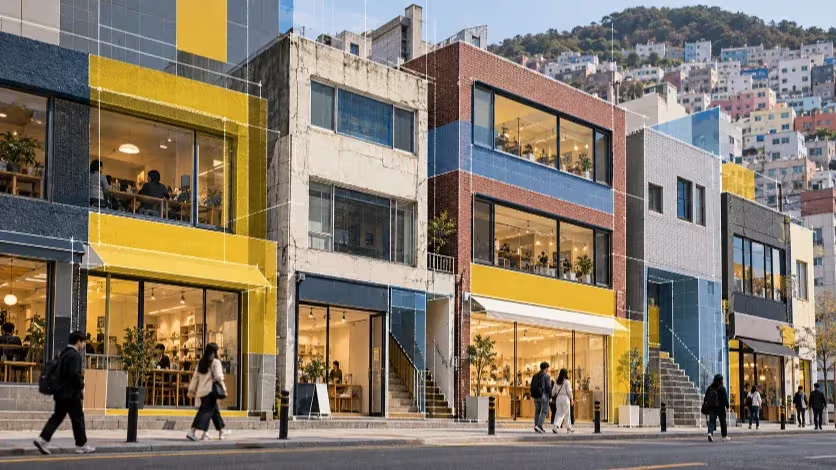 NewsSep 28, 2026
Why Some Commercial Space in Busan Is Hard to Reuse
Two empty commercial spaces exposed to the same broader economy can have very...
More from the author
More from this byline
Stay with the same line of reporting through more work from this byline.
- NewsSep 28, 2026
Why Some Commercial Space in Busan Is Hard to Reuse
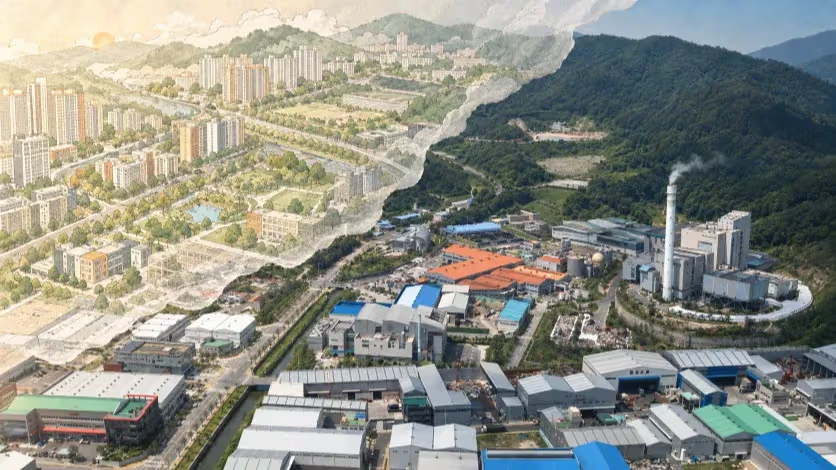 NewsSep 22, 2026
Busan Is Growing Westward as Its Waste Infrastructure Stays Put
Reader Signal
Community readWhat did this report leave you with?
Choose the signal that best reflects your reading. Select it again to remove it.
One response per article
No response selected
A moderated conversation about the reporting.
One-level replies and newsroom moderation keep the conversation anchored to this article.
Discussion Status
Open
Please sign in to join the discussion.
Newsletter
Weekly reporting and context from Busan and Korea.