Pusan National University’s Hanwha Plan Moves Corporate Recruitment Closer to Admission
PNU and three Hanwha affiliates are planning an employment-linked undergraduate department. The larger change is not a new engineering curriculum, but a corporate relationship that would begin at admission rather than near graduation.

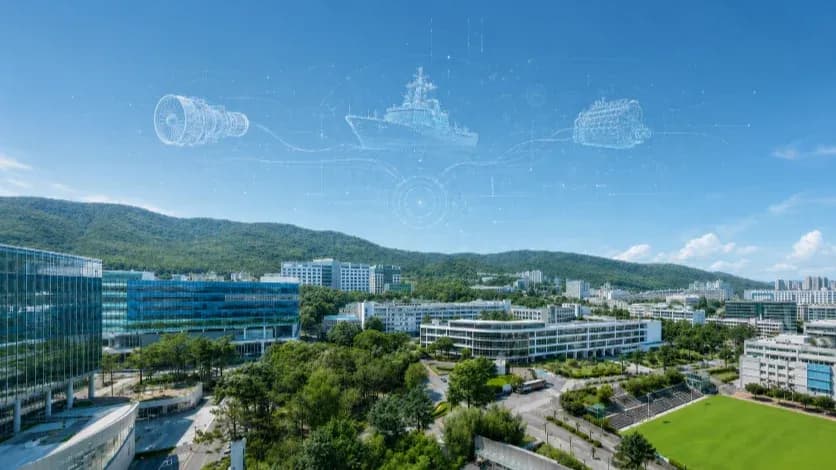
PNU already teaches much of the engineering Hanwha needs and has spent years building research and recruitment ties with the group. The proposed contract department would move that relationship to the beginning of an undergraduate degree.
Pusan National University has agreed to pursue an employment-linked undergraduate contract department with Hanwha Aerospace, Hanwha Ocean and Hanwha Engine, creating a route from university admission to eventual employment across aerospace, defence, shipbuilding and marine-engine businesses concentrated in Southeast Korea.
The agreement, signed Aug. 12 at Hanwha Aerospace’s R&D campus in Changwon, calls for a programme linking undergraduate education with recruitment and regional settlement. PNU has not yet published the department’s final name, enrolment, detailed curriculum, the allocation of graduates among the three companies, future workplaces or the academic and contractual conditions students would have to satisfy before employment proceeds. A 2028 opening and a cohort of about 30 students have appeared in news reports, but neither figure is specified in the university’s formal account of the agreement.
The institutional setting is considerably clearer than the final design. PNU has operated corporate contract education for more than two decades, maintains research partnerships with Hanwha companies and is preparing another employment-linked undergraduate department with LG Electronics. Much of the engineering knowledge Hanwha would require is also already taught across the university. The proposed department would bring those existing elements together at a stage where corporate involvement has traditionally been far more limited: the beginning of an undergraduate degree.
Contract Education Did Not Begin With Hanwha
Corporate participation in PNU engineering education predates the Hanwha agreement by roughly two decades. In 2006, the university established an undergraduate contract programme with Samsung Heavy Industries for employees who already held associate degrees. Thirty workers entered the third year of the university’s naval architecture and ocean engineering curriculum, completing the upper division of a bachelor’s degree after their relationship with the shipbuilder had already been established.
The courses retained the academic structure of conventional engineering education. Students studied structural mechanics, ship vibration, hydrodynamics, propulsion design, ship construction, welding structures and computational fluid design alongside production-system projects and field-based design training. The industrial component did not replace mechanics, fluid dynamics or structural analysis; it placed those subjects closer to the production and design problems encountered inside a shipyard.
PNU later operated a contract department with Daewoo Shipbuilding & Marine Engineering from 2019 through early 2023. University admissions material from the period classified the programme as continuing education for incumbent employees, with students entering the third year rather than being recruited from high school. Hanwha completed its acquisition of Daewoo Shipbuilding in 2023 and renamed the company Hanwha Ocean, meaning the university’s educational relationship with the corporate entity now inside the Hanwha group also predates the current proposal.
Earlier shipbuilding programmes therefore brought employees back into university after their employer had already been chosen, whereas the proposed Hanwha department would place the employment relationship inside the undergraduate degree before students have begun either their professional careers or their university specialisation. The change becomes more significant once the likely academic content is separated from the institutional arrangement surrounding it.
The Curriculum Already Exists, in Pieces
PNU would not have to construct the technical foundations of a Hanwha-linked degree from an empty catalogue. The university already teaches most of the engineering required across aerospace propulsion, naval systems, shipbuilding and large marine engines, although the subjects are distributed among existing departments rather than organised around the staffing needs of one corporate group.
The 2026 naval architecture and ocean engineering curriculum begins with mathematics, physics, chemistry, statics and programming before moving into dynamics, fluid mechanics, solid mechanics, differential equations and numerical analysis. Upper-level students can study structural mechanics, ship vibration, production engineering, thermodynamics, heat transfer, computational fluid dynamics, finite-element analysis, smart control, data science and renewable-energy engineering. Mechanical engineering adds rotating machinery, energy systems, automation and advanced manufacturing, while electrical engineering and computer science provide expertise in control, embedded systems and artificial intelligence.
Hanwha’s three businesses draw on many of the same foundations despite producing markedly different systems. Hanwha Aerospace manufactures aircraft and launch-vehicle engines and develops land, launch and naval defence systems from operations centred in Changwon. Hanwha Ocean designs and builds commercial ships, offshore structures and naval vessels while investing in digital shipbuilding, automation and alternative propulsion. Hanwha Engine develops large marine engines and propulsion systems in which thermofluid engineering increasingly intersects with electronic control, data and lower-carbon fuels.
A curriculum spanning aerospace propulsion, naval systems and large marine engines would appear unusually broad only if organised around finished products. At undergraduate level, much of the engineering underneath those products converges. A gas turbine, a marine engine and a naval propulsion system serve different markets but all require knowledge of heat transfer, fluid flow, rotating machinery, materials, vibration and control. Ship structures and defence vehicles differ radically in application while relying on common principles of mechanics, structural analysis, manufacturing and numerical simulation.
The academic challenge is therefore more likely to involve recombination than invention. A common foundation could be organised around propulsion, structural dynamics, control, manufacturing and computation before students move into later projects or electives connected to particular Hanwha businesses. An alternative design could separate students earlier by company or product line. PNU and Hanwha have not disclosed which approach they intend to take.
PNU’s Smart Home Appliance Engineering department with LG Electronics provides the closest indication of how the university now approaches corporate undergraduate education. Scheduled to admit its first cohort in 2027, the programme retains mechanical engineering as its base while drawing on materials science, electrical and electronic engineering, computing, artificial intelligence and data analysis. Academic guidance recognises conventional subjects including thermodynamics, solid mechanics, fluid mechanics, dynamics and numerical methods as part of the foundation.
LG’s programme shows that an employment-linked degree does not require replacing the conventional engineering core with a company syllabus. Existing disciplines can remain intact while industrial applications, projects and recruitment are organised around a particular employer. Hanwha presents a more complex version of the same design problem because three affiliates working across aerospace, defence, shipbuilding and marine propulsion would have to share an undergraduate foundation before their technical demands diverge.
Where that divergence begins is likely to matter more than the final department name, particularly because Hanwha has already begun crossing the boundary between ordinary university education and company-specific engineering work elsewhere at PNU.
Recruitment Moves Upstream
Hanwha Aerospace formalised research cooperation with PNU in 2023, and the relationship subsequently acquired a physical presence on campus through a Hanwha Aerospace research hub in the university’s mechanical-engineering facilities. The hub created a base for joint engineering work and shared use of research resources before any undergraduate contract department had been proposed.
Hanwha Ocean has developed a parallel relationship with the university. A joint project completed in late 2025 produced a vibration-control device for the accommodation structure of a 174,000-cubic-metre LNG carrier. PNU and the company worked through design, fabrication, testing and performance verification, and the university later said the cooperation would extend to vibration-control systems for engines.
By the time the contract department was proposed, Hanwha was therefore already bringing industrial problems into university research, while PNU was supplying laboratories, faculty expertise and engineering infrastructure to work on them. Students entering a future department would arrive at a university where the corporate relationship was embedded in research rather than introduced solely through a recruitment presentation near graduation.
Recruitment itself has also moved onto campus before the proposed department opens. In the first half of 2026, Hanwha Aerospace offered PNU students a recruitment-linked field-semester programme for manufacturing and production-engineering work in Changwon. Students nearing graduation could spend several months inside the company and, after completing the relevant recruitment process, move into a full-time position.
Bringing Hanwha into undergraduate admissions would move that contact several years earlier. Instead of approaching engineers after most of their academic choices have been made, the company would be connected to a cohort from admission onward, creating the possibility that field training, industrial projects and eventual hiring are planned within the same four-year academic structure.
Earlier access could give Hanwha more time to develop engineers for technologies whose staffing needs are difficult to meet through a short graduate-recruitment cycle, while students could exchange some of the uncertainty associated with final-year hiring for a clearer route into major industrial employers. PNU already possesses many of the mechanisms needed to make such an arrangement operational, from faculty engaged in joint research to industrial projects capable of feeding into coursework and established channels through which students enter company training.
PNU has not said how often Hanwha engineers would participate in teaching, whether the three companies would hold formal authority over curriculum design, when students would begin company-specific projects or whether performance in those projects would influence placement. Those questions become more consequential because “Hanwha employment” can lead to several different companies, occupations and places.
One Department, Three Employers
Hanwha Aerospace, Hanwha Ocean and Hanwha Engine belong to the same corporate group, but they do not offer students a single occupation, workplace or industrial trajectory. PNU has not said whether each affiliate would receive a predetermined share of graduates, whether students would choose among the companies during their degree or whether allocation would depend on grades, project experience and hiring needs closer to graduation.
For students, the issue goes beyond the company name printed on an employment contract. Someone entering university with an interest in aerospace propulsion may discover a stronger aptitude for control engineering, materials or naval systems after several years of advanced coursework. A degree that keeps company allocation open until later would preserve more room for those interests to develop; fixing the destination near admission would provide greater certainty while giving later academic choices a narrower role in determining the career that follows.
Workplace geography further complicates the promise. Hanwha Aerospace and Hanwha Engine maintain major operations in Changwon, while Hanwha Ocean’s principal shipyard is in Geoje. Hanwha Ocean has also established an engineering centre in central Busan under an agreement with the city involving KRW 10 billion in investment and plans for roughly 500 new technical jobs by 2027. A graduate entering the Hanwha group could therefore end up working on ship design in Busan, aerospace or defence systems in Changwon, or shipbuilding and naval programmes in Geoje.
The same placement decision acquires a second meaning when graduates are counted as an outcome of regional policy rather than simply as individual employees. PNU and the governments participating in the Aug. 12 agreement describe the programme in terms of retaining technical talent in Southeast Korea, a geography that extends beyond Busan’s administrative boundary.
A PNU graduate employed in Changwon may have left Busan while remaining within the broader industrial region that national higher-education policy increasingly treats as a single economic area. A graduate working at Hanwha Ocean’s Busan engineering centre would remain inside the city even though the company’s principal production base lies in South Gyeongsang. Both outcomes can satisfy a regional-retention objective while producing different economic effects for the local governments involved.
The policy environment helps explain why universities and companies are increasingly being encouraged to work across those boundaries. In April, the Ministry of Education identified employment-conditioned contract departments as one instrument for connecting regional hub universities more directly to surrounding industries and called for greater use of company-linked projects in undergraduate education. PNU subsequently formed an alliance linking Busan, Ulsan and South Gyeongsang with research institutions and major manufacturers, while Hanwha Ocean already participates in one of PNU’s industry-linked RISE programmes.
None of those connections establishes that RISE funding will finance the proposed Hanwha department. PNU and Hanwha have not disclosed its operating budget, tuition structure or the size of any corporate contribution, and existing regional-innovation funding cannot be treated as the programme’s budget without additional evidence.
What the policy context does establish is a convergence of interests. Companies need specialised engineers, PNU is being encouraged to align education and research more closely with regional industries, and local governments want skilled graduates and investment to remain outside the Seoul metropolitan area. Whether the same arrangement works equally well for students depends on contractual terms that have not yet been made public.
The Terms Will Define the Department
Employment-conditioned programmes offer an advantage that is easy to understand: students can reduce the uncertainty surrounding graduate recruitment while gaining access to corporate training and, depending on the agreement, tuition or living support. South Korea’s existing contract departments also show that the value of that security cannot be separated from the academic and employment conditions attached to it.
Sungkyunkwan University’s Semiconductor Systems Engineering programme with Samsung Electronics, for example, links later scholarship support, internships and employment to academic requirements and the company’s minimum recruitment procedures. At the more restrictive end of the spectrum, rules announced for students entering Hanyang University’s semiconductor programme with SK hynix in 2026 tie continued scholarship treatment to credit and grade requirements and calculate post-graduation service according to the duration of company support; four years of support can result in an eight-year employment obligation.
Nothing released by PNU or Hanwha suggests that comparable terms will apply to the proposed department. The examples matter because they show how much variation can exist beneath the same broad category of employment-conditioned education. Academic thresholds, corporate assessments, leave of absence, changes of major, graduate-school plans, withdrawal from the programme, repayment of financial support and post-graduation service can all affect the balance between employment security and the choices students retain during university.
The participation of three companies gives those conditions additional weight. Students will eventually need to know when an affiliate is selected, whether they can reject a particular placement and how academic preference is reconciled with the workforce requirements of the group. The answer could produce a relatively broad engineering programme in which employment remains secure while specialisation develops gradually, or a more tightly prescribed route in which curriculum, financial support and company placement are closely connected from an early stage.
PNU has not yet released the documents that would distinguish between those outcomes. A final curriculum will show how long students remain within a common engineering foundation and when Hanwha-specific work begins. The operating agreement will establish the programme’s enrollment, duration and education-cost structure, while student-facing rules will determine how academic performance and company employment are connected. Placement provisions will show whether participation by three affiliates expands the range of careers available to students or primarily gives the corporate group flexibility in allocating future engineers.
Most of the institutional ingredients needed to create the department already exist: PNU teaches the engineering disciplines the programme would require, its researchers work with Hanwha companies, students already enter Hanwha training and recruitment programmes, and national policy encourages regional universities to connect education more closely to identifiable industrial demand.
The Aug. 12 agreement proposes to bring those elements together from the beginning of undergraduate education. The significance of the department will ultimately depend less on how many new course titles appear in PNU’s catalogue than on the terms that connect those courses to employment.
Editorial Context
"Independent journalism relies on radical transparency. View our full log of editorial notes, corrections, and project dispatches in the Newsroom Transparency Log."
Reader Pulse
The report's impact signal
Be the first to provide a reading pulse. These collective signals help our newsroom understand the impact of our reporting.
Join the discussion
A more thoughtful conversation, anchored to the story
Atlantic-style discussion for this article. One-level replies, editor prompts, and moderation-first participation are now powered directly by Prisma.
Discussion Status
Open
Please sign in to join the discussion.
The Weekly Breeze
Independent reporting and analysis on Busan,
Korea, and the broader regional economy.