When the Next Hire Becomes Optional
AI could let South Korean companies expand without hiring at the same pace. The effects reach beyond payrolls—to competition, wages and household spending.

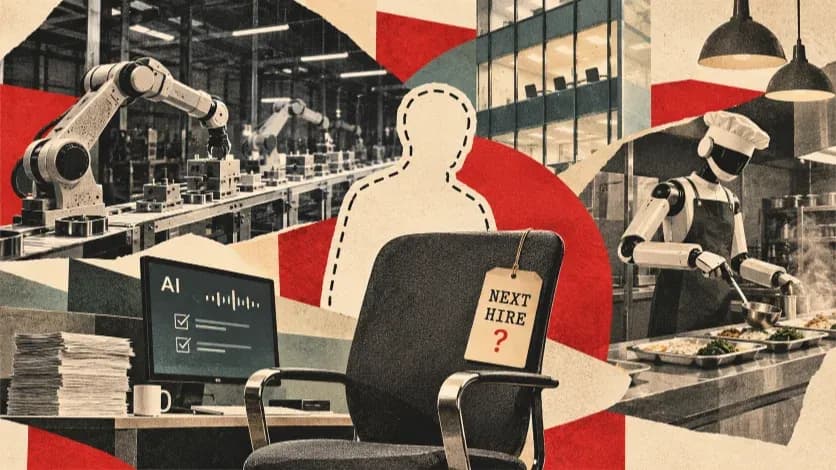
AI is changing the economics of expansion—from office recruitment to factory shifts. South Korea’s existing divide between production and household income shows what is at stake when companies grow without hiring at the same rate.
The jobs associated with South Korea’s economic growth differ sharply by industry. In the Bank of Korea’s accounts for 2024, a billion won of export demand was associated with about five employed people across domestic production chains. The same amount of consumption demand was associated with nearly twice as many. Those figures describe the existing mix of industries and demand, not the impact of artificial intelligence. They also place the next wave of automation in context: some capital-intensive export businesses already produce substantial value with relatively little labor for each won of sales.
The first signs of a new hiring calculation have emerged in offices. Employment among South Koreans aged 15 to 29 declined by 285,000 between June 2022 and June 2026, according to the central bank. Industries judged highly exposed to AI accounted for 268,000 of that net decline, while employment among people in their fifties increased in several of the same sectors. Those figures do not say AI destroyed 268,000 jobs. A post-pandemic hiring correction, firms’ preferences for experience and changes in remote work offer competing explanations. They do, however, direct attention toward a decision that rarely appears in a layoff announcement: whether a business needs to open its next junior position at all.
An experienced software team can use AI to take on work it once assigned to a new recruit. It can also use AI to help a beginner undertake more complex assignments sooner. Either choice can increase the volume of work delivered. The difference lies in how much of the growth becomes paid employment and whether the company is producing the people who will eventually replace its senior staff.
The hiring margin is visible in administrative records from Denmark. The central bank found that businesses introducing AI in 2023 or early 2024 followed a weaker employment-growth path than comparable nonusers. By mid-2025 their staffing was about 11 percent below the level implied by earlier relative trends, chiefly because they recruited less. The estimate measures a divergence from a counterfactual growth path, not an 11 percent decline in each adopter’s headcount. Economy-wide Danish employment had changed little. A business can become less reliant on new recruits without dismissing much of its existing workforce.
That difference becomes more consequential as automation moves beyond documents and code. A warehouse designed around robotic handling, unlike an existing warehouse with people still available to fix every interruption, may need fewer paid hours each time the business adds capacity. A successful adopter may increase employment by winning orders from less efficient competitors, even as those competitors shrink. The national result depends on the work created elsewhere and the channels through which profits, wages and lower prices reach households.
From adoption to operating returns
Buying access to an AI model rarely changes an entire business. In a 2026 U.S. Census Bureau survey, 18 percent of firms said they used AI in at least one business function; most adopters used it in no more than three. Among firms using AI, about 2 percent reported an AI-related decrease in headcount; the figure is not a share of all surveyed businesses. The breadth of AI integration and related operational investment, rather than individual workers’ use of AI tools, were more closely associated with reported staffing cuts. The findings are based on company responses and associations, not a causal estimate of the jobs lost to AI. They locate the economic change in the redesign of businesses rather than the spread of software subscriptions.
Consider an employee completing a report in half the former time. The business has gained capacity, but it has not necessarily saved half that worker’s wage. The report may still require review, the client may not buy more work, and other stages of delivery may be unchanged. A measurable return arrives when the firm sells more acceptable output, avoids a cost it would otherwise incur, raises its price for better service or defers new capital expenditure. The distinction between task speed and the economics of the complete operation will matter even more for machines that handle physical work.
That distinction appears in Korean business data. A 2026 Korea Development Institute study estimated that companies adopting AI and related advanced technologies between 2017 and 2023 increased sales per employee by roughly 5 to 20 percent. The gains came mainly through more sales, without systematic reductions in headcount. The measures combine earlier generations of AI and industrial technologies, so they cannot be transferred directly to today’s generative or physical AI. A company can earn more from each employee by finding more customers, rather than employing fewer people.
The factories that would install physical AI are also far from uniform. In a Ministry of SMEs and Startups survey conducted in late 2024 and early 2025, 19.5 percent of sampled small and midsize manufacturers reported having smart-factory systems; three-quarters of those systems were still at the basic stage. Manufacturing AI was present in just 0.1 percent of the surveyed manufacturing population, while 0.8 percent had dedicated AI or manufacturing-data staff. The figures refer to an earlier survey period, not the current share of factories using intelligent robots. They reveal why a capable machine may remain uneconomic where the surrounding production line lacks data, compatible equipment and people trained to maintain it.
In an analysis of 342 Korean manufacturers’ AI adoption plans, the Korea SMEs and Startups Institute found that 49.4 percent put productivity first and 48 percent named product quality. Only 1.5 percent listed cost reduction as their primary objective. Plans submitted for support cannot reveal every manager’s private financial calculation; less waste and better quality may lower costs indirectly. But they do suggest an important sequence. A manufacturer may begin automating because defective products, missed delivery dates or a shortage of skilled operators restrict sales. Labor savings may become important later, when it uses the improved process to open another line without replicating the old staffing pattern.
Legacy machinery, manual records and shortages of specialist staff were common barriers in the same research. A subsidized AI system may still require cameras, sensors, integration work, changes to how products move and people who know when the model is wrong. The investment case depends on those additional costs and on the orders the factory expects to fulfill. A large producer can spread the expense over repeated installations; an independent supplier with one short production run may have to recover it from far fewer units.
The cost of not training the next employee
A junior lawyer checking a contract, a developer following an unfamiliar defect and an accountant reconciling a faulty entry all produce work for a business. They also accumulate the experience needed to make decisions independently. Senior colleagues spend time checking their output. A firm that automates the junior task may save review time as well as production time, but it can also remove part of the process through which future senior employees learn their trade.
U.S. software vacancies give an indication of how that bargain may be changing. In a 2026 study, Samuel Westby, Alicia Sasser Modestino and Peiran Cheng found junior developer advertisements declining by about 14 to 15 percent relative to senior advertisements after ChatGPT’s release. The work demanded of nominally junior applicants had shifted toward greater experience and judgment. These were advertised positions, not documented hires, and the association does not isolate AI from the broader retreat in software recruitment.
Reviewing AI-generated code is not the same as knowing why it fails. The ability to question a plausible answer is acquired by confronting actual mistakes, yet employers increasingly expect beginners to bring that ability with them. A company that no longer trains novices can hire experienced staff from competitors. The industry still needs somebody to produce that experience in the first place.
A large London School of Economics study offers a serious alternative explanation. Across 243 million hires and 407 million job advertisements in four countries, declining junior recruitment was also closely associated with occupations where remote work had expanded. Once that exposure was considered, the statistical relationship with AI exposure weakened. Less face-to-face supervision may have made firms reluctant to hire beginners even when their tasks could not be automated. The recruitment evidence therefore points to a change in how firms organize entry-level work, not a single proven technological cause.
The consequences for learning are sharper in an experiment with patent lawyers. In a three-month randomized study of 133 lawyers at 11 U.S. intellectual-property firms, participants given a specialized AI assistant produced better patent drafts. At the end, they had to correct a flawed application without the tool. Senior lawyers who had used AI outperformed comparable senior colleagues. Junior lawyers, on average, did no better at that independent exercise; outcomes varied considerably among individuals. The experiment was small and its final assessment covered only a subset of participants. It does not show that AI prevents beginners from learning. It shows that a higher-quality product during assisted work need not translate into stronger unaided professional judgment.
That outcome is not universal. In a separate study of 5,172 customer-support agents, AI assistance increased the number of issues resolved per hour by an average of 15 percent, with particularly large gains among less-experienced workers and indications of learning. In an experiment with 673 German IT apprentices reported in October 2026, generative AI improved performance on unfamiliar assignments without an immediate loss of comprehension. Those results concern particular tasks, and long-term independent expertise remains harder to measure. They establish that an employer can also use AI to make learning more productive.
A German establishment-panel study offers evidence on the hiring decision itself. Among firms already providing apprenticeships, sustained AI adoption was associated with roughly 14 percent more new apprenticeship contracts, without a comparable rise in the number of companies offering training at all. Germany’s formal apprenticeship institutions are not a template that can simply be transferred to Korea. The finding nonetheless weakens the notion that AI must eliminate work for beginners. Employers have choices about how much of the productivity gain to use in building their next workforce.
Training is an investment with a return that may arrive years after the immediate salary cost. Firms do not necessarily capture that return when employees leave, so they can rationally prefer hiring ready-made experts. If many employers do so while reducing junior intake, scarce experience becomes more expensive to buy. The risk is less a shortage of tasks for people than a shortage of firms willing to pay for the experience future employees will need. Germany’s apprenticeship evidence demonstrates that a different investment decision is possible.
The remaining work in a robot’s shift
Physical automation has a more stubborn obstacle than drafting software: the world moves. At an Amazon fulfillment center, items occupy cramped storage compartments, often with other objects in the way. Removing one requires a machine to identify what can move, adjust its grip and sense when contact might damage the goods. Warehouse workers perform these adjustments continuously, often without stopping to think about them. A system trained to make a single successful grasp has not yet proved it can work through all the variations of a commercial shift.
Amazon's Vulcan system, introduced in 2025, combines cameras with force feedback to work in these crowded compartments. One tool shifts existing products to make room; another adjusts its grip as it places an item into storage. For retrieval, a camera guides a suction device toward the selected object. Amazon says the system can pick and stow approximately 75 percent of the different types of merchandise in its fulfillment centers, at speeds comparable to those of its front-line employees. When it encounters an item it cannot handle, it requests human assistance. The 75 percent figure describes the range of product types the company says the machine can manage. It does not measure the proportion of working hours eliminated, nor does Amazon's account establish how many employees the deployment has displaced.
Industrial robots have employed sensors and feedback controls for decades. More recent perception-and-action systems attempt to learn from demonstrations and recover when a task departs from a programmed sequence. Research from Google DeepMind and NVIDIA in 2026 advanced the planning of multistep physical actions. Such demonstrations are evidence of improving capabilities, not proof of profitable round-the-clock operation. The commercial challenge is to keep the machine working when objects arrive differently, grasping fails or surrounding equipment stops.
An independent February 2026 assessment by Epoch AI found commercially established autonomous navigation and considerable progress in controlled warehouse picking, alongside persistent problems transferring robotic skills to unfamiliar objects, settings and longer tasks. A success rate recorded in a controlled demonstration cannot be converted into a labor-saving rate at a busy site. Failed grasps, uncertain placements and unexpected interruptions matter because each can require a worker to stop what they are doing and attend to the robot.
GXO Logistics provides a narrower commercial example. Since 2024 it has deployed Agility Robotics’ Digit robots to move reusable containers between warehouse equipment in Georgia. In October 2026 the companies said the fleet had handled more than 100,000 containers and announced two additional sites for 2027. The cumulative count establishes repeated operation, but neither company disclosed the hours of human intervention, total operating cost or hiring changes. An impressive volume handled by robots is not yet a balance sheet for labor substitution.
The contrast with Amazon is instructive. Vulcan uses purpose-built tools inside storage compartments; Digit carries standardized containers between equipment. Neither depends on a machine doing everything a warehouse worker can do. Facilities can be redesigned around what the robot reliably handles, reducing the range of unexpected tasks. The crucial gain may come when a machine needs so little help that an operator can supervise several processes rather than remain beside one. That threshold is more economically significant than another demonstration of dexterity.
A shift on the balance sheet
An employer pays for a complete shift, not just the minutes spent lifting a box. It must cover absences, train replacements, supervise interruptions and maintain safe working conditions. A robot that completes most repetitive movements but calls for help frequently can raise throughput without reducing staffing. The investment produces labor savings when the remaining work can be reorganized so that paid coverage actually falls, or additional sales can be fulfilled without opening another shift.
That is why a business case needs two complete operating accounts. On the human side are wages, staffing coverage, recruitment, training and the cost of disrupted output. On the machine side are purchase or lease payments, financing, integration, building changes, power, software, downtime, repairs, safety, outside contractors and the people who still supervise the process. A machine doing 80 percent of the physical motions need not eliminate 80 percent of the paid hours. Its value depends on what its installation allows the manager to change in the schedule and what customers will buy.
Utilization can reverse the verdict on the same equipment. A machine used for a single short shift must recover its fixed costs from relatively little production. Two or three sustained shifts spread those costs over more output, although wear, failures and additional human oversight increase as well. A full warehouse with predictable demand presents a different proposition from a small manufacturer whose orders fluctuate and whose staff move among unrelated duties. The robot’s maximum rated hours are not the hours for which it can reliably produce saleable goods.
Korean employment costs sharpen that comparison but do not settle it. The 2027 minimum wage will be 10,700 won an hour, or 2,236,300 won at the standard monthly 209-hour conversion; it is a statutory floor rather than the full cost of a trained operator. Under the Labor Standards Act, qualifying night work from 10 p.m. to 6 a.m. carries a premium of at least 50 percent of ordinary pay, generally at workplaces with five or more regular employees. A factory operating several shifts may have strong incentives to reduce difficult-to-staff hours. It must still pay the engineers, safety staff or contractors who remain responsible for automated operations.
Robots do not take sick leave or resign, but they introduce other dependencies. Korean industrial-safety rules prescribe precautions during repair and inspection. A factory may exchange recruitment problems for dependence on an integrator, a software update, a replacement part or an overnight service agreement. If a stopped robot holds up the next stage of production, the supplier’s response time may be a larger cost than the wage it was expected to save. Managing equipment can be easier than managing a workforce in some tasks; it is never the same as having nothing left to manage.
The most revealing decision may concern a facility that has not been built. Managers often retain established workers because the existing line still needs them during exceptions. When designing the next line from the beginning, they can place shelves, conveyors, maintenance access and supervisors around automated flows. If the project is commercially viable, the next increment of production may require fewer new employees than the previous increment did. No dismissal is necessary for that change to appear in the hiring budget. But a poorly used machine, or one that requires constant rescue, can make the automated design more expensive than flexible human staffing.
Large corporate savings claims require a similar discipline. UPS reported about $1.8 billion in benefits from network reconfiguration and efficiency programs during the first nine months of 2026. Its restructuring included automation, sorting-network consolidation, facility changes, workforce reductions and lower expected volume from a major customer, alongside substantial separation and consulting costs. Those figures cannot be booked as a return earned by robots. Automation is one component of a broader strategy responding to changes in demand, labor costs and network design.
The jobs outside the investor’s accounts
A factory can increase its own employment after installing robots and still contribute to job losses elsewhere in its industry. In a study of 55,390 French manufacturers from 2010 to 2015, Daron Acemoglu, Claire Lelarge and Pascual Restrepo identified 598 robot adopters. They represented scarcely 1 percent of firms but accounted for roughly a fifth of employment and value added. The purchasers tended to be large businesses capable of changing market conditions for competitors.
Robot adopters experienced roughly 11 percent stronger growth in total hours worked than comparable firms, while labor’s share of their value added was about 4.3 percentage points lower, conditional on the study’s controls. Their businesses could grow while a smaller proportion of the resulting value went to labor. But the pattern at rivals was different: a 10-percentage-point increase in competitors’ robot adoption was associated with 2.5 percent less employment at exposed firms. A wider increase in adoption was associated with lower total manufacturing employment in the researchers’ industry estimates. These are historical, partly observational relationships—not numerical forecasts for contemporary physical AI.
The mechanism runs through sales. A cost advantage can allow an adopter to lower prices, deliver faster or win business from a competitor. If customers buy considerably more because the price falls, the industry can expand enough to employ more workers overall. If demand is already saturated, many of the extra orders for one producer are orders lost by another. The employees who lose their jobs may work at the company that never bought a robot. The successful adopter’s payroll, considered alone, gives an incomplete account of what happened to labor.
Germany offers a different starting point. A 2025 study found that companies confronting recruitment difficulties were more likely to invest in robotics and that adopters tended to expand their employment; negative spillovers in the study were comparatively small. The machines could allow orders to be produced that would otherwise be refused for lack of workers. Korea’s own mix of labor shortages and intense manufacturing competition makes both mechanisms relevant: robots can preserve output where operators are scarce, or shift orders between factories where demand is already being met.
Korean firm-level studies record both expansion and weaker labor demand. A 2025 Asian Development Bank study associated both AI and robot adoption with employment growth at adopters. AI adoption coincided with higher productivity and a lower labor share of value, and businesses adopting both technologies reported an immediate increase in temporary rather than permanent employment. The data concern older technologies and samples; they cannot establish what a new adaptive robot would do in 2027.
Other research finds signs of substitution. A 2024 Bank of Korea journal study using business records from 2017 to 2021 reported employment growth at robot adopters approximately 2 percent below that of nonadopters. Another Korean study, published in Empirical Economics, associated stronger industrial-robot exposure with weaker growth in manufacturing and routine-job vacancies—about 2.6 and 2.5 percentage points respectively per additional robot per thousand workers of exposure—without finding a significant decline in total local vacancies. The studies use different methods and outcomes, and none isolates the latest generation of physical AI. They suggest that new openings in a specific kind of work can weaken without an equivalent decline in employment across an entire region.
The same industry can record rising output and employment at successful adopters, a lower share of value going to labor, and fewer vacancies at other producers. Those outcomes can coexist. They can be distinguished only by following production, paid hours, actual hires and orders won or lost across competing businesses. A robot’s published task-success rate says nothing about that distribution.
Competition also determines how widely the advantage spreads. Large manufacturers have capital and engineering teams that can repeat a successful installation; smaller firms may gain similar capabilities through integrators, leasing or common software. Yet a vendor’s ability to sell the system is not proof that customers can run it profitably. If better automation cuts prices and widens demand, more firms may be able to operate. If it mainly enables a few producers to capture existing orders, the employment consequences may fall on their less automated rivals. Either way, changes in ownership, wages and purchasing power reach beyond the firms that make the investment.
The path from production to household income
South Korea already has a way to see why the composition of growth matters. The Bank of Korea’s input-output tables for 2024, released in September 2026, associated a billion won of final consumption demand with 9.7 employed people across domestic supply chains. The comparable coefficients were 7.9 for investment and 5.0 for exports; the economy-wide measure stood at 7.8, against 8.2 the year before. These are measures of employment embodied in the economy’s existing production and demand structure, not estimates of hires caused by one more billion won of spending. Their meaning is nevertheless significant: the industries supplying different kinds of demand involve very different amounts of work.
Electronics makes the difference visible. For computers, electronics and optical equipment, the coefficient was about 2.9 jobs per billion won in 2024, against 3.6 a year earlier. Price movements and the changing mix of goods can move those coefficients even when absolute employment rises. The tables establish neither AI-induced layoffs nor a general decline in the value of manufacturing. They show that Korea can increase output in a capital-intensive industry without a proportional increase in work measured per won of sales.
In its March 2026 Monetary Policy Report, the central bank examined why stronger exports and higher asset values were stimulating household consumption less effectively than in earlier recoveries. Semiconductor-led growth generates large profits, but its capital intensity, reliance on imported inputs and relatively limited direct employment narrow the path from an export order to the incomes of domestic households. Debt burdens and the uneven ownership of financial assets further complicate that transmission. These conditions predate the broad commercialization of physical AI; treating them as its consequences would be false. They provide a domestic example of what happens when production and the incomes supporting local demand follow different routes.
When productivity lifts profits faster than payroll, the additional value need not vanish from the domestic economy. Some may become higher wages, dividends or pension returns; some may lower consumer prices, fund suppliers or finance additional investment. An exporter can sell to customers abroad even if domestic consumption grows slowly. Where the benefit ends up depends on competition, ownership and spending decisions, not just on the labor a machine replaces. An economy can produce considerably more with fewer hours per unit without becoming unable to sell its output.
The distribution of that gain still matters for near-term consumption. Using household survey data, the Bank of Korea estimated that the highest-income fifth of households spent about 12 won of every additional 100 won of income, compared with around 18 won across households as a whole. These are estimated marginal propensities to consume, not fixed spending rules for individuals. A gain concentrated among households with a greater propensity to save is less likely to reach shop counters immediately than a similar wage increase for households that spend more of each additional won. Retained profits can finance investment later; falling prices can improve purchasing power today. The timing and recipients differ.
The new challenge for a labor-saving economy is therefore about distribution and demand as well as productivity. Within a factory, reliable automation may reduce the number of paid shifts needed for the next increment of output. Outside it, the gains may reach households through wages, prices, investment income, taxes or public services—or remain concentrated among fewer owners and locations. A profitable factory does not automatically generate a broad increase in household purchasing power. Nor must the reduction in its labor cost lead to weaker demand if other channels are strong.
There is no evidence that physical AI has already forced Korean real wages into a general decline. The OECD found that average real hourly wages in the first quarter of 2026 were about 5.7 percent above their early-2021 level. Researchers at the International Labour Organization have also cautioned that rapid gains on individual AI-assisted tasks have not translated into equally large measured gains across whole economies. A technology can alter recruitment in particular occupations while the wider economy continues to employ more people and pay higher real hourly wages. The aggregate evidence must not be bent to fit an inevitable-collapse narrative.
Who gets the jobs that appear elsewhere
A reduction in manufacturing work need not reduce total employment if other businesses expand. But it can change who gets hired. German worker-level records for 1994–2014 showed many employees staying at robot-exposed manufacturers and moving into different duties, while young entrants had fewer opportunities in those factories. Jobs added in services offset manufacturing losses in aggregate. An incumbent protected by an established employment relationship and a young applicant looking for an opening were not equally situated. Total employment concealed the difference.
Korea’s labor market makes that distinction consequential. The Bank of Korea reported in October 2026 that access to secure regular employment had deteriorated for young workers and that movement from less secure positions toward better ones had weakened. The bank linked the problem partly to an increasingly capital-intensive industrial structure, alongside other influences. It did not prove that AI caused the division. A change in hiring practice would, however, arrive in an economy where entry and advancement are already unequal.
A vacancy for a robot-maintenance engineer does not replace a lost opportunity in warehouse handling or junior accounting for the individual seeking work. The new role may require formal qualifications, years of operating experience and relocation. A displaced worker may know a production line intimately and still lack the certification to maintain its control system. A national job count can improve while the people displaced by a change struggle to reach the occupations that are expanding.
Adult training provides only a partial bridge. In Education at a Glance 2026, the OECD reported that 16 percent of employed Koreans aged 25–44 had participated in nonformal education or training in the relevant prior-year survey period, against an OECD average of 52 percent. Among employed adults aged 45–64, participation was 15 percent versus 45 percent. The underlying survey predates the publication and countries organize training differently, so the comparison is not a measure of course quality. It does indicate the scale of the adjustment required if employers expect workers to change careers largely at their own expense.
Location can make the mismatch more expensive. The Bank of Korea found generative- and agentic-AI-exposed occupations concentrated around the capital region, while some potentially physical-AI-exposed work was concentrated in manufacturing regions outside it. Exposure is a measure of technical susceptibility, not a count of actual job losses. The OECD’s 2026 Korea survey also found that the financial ability to move toward Seoul’s income opportunities differed with family resources. A more lucrative technical vacancy may do little for someone who cannot afford the period without income or the housing cost of moving.
If AI reduces the number of office entry posts while commercially reliable robots later narrow some routes into physical work, the ability to move between occupations could become more constrained. No Korean cohort study has yet followed that entire sequence. What the existing records establish is more specific: jobs preserved for incumbents, openings that disappear from recruitment plans and positions created in new specialties are often available to different workers. That distinction will matter long before a national unemployment statistic reveals any decisive technological break.
Korea’s next investment cycle
Korean demography will push the same technologies in another direction. The Korea Employment Information Service projected in February 2026 that the economically active population would begin shrinking around 2030, with total employment rising by about 367,000 from 2024 to 2029 before falling by roughly 303,000 through 2034. These are baseline projections, not an accounting of jobs threatened by AI. In industries unable to recruit enough people, machines may keep production running, improve safety and protect employment in supplier businesses that depend on delivered orders. A shortage of trained operators and a surplus of applicants for secure first jobs can persist in the same economy because they involve different skills, workplaces and locations.
The government is preparing a substantial intervention. In October 2026, the Ministry of SMEs and Startups announced a plan for more than five trillion won in national resources for smart-manufacturing innovation through 2030, aiming to expand the number of AI-using manufacturing SMEs from roughly 600 to 6,000. The target describes intended adoption, not 6,000 commercially successful autonomous plants. The 2027 support plan separates AI-enabled factories from robot installation and physical-AI demonstration projects. A manufacturer can receive support for collecting production data without automating a full shift; another can install machinery that remains dependent on human supervision.
For suppliers, a subsidized installation creates a sale. For the factory, the return comes only if the equipment continues to operate profitably after integration costs, service bills and the initial support are accounted for. A demonstration that never expands to a second line does not establish a repeatable business model. Renewal contracts, acceptable output per paid hour and the staffing plan for a comparable new facility would reveal more than the number of grants awarded or robots installed.
Some sectors have little room to dispense with human responsibility. A 2026 Korea Development Institute survey reported care robots at 6.4 percent of the eldercare facilities studied, while 51.8 percent of respondents would consider adopting them with financial support. Those devices are not the general-purpose robots being tested in warehouses. Their principal benefit was reported as relief from physically demanding care work, not a measured reduction in jobs. The case illustrates a boundary to substitution: equipment can make work safer and less exhausting without removing the employee whose judgment or presence the service still requires.
The pace of physical automation remains uncertain. The International Federation of Robotics expects worldwide annual installations of industrial robots to reach 806,000 in 2029; Korea installed about 30,000 in 2025, close to its level of recent years. Those figures include conventional industrial machinery. They are not forecasts of intelligent robots replacing workers. A September 2026 Anthropic model estimated that robots were technically capable of performing 74 percent of physical tasks in at least some settings, but economically competitive for tasks representing only about 0.3 percent of work across the U.S. economy under its assumptions. Those are different denominators in a cost-and-capability model, not estimates of jobs already displaced. A rapid drop in robot costs or a major improvement in reliability could alter the calculations; there is no sound basis for assigning a Korean mass-layoff total to 2029.
A software business can reorganize document work without rebuilding its offices. A warehouse with standardized containers and long operating hours may recover an automation investment relatively quickly. A small factory working with variable materials may need years of complementary investment. Even within the same industry, adoption will differ with capital access, demand, engineering staff and the frequency of exceptions. More capable robots can widen the set of profitable applications, but falling prices alone cannot make every task worth automating.
The next cycle of corporate reports should be read for hiring plans as closely as for capital spending. An expanding factory can report more sales and more employees even when each new line requires fewer recruits than the previous one. A competitor losing orders may report weaker hiring without adopting anything. An AI-intensive service company can employ fewer juniors while adding highly paid engineers. These are the changes that would show whether growth is becoming less labor-intensive, and who is excluded from its gains.
The consequences will grow if companies in more industries learn to expand output without expanding payrolls at the same rate. Korea has already observed that capital-intensive export growth reaches households differently from consumer-oriented activity. It has not established that physical AI is causing a nationwide separation of production from employment or income. But the economics of the next factory line, the unadvertised junior position and the rival supplier’s lost order point toward the same public consequence. Companies will be able to measure the additional output and the salaries they avoid paying. For workers and households, the consequential figures will be where the resulting income goes, which new jobs remain accessible and whether the purchasing power supporting the next expansion grows with production.
Continue this reporting
Reporting on the same issue
Related coverage selected from the article's desk, topics and newsroom relationships.
 NewsOct 21, 2026
What a Small Mackerel Is Worth
Busan’s catch is dominated by small mackerel even as some buyers need larger...
 NewsSep 21, 2026
Europe’s Electrical-Steel Safeguard Now Reaches Inside the Transformer
A new EU safeguard follows electrical steel into certain finished transformer...
 NewsSep 14, 2026
Foreign Tourist Spending Is Reshaping Busan’s Nampo District
Foreign spending is making long-empty commercial space valuable again in Namp...
More from the author
More from this byline
Stay with the same line of reporting through more work from this byline.
 NewsOct 27, 2026
Where Busan’s New Density Meets the Old City

Reader Signal
Community readWhat did this report leave you with?
Choose the signal that best reflects your reading. Select it again to remove it.
One response per article
No response selected
A moderated conversation about the reporting.
One-level replies and newsroom moderation keep the conversation anchored to this article.
Discussion Status
Open
Please sign in to join the discussion.
Newsletter
Weekly reporting and context from Busan and Korea.