Igidae Was Never Empty
Busan protected Igidae from fragmented development, then chose it for a Centre Pompidou outpost before settling the project’s access, financing and long-term cultural value.
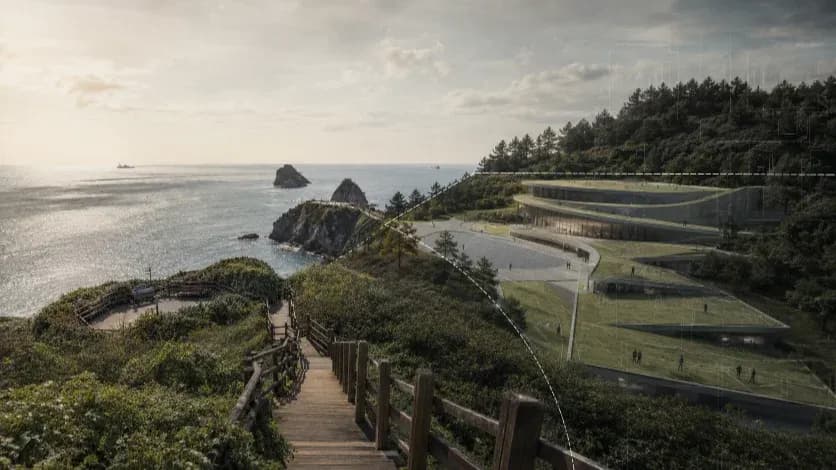
Busan protected this coast from fragmented development, then recast it as the scenic platform for a Centre Pompidou outpost and a wider arts-tourism complex. The planning sequence suggests that the brand came first, while the institution, transport system and lasting cultural return were left to catch up.
Busan once treated Igidae as a landscape that needed protection from the pressures surrounding it. When the urban-park sunset system exposed parts of the coastal area to possible development, the city placed about 1.9 million square metres in a conservation green zone, citing the park’s ecological quality, geological importance and value as a public asset. It later spent 73.7 billion won acquiring 712,000 square metres of privately held land, removing the immediate risk that the coast would be broken up parcel by parcel.
The policy direction changed within a few years. Busan began converting Igidae from a waterfront park into a neighbourhood park, a planning category that lowered the allowable building coverage but made it easier to install museums and a broader range of cultural facilities. The city then placed a Centre Pompidou outpost at the centre of an arts-park programme encompassing an arts centre, pavilions, galleries, a lookout, a visitor centre, parking and other supporting infrastructure. The museum was no longer an isolated cultural facility proposed for an unused plot. It became the international anchor for a long-term attempt to turn the protected coast into a high-profile cultural and tourism destination.
That sequence raises the question at the heart of the project. Busan did not begin by defining the museum or research institution most appropriate for Igidae’s landscape, existing cultural organisations and residents, then seek an overseas partner able to help build it. Public records instead suggest that the city pursued a prestigious international institution, selected Igidae as the setting that could distinguish the proposed outpost, attached visitor and revenue targets to the plan and left much of the access system, integrated financing and long-term local capacity to be resolved later.
The proposed museum building was estimated to cost approximately 110 billion won, and Busan set aside 4.025 billion won in 2026 for an international design competition and related work. The city also projected annual operating expenses of 12.5 billion won, about 5 billion won in ticket and ancillary revenue and 470,000 paid admissions a year. Negotiations have since been suspended under Mayor Jeon Jae-soo, who has promised a decision before the end of 2026 and whose latest comments indicate strong opposition to the existing arrangement, although no formal cancellation had been announced as of July 24.
The political change has created an argument over continuity, fiscal priorities and Busan’s reliability as an international partner. Those issues matter, but they do not answer the central policy question. The city first needs to explain why Igidae — land protected and purchased because it was already valuable — should supply the landscape, public investment and local distinctiveness for an institution whose most recognisable assets would come from elsewhere.
The Landscape Became Part of the Product
Igidae was never an empty site waiting for an architectural object to give it meaning. Its wooded slopes, sea cliffs, geological formations and views towards Oryukdo were the reason the city intervened to protect it. Busan’s 2020 announcement described the area as an ecologically and geologically important future asset for residents, noting endangered species and its inclusion in the national geopark system. The later arts-park budget retained the language of preservation while placing the same scenery inside a strategy to create a destination through art and cultural content.
That combination is presented as a natural partnership between landscape and culture. A carefully designed museum can indeed deepen public understanding of a place, and cultural buildings are not inherently incompatible with parks. The problem lies in the order and scale of the proposal. Rather than developing an institution around Igidae’s ecology, geology, maritime history or relationship with urban expansion, Busan selected an internationally recognised museum brand and used the coast to give the imported institution an identity that another conventional exhibition building could not provide.
Igidae was therefore more than the museum’s address. Its landscape was one of the assets intended to make the Pompidou outpost symbolically and commercially distinctive. The cliffs and sea would differentiate Busan from Paris, Shanghai, Malaga and, more recently, Seoul, where Centre Pompidou Hanwha opened in June 2026 inside the existing 63 Building. The Seoul partnership occupies converted private space and plans two collection-based exhibitions each year. Busan was proposing public construction on a protected coast, which means that the natural setting was carrying part of the burden of proving why another Korean Pompidou venue was necessary.
The wider arts-park plan reinforces that reading. Busan’s current budget entry describes a 1.31 million-square-metre programme extending to 2040, with a “world-class museum,” Oryukdo Art Center, art pavilions, a timber lookout, a visitor centre and parking, along with galleries to be introduced through non-budget projects. The official purpose joins the preservation of the natural scenery with a strategy to turn the coast and cultural content into a recognised destination.
City council discussions went further, openly connecting the arts park with global intellectual property, visitor concentration, luxury tourism, city-tour routes and additional themed facilities. Tourism officials described international cultural content as a tool with strong drawing power and said the Pompidou could be incorporated into passes, tours and transport programmes. Proposals raised around the development also included artist residences, a cultural workation centre and further visitor services near the entrance to Igidae.
The project was consequently larger than a debate over whether one museum building would damage a park. Busan was preparing to reorganise the way the landscape functioned, using the museum as an anchor for transport services, commercial activity, cultural facilities and a new tourism narrative. Even if individual buildings were confined to previously disturbed or military-used land, the flow of people and services required by the development would extend well beyond their physical footprints.
The city has stressed that the change from waterfront park to neighbourhood park reduced the overall building coverage allowed on the land. That point deserves recognition, because it challenges exaggerated claims that the whole of Igidae would be covered with structures. Yet a lower building ratio does not settle the planning issue. A network of museums, galleries, parking areas, buses, delivery routes and visitor amenities can alter a landscape through intensity of use even when the structures occupy a relatively small percentage of the total area.
Busan’s justification contains an unresolved circularity. Igidae’s natural character is used to strengthen the appeal of the museum, while the museum’s projected popularity is used to support transforming the coast into a cultural-tourism destination. The more successful the outpost became as a visitor attraction, the greater the demand for transport, parking, lighting, servicing and additional commercial activity around the park. The landscape generates the project’s distinctiveness, but the audience required by the project also creates the pressure most likely to change that landscape.
The city should therefore be able to show that it examined alternatives before selecting a foreign-branded museum as Igidae’s organising institution. A smaller centre built around coastal ecology, geology, climate exposure and Busan’s relationship with the sea might have created cultural value from the place itself. An urban location could have offered easier public transport and brought investment to an old downtown or former industrial district without relying on a protected coastline for global visibility. No released comparative assessment has demonstrated that these choices were seriously tested against the Pompidou plan.
The original question is consequently broader than environmental mitigation. Busan must explain why a coast protected from fragmented private development should be converted into the scenic and logistical foundation for a publicly led cultural-tourism complex, especially when the institution at its centre was not created from the history, research needs or artistic production of the site.
The Museum Came Before the Institution
The project’s finances reveal the same planning order. The most familiar figure is the approximately 110 billion won assigned to the Pompidou building. Busan’s official 2026 expenditure system, however, lists the entire Igidae Arts Park at 114.85 billion won through 2040, despite including a “world-class museum” alongside the arts centre, pavilions, visitor facilities and parking. A separate council discussion cited a long-term total of 367.2 billion won. The figures may refer to different phases and accounting scopes, but the city has not produced a public reconciliation showing how the museum, surrounding park works, transport facilities and privately financed components fit together.
That fragmented presentation has a substantive effect. It makes the museum appear more self-contained than the wider plan suggests it could ever be. A building expected to attract hundreds of thousands of visitors depends on roads, public transport, parking, loading areas, utilities, security and landscape management. Separating those costs among departments, project stages and non-budget schemes may be administratively normal, but it prevents residents from seeing the full public commitment needed to make the museum function.
Private participation was expected to provide some of the surrounding galleries and facilities, with municipal spending acting as a catalyst for further investment. During council questioning, however, officials referred to anticipated interest rather than confirmed participants. The 2026 budget entry still describes parking and forest galleries among the projects for which financing or non-budget participation must be secured.
Parking exposes the weakness in treating these components separately. Councillors raised concerns about the difficulty of accommodating large numbers of vehicles near the museum, while the city considered parking associated with the Oryukdo Art Center and sites outside the immediate area. If the attendance forecast depends on facilities whose location, funding and delivery are unsettled, the museum’s building cost cannot be evaluated independently from the infrastructure around it.
The 470,000 paid-visitor forecast was nevertheless specific enough to support an annual revenue estimate. City officials said the projection drew on attendance and ticket prices at major exhibitions held at the Seoul Museum of Art, the National Museum of Modern and Contemporary Art and the National Museum of Korea, including the Habsburg and Edward Hopper exhibitions. They described the resulting estimate — approximately 5 billion won based on an average spend of around 10,000 won — as conservative.
Those exhibitions demonstrated genuine demand for major international art, but a time-limited blockbuster does not behave like a permanent museum. A closing date concentrates attention; national publicity creates urgency; visitors travel to established institutions with familiar transport connections. A year-round museum must sustain ordinary months, exhibition changeovers, weekday demand and repeat attendance after the novelty of the opening programme has faded.
The public forecast does not show how many visitors would come from Busan, elsewhere in Korea or overseas, how often local residents would return, how discounted and free admissions were treated or how the Seoul Pompidou partnership might affect demand. Spread across 300 operating days, the target would require an average of approximately 1,570 paid entries a day, with considerably heavier concentrations around major openings, weekends and holidays. The actual movement through Igidae would be greater once school groups, free visitors, employees, contractors, deliveries and ordinary park users were included.
Transport planning remained at a much earlier stage. Council discussions acknowledged Igidae’s weak accessibility and the need to examine bus-route changes, shuttle operations, parking and a possible tram. Tourism officials promised interdepartmental coordination, yet no released modal analysis has shown how the projected audience would divide among private cars, buses, taxis and other public transport.
The contrast is revealing. In the financial model, 470,000 visitors appeared as revenue. In the site plan, the same people remained an unresolved transport and environmental load.
That gap suggests that the audience target served first as a justification for the project rather than the output of an integrated demand and access study. A transport-tested forecast would begin with the site’s realistic carrying capacity, travel times, parking limits, public-transport frequency and peak-day movements. Busan instead presented a precise income figure while still considering how the visitors behind it would reach the coast.
The annual operating plan contains another unresolved layer. The city projected total expenses of 12.5 billion won and acknowledged that admissions and ancillary income would not cover them. Public museums are not expected to operate as commercial attractions, and a subsidy is not evidence of failure. The concern is that the available account does not clearly reconcile the operating projection with the royalty discussed publicly, international artwork transport, insurance, conservation, technical installation, security or exchange-rate exposure.
Busan was therefore progressing towards architectural design with the museum’s most visible number — its construction cost — separated from the larger expenditure needed to support its audience, while the revenue target was more developed than the access plan. The sequence does not prove that the project could never be made viable. It shows that the brand, site and headline visitor figure advanced before the city had publicly demonstrated the institution as a complete financial and operational system.
Busan Would Own the Building, but Would It Own the Museum?
Centre Pompidou could bring substantial cultural value to Busan. Its collection, curators, conservators, registrars and international relationships could support exhibitions that the city’s municipal museums would struggle to assemble quickly. The partnership could also help local professionals develop experience in international lending, research, preservation and exhibition production.
The critical issue is which part of that value would become Busan’s own. A city can own a museum building while remaining dependent on another institution for the name, collection, exhibition concepts and professional authority that give the building its attraction. The proposed outpost risked creating precisely that imbalance: Busan would finance and maintain the permanent structure, while the assets most capable of drawing 470,000 paying visitors remained connected to the continuing Pompidou relationship.
Previous city explanations referred to a joint artistic committee and promised distinctive exhibitions rather than simple duplication of the Seoul programme. Mayor Jeon has since claimed that all meaningful decision-making would remain with Pompidou, an assertion that cannot be treated as established fact while the agreement remains unpublished. The city should release enough of the draft to show who may initiate an exhibition, who selects the works, who approves the interpretation and which party holds the final authority when the partners disagree.
The division of labour matters because exhibition delivery and curatorial authorship are different forms of participation. Busan staff might manage translation, local education, installation, security and administration after a theme and major works had been chosen elsewhere. Such experience would be useful, but it would not provide the same institutional development as joining the original research, negotiating with lenders, shaping the argument and producing the catalogue.
A curator who enters after an exhibition’s intellectual structure has been fixed learns how to deliver that project. A curator involved from the beginning develops the judgement, relationships and negotiating experience required to create the next one independently. The second outcome would leave Busan with stronger cultural authority; the first could leave the city increasingly efficient at hosting exhibitions whose meaning and prestige were still produced elsewhere.
The city’s staffing preparations suggest that the institution itself lagged behind the building proposal. During a council session, the culture bureau said that only one dedicated curatorial employee was handling the Pompidou project at that stage, while a councillor warned that the proposed museum’s curatorial staffing appeared inadequate compared with the Busan Museum of Art and Museum of Contemporary Art Busan. The administration responded that the legal, staffing and budgetary structure would be developed as the agreement advanced.
That answer captures the planning problem. Busan was moving towards an international museum agreement and architectural programme while the organisation capable of absorbing the partnership’s expertise was still being designed. Professional exchange produces limited lasting value when the host institution lacks enough curators, conservators, registrars and researchers to participate deeply and retain what they learn.
The same concern applies to collections. Museums gain long-term authority through works they acquire, preserve and interpret. A collection allows an institution to conduct research, build relationships with artists and create exhibitions without continually purchasing access to outside material. Public descriptions of the Busan project emphasised the exhibitions arriving through Pompidou far more clearly than the permanent collection Busan would assemble for itself.
Museum of Contemporary Art Busan had approximately 1.48 billion won in its 2026 budget for acquisitions, collection management, storage and preservation. The sum cannot be directly exchanged with a new museum’s capital budget, but the scale provides an important cultural-policy comparison. Busan was prepared to contemplate about 110 billion won for a new building while the annual investment in works that would remain permanently within an existing contemporary-art institution was a small fraction of that amount.
The contrast does not establish that Busan should avoid new construction. It shows how a building-led policy can command political and financial attention more easily than the slower work of acquiring art, training curators, maintaining archives and supporting original research. Those less visible investments are precisely what would allow a museum to retain authority after an overseas partnership ended.
Busan already possesses a professional base from which to develop such an institution. The Busan Museum of Art has reported annual audiences of around 500,000 and plans to produce exhibitions capable of travelling overseas, while the city’s contemporary-art museum maintains its own collecting and preservation programme. These institutions may lack resources and international reach, but they are not empty vessels waiting for an overseas brand to create a cultural ecosystem from nothing.
A productive Pompidou agreement could have reinforced that system. Busan curators could participate from the first stages of research; local artists could receive funded commissions; resulting works could enter a municipal collection; exhibitions developed in the city could travel to partner venues abroad. The publicly available plan did not translate those possibilities into measurable commitments, named opportunities or permanent acquisition budgets.
Centre Pompidou Hanwha makes that omission more consequential. The Seoul venue already offers collection-based exhibitions jointly curated by French and Korean teams in an adapted private building. Busan’s larger public commitment and environmentally sensitive site need a stronger justification than bringing the same global name to another Korean city.
The proposed outpost would earn its place only if it gave Busan something structurally different: meaningful curatorial authority, a sustained acquisition and commissioning programme, long professional placements and reliable routes through which work produced in Busan could enter international circulation. Exhibition exclusivity might create temporary distinction, but it would disappear with the agreement. People, collections, archives and the ability to produce major exhibitions independently would remain.
Without those assets, Busan could end up owning a costly building while repeatedly buying the cultural content needed to make it valuable. The city would have created an international exhibition venue, rather than an international museum capable of speaking with its own collection and intellectual authority.
A Cultural Exporter Should Demand Two-Way Exchange
The Pompidou proposal also belongs to an older model of urban cultural development. Cities seeking rapid international visibility recruited prominent architects and museum brands whose reputations had already been established elsewhere. The name shortened the slow process of building trust, while a landmark building provided a visible symbol of metropolitan ambition.
Korea’s cultural position has changed since that model first became influential. Korean creative industries now reach global audiences, although success in film, television or music does not automatically produce a strong visual-art institution. The relevant change is that Korean cities no longer need to approach international cultural partnerships only as recipients seeking recognition from older centres.
Busan’s own history offers a more useful comparison than national cultural pride. The Busan International Film Festival opened in 1996 as Korea’s first international film festival and became a platform through which Korean and Asian cinema could be introduced, debated and connected to the international film world. Its authority grew from programming, professional relationships and sustained local work rather than from licensing the identity of Cannes, Venice or Berlin.
A museum operates differently from a festival. It requires collections, conservation, research and continuous staffing. The institutional lesson remains relevant: Busan achieved international standing in cinema by creating a platform that other people wanted to enter, rather than remaining a venue where recognised content produced elsewhere was displayed.
International cooperation was essential to that achievement and would remain essential to any serious visual-art strategy. Foreign collections, curators and institutions are sources of knowledge and exchange, not threats to cultural independence. The standard of the partnership should nevertheless reflect Korea’s changed position.
A two-way agreement would be measured by movement in both directions. Pompidou works would come to Busan, and exhibitions conceived in Busan would travel outward. French professionals would train local staff, and Busan curators would acquire the authority to lead joint research. International artists would enter the city, while artists working in Busan would receive commissions, documentation and presentation through overseas partner institutions.
The original proposal was promoted largely through what Busan would receive: a major name, famous works, visitor attention and international status. A contemporary cultural partnership should place equal weight on what the city becomes capable of producing and distributing. Otherwise, globalisation is reduced to the ability to purchase access to institutions whose authority remains concentrated elsewhere.
Mayor Jeon’s criticism that the era of admiring anything brought in from overseas has passed speaks directly to this concern. His description of the contract’s decision-making structure still requires independent verification, but his broader question is legitimate: what would the investment leave within Busan’s cultural ecosystem?
The answer cannot be limited to the number of visitors, the fame of the opening exhibition or the architecture photographed against the coast. A cultural exporter should expect the relationship to leave qualified professionals, publicly held works, research archives, international contacts and exhibitions that begin in Busan rather than merely arrive there.
Jeon Must Replace a Model, Not Merely Cancel a Project
As of July 24, Jeon had not formally cancelled the Pompidou outpost. He said the administration would undertake an intensive review from September and reach a decision by the end of the year. His comments nevertheless place him close to rejecting the current model: he has argued that the city would gain too little control and that the money could strengthen the Busan Museum of Art, Museum of Contemporary Art Busan and the broader cultural capacity of eastern and western Busan.
The review is justified by the weaknesses already visible in the public record. The conversion of Igidae into an arts-tourism destination has not been fully separated from the case for protecting the coast. The different project costs have not been reconciled. The audience forecast advanced ahead of a transport-tested access model. The long-term local ownership of curatorial authority, collections and research remains uncertain.
Cancellation alone would not correct those weaknesses. Removing the Pompidou name would stop one proposed partnership, but it would not automatically turn Busan into a city that produces internationally significant visual art. The municipal museums would still require larger acquisition budgets, more curators and conservators, research support, artist commissions and stronger routes into international circulation.
Jeon’s alternative therefore needs the same level of detail he is demanding from the inherited project. The administration must state how much additional annual funding would go to existing museums, which specialist positions would be created, how collections and commissions would expand and which international partnerships would replace the exhibitions and professional exchange promised through Pompidou.
The future of Igidae must also be addressed separately. The official arts-park programme continues through 2040 and includes facilities beyond the French museum. Ending the outpost would not automatically end the pavilions, galleries, parking, visitor centre or broader effort to convert the coast into a cultural-tourism destination.
A credible review should therefore examine two decisions rather than one. The city must decide whether a permanent overseas-branded museum is the right institution for Busan, and whether Igidae should carry the scale of development envisaged under the wider arts-park plan. Cancelling the Pompidou while continuing the rest of the destination strategy could leave much of the original environmental and transport problem intact.
International credibility also deserves a serious account. Busan cannot treat advanced agreements as disposable every time political power changes. The city should disclose expenses already incurred, potential liabilities and the provisions governing withdrawal before deciding that termination is inexpensive or consequence-free.
Transparent reconsideration is not the same as arbitrary cancellation. An international partner should also expect a city to determine its full financial exposure, clarify the authority it will retain and evaluate whether a sensitive public site is appropriate before accepting a long-term obligation. A review grounded in disclosed evidence would protect Busan’s credibility more effectively than either automatic continuation or a politically symbolic reversal.
The available choices extend beyond keeping or cancelling the proposal in its current form. Busan could seek a smaller programme in an existing building, organise Pompidou exhibitions through its current museums, negotiate long-term curator placements and collection loans, or establish a joint research and commissioning platform without constructing a permanent branded outpost at Igidae. Each model would preserve international cooperation while changing the balance between borrowed recognition and local institutional development.
The previous administration risked treating an overseas brand as a substitute for an institutional strategy. The new administration risks treating cancellation as a substitute for one. Busan will avoid both failures only by defining the museum capacity it intends to build, the cultural work it wants to send outward and the role Igidae should play before choosing the architecture and partner.
Keeping the Pompidou would not by itself make Busan more international, just as ending the project would not make the city culturally independent. Either decision must be judged by whether Busan gains the people, collections and authority required to produce work capable of travelling outward, rather than remaining a permanent buyer of recognition created elsewhere.
Igidae was already one of Busan’s most valuable public cultural landscapes before the Pompidou proposal appeared. The city should require far more than a famous name before turning that landscape into the stage on which an imported institution establishes its local identity.
Continue this reporting
Reporting on the same issue
Related coverage selected from the article's desk, topics and newsroom relationships.
 NewsSep 20, 2026
What It Takes for U.S. Navy Repair Work to Become a Busan Industry
HJ Shipbuilding has brought U.S. Navy maintenance work to Yeongdo. Whether it...
 NewsSep 17, 2026
Busan’s Finished Homes, Unfinished Projects
Busan’s unsold homes sit in one monthly total, but they belong to very differ...
 NewsSep 16, 2026
Busan’s Young-Adult Migration Turns Sharply at 25–29
Busan can still draw young adults into the city, but keeping them becomes far...
More from the author
More from this byline
Stay with the same line of reporting through more work from this byline.
Editorial Record
Corrections, sourcing notes and newsroom disclosures remain part of the published record. View Newsroom Notes →
Reader Signal
Community readWhat did this report leave you with?
Choose the signal that best reflects your reading. Select it again to remove it.
One response per article
No response selected
A moderated conversation about the reporting.
One-level replies and newsroom moderation keep the conversation anchored to this article.
Discussion Status
Open
Please sign in to join the discussion.
Newsletter
Weekly reporting and context from Busan and Korea.