North Port’s New Ministry and the Unfinished Work of Busan’s Old Downtown
Busan has secured a permanent center of national maritime administration at North Port. The harder task is ensuring that the ministry’s spending, decision-making, and daily activity reach the older neighborhoods behind Busan Station.

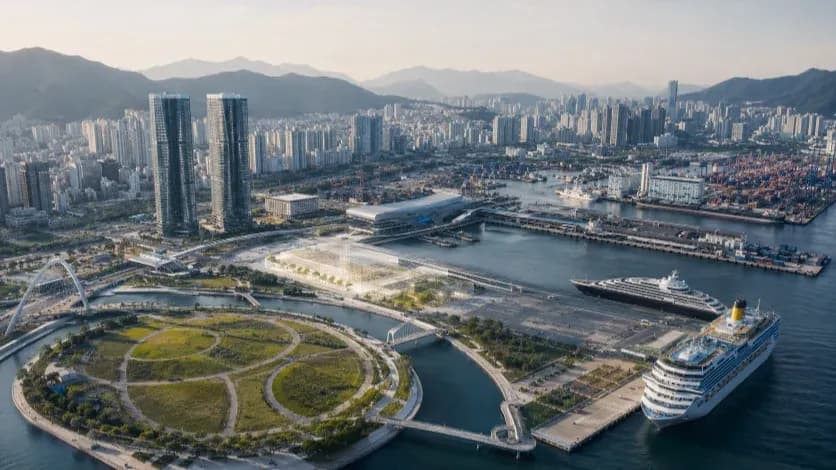
The permanent headquarters of the Ministry of Oceans and Fisheries gives central Busan an institution of national consequence, although its wider urban significance will depend on whether administrative authority, public expenditure, housing investment, and everyday mobility extend from the reclaimed waterfront into the older city behind it.
From the North Port parcel selected for the permanent headquarters of the Ministry of Oceans and Fisheries, the urban division that will shape the project’s legacy is visible across a remarkably short distance. Reclaimed land stretches beside the harbor in broad, level parcels prepared for public institutions, commercial development, and open space, while the ground beyond Busan Station rises abruptly into Choryang’s older neighborhoods, where steep streets, fragmented housing, and demographic decline have persisted through successive programs of urban renewal. Although the waterfront and the hillside occupy the same field of view, the investment, employment, and public services concentrated on the lower ground have rarely moved into the established city with comparable ease.
On August 6, 2026, the ministry confirmed that its permanent headquarters would be built on a 72,456.7-square-meter site in the first phase of the North Port redevelopment, near Busan Station and the international passenger terminal. The ministry plans to determine the facility’s scale within 2026 and complete construction by 2030, replacing the leased buildings in Dong-gu from which it has operated since completing its relocation from Sejong at the end of 2025. The decision establishes a permanent center of national maritime administration beside the port and gives North Port a degree of institutional certainty that privately financed waterfront projects seldom obtain from market demand alone.
That certainty carries substantial economic and political value because a central ministry generates recurring activity that does not depend on the success of a hotel, retail complex, or speculative office project. Officials, shipping companies, port operators, researchers, lawyers, foreign delegations, and other public agencies will return to the district because national policy is formulated and administered there, creating a durable source of demand around which complementary services and institutions may organize. Busan has therefore secured something more consequential than another public building: it has acquired a permanent location for decisions that have long been exercised at a distance from the industries and communities most affected by them.
The same achievement raises the standard by which North Port should be evaluated, since the ministry is entering a part of Busan where public land, national infrastructure, and decades of planning have already created favorable conditions for investment. Immediately beyond the redevelopment boundary lie neighborhoods that continue to lose population, contain a large share of the city’s vacant and deteriorating housing, and remain difficult to reach despite their physical proximity to the waterfront. Their recovery has repeatedly appeared among the public justifications for North Port, which means that the relevant urban question is no longer whether a major institution will arrive, but how far the authority, contracts, households, and daily movement generated by that institution will travel beyond the site.
An Institutional Gain With an Existing Public Record
North Port has long been presented through images of future completion, with successive plans projecting offices, cultural facilities, public spaces, and transport links across land whose development remained dependent on changing political deadlines, infrastructure agreements, and private investment. The ministry introduces a different form of permanence because its administrative functions will continue even when other parts of the district advance more slowly, generating weekday activity and recurring demand for accommodation, meetings, professional services, building operations, and transportation. That institutional presence can stabilize the redevelopment while giving maritime companies and public agencies a reason to organize longer-term activity around central Busan.
Busan also offers an economic setting unavailable to many of the purpose-built innovation cities that received public agencies during Korea’s earlier relocation program. The city already contains a major container and transshipment port, maritime universities, national research institutes, shipowners, logistics companies, financial institutions, and specialist legal and technical services, while Busan Station and the passenger terminal connect the site to national and international networks. Because the ministry will enter an existing metropolitan economy rather than a newly urbanized enclave, the possibility of combining administrative authority with established industrial and research capacity is considerably stronger.
Buildings and organizational addresses, however, provide an incomplete measure of institutional concentration because a functioning maritime center depends on the location of budgets, personnel, commercial mandates, and senior decisions. A ministry may operate in Busan while commissioning major research and advisory work elsewhere; a company may transfer its registered headquarters while retaining finance, strategy, or executive management in Seoul; and a university may appear in a partnership without controlling the questions, resources, or senior appointments that determine its intellectual value. A credible account of North Port’s progress would therefore identify the departments, budgets, senior positions, procurement authority, and research programs actually exercised in Busan, allowing institutional substance to replace promotional counts as the principal measure of relocation.
The physical design of the headquarters will influence that substance by directing how employees, visitors, and neighboring businesses encounter the institution during ordinary working days. Entrances, security boundaries, parking, service roads, internal dining, and conference facilities will determine whether daily demand reaches Choryang and the station district or remains absorbed within a self-contained administrative campus. Although the ministry requires secure working areas and controlled access, those operational requirements remain compatible with continuous pedestrian routes, publicly accessible meeting and exhibition spaces, and a waterfront edge that strengthens the relationship between the passenger terminal, Busan Station, and the established city.
North Port’s public responsibilities did not begin with the headquarters decision, since Busan had already defined the reconnection of the harbor and the old downtown as a central objective of redevelopment. In February 2021, the city completed the North Port Integrated Development-linked Downtown Reinvention Masterplan, which organized 53 projects across four strategic fields and linked the redevelopment with hillside housing, commercial renewal, railway land, and the city’s bid for the 2030 World Expo. The proposals included development axes through Choryang, Sujeong, and Yeongju, a pedestrian connection among an old-downtown business area, Busan Station, and North Port, and new housing and cultural projects along the hillsides.
Several assumptions supporting the 2021 program have since changed, most visibly through the failure of the Expo bid, the continued uncertainty surrounding major railway projects, and the ministry’s arrival as a permanent institution whose scale had not been fixed when the earlier plan was prepared. Those changes justify substantive revision, since projects designed around an international exposition or a particular infrastructure sequence cannot be preserved merely to maintain administrative continuity. Revision becomes problematic only when it erases the public history of what was announced, funded, redesigned, delayed, or abandoned.
Busan has not published a consolidated project-level account showing how the 53 initiatives progressed after the masterplan was completed, even though information may exist across departmental budgets, design contracts, and later plans. Without a stable register linking each project to its responsible institution, financing, current stage, and reason for alteration, residents and businesses cannot distinguish a proposal that remains active under another name from one that quietly lost its policy basis. The absence of that record matters because urban plans influence household decisions, land values, and business expectations long before construction begins, allowing the political value of an announcement to survive even when responsibility for implementation becomes difficult to locate.
The city has meanwhile begun a new planning cycle for the same broad geography through a living-area plan covering Busanjin, Seo, Dong, Jung, Yeongdo, and Nam districts. Busan launched a citizen group of approximately 130 residents in July 2026 and scheduled district workshops to combine neighborhood experience with big data, identify deficits in cultural, childcare, sports, and other social infrastructure, and develop new spatial guidelines for an area confronting population decline and rapid aging. The process may improve the quality of current planning, although it will acquire greater administrative credibility if each new proposal can be traced against the commitments already made since 2021.
The ministry therefore strengthens the case for revising and completing Busan’s earlier commitments rather than providing an administrative blank page on which North Port can be planned again. A public register preserving the origin, budget, responsible agency, approval status, and current disposition of each undertaking would allow the city to acknowledge projects rendered obsolete by the Expo result while preventing later improvements from being credited selectively to the headquarters. Such a record would also establish the baseline needed to determine whether the ministry has expanded the old downtown’s economic and residential capacity or merely created a highly successful precinct within it.
How Administrative Demand Will Move Through Central Busan
Korea’s earlier public-institution relocation program provides a useful boundary around the claims Busan can reasonably make for the ministry. Research by the Korea Development Institute found that innovation cities receiving public agencies experienced increases in population and private employment, particularly in manufacturing and locally consumed services, while knowledge-intensive employment did not rise consistently enough to establish a self-sustaining regional growth model. The study also found that, after the initial relocation period, several innovation cities drew residents from surrounding municipalities more readily than from the Seoul metropolitan area, producing local redistribution alongside the intended national decentralization.
Those findings also identified conditions that place Busan in a more favorable position than isolated relocation sites, since family settlement and knowledge-sector employment were stronger where public institutions could use the infrastructure, labor market, and industrial base of an existing metropolitan center. Busan’s universities, hospitals, schools, professional services, and established maritime industries provide the human and institutional resources required to deepen the ministry’s regional effects, while the national rail network reduces the practical isolation that constrained some earlier innovation cities. The city’s advantage therefore lies in its capacity to connect the ministry with an economy already capable of supplying specialized labor and services, although the presence of that capacity does not determine how widely the benefits will be distributed.
A 2025 Industrial Research Institute report reinforces the importance of geography by finding that public-institution relocation produced its strongest early employment gains in non-tradable services located close to the receiving institution. Those effects declined rapidly with distance, whereas employment in industries serving wider markets developed more slowly and depended on the economic capabilities of the surrounding city. The study’s results suggest that Busan may outperform smaller relocation centers in building tradable maritime industries, while also indicating that the first and most visible gains will remain concentrated near the headquarters.
The immediate economy around North Port is therefore likely to emerge through hotels, restaurants, transportation, building management, security, event production, furnished accommodation, and professional offices whose business benefits from frequent contact with the ministry. These activities would provide genuine value to Dong-gu by strengthening regular weekday demand, reducing dependence on episodic tourism or major events, and supporting the reuse of underoccupied commercial buildings near Busan Station. Their growth would nevertheless describe an economy of administrative proximity rather than proof that Busan had developed a deeper maritime innovation system.
Higher-value effects will require the transfer or creation of functions that sell expertise beyond the immediate district, including marine insurance, shipping finance, international arbitration, maritime law, data services, vessel technology, and advanced research. Universities and institutes will need multi-year programs, common data, laboratories, and senior appointments capable of sustaining professional careers in Busan, while private companies will need commercial mandates and decision-making teams whose work extends beyond maintaining access to the ministry. The headquarters can reduce the cost of institutional coordination, but the quality and duration of the relationships formed around it will determine whether administrative proximity becomes productive specialization.
The geography of central Busan will shape those relationships through several distinct channels, beginning with the corridor linking North Port, the passenger terminal, Busan Station, and lower Choryang. This area contains the transport connections, hotels, restaurants, and relatively adaptable buildings needed to absorb administrative demand immediately, while flatter terrain and larger parcels make redevelopment easier than in the hillside neighborhoods behind it. The volume of activity reaching existing streets will depend heavily on the headquarters design, since internal dining, parking, and meeting facilities could retain expenditure that nearby businesses otherwise expect to receive.
Jungang-dong occupies a more conditional position because its older office stock and long history of maritime administration support ship agencies, law firms, brokers, and related services that could gain from closer access to the ministry. New demand may encourage renovation and business formation, although modern offices within North Port could also attract companies already operating in Jungang-dong, creating the appearance of growth through a short-distance transfer of activity. Employment, office occupancy, company origins, and the location of senior functions will therefore need to be examined across both districts if Busan is to distinguish expansion of its maritime economy from internal redistribution.
Jwacheon and Beomil depend more heavily on the second phase of North Port, which includes port, railway, and urban land extending beyond the first-phase waterfront. The ministry strengthens the institutional rationale for developing this corridor, but expectations surrounding future offices, housing, and transportation can affect land values and ownership decisions well before infrastructure becomes available. Residents and businesses may consequently encounter deferred maintenance, acquisition pressure, and construction disruption during a period in which the employment and public-space benefits used to justify redevelopment remain prospective.
The Choryang and Sujeong hillsides face a more fundamental limitation because their geographic closeness to the headquarters conceals the practical difficulty of moving between steep residential streets and the waterfront. Stairs, gradients, narrow roads, and incomplete barrier-free connections turn short distances into demanding daily journeys, especially for older residents whose neighborhoods already contain a high concentration of aging housing. Administrative demand will not ascend those slopes through proximity alone, which places local buses, vertical mobility, accessible pedestrian routes, and the distribution of neighborhood services at the center of any credible claim that North Port is supporting hillside regeneration.
Yeongdo possesses a different form of proximity through maritime universities and national research institutes whose work aligns directly with the ministry’s policy responsibilities. Bridges, congestion, and uneven internal transportation complicate frequent movement, but the larger issue concerns the organization of research and professional work across the water. Joint budgets, shared data, research appointments, demonstration projects, and career pathways for graduates would provide stronger evidence of integration than broad declarations that the relevant institutions belong to the same maritime cluster.
Seo-gu’s fisheries, seafood processing, port labor, and maritime medical functions require another policy channel because the district is unlikely to absorb much of the headquarters economy through offices and hospitality. Its potential gains lie in fisheries regulation, export policy, seafood safety, market modernization, seafarer health, and contracts tied to industries already embedded in the district. The ministry can strengthen those sectors when programs and procurement recognize their specific productive base, whereas generalized claims about old-downtown revitalization offer little guidance about how such benefits would reach them.
Central Busan therefore cannot be analyzed as a single receiving economy because the waterfront, station district, hillside neighborhoods, Yeongdo, and Seo-gu differ materially in accessibility, housing conditions, and industrial capacity. Locations able to absorb administrative demand immediately will coexist with areas whose participation depends on targeted transportation, housing, research, or industrial policy, creating an investment frontier that advances through selected streets and parcels rather than a uniform wave of regeneration. Recognizing that unevenness before construction begins would allow Busan to design interventions around the mechanisms available in each area instead of discovering later that aggregate district statistics had concealed widening differences.
The Housing Market Will Move First
Property markets are likely to respond to the headquarters before the wider economy can establish whether administrative relocation has produced durable industrial growth, since expectations surrounding permanent public investment enter land prices, renovation decisions, and ownership strategies more quickly than new employment, household settlement, or neighborhood services. Central Busan will therefore experience the early effects of the ministry against a demographic background that remains unfavorable to residential recovery. The city’s July 2026 population briefing recorded 3,232,370 residents, of whom 843,879 were aged 65 or older, placing the elderly share at 25.5 percent while the most recent monthly migration figure included in the report showed a net loss of 1,149 people.
Vacant housing provides the clearest physical expression of that contraction, although the statistical record has changed materially since the earlier version of this article was prepared. Busan’s second comprehensive vacant-home survey counted 7,803 properties, an increase of approximately 54 percent from the 5,060 recorded in the first survey, with a large share concentrated in older districts including Dong, Yeongdo, Seo, and Busanjin. The figure is more current and methodologically relevant than broader vacancy estimates drawn from statistical systems using different definitions, although it remains a survey of conditions identified through the city’s formal process rather than a real-time inventory of every unused dwelling.
The increase is significant because Busan’s annual pace of demolition, rehabilitation, and reuse remains small relative to the surveyed stock, while the category itself includes properties with very different conditions and prospects. A structurally dangerous house on an inaccessible hillside, an inherited property with fragmented ownership, a dwelling held vacant for redevelopment, and a building awaiting renovation for tourism all enter the policy debate under the same general label even though they require different interventions. Effective housing policy must therefore begin with the physical condition, ownership, access, and realistic reuse potential of individual properties rather than assuming that every vacant home constitutes an inexpensive asset available for new residents.
The Busan Development Institute’s vacant-home SOS index provides additional evidence about the geography of future risk by analyzing 205 administrative neighborhoods through eight variables, including slope, building age, land value, parcel and building size, population aging, natural population change, and the prevalence of detached housing. The index found the highest risks concentrated in the old downtown and identified signs that vacancy pressure was spreading into adjacent areas, while recommending that the formal survey cycle be shortened from five years to two. The research does not replace field inspection, but it confirms that the districts surrounding North Port face structural conditions likely to generate additional vacancy even if selected parcels begin attracting investment.
Many homes in those neighborhoods cannot be converted readily into housing for ministry employees or younger households because steep streets, narrow access, divided ownership, unauthorized alterations, and advanced structural deterioration make renovation more expensive than nominal property values imply. Some buildings no longer possess a viable residential future and will require demolition, whereas others could remain useful if title problems, professional renovation, and long-term management were addressed through public or nonprofit intervention. Treating the stock as a homogeneous reserve would underestimate both the cost of recovery and the degree to which public coordination is needed.
The headquarters may nevertheless create valuable residential demand around North Port and Busan Station by attracting civil servants, researchers, maritime professionals, consultants, and employees of related firms who prefer to live near work and national transportation. Permanent households would support grocery stores, clinics, childcare, schools, and evening commerce more reliably than visitor activity, while central Busan’s rail access may appeal to professionals whose work requires frequent travel elsewhere in Korea. Rising demand could also make energy upgrades, structural repairs, and accessibility improvements financially possible in buildings that prolonged population loss had rendered marginal.
Higher land and housing values would not, by themselves, demonstrate failure, since neighborhoods weakened by decades of disinvestment need transactions, renovation, and renewed confidence in the usefulness of property. The policy issue concerns the relationship between market recovery and residential recovery, which may reinforce one another when investment produces safe long-term housing but can diverge when owners hold buildings vacant for site assembly, convert viable homes into short-term accommodation, or allow asking prices to rise while physical conditions continue deteriorating. A neighborhood can therefore become more valuable to investors without becoming more habitable for permanent residents.
Development is likely to favor the properties easiest to assemble and finance, particularly near Busan Station, lower Choryang, and major access routes where the terrain is flatter and parcels are better suited to offices, hotels, serviced residences, and compact apartments. Housing farther uphill may receive little direct investment even as owners adjust their expectations in response to projects occurring below, creating incentives to defer maintenance while awaiting acquisition or a future change in land use. The result could be simultaneous appreciation and decline, with selected lowland properties advancing rapidly while difficult residential streets remain trapped between higher speculative expectations and weak demand for actual occupation.
Short-term accommodation deserves particular scrutiny because the ministry will bring visiting officials, consultants, conference participants, and industry representatives who create a market for furnished units near the headquarters. That demand can finance the restoration of buildings unlikely to return to conventional housing, although it can also remove viable dwellings from long-term tenancy when visitor-oriented use produces higher returns. Distinguishing the rehabilitation of genuinely unusable property from the conversion of scarce residential stock will become increasingly important as public investment improves the commercial prospects of central Busan.
Busan has already expanded its approach beyond demolition by purchasing selected vacant properties for social infrastructure and supporting several forms of reuse, including foreign-student housing and small public facilities. The second survey and the continuing concentration of risk indicate that isolated demonstration projects will not be sufficient, particularly where annual intervention remains far below the number of properties requiring attention. A larger acquisition and rehabilitation program could concentrate on sites capable of supporting long-term residence, while resale restrictions, minimum tenancy periods, and controls on subsidized conversions would be needed to ensure that public investment creates durable housing rather than a short route to private capital gains.
Housing composition requires the same attention as unit count because studios and serviced residences may raise occupancy without rebuilding a stable neighborhood population. Families need larger homes, childcare, schools, and safe daily routes, while older residents need accessible entrances, nearby healthcare, and opportunities to move within their community when steep or deteriorating houses become unsuitable. A district that accommodates a growing weekday workforce while continuing to lose families and older long-term residents would record economic activity without achieving residential recovery.
Commercial tenure belongs within the housing analysis because permanent households depend on the stores and services surrounding them, while small businesses often experience redevelopment pressure before additional customers arrive. Rent expectations can rise when major public projects are announced, and construction can disrupt access for several years, leaving established shops to absorb the transition while larger businesses enter after the district becomes easier to use. Baseline information on commercial rents, vacancy, lease turnover, and business closures along the routes most exposed to North Port would allow later increases in aggregate sales to be assessed against changes in the everyday services required by residents.
The ministry’s proximity to vacant and deteriorating housing will have no automatic economic force unless Busan creates a practical connection through acquisition, renovation finance, tenure protection, transportation, and current field data. A preconstruction survey focused on North Port’s surrounding neighborhoods would allow later changes to be separated into long-term occupation, demolition, continued vacancy, short-stay conversion, and commercial reuse, preventing a decline in the headline vacancy count from being presented as residential success without regard to what replaced it. The housing market will move first, which is precisely why public policy must establish its baseline and protections before the headquarters and surrounding development fully reprice the area.
Public Support Requires a Local Settlement
The legal framework created to support Busan’s maritime-capital strategy makes the need for a clearer relationship between relocation assistance and neighborhood benefit more pressing. The Special Act on Support for Institutions Relocating to Busan as a Maritime Capital took effect in June 2026 and authorizes assistance for public institutions, maritime companies, and employees moving to the city, while the implementing decree permits national-property rent reductions of up to 100 percent and provides for separate housing-supply standards for relocating workers. These provisions acknowledge that transferring substantial organizational functions involves costs extending beyond office space to housing, education, childcare, and family employment.
Such assistance is justified when the national government seeks a genuine transfer of authority and economic activity rather than a formal change of address, since institutions must reproduce secure systems and companies may disrupt established labor markets and commercial relationships. Employees asked to move across the country also face decisions affecting spouses, children, housing, healthcare, and long-term family stability, which cannot be resolved by an administrative order alone. A relocation policy that ignored those costs would encourage partial moves, long-distance commuting, and the retention of important functions in the capital region.
The law gives considerable specificity to the resources available for enabling relocation, while the benefits expected by the receiving neighborhoods remain dependent on later decisions about procurement, housing, land, public space, and transportation. Other national statutes and individual project agreements may impose employment, competition, or disclosure requirements, so the special act should not be described as eliminating local obligations altogether. The relevant policy gap lies in the absence of an equally detailed agreement connecting public assistance with the contracts, skills, housing, and access that would allow surrounding districts to participate in the value created by the ministry.
Construction will produce the largest early contracts, although the longer institutional economy will arise from security, cleaning, maintenance, catering, information systems, translation, conferences, research, legal services, and transportation after the building opens. When public agencies combine those services into large packages for administrative convenience, capable smaller suppliers may be excluded even though they could perform particular components competitively. Publishing a procurement pipeline before tenders are issued would give Busan firms, vocational institutions, universities, and social-economy organizations time to acquire qualifications, develop partnerships, or form consortia around opportunities that are otherwise visible mainly to established national contractors.
The value of such participation cannot be captured through a single local-procurement percentage because formal registration in Busan does not reveal where work is performed, how many people are employed, how long positions last, or whether the contractor has an established operating base in the city. Public reporting would be more informative if it distinguished prime contracts from substantive subcontracting, temporary construction employment from continuing operations, and nominal local addresses from actual labor, management, and production located in Busan. Where specialized national contractors are necessary, transparent reporting on subcontracted value, occupational training, and work location can widen the regional effect without compromising technical standards or open competition.
Research and professional services require a different procurement structure because their regional value depends on intellectual leadership and the continuity of specialist teams. Busan’s universities, national institutes, and maritime firms need early knowledge of the ministry’s research agenda, access to relevant public data, and opportunities to lead multi-year programs whose budgets and senior appointments remain in the city. A local institution listed as a junior partner on a short study designed and directed elsewhere contributes far less to regional capacity than a Busan-based team controlling the research question, personnel, infrastructure, and subsequent work.
Publicly supported institutions and companies should also be assessed through the functions they actually operate in Busan, since aggregate headcounts cannot distinguish senior decision-making from administrative presence. Disclosure can remain aggregated where personal or commercial confidentiality is required, but the public record should identify the departments, occupational composition, executive roles, procurement authority, and research management located in the city. Strategy, finance, legal affairs, and technical leadership generate supporting industries and career pathways that a liaison office or statutory address cannot reproduce.
Employee housing assistance creates an opportunity to connect relocation with the wider residential recovery of central Busan rather than treating the two objectives as competing claims on public resources. New construction may be necessary for households whose needs cannot be met by the existing stock, while public acquisition and rehabilitation can restore selected vacant properties to long-term use for younger workers, researchers, families, and existing residents who need accessible housing within their community. Childcare, healthcare, schools, and transportation provided for relocated households will contribute more to the city when they are planned as shared urban infrastructure instead of an enclosed employee settlement.
The headquarters site carries a parallel responsibility because public land and national expenditure are creating a permanent institution on a waterfront whose redevelopment has consistently been justified through public access and integration with the old downtown. Secure administrative areas can coexist with continuous pedestrian routes, publicly accessible rooms, exhibition space, and a harbor edge that remains usable beyond official appointments. Those conditions must be specified while the project brief, circulation plan, and land agreements remain open, since later attempts to recover access around completed security and vehicle systems will be more expensive and less effective.
No single organization controls all of these decisions: the Ministry of Oceans and Fisheries directs the headquarters and much of its institutional demand; Busan Metropolitan Government controls planning, transportation, housing, and many business programs; Busan Port Authority manages critical land; and district governments possess the most detailed knowledge of local buildings and commerce. A common agreement assigning responsibility for procurement disclosure, organizational functions, housing measures, public access, and construction mitigation would prevent fragmented authority from becoming fragmented accountability. Public assistance will retain stronger legitimacy when residents can identify the institutional authority, durable work, habitable housing, and accessible public space produced alongside the relocation itself.
The Years Between Commitment and Completion
The 2030 target for the ministry’s permanent headquarters provides a clear date for one building within a wider urban program whose components are advancing through separate legal, financial, and construction schedules. North Port’s second phase covers approximately 2.28 million square meters across port, railway, and surrounding urban land, involves a consortium including Busan, Busan Port Authority, Korea Land and Housing Corporation, Busan Urban Corporation, and Korea Railroad Corporation, and carries an official project period extending from 2020 to 2030. Busan’s current schedule anticipates an implementation agreement in 2026, project and implementation approvals in 2027, construction commencement in 2028, and infrastructure development continuing after 2030, which means that the headquarters may open while significant surrounding areas remain under preparation or construction.
Transportation follows another chronology through the second Busan Urban Rail Network Plan, which received national approval in June 2026 and includes the Busan Port Line among ten routes covering the city’s next decade of rail development. The proposed 24.21-kilometer hydrogen-tram route would connect Taejongdae, Jungang-dong, North Port, the southern port districts, and the university area, potentially widening the geography capable of participating in the ministry’s activity. Statutory inclusion gives the route policy standing, although feasibility review, financing, design, and construction must occur before the line provides any practical improvement in accessibility.
The Busan Maritime and International Commercial Court adds a third timetable, with operations scheduled to begin on March 1, 2028, in temporary premises at the Dong-gu Culture Platform in Jwacheon while a separate permanent courthouse is targeted for completion in 2032. A ministry at North Port, a court in Jwacheon, professional services in Jungang-dong, and research institutions in Yeongdo could eventually form a broader urban network more closely integrated with the established city than a single administrative campus. That network will depend on shared cases, contracts, research, transportation, and repeated professional contact, since a collection of buildings described as a cluster does not ensure that organizations work together in practice.
The divergence among these schedules creates a temporal imbalance because property expectations, construction disruption, and acquisition pressure can arise years before improved transportation, permanent professional employment, and residential services become available. Landowners may incorporate planned infrastructure into current prices, tenants may face uncertainty or rising rents, and small businesses may lose access during construction while the customers expected from the completed district remain prospective. Public communication that groups all announced institutions and transportation projects into one coherent future image can obscure the fact that each possesses a different level of approval, financing, and delivery risk.
An integrated public schedule would therefore need to separate institutional progress, construction progress, network delivery, and neighborhood outcomes, since each category answers a different question and operates on a different timeline. The transfer of departments and decision-making can occur before permanent buildings; construction milestones reveal little about whether related industries have formed; and a rail line included in a statutory plan provides no current mobility benefit until service begins. Presenting these stages distinctly would allow residents and businesses to judge which future conditions are reasonably secure and which remain contingent.
The international cases most relevant to Busan are useful precisely because they demonstrate how cities can act before the full benefits of redevelopment mature. Rotterdam incorporates social-return requirements into public procurement, using contract conditions to connect municipal expenditure with employment and training for people facing barriers in the labor market, while adjusting the obligation to the character of the work and supporting employers through coaching and training programs. The transferable lesson lies in the timing of intervention, since social objectives enter the tender while public authorities retain bargaining power rather than being requested as voluntary contributions after the contract has been awarded.
North Port could adapt that principle within Korean procurement law by examining construction, building operations, research, and digital services separately, identifying where apprenticeships, certified training, supplier partnerships, or durable employment are realistic. An inflexible percentage applied across every contract would encourage superficial compliance, whereas contract-specific analysis could connect training to actual occupational demand and distinguish several weeks of temporary work from a qualification or continuing position. Administrative support would also be necessary to match contractors with vocational schools, universities, district employment services, and eligible workers.
Hamburg’s HafenCity demonstrates a complementary form of leverage through public control over land, using concept-based site tenders that assign 70 percent of the evaluation to the development proposal and 30 percent to price, while supporting a socially mixed housing stock that includes publicly subsidized units, cooperatives, joint building ventures, and housing for families, students, older people, and residents with disabilities. The project’s institutional relevance lies in the ability to evaluate housing tenure, community facilities, ground-floor uses, and public-space quality before development rights are transferred and rising land values narrow the available choices.
North Port differs from HafenCity because the ministry site must serve national administrative and security functions, while the surrounding old downtown already contains established communities and difficult housing rather than a largely new residential district. Hamburg’s housing ratios and tender practices cannot be imported mechanically, but the underlying use of public land remains pertinent wherever Busan, the port authority, or national agencies control parcels whose value has increased because the ministry and public infrastructure are coming to the district. Long leases, concept-based evaluation, enforceable development agreements, or dedicated revenues could secure long-term housing, affordable commercial space, public facilities, and pedestrian access before those outcomes must be purchased later at post-development prices.
The combined lesson from Rotterdam and Hamburg concerns neither city’s waterfront image, since Busan already possesses the technical capacity to build prominent offices and promenades. Public purchasing power is most effective before contracts are awarded, while public control over land is most valuable before development rights and future appreciation have been privately absorbed. North Port remains within that period of leverage because the headquarters site is selected but its design, procurement packages, surrounding land uses, and operational economy have not yet been fixed.
The Record by Which North Port Should Be Judged
Busan will be unable to determine whether the ministry strengthened the old downtown unless it records the area’s condition before major construction, procurement, and property transactions alter it. Later administrations may be able to describe change, but without a common preconstruction baseline they will struggle to establish whether activity was newly created or shifted from elsewhere in the city, how far the effects traveled, and which households or businesses absorbed the costs. The evaluation period should therefore begin while the principal decisions remain open and continue for at least five years after the headquarters opens, allowing slower changes in professional employment, research capacity, and household settlement to emerge.
The purpose of such an evaluation would not be to attribute every change in central Busan to the ministry, since interest rates, tourism, demographic decline, port activity, national housing conditions, and unrelated projects will continue to influence the same neighborhoods. A credible public record would instead test whether the mechanisms invoked to justify the headquarters are producing the expected results, including completion of earlier commitments, retention of institutional spending and authority in Busan, recovery of housing as a place of permanent residence, and improvement in the routes through which residents reach the waterfront.
The delivery record should begin with a unified register covering the 2021 masterplan, the current living-area plan, both phases of North Port, related transportation projects, and the maritime institutions being assembled around them. Each undertaking would retain its originating plan, responsible agency, budget, statutory stage, current schedule, and explanation for major revision or cancellation, preventing a concept, a feasibility study, and a financed construction contract from appearing with the same degree of certainty. Preserving the administrative history of projects across changes in title or political leadership would allow revision without allowing responsibility to disappear.
Economic absorption requires a record extending beyond total investment and company registrations, which reveal the scale of activity without showing where substantive work occurs. Procurement reports should identify prime contractors, meaningful subcontractors, actual work location, employment duration, and training, while research reporting should identify the lead institution, principal staff, program period, budget controlled in Busan, and subsequent work. Institutions and companies receiving public assistance should disclose the departments and occupational functions operating in the city, providing evidence of whether strategy, finance, legal affairs, research management, and procurement authority moved alongside administrative headcount.
Housing monitoring should distinguish properties returned to long-term occupation from those demolished, converted to short stays, transferred to commercial use, or held vacant while awaiting redevelopment. Sale prices and rents need to be read alongside household numbers, length of residence, building condition, and age composition, since rising values accompanied by greater permanent occupation describe a different process from appreciation occurring alongside continued population loss. Employee residence and commuting patterns could be published in broad anonymized zones, allowing the city to determine whether the ministry is supporting household settlement, weekday commuting from other districts, or continued ties to the capital region without compromising individual privacy.
Commercial records should follow rents, vacancy, lease turnover, and business openings and closures along the streets most likely to receive additional movement or construction pressure. Businesses serving permanent residents need to be distinguished from those oriented primarily toward visitors or office workers, because aggregate sales may increase while pharmacies, grocery stores, repair services, and inexpensive restaurants disappear. Such changes would not necessarily invalidate the redevelopment, but they would reveal whether the neighborhood economy was becoming more supportive of residential life or more specialized around institutional and visitor demand.
Access must be evaluated through actual journeys rather than administrative boundaries or simple distance bands, since railways, bridges, gradients, and incomplete crossings shape central Busan more powerfully than straight-line proximity. Route audits from Busan Station, Jungang-dong, Jwacheon, Yeongdo, and selected hillside neighborhoods should record travel time, gradients, footway continuity, crossings, elevators, public-transport frequency, seating, shade, security detours, and operating hours. Older residents, wheelchair users, and adults traveling with children should participate, ensuring that a connection designed around a healthy commuter is not reported as universally accessible.
The boundary of the headquarters deserves separate attention because the number and location of entrances, publicly accessible rooms, exhibitions, waterfront paths, and opening hours will determine whether residents experience the ministry as part of the city or as a secured compound beside it. A path shown as public on a site plan does not provide ordinary urban access when it closes outside institutional hours or requires a substantial detour around parking and official vehicles. These conditions can be measured from the beginning and revisited after opening, giving the design brief a continuing public meaning.
Governance will present a greater challenge than data collection because the relevant information is divided among the ministry, Busan Metropolitan Government, Busan Port Authority, national housing and railway bodies, and district governments. A permanent evaluation unit supported by a published data-sharing agreement, independent researchers, and representatives of affected districts would be needed to prevent each organization from reporting success within its own administrative boundary while the combined urban outcome remains unassigned. The civic participation group created for the living-area plan could contribute local knowledge, although resident testimony and quantitative evidence should inform one another without being treated as substitutes.
Reporting also requires consequences, since measurement that produces no institutional response becomes an archive rather than a tool of urban management. A rapid loss of long-term rentals, unusual commercial vacancy, repeated failure to deliver contract-related training, or substantial delay in a connecting project should trigger investigation, publication of the cause, and a corrective plan where intervention remains feasible. External economic conditions may explain some movement, but government should establish that explanation through evidence instead of allowing unfavorable trends to disappear within a broad narrative of progress.
The principal records should remain separately visible because a composite score would allow timely construction to compensate numerically for inaccessible streets, housing loss, or weak transfer of decision-making. A completed headquarters cannot offset failure to connect it to the city, just as rising land values cannot substitute for permanent households and a large procurement total cannot prove that regional capability has deepened. A credible result would require several developments to appear together: earlier commitments advancing through a traceable process, institutional expenditure supporting firms and professionals operating in Busan, long-term housing and neighborhood services improving, and residents gaining practical access to the waterfront.
Without such a record, North Port will be vulnerable to retrospective evaluation in which every favorable event enters the account of success while delayed connections, transferred businesses, and continuing housing decline remain outside the frame. New buildings, visitor numbers, and corporate announcements will be easy to count, whereas the loss of a household, the relocation of a Jungang-dong firm, or the persistence of an inaccessible hillside route will be easier to classify as unrelated. Establishing the baseline before construction begins would prevent the project’s boundaries from expanding to absorb benefits and contracting to exclude costs.
Evidence Beyond the Waterfront
When the permanent headquarters opens, its architecture will give Busan a compelling image of institutional arrival, placing a national ministry beside the port whose industries it regulates and within reach of the railway station, passenger terminal, and maritime organizations distributed across the metropolitan area. The achievement will be substantial because Busan will have secured a durable center of national authority in a field where administrative and corporate decision-making have remained disproportionately concentrated around Seoul. The building will also demonstrate that the city can convert a long political campaign for decentralization into a permanent institutional presence.
Architecture will reveal only the most visible part of the result, while the deeper evidence will emerge through the departments exercising authority in Busan, the suppliers receiving continuing work, the research programs led locally, the homes occupied over the long term, the businesses surviving the transition, and the routes residents use between the old downtown and the harbor. Government can relocate offices through legislation, budgets, and administrative orders, whereas neighborhood recovery proceeds through a slower accumulation of housing quality, secure tenure, professional careers, transportation, and ordinary services. The ministry gives Busan an unusually strong institution around which to organize those systems, but it cannot replace the policies and agreements required to connect them.
North Port possesses advantages that many earlier relocation sites lacked because Busan already has the industries, research institutes, professional expertise, and metropolitan infrastructure capable of using a national ministry. Those advantages provide a credible opportunity to acquire decision-making functions and specialized employment rather than public-sector headcount alone, although they also make a weak urban outcome more difficult to explain. Public land has been committed, special legislation supports institutions and employees, and successive plans have promised that the waterfront will reconnect with the older city, leaving execution rather than a lack of institutional resources as the central test.
Several years after 2030, procurement records will show whether firms operating in Busan entered durable supply chains, organizational disclosures will reveal whether authority moved with the offices, and housing surveys will establish whether vacant buildings returned to residence or merely acquired a different speculative use. Commercial records will show whether established districts expanded, adapted, or lost activity to the new precinct, while route audits will reveal whether the waterfront became easier to reach for residents who had always lived within sight of it. Those ordinary records will provide a more demanding account of the ministry’s urban legacy than the number of buildings completed around the harbor.
The physical relationship visible from North Port will remain familiar, with level reclaimed land extending beside the water while Choryang’s older streets rise behind Busan Station, although the administrative and economic relationship between those places need not remain fixed. Contracts can reach firms beyond the development boundary, housing investment can enter established neighborhoods, research can connect North Port with Yeongdo and Seo-gu, and transportation and public-space design can reduce barriers that short geographic distances have long concealed. Whether those connections emerge will depend on decisions made before the most important contracts, land agreements, and circulation patterns become irreversible.
North Port will eventually provide the skyline by which the project is remembered. The old downtown will provide the evidence by which it should be judged.
Continue this reporting
Reporting on the same issue
Related coverage selected from the article's desk, topics and newsroom relationships.
 NewsSep 18, 2026
The Other AI Race Is for the Freedom to Change Course
Korea’s HBM strength gives it unusual leverage inside the AI stack. The harde...
 NewsAug 27, 2026
South Korea Has Outgrown Washington’s Nuclear Rules
The U.S. once constrained South Korea’s nuclear fuel cycle over real prolifer...
 NewsJul 10, 2026
South Korea’s Smart Cities and the K-AI City Planning Challenge
South Korea has spent more than two decades building smart cities around digi...
More from the author
More from this byline
Stay with the same line of reporting through more work from this byline.
- NewsSep 18, 2026
The Other AI Race Is for the Freedom to Change Course
 NewsSep 5, 2026
How a Political Appointment Becomes a Judgment of Character
Editorial Record
Corrections, sourcing notes and newsroom disclosures remain part of the published record. View Newsroom Notes →
Reader Signal
Community readWhat did this report leave you with?
Choose the signal that best reflects your reading. Select it again to remove it.
One response per article
No response selected
A moderated conversation about the reporting.
One-level replies and newsroom moderation keep the conversation anchored to this article.
Discussion Status
Open
Please sign in to join the discussion.
Newsletter
Weekly reporting and context from Busan and Korea.