What Is Still Worth Going to See?
Busan’s biennale faces questions of artistic judgment and institutional care. A BIFF project-market selection returns as a finished film, while the city’s new concert hall draws crowds. What endures beyond the event itself?


Busan's biennale, film festival and concert hall are offering more ways to encounter art. Their most consequential choices concern what the works can deliver, what the encounter adds, and what survives when the event ends.
The voices reached the outside of a warehouse on Busan's Yeongdo Island. Reviewing the 2026 Busan Biennale for e-flux, Adeline Chia described hearing them mix with port traffic and the thuds of harbor machinery before following their source into Space OneZ. Inside, nineteen voices recorded separately for Brahim Tall's The Choir of Dissonance: The Creation of the Sea moved through an arrangement of speakers, from uneasy, fractured sounds toward sustained harmonies. The harbor did not fall silent to accommodate the installation. Its continuing activity entered what a visitor could hear, introducing a second sound world alongside the one the artist had composed.
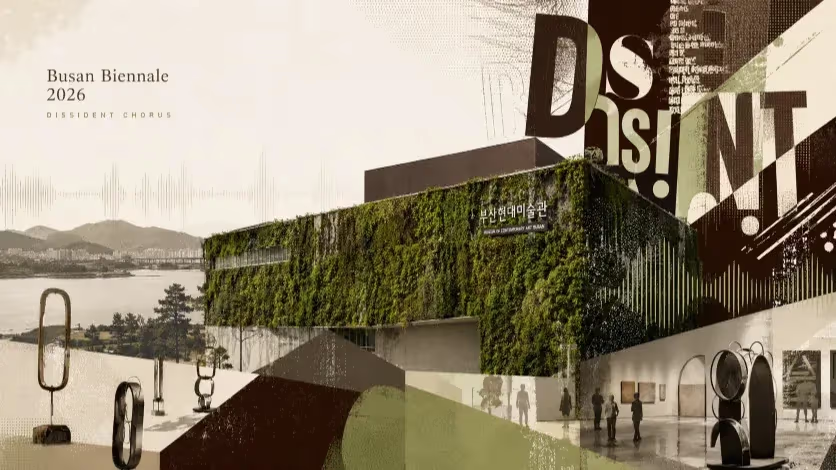
Such a conjunction helps explain why people might cross a city to experience a work rather than settle for its description or a photograph. It also sets a demanding standard for a biennale organized under the title Dissident Chorus. Artistic directors Amal Khalaf and Evelyn Simons describe three venues as movements in a larger score: the Museum of Contemporary Art on Eulsukdo, a former marine-equipment warehouse and an emptied school on Yeongdo. The curatorial proposition is expansive, joining maritime history, ecological relations, political resistance and collective memory. Yet the achievement of that proposition depends on what happens in and between actual works. A persuasive account of why resistance and water belong together cannot manufacture the sounds a visitor hears, the images that hold attention or the relationships that an exhibition creates.
The same problem appears in another form across Busan's cultural calendar. The city's international film festival closed on October 15 reporting more than 200,000 film admissions, and its new concert hall had announced an average seat occupancy of 84.4 percent for its first hundred days. Those are substantial measures of attendance, particularly in a country where audiences can choose among increasingly convenient ways to watch and hear culture. But entry into a venue is only a record of a decision made. It says little about whether a film was discovered, a difficult work justified the effort of understanding it, or a performance created a relationship with music that might last. To judge the institutions now shaping Busan's cultural life, their announced programs and successful turnouts have to be brought back to the particular art presented.
What the Work Can Carry
At Space OneZ, Tall's installation does more than attach an ethical aspiration to a chorus. The work distributes recorded voices among nineteen physical sources, placing them at heights related to the singers and allowing the visitors' presence to affect the sound's intensity. The distinction between separate voices and an emerging ensemble is therefore produced acoustically, rather than supplied only in an accompanying explanation. Chia's description is especially valuable because it follows what she heard: an agitated passage, increasingly dense voices and a release into harmony, all within earshot of a working harbor. That report supplies evidence of an artistic structure and a situated listening experience. It cannot tell us how every visitor responded, but it lets the claim about collectivity be tested against something more substantial than the artist's intention.
Joar Songcuya approaches maritime life without the same apparatus. A Filipino former seafarer and marine engineer, he developed a painting practice while still working aboard ships, at times returning to his cabin to draw after shifts in the engine room. The Seamanship Project, represented in Busan by 105 small paintings, assembles faces, tasks and incidents into an extended record of working life. They were shown on metal mesh inside the former equipment warehouse. Chia noted the works' bright colors and their evocation of nautical and emotional weather; a separate on-site account by Shunta Ishigami described the series' attention to ordinary shipboard labor. Scale and accumulation are crucial here. A hundred small images refuse the single panoramic view through which maritime labor can become an anonymous emblem, allowing the work to move between individual observation and the collective conditions of a voyage.
The comparison with Songcuya's six long scrolls, Around the World in Ten Years, helps reveal what is at stake in that choice. The scrolls bring ports, machinery, people and natural phenomena together outside the chronology of any one journey. Their extended surfaces arrange memory as a constructed geography; the small paintings give recollection the form of separate, recurring encounters. Both depend on a history the artist actually lived, but autobiography does not do the artistic work for him. The images' handling of color, mark, sequence and spatial relation must carry it. Published descriptions and photographs support a comparison of the two formats, though an independent judgment on the paintings' full visual force still requires looking at them directly. Their presence in the maritime warehouse cannot serve as a substitute for that examination.
Two formats, two ways of carrying maritime memory
Songcuya’s Busan presentation placed two different bodies of work in conversation: many small paintings in The Seamanship Project and six much longer scrolls in Around the World in Ten Years. The difference is not only size. It changes how memory is organized for the viewer.
The Seamanship Project
105 small paintings shown as an accumulated record of faces, tasks, incidents and shipboard life.
The many separate images resist a single panoramic reading. The viewer moves from one observed encounter to another, building a collective record out of repeated fragments.
Format BAround the World in Ten Years
Six long scroll paintings bringing ports, machinery, people and natural phenomena into an extended remembered geography.
The elongated format reorganizes remembered life into a constructed visual terrain. Instead of many separate moments, the work encourages the eye to travel across a larger field.
Another work at the former Busan Nam High School demonstrates how an explicitly political subject can take formal shape. Heaven Baek's eight-minute, forty-eight-second six-channel installation Grass-Grown Corpse Over the Sea and the Mountains draws on testimonies from women mobilized for forced labor under Japanese colonial rule and the imperial military song Umi Yukaba. The anthem's celebration of death for the state is set against recollections of girls and young women whose hopes preceded coercion and exploitation. According to Chia's on-site review, the installation combines excerpts of testimony with images including kelp and military structures, while its electronic-pop music turns the inherited martial language toward a vision of survival. The biennale's own account emphasizes the artist's use of green and blue fields and the material presence of seaweed. Whether that transformation is wholly persuasive cannot be determined from a written description, but its artistic problem is clear: how can a song that once normalized sacrifice be made to carry the lived experiences it helped suppress?
Lala Rukh's Rupak offers a contrasting demonstration of formal precision. The late Pakistani artist composed a tabla solo based on the seven-beat rupak taal, then spent two months marking its rhythm across eighty-eight drawings. Scanned and animated, the drawings show shifting white dots in time with the music. The work makes a decision about medium visible: a recurring musical pattern is transformed into changing relations of location and duration on a screen. It cannot be assessed merely by noting that it connects art and music. The stronger question is whether the visual sequence reveals temporal relationships that listening alone might leave unnoticed. But the specific correspondence between sound and image gives a viewer a basis for judgment that is not supplied by an abstract declaration of cultural solidarity.
The exhibition also contains an emphatically constructed work whose artistic ambition is inseparable from a question of institutional care. In TEN THOUSAND DREAMS, Korean artist Sungsil Ryu places twelve artificial figures on stacked industrial scissor lifts and sets them into a fifteen-minute sequence of songs composed with producer HWI. The figures include a child under pressure to become a global success, an elderly skeleton ordered to keep striving, and a girl burdened with an impossibly long assignment. The lifts make the injunction to rise literal; the dummies' regimented stillness and the brightness of apparently hopeful choral voices turn that national language of unlimited aspiration into a grotesque joke. Its social argument is enacted through height, repetition, manufactured bodies and sound. Whether those elements sustain their satirical force through the entire performance is a question for direct viewing, but they offer more to examine than an artist's explanation of social pressure.
On September 5, however, the biennale organizers acknowledged that the work had been damaged when additional supports were installed beneath its lift on September 1. They also apologized for failing to consult the artist adequately and for inadequately informing visitors why access had been restricted. The decision to reinforce a large industrial structure arose from a safety concern; that does not excuse damage during the operation or the deficiencies in communication the organizers themselves admitted. The work's physical requirements and its exhibition conditions are connected, although the accident tells us nothing about the merits of Ryu's satire. The committee said it was working to restore the piece; the date of full restoration and the total time visitors could not encounter the work have not been independently established. Those details matter to an exhibition that asks its audience to travel between three sites.
These works present real counterexamples to the idea that contemporary art built from individual memory or public causes must become an ornate personal diary. They also sharpen a criticism of the exhibition's weaker moments. Chia found the off-site venues more alive to their conditions than sections of the main museum, where familiar curatorial formulas and installations inflated for visual impact sometimes diminished the experience. That is her assessment, grounded in her visit, rather than an independent verdict on every work in the museum. It nonetheless identifies a serious curatorial risk. When labor, ancestry, care and resistance become a common vocabulary for very different artistic practices, the language can make the works seem equivalent before their materials and forms have been judged. A biennale has to create relationships among works without using the moral importance of their subjects to excuse differences in achievement.
The curators have offered a more substantial answer to the charge that the exhibition turns art into generalized moral language. In a September interview with e-flux, Khalaf and Simons argued that their chorus was never intended to produce unanimity. Simons compared its disruptive plurality to noise music, and Khalaf described why some communities need the right to leave parts of their work opaque to outsiders. Their account identifies a genuine artistic and ethical tension: a difficult work need not become transparent merely to satisfy the visitor, particularly when its materials come from vulnerable lives. But an institution can respect that opacity while being precise about its own claims. The relevant distinction is between a work that makes ambiguity productive through form, and a broad thematic statement asked to do the work of a composition. The curators' intention should inform that judgment without settling it.
The exhibition's public discussion program adds another test. An August 30 dialogue introduced the curators' intellectual framework, while an October 3 event advertised a discussion of coastal futures, resistance and artistic practice in Jeju, including the struggle around Gangjeong. The subjects merit historical and ecological rigor. Yet a program listing cannot demonstrate that its speakers engaged with contrary evidence, offered substantial research or answered difficult questions. The full presentations and exchanges have not been independently obtained for this article, and an impression formed at one event cannot be generalized into a judgment on the whole intellectual program. The question remains concrete: what knowledge could a visitor take away that was unavailable in the event's description, and how might that knowledge alter an encounter with the art?
Getting to the works is part of this question, although transport should not be confused with artistic success. The biennale provides a free shuttle connecting all three venues, with three daily departures from the museum. Public schedules list six docent tours a day at the museum and three at the former school, but none at Space OneZ. That distribution is striking because the warehouse is precisely where independent criticism has found some of the strongest relationships between art and site. It would be careless to infer inconvenience or dissatisfaction from the timetable alone: visitors may value the freedom to listen without an authorized interpretation, and other transport options exist. Nevertheless, an exhibition that treats geographical separation as part of its composition takes on a responsibility to understand how people actually complete the journey. The advertised architecture of an experience and its use by visitors are different kinds of evidence.
Cinema After Abundance
The pressure on the Busan International Film Festival comes from a different direction. A Korean Film Council survey of 3,000 film consumers, conducted in 2025 and reported in March 2026, found that 45.8 percent said they had reduced cinema visits over the previous year. Among respondents who went less often, ticket prices were the most frequently cited reason, at 25.1 percent; a lack of appealing theatrical films followed at 21.5 percent. Streaming access also entered their choices. Yonhap's account of the study cautioned against a simple causal story in which streaming replaces the theater. That finding concerns a nationwide survey, and its underlying statistical model was not independently reanalyzed here; it does not describe BIFF visitors. A decline in ordinary admissions therefore cannot be carried over mechanically to the audience of a festival, where a particular film may be rare, unavailable elsewhere or accompanied by an encounter that cannot be streamed.
Busan's 2026 program makes the retreat-into-nostalgia argument especially difficult to sustain. Organizers reported 315 films and ninety-four world premieres, against ninety world premieres a year earlier. Neither figure can measure how daring or accomplished the films were, and the four-film difference is no story of sudden reinvention. The meaning of a premiere lies first in what is being premiered. Lim Hayeon's Beach Fictions, singled out by critics Guy Lodge and Wendy Ide, tells variations of a day in the life of a young woman pushed away from home by gossip. In one version, remarks from others help direct her expectations; in the other, altered encounters lead to a different emotional course. The film makes storytelling itself unstable: a rumor can construct a person's identity, while a change in what she is told can help determine what she does next.
The structure has a recognizable predecessor in Hong Sangsoo's Right Now, Wrong Then, which also revisits events through a second telling. Lodge explicitly makes that comparison. But it would be mistaken to classify Lim's film as derivative on the basis of a repeated narrative device alone. His review examines small tonal and compositional differences between the two trajectories; Ide describes a deft control of the film's intricate structure and the performances sustaining it. Here the test of originality is how a formal method is made responsive to a particular character and predicament. Those are the critics' observations, not a claim that this newsroom has independently watched the full film. They provide something far more useful than the word 'new' on a festival schedule: grounds for asking what a debut filmmaker has achieved within a history of other films.
Shashank Walia's Birds in the Dark, which won the New Currents Award, offers a different form of discovery. Reviewing the film, Robert Daniels described black-and-white images in which a shackled man, the person guarding him and a sunlit forest are arranged to make power visible within a seemingly intimate frame. He also noted panoramas that set agricultural labor by hand alongside industrial tractors as the film explores caste, attachment and political action. Cinematography here does not merely decorate a topical account. It establishes differences in power, territory and bodily freedom through distance, perspective and contrast. An award offers recognition; this account of particular frames begins to explain why the film might demand the experience of viewing it.
A film festival's new work can also challenge production habits. Kim Si-jin's debut feature The Flower was made as a seventy-one-minute stop-motion animation set around a crematorium, a comparatively rare undertaking in Korean feature filmmaking. Its frame-by-frame manipulation of physical materials creates artistic possibilities beyond the novelty of an unusual production method. The official festival description cannot settle whether those possibilities were realized. The question concerns how the movement, texture and resistance of constructed objects serve a story of mortality. A film may be technically demanding without being dramatically convincing, just as a seemingly familiar technique can acquire new life in another director's hands. This is the distinction a festival must help audiences make rather than leaving the rarity of production to serve as its own recommendation.
When an Old Film Returns
The films brought back from earlier decades raise a related question. In Community BIFF, Joel and Ethan Coen's Inside Llewyn Davis was programmed with a live folk performance and conversation under the title We Sang an Old Song. The 2013 film already makes music and its evaluation the subject of a severe dramatic test. Llewyn's performance of the ballad The Death of Queen Jane during a Chicago audition receives a judgment based on its commercial prospects; the film's recurring incidents and songs complicate how the viewer understands a life that seems unable to progress. A live performance might draw attention to those formal and musical decisions or remain an enjoyable event alongside them. The original screening and subsequent conversation have not been reviewed here, so the claim must stop at the design of the program.
The distinction becomes sharper with Master Talk, Community BIFF's live-commentary format. Its history reaches back at least to 2020, when festival materials warned that directors' remarks could overlap the soundtrack as audiences watched and chatted. In 2026, Waikiki Brothers and The City of Violence were selected for events in which filmmakers and performers could comment on scenes in real time while viewers submitted questions by phone. This gives spectators an opportunity to hear why a director chose a cut, a movement or a performance, but it also creates an intervention into the timing and sound of a completed film. The format's longevity is relevant: six years of repeated programming cannot be presented as an innovation born suddenly from competition with streaming. Its development should be judged by whether the explanation becomes more attentive to cinematic form, and by whether viewers are given a better experience of the work rather than simply more commentary during it.
The festival's Ahn Sung-ki retrospective illustrates another form of return. Developed with the Korean Film Archive and accompanied by critical material and discussions, its purpose extends beyond the immediate pleasures of recognizing a beloved actor. Placed side by side, performances from different stages of a career can reveal changes in the body, voice and social expectations of Korean screen acting. Such discoveries require careful selection and historical interpretation; projecting a familiar title is not enough. But a festival that abandoned older films solely to advertise novelty would lose one of cinema's crucial resources. Historical understanding can itself change what future filmmakers and audiences see.
The Films That Do Not Yet Exist
There is a future-facing part of BIFF that remains almost invisible to a spectator choosing a screening. The Asian Project Market received 604 proposals from forty-eight countries and selected thirty projects in 2026. Organizers counted 746 meetings involving 133 companies. These numbers measure activity, not the financing of a feature film, and the industry's work is particularly vulnerable to the temptation to celebrate an event before anyone can know what it has made possible. But the festival's completed-project archive now provides a more substantial form of evidence: some films that passed through the market have reached international premieres and then returned to Busan as finished works.
Filipiñana offers a traceable example. In 2023 Rafael Manuel took his planned Philippine feature to Busan's Asian Project Market, where it won three project awards. By January 2026, the completed film was screening in Sundance's World Cinema Dramatic Competition, where it received the jury's Special Award for Creative Vision. It returned to BIFF's A Window on Asian Cinema section in October with five listed screenings, including two sessions with guest visits. One of the first tasks of the feature's protagonist, a seventeen-year-old working at a wealthy Manila country club, is to position golf balls for players as they swing within inches of her. The film's restricted viewpoint, controlled compositions and treatment of physical space turn the manicured grounds into a diagram of economic power. Writing in The New Yorker, Richard Brody praised how its fixed frames organize dense activity across the width and depth of the image; Carlos Aguilar, reviewing it for RogerEbert.com, found a severe critique of the expendability of labor beneath the club's polished appearance. Their critical accounts establish a specific cinematic achievement to investigate, rather than merely another award to list.
The chain is unusually clear: a project proposed to industry partners in Busan in 2023 became a finished film, won an international distinction and appeared before BIFF audiences in 2026. The history is longer than the market entry. Manuel had already won a Berlinale prize for a short film of the same name in 2020, and the project record lists support from several international development institutions. The APM archive identifies the 2023 selection and its three awards but does not disclose the financing agreements or decisions that followed. Busan can claim a documented place in this history; it cannot claim sole authorship of the film's eventual completion. Another project, Wregas Bhanuteja's Levitating, went from APM selection in 2024 to competition at Sundance in 2026. These are tangible outcomes, while the many projects that remain incomplete or are never distributed still need to be included in a fair assessment of the system. A successful example is not the conversion rate of an entire market.
Different stages, different measures
The market’s headline figures describe activity at different points in the process. They should not be read as a single conversion funnel from proposal to completed film.
These figures describe recorded meetings and participation, not financing completed films.
Traced long-term outcomeFilipiñana
One documented trajectory, not a measured completion rate for the whole market.
The Asian Film Academy's training program presents a different time horizon. In 2026, twenty-four fellows from fourteen countries and regions completed eight short proof-of-concept films meant to support possible future features. The previous year's fellows also made eight shorts, so the output count cannot demonstrate a leap forward. The consequential question is whether organizing the work around prospective features gives filmmakers more durable opportunities to develop those projects. Film markets and academies are measured by results that unfold over several years. The existence of Filipiñana means the evidence is no longer limited to meetings and good intentions; it does not eliminate the need to ask how often that path is possible or whose work reaches an audience after the festival ends.
Who Can Find the Festival?
The 2026 BIFF reported 200,043 film admissions: 185,239 for the main program, 5,186 for Community BIFF and 9,618 for BIFF Everywhere. The two outreach programs together accounted for 14,804 admissions, about 7.4 percent of the film-admission total. This describes the scale of recorded activity, not the proportion of unique viewers who participated in outreach, and it does not measure artistic quality. These are screening entries, not a count of individual people or Busan residents. The distinction matters because the city contains different relationships to the festival. International premieres and industry meetings remain concentrated around its major venues in Centum, while Community BIFF organizes programs in Nampo-dong and BIFF Everywhere takes screenings into public spaces. A moviegoer who travels to see a rare Asian premiere and a passerby who encounters an outdoor screening near a market are both part of the festival's audience. Their discovery, access and reasons for attending are not interchangeable.
The Everywhere program included a pedestrian street near Pusan National University, markets and a waterfront park. It also advertised a screening in the international-departures duty-free area at Gimhae Airport and held events outside Busan, including in Yangsan and Seoul. There can be good reasons to program all of those spaces, but a location inside an airport security-controlled setting should not be treated as the same form of access as a public street. Nor does an event beyond city boundaries demonstrate that a resident of Busan learned about the festival. Those differences can be documented without prejudging the organizers' intentions; what remains missing is evidence of who attended, who knew about each event, and whether a first encounter led to a later choice.
One short film, two very different settings
The same nine-minute animation was listed for a pedestrian street and an international-departures duty-free area.
Pusan National University
A screening at the central intersection of the car-free street, alongside the feature I Am Happy and a scheduled guest visit.
October 9 · 7 p.m.
Departure-area screeningGimhae International Airport
Part of a short-film selection in the international-departures duty-free area, together with titles including the barrier-free version of Magic Candies.
October 9–12 · departure-area access
A serious international festival should not be evaluated solely by the proportion of casual local viewers who recognize its selections. One of its responsibilities is to create a place for demanding work whose audience may be small and geographically dispersed. Yet a program described as taking cinema into neighborhoods makes an additional claim about how culture meets the city. That claim needs another kind of evidence: announcements reaching people beyond existing followers, practical opportunities to attend and experiences strong enough to make the next screening intelligible as an invitation. Official admissions prove that screenings were used. They do not establish the depth of the relationship established with a city.
The Music and the Institution
Busan Concert Hall offers a final, instructive contrast because the work of a listener may be intense without producing a visible act of participation. On October 16 the Busan Philharmonic Orchestra is scheduled to perform Saint-Saëns's Second Piano Concerto and Rachmaninoff's Second Symphony. The concerto's unusually slow, improvisatory opening asks the soloist to sustain a kind of expressive freedom before the brilliant scherzo and driving finale. The symphony's broad architecture, including the long clarinet melody of its slow movement, places a different demand on memory: themes accumulate significance through recurrence and orchestral transformation. A listener does not need to speak or manipulate a device to follow these relationships. The value of hearing them live depends on the interpretation, the orchestra's balance and the pacing with which the performers allow the music to develop. At the time of this draft, the concert has not been independently heard or reviewed for this article.
The hall's early numbers show why it deserves close attention. The city reported seventy-seven performances and 63,197 admissions in its first hundred days after opening in June 2025, with average seat occupancy of 84.4 percent. A local newspaper later reported more than 100,000 accumulated admissions within about six months and noted criticism of limited connections with Busan's own musical community. The same reporting credited the hall with attracting international orchestras and musicians previously difficult to hear locally, as well as introductory concerts. Those achievements can coexist. A new acoustic venue may expand the city's listening opportunities while leaving unresolved how often local performers can use it and whether newcomers become continuing listeners.
There are concrete attempts at that second responsibility. For its July first-anniversary festival, Classical Busan announced that twenty young musicians from the city would join the Asian Philharmonic Orchestra under Chung Myung-whun for Dvořák's Ninth Symphony. The program paired that collaboration with major international soloists and chamber music, while an official ticket notice offered a 10,000-won student price for an anniversary performance. The involvement of regional players is significant, particularly in a festival led by an internationally recognized conductor. It would be an overstatement to call the hall indifferent to local talent. Still, the announced collaboration does not show whether those musicians later found sustained work or rehearsal and programming opportunities in the venue.
The institution has also tested an experience far from the enclosed concert hall. A free outdoor production of Carmen at North Port required advance reservation, and organizers offered another roughly 400 restricted-view seats shortly before its July dates. The added capacity demonstrates demand for that event, while the restricted sight lines and reservation process show why free admission is not identical to an unrestricted experience. Published rental calls provide further possible access for regional presenters, but a vacant date offered on a calendar is not proof of a successful application or an affordable production. To assess whether the hall is changing musical life beyond occasional celebrations, the missing evidence is the proportion of programs open to local ensembles, the repeat opportunities they receive and the paths by which first-time listeners find reasons to return.
The temptation to call for more interactive classical concerts is not itself an answer. A study published in 2026 compared eleven chamber concerts presenting the same three compositions to 802 participants in Germany. Different presentation formats changed several aspects of audience experience, but did not produce a consistent improvement in judgments of the musical performance; some participatory arrangements produced mixed social outcomes. It cannot describe Busan's listeners, and it does not prove that conventional concerts are always preferable. It shows why a visible invitation to participate is a poor substitute for studying the actual artistic experience. For a concert hall, the central test remains whether listeners can hear persuasive performances, find their way into unfamiliar repertoire and return for reasons deeper than the rarity of a visiting celebrity.
The most persuasive evidence across these institutions does not point in one direction. Filipiñana establishes a real passage from a project represented at Busan's film market to a finished feature seen by festival audiences three years later, while leaving the role of particular financing decisions unresolved. At the biennale, Ryu's physically ambitious satire suffered damage during an intervention undertaken by the organizers, who publicly acknowledged shortcomings in their response. The concert hall can point to actual student pricing, public performance opportunities and a planned collaboration with young Busan musicians, although none supplies a measure of musical quality or long-term participation. The strengths and shortcomings are different in each case. Their significance is lost when three unlike cultural institutions are treated as interchangeable versions of one fashionable argument about experience.
The practical stakes are nevertheless clear. A festival can document the films that reach completion after its project market; a biennale can document how damaged works are restored and how accurately visitors are informed; a concert hall can document which musicians gain recurring access to its stages and which audiences return beyond the headline performances. Those records would help distinguish lasting cultural capacity from the activity of staging an event. They would also create more demanding conditions for criticism, allowing the public to examine artistic claims against what institutions actually make possible. Busan now has the venues, international networks and audiences to ask these questions with specificity. The evidence already available reveals genuine achievements and accountable errors. Whether those experiences produce a deeper cultural life depends on outcomes that cannot be inferred from an opening ceremony, a theme or a ticket count.
Continue this reporting
Reporting on the same issue
Related coverage selected from the article's desk, topics and newsroom relationships.
 NewsOct 14, 2026
What Became of Busan’s University Streets?
From 2015 to 2023, registered businesses grew near Pusan National University...
 NewsOct 12, 2026
Bukangi, the Shark That Stayed in Busan’s North Port
A rescue net guided Bukangi toward the sea, but the dusky shark returned to B...
 NewsOct 6, 2026
Busan’s Water System Is Entering a Harder Era of Renewal
Busan spent decades building a water system that can absorb major failures. N...
More from the author
More from this byline
Stay with the same line of reporting through more work from this byline.
 NewsAug 24, 2026
Busan Is Building Policy Around a Running Boom
Reader Signal
Community readWhat did this report leave you with?
Choose the signal that best reflects your reading. Select it again to remove it.
One response per article
No response selected
A moderated conversation about the reporting.
One-level replies and newsroom moderation keep the conversation anchored to this article.
Discussion Status
Open
Please sign in to join the discussion.
Newsletter
Weekly reporting and context from Busan and Korea.