Foreign Tourist Spending Is Reshaping Busan’s Nampo District
Foreign spending is making long-empty commercial space valuable again in Nampo. The customers returning to Busan’s old downtown are also changing which businesses and properties can recover.

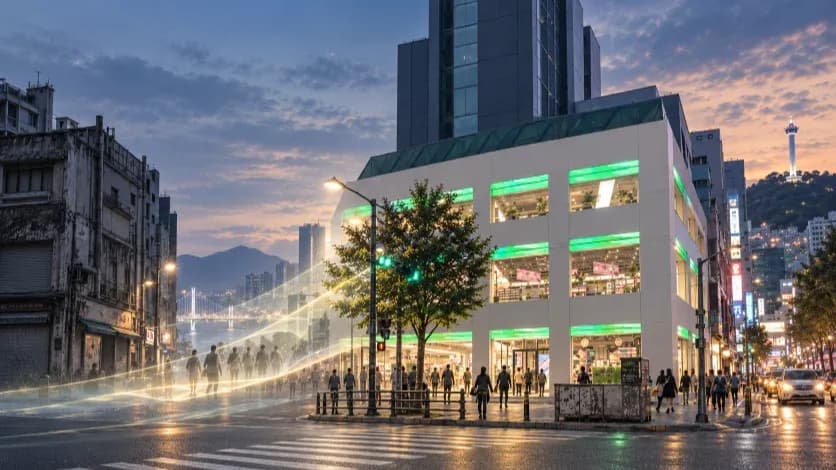
Foreign visitors are making long-empty commercial space valuable again in Nampo. But the new demand is reviving particular properties and businesses faster than the broader economy that once sustained Busan’s old downtown.
For more than five years, four floors near BIFF Square remained empty. Topten left the building in late 2020, and no retailer large enough to replace it followed. In a district once crowded with department-store shoppers, moviegoers, students and diners from across Busan, a vacancy of that size stopped looking temporary. It became part of the landscape left behind as the old commercial centre lost customers and businesses.
Those floors reopened on August 28 as a 2,970-square-metre Olive Young, roughly four and a half times larger than the branch the company had operated nearby. The store sits between BIFF Square, Gwangbok-ro and other streets already heavily used by visitors, and it was designed with international shoppers in mind. One of Nampo’s most conspicuous empty properties had found a tenant capable of using almost 900 pyeong at once.
The scene lends itself easily to a story of revival. By June, a local headline could already describe Nampo’s commercial district as “coming back,” while public programmes were again being framed around the revitalisation of the old downtown. The description is understandable: crowds have returned, large companies are investing and some long-empty spaces are being occupied again. The customers making those spaces viable, however, are changing what kind of commercial centre is returning.
A New Customer Base
Foreign spending around Nampo has grown large enough to alter decisions about rent, floor space and investment. In 2025, foreign customers accounted for an average 71 percent of sales at three existing Olive Young stores around Nampo and Gwangbok, before the larger Nampo Town outlet opened. Overseas-card sales in Nampo-dong later rose 143 percent over the latest 12-month comparison. A large retailer considering Nampo today is looking at a customer pool that scarcely resembled the one available during the district’s weakest years.
Foreign-card spending has also risen rapidly in Millak, Gwangan and Jeonpo, while Haeundae’s Jung-dong and U-dong have continued to grow strongly. Several districts are benefiting from a larger foreign market at the same time. The old downtown has gained a new source of demand without displacing Busan’s established beach districts. More parts of the city can now support businesses built around international visitors.
Source: Korea Credit Data, Aug. 2026; district figures reported by Seoul Shinmun, Aug. 12, 2026.
The money becomes much more concentrated once it reaches individual businesses. Korea Credit Data found that the top 1 percent of businesses in its Busan sample captured 52.9 percent of overseas-card spending. A street can therefore grow busier while the additional revenue flows disproportionately to businesses already positioned to capture visitors. One property becomes more valuable than it has been in years while another remains empty only a short walk away.
Nampo’s new Olive Young fits the customer mix unusually well. The brand is already familiar to international shoppers, beauty products are a major part of Korea-oriented retail tourism, and the store occupies a large site on an established visitor route. Its scale allows the outlet to operate as a destination in its own right. A clinic, repair shop or neighbourhood service nearby receives no equivalent advantage from the same increase in foreign foot traffic.
Commercial space is being revalued accordingly. Locations combining tourist flow, recognisable products, large floor plates and strong brands can become viable again quickly. Properties dependent on a shrinking local catchment may remain weak even as pedestrian numbers rise around them. The new market is deciding which parts of Nampo recover first.
When Vacancies Become Opportunity
Nampo’s weakening began long before the current surge in foreign visitors. Jung-gu continued to lose population between 2019 and 2024, extending a contraction that had already reshaped Busan’s historic centre. The district also lost some of the workers, students and repeat visitors who once returned for cinema, shopping, meals and ordinary errands. Commercial vacancies accumulated after those patterns of use had begun to thin.
The earlier Nampo economy drew strength from repetition as much as volume. Residents returned to the same clinics, restaurants, laundries and repair shops throughout the year, while workers and students generated spending through the working week. Busan residents from outside Jung-gu also came back because Nampo functioned as a metropolitan centre rather than an occasional destination. Thousands of routine transactions spread demand across businesses that had little connection to tourism.
As those customers weakened, some commercial spaces became increasingly difficult to justify. A four-floor retail property designed for heavy footfall requires a tenant willing to make a much larger bet than the operator of a small neighbourhood unit. Years of vacancy near BIFF Square reflected how far expectations for Nampo’s future demand had fallen. The building had become too large for the market that remained.
Foreign tourism changed that calculation without recreating the market that had disappeared. A beauty retailer can look at rising international spending, a well-travelled tourist route and a large available site and see an opportunity that made little sense under the weaker demand of a few years earlier. The building needed a customer base capable of supporting a different use. That customer base now exists.
The decline also left physical room for the new market to take shape. Large and prominent spaces were available precisely because previous uses had disappeared and replacement demand had remained weak. When foreign spending accelerated, some of those spaces could be reorganised around customers with different priorities. The tourism boom is taking root in a commercial landscape produced by the contraction that came before it.
Business turnover shows how unevenly the change is proceeding. Among 188 operating lodging establishments reviewed for this article, 30 new businesses were recorded against three closures. General restaurants recorded 95 openings and 180 closures, while limited-service food and drink businesses recorded 44 openings and 84 closures. More overnight visitors give accommodation a relatively direct source of demand, while food businesses still face a crowded market, labour costs, rent and intense competition.
Small-store vacancy in Nampo stood at 17.9 percent in the fourth quarter of 2024. That level gives the latest openings a different meaning from ordinary retail expansion in a tight market. Olive Young has shown that one of the district’s largest long-empty spaces can become commercially useful again. Many other properties are still waiting for a business model capable of doing the same.
A Different Commercial Centre
Tourists spend in ways that differ from residents and repeat local users. A short stay can generate substantial spending on accommodation, beauty products, fashion, dining and experiences, especially when those purchases are already part of the reason for visiting Korea. Clinics, repairs, groceries and other routine services draw their strength from people who live, work or study nearby and return through habit or necessity. The two groups can use the same streets while sustaining very different businesses.
The longer record of Jung-gu businesses carries traces of those different pressures. Laundry businesses have contracted sharply, beauty services have increased and medical services have remained comparatively stable. Local functions have changed at different speeds, just as visitor-facing sectors have. Population decline, shifting habits and the arrival of new outside demand are unfolding together.
Capital responds most quickly where that new demand is easiest to convert into revenue. A large site on a tourist route becomes easier to lease when a hotel, cosmetics store or restaurant can project a steady flow of outside customers. A smaller property serving a shrinking residential catchment can remain difficult even while the area around it grows busier. The vacancies that disappear first reveal which customers are gaining influence over the district.
Olive Young makes that transition unusually visible. The store has brought four dark floors back into use and added another destination to a street that badly needed investment. Its commercial case does not depend on Jung-gu’s population returning to an earlier level or on Nampo recovering its former place in the routines of Busan residents. It depends on enough shoppers wanting what the store sells, and an increasing share of those shoppers now arrive from outside Korea.
Nampo can regain commercial usefulness under those conditions while becoming different from the place that declined. New hotels can fill rooms, recognised retail brands can take large spaces and visitor-oriented businesses can expand while other vacancies and older services remain weak. Activity has returned to parts of the district, but the customer base directing that activity has changed.
Revival on Different Terms
Gamcheon Culture Village shows how far the value of a place to visitors can eventually separate from the way residents use it. Visitor numbers grew enough for Saha District to designate a special management area and move to regulate visiting hours and tourist vehicles. Tourism made the village more visible and economically valuable, while the same popularity created enough pressure on residential life to require active management. Success as a destination brought a new set of problems for a neighbourhood that still had to function as a place to live.
Huinnyeoul Culture Village developed under different conditions. Its residential population contracted sharply while cafes and other visitor-facing businesses became prominent in the streetscape, alongside ageing, steep terrain, old housing and Yeongdo’s wider population decline. The village became more useful to visitors while the population living inside it continued to shrink. Tourism entered a place whose residential foundations were already under pressure.
Nampo began from a different position. It had spent generations as a metropolitan shopping centre, and foreign visitors are entering streets built for commerce rather than converting a residential village into a destination. Yet all three places show how quickly visitor popularity can outpace older urban functions. A fuller street does not reveal on its own which uses of that street are becoming stronger.
In Nampo, the change is occurring through leases, customer mixes and investment decisions rather than overt conflict over residential space. A different set of customers can gradually influence which businesses expand, which properties are renovated and which streets receive capital. From the pavement, that transformation can resemble the return of the old downtown even while a different commercial centre is taking shape underneath it.
A New Market in the Old Downtown
Foreign tourism has given Nampo a source of demand the district had struggled to replace. Long-empty buildings can return to use, retailers can justify investments that would have seemed implausible a few years earlier, and restaurants, independent shops and cultural businesses can benefit when visitors move beyond a handful of flagship destinations. The influx has improved the prospects of parts of the old downtown in ways that should not be reduced to spectacle.
The gains have appeared first in places that fit the new customer base. Prominent retail sites, accommodation and businesses already legible to international visitors have stronger reasons to invest, while high vacancy and continued turnover remain elsewhere. Residents, workers and repeat local users still sustain another layer of commerce through routines that visitor numbers cannot reproduce on their own. Those two sources of demand now overlap in Nampo without strengthening every part of it at the same pace.
Nampo’s earlier strength came from having many reasons to be there at once. Shopping, cinema, work, errands, food and everyday services reinforced one another and made the district part of ordinary metropolitan life as well as a destination. Tourism has added a powerful new reason to visit after much of that older ecosystem weakened. The commercial centre emerging from that sequence will be shaped by what the new customers support and by which older uses can remain viable beside them.
The four floors near BIFF Square no longer sit empty. Their new tenant has found enough customers to make one of Nampo’s largest long-vacant spaces useful again, and many of those customers come from outside Korea. Around that building, other vacancies and older businesses still carry the effects of the decline that made such a large empty space possible in the first place. Nampo has found a new market inside the space left by the old one.
Continue this reporting
Reporting on the same issue
Related coverage selected from the article's desk, topics and newsroom relationships.
 NewsSep 11, 2026
Busan-Jinhae’s New Industrial Strategy Meets a Jobs Divide
As BJFEZ prepares to add AI, data and advanced energy to its industrial prior...
 NewsSep 9, 2026
Busan’s Ageing Economy Is Not One Market
As one in four Busan residents reaches 65 or older, ageing is reshaping care,...
 NewsAug 18, 2026
The Capital Behind South Korea’s Hot Pot and Buffet Boom
South Korea’s large-format restaurants are scaling into a difficult market, r...
More from the author
More from this byline
Stay with the same line of reporting through more work from this byline.
- NewsSep 11, 2026
Busan-Jinhae’s New Industrial Strategy Meets a Jobs Divide
 NewsSep 7, 2026
How 38,000 Future Residents Entered Busan’s Growth Plan
Editorial Record
Corrections, sourcing notes and newsroom disclosures remain part of the published record. View Newsroom Notes →
Reader Signal
Community readWhat did this report leave you with?
Choose the signal that best reflects your reading. Select it again to remove it.
One response per article
No response selected
A moderated conversation about the reporting.
One-level replies and newsroom moderation keep the conversation anchored to this article.
Discussion Status
Open
Please sign in to join the discussion.
Newsletter
Weekly reporting and context from Busan and Korea.