The Next Geography of Busan
Busan's planned-district renewal connects aging neighborhoods with new housing, industrial employment, and the transport networks that shape everyday life.

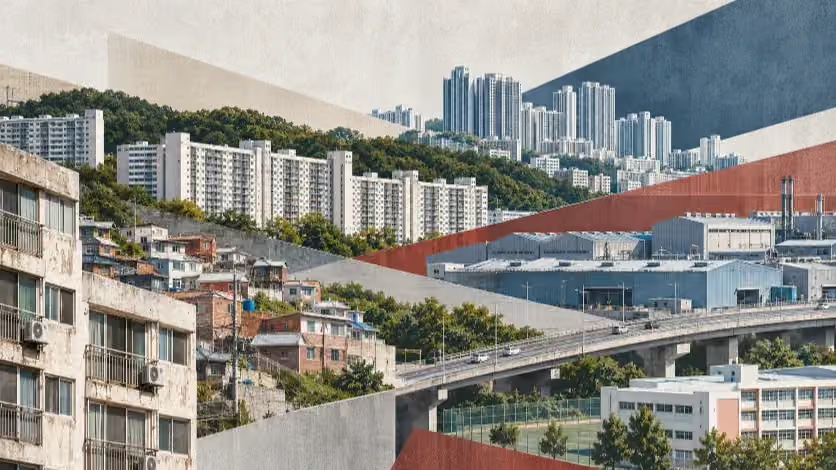
As Busan prepares to renew six aging planned districts, the distribution of homes and jobs reveals why reconstruction will reach far beyond the neighborhoods being rebuilt.
At a September 4 City Council hearing on the future of Mora, the discussion turned to housing several kilometers away. Busan plans to draw on dwellings supplied by development and redevelopment projects within a 10-kilometer radius to accommodate residents who need to move during reconstruction. The head of the municipal housing bureau explained that each such area could encompass five to seven administrative districts, with some districts appearing in more than one catchment. Officials intend to stagger projects to limit simultaneous demand for accommodation.
On November 23, residents of Gaegeum–Danggam, Mandeok, Dadae, and Mora attended a briefing on the second phase of Busan's program to renew aging planned residential districts. The city has submitted its basic plans for the four areas for national approval, following the publication of plans for Hwamyeong–Geumgok and Haeundae in April. South Korea's special legislation allows extensive areas of housing built under earlier development programs to be considered together, with provisions for reconstruction, infrastructure, and relocation. The July drafts identified 31 prospective renewal areas in the four districts, six of them intended to support relocation. These plans establish a framework for subsequent decisions on individual projects; they do not authorize construction.
The relocation proposals span a city that is building new communities along the lower Nakdong River while replacing housing in established neighborhoods and preparing to renew large residential estates occupied for decades. Many residents already work outside the administrative district in which they live. As older homes are withdrawn from use and new ones become available, the places where households can secure accommodation will affect their access to employment, schools, and services. Reconstruction in one part of Busan may consequently involve housing and infrastructure in several others.
The City Built in Stages
Busan's large-scale residential development followed decades of industrial expansion and mounting demand for housing. The municipal history records that the city's population grew from approximately 1.8 million to 3 million during the 1970s. Housing construction had to accommodate a rapidly expanding urban population in a landscape where mountains and narrow stretches of coastal land had already influenced the pattern of settlement. Municipal development projects and private apartment construction gradually extended the supply of permanent dwellings; by the end of 1988, however, the city recorded a housing supply rate of only 58.3 percent, under the statistical definition then in use.
The dates recorded in a 2025 municipal report reveal the successive stages of large-scale land development. Land development projects in Dadae reached completion between 1985 and 1996, those in Mandeok between 1985 and 2001, and those in Mora between 1989 and 1994. Gaegeum–Danggam developed through projects completed between 1990 and 2004, while Hwamyeong–Geumgok followed between 1995 and 2002. The designated Haeundae housing development areas were completed in 1997, although the wider new-town project continued beyond that date. The dates refer to the preparation of residential land, rather than the completion of every apartment building. Dadae extends along the southwestern coast; Mandeok and Hwamyeong–Geumgok occupy parts of the northern residential belt; Mora adjoins the Sasang industrial area; and Gaegeum–Danggam lies within the established urban fabric of Busanjin.
The ambition behind comprehensive residential development is evident in Busan's 2001 administrative white paper. The Haeundae new town covered a planned area of just over three square kilometers, with provision envisaged for 120,000 residents. Its program included sixteen schools, district heating, sewage treatment, underground utility infrastructure, and cultural and welfare facilities. The same white paper described the development of Myeongji as a means of providing housing in support of the Noksan National Industrial Complex, with a planned population of approximately 50,000. Both projects were conceived during a period of urban expansion, although Myeongji's original rationale was more explicitly tied to industrial development.
Economic activity continued to develop around these residential areas. In eastern Busan, plans drawn up in the 1990s for the former Suyeong airfield led toward the creation of the Centum business and convention district. Along the lower Nakdong, the Eco Delta City project, initiated in 2012, extended urban development across parts of Gangdong, Myeongji, and Daejeo 2-dong. Its current project program envisages approximately 30,000 homes and accommodation for 76,000 people. The development represents a further stage in the conversion of land in western Busan to urban uses, following the earlier industrial and residential investments around Noksan and Myeongji.
The rail network developed on a different schedule from the housing. Metro Line 2 opened between Hopo and Seomyeon in 1999 and reached Jangsan in Haeundae in 2002. Line 3 began serving Mandeok in 2005, and the extension of Line 1 to Dadaepo opened in 2017. By the time the last of these connections became available, housing in Dadae had been occupied for decades. The extension gave the neighborhood direct access to a rail line running through the original downtown and Seomyeon, adding a connection that had not existed when the housing was built.
Urban formation / 1985–2026
The city was built in stages
Recorded land-development completion years and selected transport openings. The two timelines describe different investments.
The current renewal proposals acknowledge these differences. The July drafts envisage improving pedestrian access in the sloping neighborhoods of Gaegeum–Danggam, strengthening activity around Mandeok's metro station, making greater use of Dadae's coastal setting, and improving the connection between Mora and the adjoining industrial area. These proposals draw on the terrain and the economic and transport networks around each district, much of which has evolved since the estates were built.
The Geography of Home and Work
Four western districts—Gangseo, Sasang, Saha, and Buk—accounted for approximately two-thirds of Busan's manufacturing employment in 2023, according to establishment survey figures compiled by the Busan Development Institute. Their share of employment across all industries was 29 percent. Gangseo alone had about 73,300 manufacturing workers, or more than a third of the city's manufacturing workforce, while Sasang and Saha accounted for another 34,300 and 27,100, respectively. The concentration of industry on both sides of the lower Nakdong has created a substantial employment area extending across the boundary between older industrial neighborhoods and newer development sites.
Buk, Sasang, and Saha, which contain four of the six planned districts, recorded a combined net residential outflow of just over 12,000 people in both 2024 and 2025. Gangseo's net gain, by comparison, rose from 111 people in 2024 to 7,105 in 2025. Housing accounted for its largest positive balance among the reported reasons for moving, at 5,618 people. Employment accounted for the largest negative balance in Buk, while housing accounted for the largest in Sasang and Saha. Those figures cover entire administrative districts, including neighborhoods outside the renewal areas; they describe reported reasons for moves rather than tracing the effects of particular developments.
Sasang's continuing economic importance is evident in the 2025 regional commuting survey. Although the district recorded a net residential outflow of 3,476 that year, an estimated 77,805 people traveled into it from other municipalities or districts for work, compared with 54,456 who commuted outward. Sasang and Gangseo were also the two leading destinations among Buk residents who worked outside their home district. Nearly a third of Saha's outward commuters traveled to Gangseo. The figures are survey estimates based on residents of Busan, Ulsan, and South Gyeongsang Province; incoming commuters from outside that region are not covered. They show the importance of Sasang as a workplace and of the older western residential districts as sources of labor for surrounding employment centers.
In Gangseo, an estimated 70 percent of commuting residents worked within the district in 2025, the highest share in Busan. Yet its workplaces also attracted approximately 137,000 commuters from elsewhere in the survey region, including substantial numbers from Gimhae and Changwon. The relatively high share of residents working within Gangseo does not indicate how long their journeys take across a district containing extensive industrial and residential areas.
A February 2025 study of 1,506 Busan residents working in industrial complexes around Noksan offers a more specific account of that geography. Just under 30 percent lived in Gangseo, while roughly 42 percent lived in Saha, Sasang, or Buk. The report gives an overall average of 55.5 minutes for the journey to work. Among Gangseo residents the mean was 38.5 minutes, compared with approximately an hour among respondents living in each of the three older western districts. Differences in transport modes and workplace locations mean that these averages cannot predict how much time an individual would save by moving. They do establish the importance of housing location within western Busan, where access to industrial employment depends in part on the connections between residential developments and dispersed workplaces.
The established city contains labor markets of a different character. In 2023, Busanjin, which includes Seomyeon, had approximately 176,000 people working in local establishments, the highest total among Busan's sixteen districts and counties. Haeundae had approximately 157,000. Busanjin also had the largest estimated population of residents commuting outside their home district in 2025, with Sasang their leading destination. Its role as a major employment center therefore coexists with its importance as a residential location for people working elsewhere. In the original downtown, Jung and Dong attracted substantially more commuters than they sent out despite net residential losses in the same year.
The relationship between eastern Busan's established centers and newer development areas is also visible in the commuting survey. Gijang attracted an estimated 40,198 workers from elsewhere, while 34,327 of its residents commuted out. Haeundae accounted for 28.4 percent of the county's inbound commuters, and Gijang was the leading destination among Haeundae residents traveling outside their district for work. Industrial parks around Jeonggwan and Jangan give the county economic functions alongside residential development. The city's living-area plan proposes expanding industrial and research activity around Jangan, developing the Osiria tourism area, and strengthening railway connections. Gijang's net residential outflow narrowed from 2,678 in 2024 to 375 in 2025, although these two years alone cannot establish a lasting change in its residential appeal.
In 2025, Busanjin and Gangseo were the only two of Busan's sixteen districts and counties to record net residential gains. Busanjin's gain of 7,128 people was slightly greater than Gangseo's, but the respective net migration rates were 2.0 and 4.9 percent. The larger proportional change occurred in Gangseo; the established city nonetheless absorbed a comparable number of residents through net migration in Busanjin. Housing accounted for Busanjin's largest positive balance among reported moving reasons, at 4,773 people. A year earlier, the district had gained just 1,027 through net moves, while Dongnae and Yeonje had recorded considerably larger gains before both turned negative in 2025. The availability of newly completed housing at particular moments is a plausible explanation for some of these changes, alongside shifts in household preferences, although the contribution of individual developments remains unmeasured.
All 16 districts / 2025
Where people move and where they work
Gangseo and Busanjin both gained residents through migration, but their estimated commuting balances diverged. Several districts with net migration losses still recorded positive commuting balances.
Migration scale: −5% to +5%. Commuting scale: −120,000 to +120,000 people.
The scales are independent. Shading extends from zero toward each signed value; the printed numbers give the direction and magnitude. Small commuting balances, such as Yeongdo’s, should not be read as statistically established differences.
The citywide migration balance obscures much of this movement. Subtracting arrivals from other provinces and metropolitan cities from Busan's total registered arrivals yields 256,178 moves within the city in 2025, counting individual moves rather than unique residents or households. Over the same year, domestic migration across the city boundary produced a net loss of 12,181 people. The aggregate outflow can thus coexist with considerable housing turnover and local gains. Among people aged 20 to 24, the external balance was positive by 927; among those aged 25 to 29, it was negative by 5,437. Employment was the reported reason associated with the largest negative balance across all ages, at 9,063. Housing construction may influence the locations in which residents settle, but these age-specific movements point to the importance of opportunities available during the transition into working life.
The Housing Between Old and New
In February 2025, Busanjin issued a notice confirming the completion of the Yangjeong 1 redevelopment project. Nearly twenty years had passed since the designation of the redevelopment area in June 2005. The 2022 sales notice described a development of 2,276 apartments, of which 1,162 were being offered through ordinary and special subscription arrangements. The 1,162 units offered through these channels represent only part of the planned development. Neither figure measures the increase in housing stock: that calculation also requires the number of dwellings removed. The net migration figures for Busanjin cannot establish how many incoming residents settled in Yangjeong.
A study by housing researcher Yun Kyung Oh, published in December 2025, estimated that approximately 52,000 of the 106,000 apartments entering supply between 2020 and 2024 came from redevelopment and reconstruction. In Dong, such projects accounted for approximately 90 percent of apartment supply during the period. Their share was considerably lower in Gangseo and Gijang, where new residential sites provided another means of expanding the housing stock. The study also found that more than half of Busanjin's apartment supply came from renewal projects. The migration gains recorded in Busanjin and Gangseo therefore occurred in districts with different historical routes to expanding housing capacity.
The distinction has consequences for the housing market during construction. On newly developed residential land, additional homes can become available without the prior removal of an equivalent number of dwellings at that location. In an occupied redevelopment area, housing is withdrawn from use before replacements become available. The temporary reduction in local capacity can increase demand for accommodation elsewhere, even when the completed project is designed to provide more homes than it replaces. Across several projects, the relationship between the dates of demolition and completion matters as much to households seeking accommodation during reconstruction as the number of homes ultimately planned.
The city's aging housing stock also extends considerably beyond the six planned districts. Oh's analysis of the 2024 housing census put the proportion of dwellings at least twenty years old at approximately 59 percent across Busan, rising to around 80 percent in Yeongdo and 77 percent in both Jung and Sasang. Age alone does not establish the physical condition of a dwelling or its suitability for comprehensive redevelopment. In parts of the original downtown, particularly Dong, Seo, and Jung, the study identified aging detached homes as a prominent concern. Smaller land parcels, existing streets, and mixed residential and commercial uses can complicate the assembly of land for redevelopment in ways that differ from the reconstruction of a large apartment estate. Legislation in force since 2018 provides alternative arrangements for smaller-scale reconstruction and block-level renewal, while Busan's broader urban renewal strategy includes improvements to streets and public amenities.
Improvements to existing housing rarely appear in statistics on newly completed apartments. A dwelling adapted to the needs of an older resident may allow that person to remain near shops, transportation, and social support. Block-level renewal can preserve parts of an existing street network, whereas comprehensive reconstruction may create more scope for changing the layout of a neighborhood and increasing its housing capacity. The suitability of these approaches varies with the buildings and the people who occupy them. A citywide assessment of housing renewal needs to account for changes in the kinds of dwellings available, including their size, cost, and tenure, as well as the number being built.
Staying Within Reach
In 1994, while development in Dadae was still underway, the City Council considered a proposal to provide temporary rental housing in the Dadae 4 area for households affected by redevelopment elsewhere. Council members questioned the suitability of a sloping site and whether existing permanent rental apartments could be used instead. The head of the municipal development corporation defended the proposal on the grounds that households whose homes were demolished needed somewhere to live during construction. More than three decades later, the city is preparing relocation arrangements for the renewal of residential areas built during that period.
The July 2026 draft plans identified four relocation-support areas in Dadae and none separately designated in Mora. When asked about the difference in September, the municipal housing bureau explained that rental and other apartments were mixed within Mora's complexes, complicating the identification of a separate area for that purpose. Officials were considering additional locations and intended to refine the arrangements in subsequent plans. The difference illustrates how the physical organization of existing housing affects the options available for the sequence of reconstruction. It does not establish how many temporary dwellings either district will have available.
Under Articles 31 and 32 of the special act, local authorities and project developers must prepare relocation measures for owners and tenants, and dedicated or existing public housing may be used for temporary accommodation. In November, Busan published a recruitment notice for rotational rental housing at an apartment complex in Nambumin, in Seo District. Under an earlier recruitment round, from July 2025 to March 2026, priority was given to tenants who owned no dwelling and had lived for at least two years in a redevelopment area whose homes were subject to demolition. Owners who had lived in the area for the same period and owned no other home could also qualify. Both groups had to meet the income requirement. The earlier recruitment round was limited to projects with approved property-disposal and allocation plans. Its rules illustrate the distinction between the existence of temporary rental housing and a household's eligibility to use it; no allocation for the six planned districts has been established by that notice.
For the planned districts, the practical capacity of a relocation program will depend on the homes actually available when households need to leave, their rental terms and eligibility rules, and their accessibility. A home in Gangseo may offer a convenient location for a worker employed in Noksan but lengthen the journey of another household member employed in Seomyeon. Moving with school-age children involves a further set of decisions about attendance areas and travel. The 10-kilometer radius discussed at the council identifies a market from which accommodation might be drawn; it does not establish how much of that market will offer suitable housing to a particular household.
According to the education office, the first apartment residents of Eco Delta City arrived in 2024, and a kindergarten, elementary school, and middle school opened in 2025. Three further institutions received national investment approval in July 2025 for planned openings in March 2029. On November 3, 2026, the education office announced national investment approval for another kindergarten, elementary school, and high school, with openings scheduled for March 2030. The proposed elementary and high schools are each planned for 43 classes, including one special education class. The education office is adding facilities through successive investment decisions. The dates show the sequence of selected housing and school projects; they do not measure current classroom capacity or establish delays against earlier schedules.
In the established districts, schools and other facilities are already operating, and their future requirements depend on the number and composition of households living nearby during and after reconstruction. A neighborhood may require additional services for older residents even as the number of school-age children declines. At the September council hearing, the housing bureau said that existing schools, parks, and water and sewerage facilities had informed the population capacities envisaged in the basic plans. Further requirements would be developed through the more detailed plans for individual renewal areas. A change in demand may extend beyond the reconstruction site, particularly where several developments share a school attendance area or utility network.
A City on Different Timetables
On November 24, the day after the briefing, the Busan Transportation Corporation announced the completion of structural work along the main alignment of the 6.9-kilometer Sasang–Hadan light rail line, according to Yonhap. Civil engineering work had reached 94 percent, but the corporation aims to finish the remaining construction in the second half of 2028 before beginning trial operations. The railway is designed to connect existing metro lines in the western part of the established city. A further proposed link from Hadan through Myeongji to Noksan would extend that network toward the industrial employment concentrated across the river. Procurement difficulties and the cost of underground construction were discussed at a municipal audit in November; an opening date for that link remains uncertain.
Mandeok has already experienced a change in its position within the road network. The 9.62-kilometer underground expressway connecting Mandeok and the Centum area opened in February, linking a residential district initially developed in the 1980s to an eastern economic center that had yet to emerge at the time. The new road creates a direct route across the city, but its usefulness for individual journeys depends on access to the tunnel, congestion on connecting roads, and the toll. In March, a council member cited municipal data showing that morning travel speeds on two nearby road sections had fallen after the opening. Those early observations cover only two road sections and do not establish the expressway's overall or lasting effect on travel. They identify a practical constraint on the accessibility offered by a new cross-city route: its connections to the roads that serve individual neighborhoods.
Busan's 2040 city master plan, finalized in 2023, envisages ten specialized urban centers, development around 130 metro stations, and six larger living areas to guide local investment. The 2035 planned-district renewal framework operates within more tightly defined residential areas, alongside the city's broader 2030 urban and residential renewal plan. These planning instruments meet where a neighborhood relies on facilities serving a wider area. A pedestrian connection to a station can be incorporated into the redevelopment of an estate; the frequency and destinations of trains serving that station, or the capacity of the roads leading to it, depend on decisions made beyond the estate.
The financing of infrastructure reflects this difference in scale. The municipal housing bureau explained in September that public contributions from individual projects would be determined at project approval and collected before completion, with contributions taking the form of both land and cash. Such arrangements can help provide neighborhood amenities as projects advance. Other investments, including major transportation connections and schools serving several developments, may require separate funding and administrative decisions. Their schedules need not coincide with the construction of individual housing projects. A park within a project area and a school serving several neighboring estates may therefore follow different investment schedules. The date an apartment building is completed cannot establish when all the facilities on which its residents depend will be ready.
The districts Busan is preparing to renew already occupy positions in an urban economy that their original development plans could scarcely have anticipated. Mandeok has gained a direct road connection toward Centum, while residents of Buk and Saha work in industrial centers across the Nakdong. The next generation of housing in these places can draw on those connections, provided its design, cost, and location accommodate the households that need them. In Mora, the city is already looking beyond the neighborhood for homes to accommodate residents during reconstruction. The wider housing market will be involved long before the first replacement apartments are ready; the city to which households might eventually return will have continued to change in the meantime.
Continue this reporting
Reporting on the same issue
Related coverage selected from the article's desk, topics and newsroom relationships.
 NewsNov 17, 2026
The Long Return of Busan’s Buried Streams
Busan’s reopened streams reveal the challenges of restoring urban waterways,...
 NewsNov 16, 2026
Busan’s Sea Taxi and the Economics of a Connected Coast
Busan’s planned sea taxi would link the Suyeong River, Gwangalli and Haeundae...
 NewsNov 14, 2026
Who Pays to Host Busan’s Waste?
Busan’s Saenggok waste site has been shaped by relocation deals, recycling ri...
More from the author
More from this byline
Stay with the same line of reporting through more work from this byline.
 NewsNov 13, 2026
The Uneven Geography of Busan’s Business Growth
 NewsNov 11, 2026
The Cost Behind Busan's 10,000-Won Rent Promise
Reader Signal
Community readWhat did this report leave you with?
Choose the signal that best reflects your reading. Select it again to remove it.
One response per article
No response selected
A moderated conversation about the reporting.
One-level replies and newsroom moderation keep the conversation anchored to this article.
Discussion Status
Open
Please sign in to join the discussion.
Newsletter
Weekly reporting and context from Busan and Korea.