Busan’s Water System Is Entering a Harder Era of Renewal
Busan spent decades building a water system that can absorb major failures. Now it must renew aging transmission mains and rebuild four water treatment plants without losing the reliability that investment created.

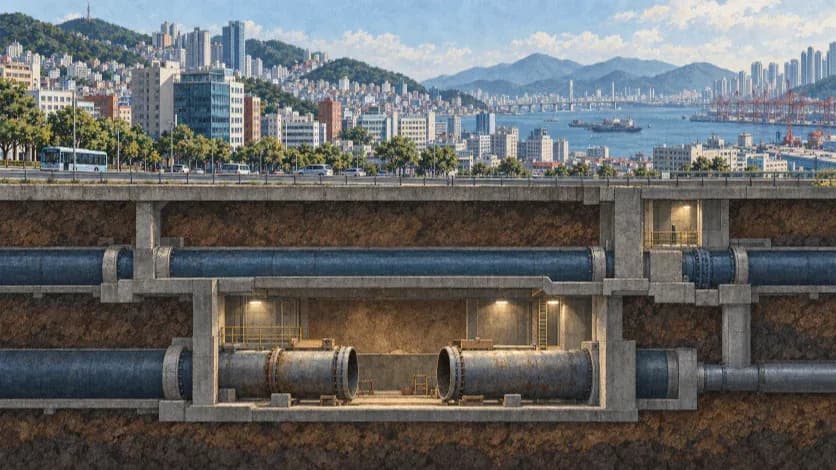
A leak in one of Busan's largest transmission mains could be isolated because another route was available to carry the water — the product of decades spent renewing pipes and building operating flexibility. Now the city has to replace the infrastructure that created that reliability while deciding which still-functioning assets carry the greatest risk.
In late August, corrosion opened a leak around a welded section of a 2,200-millimeter transmission main in Daedong-myeon, Gimhae. The pipe belongs to the Deoksan Water Treatment Plant system, which carries more than half of Busan's tap-water supply. Repairing the damaged section required taking one of two major transmission routes out of normal operation.
Water had another route into the city. Deoksan supplies domestic water through 2,200-millimeter and 2,400-millimeter transmission mains, and Busan Water Authority prepared to consolidate the flow into the larger pipe while the damaged line was repaired. Operators planned several days of gradual valve adjustments before the work to limit sudden changes in flow and pressure inside the network. The repair could therefore be organized around maintaining household supply while one major route was unavailable.
The leak exposed two conditions at the same time. A major physical asset had deteriorated enough to fail, while infrastructure built around it gave operators another path for the water. Busan has spent decades creating that separation through pipe renewal, alternative transmission routes, treatment capacity, reservoirs, pumping facilities and operating experience.
Much of that infrastructure is now approaching another period of renewal. Hundreds of kilometers of water mains are moving through the city's Phase 4 water-main renewal program, and Deoksan, Hwamyeong, Myeongjang and Beomeosa Water Treatment Plants are heading toward a five-stage reconstruction program extending toward mid-century. Many of the assets competing for attention still work normally. Busan must increasingly decide which of them should be inspected, strengthened or replaced while there is still time to choose the order.
The Reliability Busan Built
Busan shut down Hwamyeong Water Treatment Plant for seven days in April 2024. The closure was planned for repairs to aging facilities, including valves in the granular activated-carbon filtration system, and the authority began shifting supply before production stopped. Roughly 323,000 cubic meters of daily Hwamyeong production was replaced by increased production elsewhere in the system. The city kept supplying water while one of its four treatment plants was deliberately taken out of production.
The shutdown was not equivalent to a sudden plant failure. Operators knew when Hwamyeong would stop, what work had to be completed and which other facilities would carry additional production. That distinction makes the episode more useful, rather than less useful, for understanding the system Busan had built: water could be redistributed across treatment and conveyance assets when one large producer was unavailable under controlled conditions.
That ability was accumulated through repeated physical investment. Busan has pursued staged renewal of aging water mains since the 1980s, and its third major program alone covered 1,087 kilometers of pipe between 2011 and 2020. By 2019, as that program neared completion, the city was already preparing the fourth stage and accelerating work where road excavation was possible. Major transmission routes were also being duplicated or interconnected so that maintenance on one path did not automatically require a loss of service.
Treatment capacity is only one part of that operating flexibility. Busan's system includes 76 distribution reservoirs, 180 pumping facilities and thousands of kilometers of transmission, distribution and service pipe. A plant can produce additional water only if the surviving network can move that water to the places that have lost another source of supply. The value of spare capacity is therefore inseparable from the routes, storage and operating controls around it.
The resulting network can absorb some large planned losses without passing them directly to households, as the Hwamyeong shutdown demonstrated. That performance also raises the standard for the next round of renewal. The city has to replace aging parts of the system without giving up the routes, reserve capacity and operating room that earlier investment created.
Choosing the Next Pipes Before They Fail
Busan began preparing its fourth pipe-renewal program before the third one had finished. Earlier programs could concentrate heavily on materials and asset categories already known to perform poorly, including aging coated steel and cast-iron pipes. By 2019, the remaining task was becoming less straightforward: the city began advancing Phase 4 planning on the basis of network diagnosis while many of the candidate assets were still carrying water.
That shift changed the information required to decide which pipe should come next. Age remains useful, but two pipes installed in the same period can carry very different risks if one has deteriorated faster, sits beneath unstable ground, feeds a critical area or has no practical bypass. Conversely, an older pipe can remain less consequential if its condition is sound and operators can reroute supply around it. Renewal becomes a comparison among functioning assets rather than a search only for visibly failed ones.
Busan completed a lifecycle asset-management system in December 2021 that cataloged 582,212 pipeline and network assets and another 14,858 assets at intake stations, treatment plants, reservoirs and pumping stations. The system was built to estimate remaining life, manage lifecycle cost and risk, and project future investment demand. Instead of using elapsed age as the sole proxy for deterioration, planners could connect a physical asset to its condition, role, likely consequences of failure and expected replacement timing.
The risk model places the surrounding system inside that calculation. Busan's published methodology combines the probability of failure with the seriousness of the resulting damage and the amount of spare capacity available to soften the consequence. A reservoir with alternative storage, or a pumping system with an available standby unit, does not carry the same service risk as an otherwise similar asset with no substitute. The most severe combinations rise toward the front of the replacement plan.
The same lifecycle system projected a larger volume of pipe reaching replacement timing after 2027. That projection did not identify a crisis year. It showed that Busan's own asset records anticipated a heavier renewal workload as another generation of infrastructure moved deeper into its service life. The difficult question was becoming how to distribute inspection, capital and construction capacity across that larger population before failures themselves set the schedule.
A risk score still cannot dig up a street. Pipes have to be isolated without destabilizing supply, road access has to be available, money has to be assigned and nearby construction can make one project practical before another. Those constraints put greater value on accurate condition information because uncertainty at the top of the list can consume scarce construction capacity while another high-consequence asset remains underground.
The next renewal cycle therefore began with a different task: deciding which assets that were still in service should be renewed first.
How One Rupture Redrew the Inspection Map
On Jan. 16, 2013, a 2,200-millimeter steel transmission main ruptured beneath Gaya-daero in Gamjeon-dong, disrupting water service to more than 130,000 households across Busan. The pipe had been laid in 1993. Officials examined stresses that included weak reclaimed ground, heavy traffic, repeated temperature changes and cracking around the connection. The failure was difficult to explain by age alone.
Busan Water Authority widened its inspection program after the rupture. Beginning that March, internal-camera inspections were extended to steel mains 800 millimeters or larger, covering roughly 333 kilometers of the network. Repair crews restored the broken section in Gamjeon-dong, but the larger response reached pipes that had not failed. One rupture had expanded the inspection map across a class of assets capable of producing large service consequences.
Busan had encountered the complexity of those failures before. At a City Council hearing in February 1998, officials described a 2,200-millimeter main in Hakjang-dong as a failure attributed at the time to a defect in the pipe itself, while a separate failure in Samnak-dong was attributed to conditions around the installation site. The record did not describe one defect moving through every large pipe. It showed that similar transmission assets could lose integrity through different combinations of material, construction and surrounding conditions.
Another 2,200-millimeter main ruptured beneath Saebyeok-ro in Sasang in July 2025. Crews excavated about seven meters to reach the pipe and identified damage at a welded connection. The surrounding area had already drawn attention because of ground failures and subway construction, but proximity alone does not establish what broke the pipe. The stronger continuity lies inside the transmission assets: a welded interface had again become a point at which a major route lost integrity.
The August 2026 Deoksan leak produced a different service problem. Operators could prepare to remove the damaged transmission main because a parallel route remained available to carry the water. The physical deterioration still occurred, but the network around the pipe gave the authority a way to contain its service consequence. By then, the effect of losing a major main depended as much on what remained available around it as on the condition of the failed asset itself.
Across those incidents, the risk carried by a large main extends beyond the pipe wall. Weld condition, corrosion, ground movement, the ability to isolate a damaged section and the availability of another route all influence what happens after integrity is lost. The 2013 rupture showed that Busan could turn one major failure into surveillance across hundreds of kilometers. Phase 4 moves the decision earlier still: an inspection finding has its greatest value when it changes what happens to another asset before that asset begins leaking.
That can mean shortening an inspection interval, strengthening a bypass, bringing a replacement forward or using another construction project to reach a vulnerable section while the road is already open. None requires waiting for another rupture to demonstrate the consequence. By the time a high-capacity main breaks, many of the decisions that determine the scale of the resulting disruption have already been made.
Keeping Water Moving Through a Rebuild
Busan is preparing to rebuild the four treatment plants that produce its drinking water while those plants continue serving the city. The modernization program covers Deoksan, Hwamyeong, Myeongjang and Beomeosa Water Treatment Plants, carries an estimated cost of about KRW 2.57 trillion and is divided into five stages extending toward 2050. Busan Water Authority chose staged construction specifically to preserve stable supply while old facilities are reconstructed. For years at a time, part of the production system will be a construction site while the rest must continue producing and moving water every day.
Deoksan and Hwamyeong make that sequencing especially consequential. Busan lists total treatment capacity at about 1.899 million cubic meters a day when industrial-water capacity is included: 805,000 cubic meters of domestic-water capacity and 352,000 of industrial-water capacity at Deoksan, 544,000 at Hwamyeong, 190,000 at Myeongjang and 8,000 at Beomeosa. The authority classifies 1.701 million cubic meters a day, or about 90 percent of the total, as dependent on the Nakdonggang River through Deoksan and Hwamyeong. Removing part of that production core for reconstruction transfers more work to the facilities and conveyance routes that remain available.
The seven-day Hwamyeong shutdown already demonstrated that Busan can shift a large block of production elsewhere when an outage is prepared in advance. The reconstruction program turns that short exercise into a long operating condition. A planned shutdown gives operators a known start, a known amount of unavailable production and an expected return date; a treatment unit under reconstruction remains unavailable for as long as that stage requires.
Storage can bridge a disruption only for a finite period, while additional production from another plant still has to travel through transmission mains, reservoirs and pumping facilities with their own constraints. A headline figure for unused treatment capacity can therefore overstate the protection available if the water cannot be transferred through the surviving network. Reserve production has practical value only when the plant, pipe and storage chain needed to deliver it remains intact.
The Deoksan transmission-main leak exposed the same relationship farther downstream. Operators could prepare to remove the damaged 2,200-millimeter line because a parallel 2,400-millimeter route remained available. During treatment-plant reconstruction, each planned outage will similarly change the combination of plants, mains and reservoirs available to absorb something that was not on the construction schedule. A secondary connection under ordinary conditions can become one of the most consequential pieces of infrastructure in the city once a primary route is unavailable for months.
Before each construction stage begins, Busan will effectively create a temporary version of its water system. The assets carrying additional flow during one phase may differ from those required during another, and the value of a transmission route can rise even though nothing about the pipe itself has changed. Work on reservoirs, emergency connections and surrounding mains therefore becomes part of treatment-plant modernization even when it sits outside the plant construction contract. Some of the most important preparation for rebuilding a treatment plant may occur kilometers away from it.
Two Treatment Plants, One River
Algal warnings were in effect for a total of 194 days at Mulgeum and Maeri in 2025. Busan's 2026 response plan again prepared for extended blooms by increasing monitoring and coordinating measures across agencies, while treatment plants can intensify processes such as oxidation, disinfection, coagulation and filtration when raw-water conditions worsen. Those capabilities allow the production system to absorb deterioration before it reaches household taps.
Deoksan and Hwamyeong, however, derive their importance from the same Nakdonggang River system. Separate treatment plants provide strong protection against failures contained inside one facility, and separate transmission routes can protect supply when one pipe ruptures. A river condition affecting the intake system crosses those facility boundaries before treatment begins. Several layers of operational redundancy can therefore face the same upstream pressure at the same time.
The selective-intake project at Mulgeum expands the choices available inside that shared source. The planned intake tower is designed to draw water from different depths instead of relying on a fixed level, allowing operators to avoid layers where harmful cyanobacteria are concentrated. Busan aims to have the facility operating in 2028. The Nakdonggang River remains the source, but operators gain another way to choose the raw water entering the treatment system as conditions change.
Busan has spent much longer trying to change the geography of supply itself. The 2021 Nakdonggang integrated water-management plan envisioned developing 900,000 cubic meters a day from upstream and riverbank-filtered sources, with 420,000 cubic meters allocated to Busan. The project has since moved through feasibility work, negotiations and political resistance over local impacts and compensation; official records show intergovernmental talks were still continuing in 2026. Moving an intake changes more than hydraulics because communities outside Busan become part of an infrastructure decision whose benefits and costs cross municipal boundaries.
Selective intake, advanced treatment and a geographically separate source intervene at different points along the same water-supply chain. The first gives operators more choice within the Nakdonggang River. The second expands what treatment plants can remove after raw water arrives. The third can preserve part of the city's supply when conditions affect the existing intake geography itself.
Deoksan and Hwamyeong will emerge from modernization with newer treatment systems, but their reliability will still be shaped by what reaches them and by what remains available when the usual source is under stress. Busan has built several layers of backup into its water system. The deeper form of protection comes when those layers do not all depend on the same river condition, route or facility remaining usable at the same moment.
Where Risk Becomes Construction
Roughly 400 kilometers of Busan's water mains have been identified for Phase 4 renewal. That population is already the product of a more sophisticated process than simply locating the oldest pipes, because the city's asset-management system can weigh condition, remaining life, probability of failure, service consequence and the availability of another route. The difficult part begins after assets have entered the program. Hundreds of kilometers of pipe cannot be excavated at once, and the order in which they are reached determines which risks remain in the ground longest.
A high-priority main may need another connection strengthened before it can safely be isolated. A different section can move earlier because road or sewer work has opened a corridor that would otherwise have to be excavated again several years later. Annual capital programs limit how many projects can proceed simultaneously, while hydraulic conditions determine which assets can disappear from service at the same time. The construction queue is shaped by both the risk carried by an asset and the network that has to keep operating while that asset is replaced.
Those constraints do not erase the underlying ranking. They make annual sequencing a second engineering decision. Delaying a vulnerable main can reduce system risk if the intervening project creates the bypass required to replace it safely; moving another section forward can do the same when a rare construction opportunity avoids a second excavation and leaves a stronger route behind. The result has to be judged by the risk remaining across the system after a sequence of projects, rather than by whether every construction list follows a numerical score from top to bottom.
Treatment-plant reconstruction will keep changing that calculation. A connection that becomes the principal bypass around a construction zone acquires greater importance even when its physical condition has not changed. A parallel main can move from reserve status to the only practical route carrying additional flow. A reservoir or pumping station can become more consequential because another facility that normally shares the load is temporarily unavailable.
The large-main failures since 2013 show what sits behind those rankings. Gamjeon-dong led to inspection across hundreds of kilometers, while later failures returned attention to welded sections, corrosion, ground conditions and the ability to isolate or bypass a damaged route. Each event produced information before the next annual program was fixed. That information becomes infrastructure only when it changes an intervention somewhere else — another inspection brought forward, another connection strengthened or another section of pipe reached before failure chooses the timing.
Busan's current investment plan already places Phase 4 water-main renewal alongside improvements to the Deoksan-Hwamyeong emergency connection, major raw-water conduits, additional distribution reservoirs and other supply facilities. Those projects are physically linked even when they sit on separate budget lines. A stronger emergency connection can change the consequence of a future plant outage; a reservoir can change how long operators can sustain an interruption; renewing a transmission route can increase the amount of construction the rest of the system can tolerate.
Each annual budget converts only part of Busan's accumulated knowledge into excavation and new infrastructure. By the time a main ruptures, several of the decisions controlling the outcome have already been made: how closely it was inspected, where it sat in the renewal queue, whether operators could isolate it and whether another route was ready to accept the flow. Phase 4 is where increasingly precise knowledge of the network becomes a different physical network.
A Smaller City, a Full Network
Busan's 2040 water plan assumes that the city will lose nearly 300,000 residents while continuing to supply water to its entire population. Planned population falls from 3.38 million in 2025 to 3.08 million in 2040, while maximum daily demand for treated water declines from about 1.21 million to 1.14 million cubic meters. The service target remains 100 percent coverage. Fewer customers will use less water across infrastructure that still has to reach the neighborhoods, commercial districts and industrial areas that remain.
The network does not contract automatically with population. Transmission mains still have to connect treatment plants and reservoirs, pumping facilities still have to overcome elevation, and distribution pipes still have to reach settled areas even when fewer people live behind them. Busan currently operates more than 8,500 kilometers of water pipe across a city whose difficult topography already makes the location and connectivity of infrastructure important.
Lower demand can eventually justify different pipe sizes, storage arrangements or operating zones, but those changes occur through deliberate construction rather than demographic arithmetic. A pipe installed today can remain underground for decades. Replacing an asset therefore creates an opportunity to reconsider how much water a future district will need and how that water should move through the network, rather than automatically reproducing every assumption embedded in the asset being removed.
Phase 4 will install infrastructure that remains in service well beyond 2040. Each project can preserve the geometry it replaces or adjust part of the network to future demand. That gives renewal a second purpose alongside removing deterioration. Busan is choosing which parts of a water system built for a larger city should survive unchanged into the middle of the century.
Before the Next Break
Busan spent decades creating layers between physical failure and the customer. Weak assets were replaced, alternative transmission routes were added, treatment could be shifted between plants and major ruptures widened the scope of inspection. Those investments never promised that steel would stop corroding or that every joint would remain intact indefinitely. They changed the consequences when deterioration finally produced a failure and gave operators more opportunities to intervene before it did.
The coming renewal cycle begins from that higher level of reliability. Many of the pipes now competing for investment still carry water normally, even as four treatment plants approach staged reconstruction and parts of the network prepare to take on different roles during construction. Deoksan and Hwamyeong will continue operating inside a source system capable of placing pressure on both facilities at once. Rebuilding one layer of protection can temporarily increase the work demanded of another.
Some of the most consequential choices will be made while nothing appears to be wrong. An inspection can move a main forward before corrosion becomes leakage. A road project can create the moment to replace a vulnerable section. A connection can be strengthened before treatment-plant construction makes it essential, while a different intake or supply route can prevent one upstream event from consuming several layers of backup at once.
The Deoksan leak reached a system in which another route was already available. The next major failure will encounter whatever Busan has built by then: the pipes replaced, the connections strengthened, the capacity committed to construction and the alternatives left available. Busan has become increasingly capable of seeing risk before residents experience it. The durability of that achievement will be decided in the years before the next break, while the assets in question are still carrying water.
Continue this reporting
Reporting on the same issue
Related coverage selected from the article's desk, topics and newsroom relationships.
 NewsSep 28, 2026
Why Some Commercial Space in Busan Is Hard to Reuse
Two empty commercial spaces exposed to the same broader economy can have very...
 NewsSep 20, 2026
What It Takes for U.S. Navy Repair Work to Become a Busan Industry
HJ Shipbuilding has brought U.S. Navy maintenance work to Yeongdo. Whether it...
 NewsSep 17, 2026
Busan’s Finished Homes, Unfinished Projects
Busan’s unsold homes sit in one monthly total, but they belong to very differ...
More from the author
More from this byline
Stay with the same line of reporting through more work from this byline.
Reader Signal
Community readWhat did this report leave you with?
Choose the signal that best reflects your reading. Select it again to remove it.
One response per article
No response selected
A moderated conversation about the reporting.
One-level replies and newsroom moderation keep the conversation anchored to this article.
Discussion Status
Open
Please sign in to join the discussion.
Newsletter
Weekly reporting and context from Busan and Korea.