Busan’s Quantum-Sensing Cluster Begins With Battery Inspection
Busan’s battery-sensing project shows what South Korea’s new quantum cluster must solve beyond the lab: machinery, shielding, software, calibration and industrial performance.

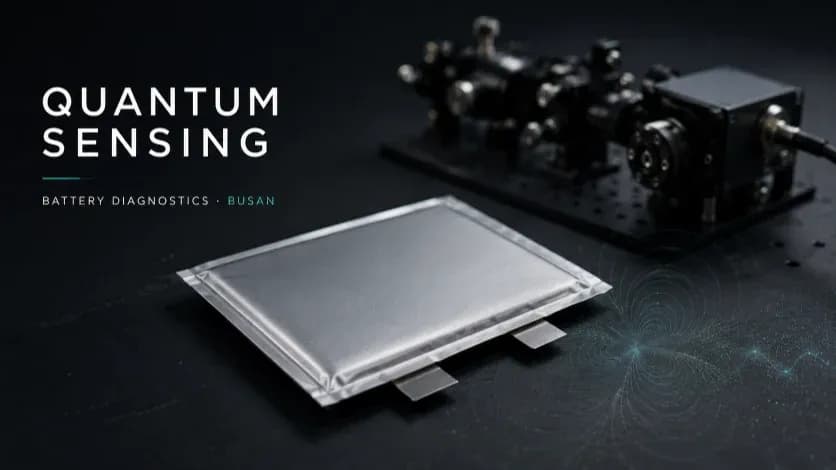
South Korea has assigned quantum sensing to Busan, Ulsan and South Gyeongsang. A battery project in Busan shows how much of the work lies in machinery, shielding, software and measurement before a sensor becomes industrial equipment.
South Korea designated its first three regional quantum clusters on Sept. 1, assigning Seoul to quantum computing, Gwangju and South Jeolla to quantum communications, and Busan, Ulsan and South Gyeongsang to quantum sensing. The southeastern program is scheduled to run from 2027 through 2030, with Pusan National University and UNIST serving as its two technology hubs. Shipbuilding and marine engineering, ports and logistics, aerospace and defense, and mobility and energy have been identified as industries where the region will develop applications. The program extends from sensor fabrication through packaging, testing, certification and field demonstration, with final funding still dependent on the national budget process.
Ulsan already has the largest new piece of dedicated quantum-device infrastructure in the region. UNIST opened its 30 billion won Quantum-Nano FAB in March, combining device design, fabrication, analysis and validation in one facility. Beyond the university are automotive plants, shipyards, petrochemical complexes and machinery companies; South Gyeongsang adds aerospace and defense manufacturing, while Busan contributes the country’s largest container port, maritime industries and a substantial base of logistics and industrial-service companies. A device developed in the southeast can move quickly from a controlled research environment into factories, vessels and machinery where vibration, electromagnetic interference, temperature, maintenance and cost become part of the engineering.
Busan had begun doing that work before the national designation arrived. In August 2025, the city announced a two-year, 2.45 billion won project to diagnose battery defects with quantum magnetometers, including 1.65 billion won in central-government funding. The consortium brings together the Busan IT Industry Promotion Agency, Pusan National University, Neotech, Dongil Rubber Belt and battery company Cobat. Its work extends beyond the magnetometer itself to the mechanical system, sensor control, data processing and industrial comparison required to use a highly sensitive measurement inside an existing production process.
By late 2025, Dongil Rubber Belt had developed a nonmagnetic timing belt and shielding-related components intended to prevent the inspection apparatus from interfering with the magnetic signal, while Neotech had built a multichannel monitoring system to collect and correct sensor data. Cobat was responsible for producing aged battery cells, establishing reference data and comparing the system with existing inspection methods. Those tasks put ordinary engineering around an unusual measuring device — mechanical handling, vibration control, electromagnetic shielding, electronics, software and test procedures — before the sensor can be treated as factory equipment.
A Busan Metropolitan Council hearing in July provided a later view of the project. BIPA acting president Lee Jae-deok told council members that batteries had been placed on a specially designed belt and examined using the sensing system, saying the work had reached a stage where practical application was possible. The public material available so far does not disclose defect-detection rates, false positives or negatives, inspection speed, recalibration requirements or operating cost, all of which would matter to a manufacturer comparing the system with equipment already on a production line. The equipment has been demonstrated in an industrial setup; comparable performance against incumbent inspection methods has not been published.
The Southeast’s Industrial Base
QED-C, the U.S.-based Quantum Economic Development Consortium, estimates global quantum-sensing revenue at about $470 million in 2025 and $1.1 billion by 2028. Its 2026 survey covered 58 respondents representing 47 companies, and more than one-third reported no quantum-sensing sales in 2025. Defense is projected to account for 35 percent of revenue in 2028, with civilian government bringing the combined public-sector share to 47 percent.
Quantum sensing encompasses instruments that enter very different markets. Atomic magnetometers, gravimeters, inertial sensors, optical clocks and other devices measure different physical quantities and compete with different established technologies. A magnetic sensor proposed for battery inspection has to justify itself against electrical, imaging and other nondestructive methods already used by manufacturers; a navigation sensor enters vessels or aircraft equipped with technologies that have established reliability and certification records. Sensitivity remains important, but customers also buy speed, stability, maintenance, size, power consumption and compatibility with equipment already in service.
The southeastern program includes many of the physical steps between the underlying quantum device and industrial use. Its scope covers fabrication, packaging, testing, certification and field demonstration, while UNIST’s new fab gives the region a facility for producing and validating devices. Around it is an economy that already manufactures machinery, electronics, ship systems, automobiles and aerospace components for environments where vibration, corrosion, temperature changes and prolonged operation are routine design constraints. The companies in those industries are not customers simply because they sit inside the cluster, but they provide the conditions in which new equipment has to function.
The United States is also investing in manufacturing at this stage of quantum development. NIST announced an initial $20 million Quantum Manufacturing Engineering Center in June after identifying manufacturing engineering as a weakness in efforts to expand commercial quantum production. The center will work on scalable components and complete systems, including enabling equipment such as cryostats and lasers, and its mandate includes quantum sensing and sensor manufacturing.
Busan’s battery consortium puts those disciplines around a single sensor. Dongil Rubber Belt did not join the project as a quantum-physics laboratory; its work concerns a belt and surrounding components that will not overwhelm an extremely weak magnetic measurement. Neotech handles control, correction and data, while Cobat supplies the batteries and the inspection process against which the system has to perform. If the project produces equipment that can be used routinely, much of what an operator sees and maintains will consist of machinery, electronics and software surrounding the quantum measurement.
The industries named in the cluster contain costly measurement problems, but access to a shipyard, terminal or factory does not create demand on its own. Shipbuilders already use established inspection techniques, ports purchase systems according to throughput and reliability, and aerospace and defense suppliers work within demanding qualification regimes. New sensing equipment enters those environments only when a particular measurement improves an existing process enough to justify the additional equipment, operating procedure and cost.
A Battery Project and a 455 Million Won Order
Another quantum project linked to Pusan National University has already produced a manufactured piece of equipment and a recorded purchase. Researchers at the university and the Korea Institute of Machinery and Materials developed a domestically produced dry dilution refrigerator, equipment used to cool some quantum systems to extremely low temperatures. The national R&D exhibition at the 2026 Korea Science Festival says the work led to the establishment of Busan-based Quantum Kelvin and delivery of Korea’s first domestically produced unit. The refrigerator serves quantum computing rather than sensing, but it offers a nearby example of specialized quantum equipment moving beyond the original research project.
A June 2025 procurement record identifies Kyungpook National University’s Industry-Academic Cooperation Foundation as the buyer of a cryogenic refrigeration system from Quantum Kelvin for 455 million won. Universities and research institutes remain important customers for quantum equipment, so a single institutional order says little about the eventual size of the private market. It nevertheless records a supplier, a defined machine, a buyer and a price.
The battery system enters a different commercial setting. Its prospective users already inspect batteries, meaning the new method has to provide information valuable enough to justify the shielding, machinery, calibration and software required to obtain it. Government funding can carry part of that engineering risk while the system is being developed. QED-C’s survey shows public research funding remaining central to the sector, while government and defense customers are expected to account for a substantial share of sensing revenue through 2028.
Consistent measurement becomes more important as suppliers begin competing for purchases. NIST brought companies, laboratories and metrology specialists together in May to identify measurement and characterization requirements for quantum technologies, including quantum sensing. The work feeds into NMI-Q, a G7-endorsed collaboration among national metrology institutes developing measurement practices for emerging quantum technologies. Buyers comparing instruments need calibration procedures and test conditions that allow performance reported by different suppliers to be compared outside the laboratories where the devices were developed.
Busan’s battery project raises those questions in a practical form. Detection accuracy on a set of cells has to be tied to the defect type, reference method and test conditions. Inspection speed has to account for the complete handling system rather than the sensor alone, while magnetic sensitivity has to survive motors, structural steel and electrical equipment surrounding a working line. Longer operation would also show how often the system requires recalibration and whether its results remain stable. Those figures have not been disclosed in the public material reviewed for the project so far.
The three-region structure divides much of this work before a finished sensing system reaches a customer. Ulsan begins with the Quantum-Nano FAB and some of South Korea’s largest manufacturing sites. South Gyeongsang contributes aerospace, defense, shipbuilding, machinery and mobility industries, while Busan brings Pusan National University and operating environments connected to ports, logistics and maritime systems. Device fabrication, control software, components, installation and servicing do not have to accumulate in the same jurisdiction simply because the companies involved belong to one regional cluster.
Busan has industrial roles available outside device fabrication itself. Its battery consortium already includes a manufacturer working on the physical apparatus and a software company working on sensor control and data. Calibration, industrial validation, installation and maintenance would remain necessary if the equipment were installed more widely, while maritime sensing would add engineering around vessels, terminals and offshore operating conditions. Whether individual companies develop those activities beyond the projects in which they first participated will emerge through their products and customers.
Busan officials had chosen sensing as the city’s specialization before the national designation was announced. At the July council hearing, Future Technology Strategy Bureau chief Kim Dong-hyun said quantum computing was already stronger in Daejeon and the Seoul metropolitan area and that Busan intended to concentrate on quantum sensing. Elsewhere in the same hearing, BIPA described batteries already moving through the experimental inspection setup.
Continue this reporting
Reporting on the same issue
Related coverage selected from the article's desk, topics and newsroom relationships.
 NewsAug 31, 2026
Gadeok’s Future Depends on the Network Busan Builds
Busan’s aviation market is growing years before Gadeok is scheduled to open....
 NewsAug 29, 2026
Busan Biennale 2026: What ‘Dissident Chorus’ Reveals After 45 Years
Busan Biennale 2026 opens with ‘Dissident Chorus,’ 46 artists and teams from...
 NewsAug 28, 2026
The Reactor Built for a Different Grid
Korea’s i-SMR gives up some of the economies of scale that made conventional...
More from the author
More from this byline
Stay with the same line of reporting through more work from this byline.
 NewsAug 23, 2026
When Smart Glasses Stop Looking Like Computers
 NewsAug 15, 2026
Busan Port’s Next Automation Challenge Lies Between the Machines
Editorial Record
Corrections, sourcing notes and newsroom disclosures remain part of the published record. View Newsroom Notes →
Reader Signal
Community readWhat did this report leave you with?
Choose the signal that best reflects your reading. Select it again to remove it.
One response per article
No response selected
A moderated conversation about the reporting.
One-level replies and newsroom moderation keep the conversation anchored to this article.
Discussion Status
Open
Please sign in to join the discussion.
Newsletter
Weekly reporting and context from Busan and Korea.