Europe’s Heatwave Tests Net Zero in a Less Predictable Climate
Carbon targets remain essential, but extreme heat is exposing a harder test for the energy transition: whether grids, buildings, cooling systems and household budgets can withstand the climate already arriving.

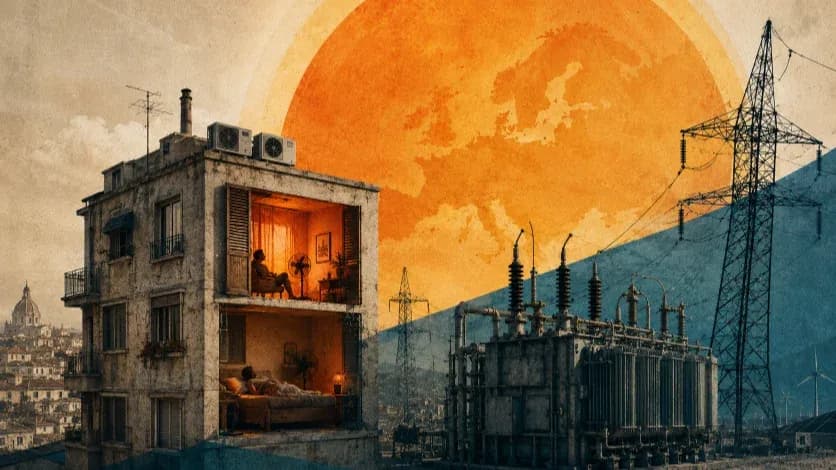
Europe’s heatwave shows why carbon targets remain necessary but insufficient. A hotter world is testing the grids, buildings, cooling systems, household budgets and political choices that must make the energy transition livable.
Paris reached 40.9°C in late June, and the heat quickly moved indoors. In apartments built for a milder climate, some residents booked hotel rooms for air conditioning. Others slept outside rather than return to rooms that had not cooled overnight. The heatwave also reached the machinery of daily life: rail services slowed, schools changed schedules, and warm river water forced parts of Europe’s power system to reduce output.
Climate policy was not designed for moments like that. It was designed to make warming measurable and governable. Carbon markets, renewable-energy targets, vehicle rules and net-zero laws all depend on a managed pathway: emissions peak, fall and eventually approach zero. Heat does not follow that sequence. It arrives through blocked weather patterns, tropical nights, failed ventilation, overloaded local equipment and bills that decide whether cooling is used or endured.
The energy transition was written as a route away from fossil fuels. Extreme heat is testing it as an operating system. Cars, heating, cooling, data centres and parts of industry are moving onto electricity just as a hotter climate is making electricity more important for daily safety. Cleaner power remains essential. The harder test is whether that power reaches an apartment block, a hospital ward, a school or a factory during the hours when heat turns demand into risk.
Europe makes the test sharper because it did not arrive at the heatwave without climate policy. The European Union has one of the world’s most developed frameworks for emissions reduction, with binding targets, a carbon market and a legal path toward climate neutrality. Those institutions can change investment incentives and cut future emissions. They do not cool a fifth-floor flat at midnight, replace an ageing distribution line before a heatwave, or decide whether a pensioner can afford to run an air conditioner through the night.
Every fraction of warming avoided still matters. Giving up on mitigation would make the heat burden larger and more expensive. Yet the systems meant to deliver net zero now have to operate inside the warmer climate that past emissions have already created. Grids have to carry new peaks. Buildings have to keep heat out. Cooling has to spread without overwhelming the networks that supply it. Governments have to protect households that cannot buy their own way out of heat.
The June heatwave exposed more than Europe’s readiness for summer. It exposed an old assumption built into modern infrastructure: the past could guide the future. Energy policy is still written in target years and investment plans. Heat is moving through apartments, substations, rivers and household budgets now.
The old assumption was predictability
Modern infrastructure was built with confidence in the past. Engineers studied decades of temperature, rainfall, river flow and electricity demand, then designed roads, drainage, power stations, substations and buildings around the ranges those records described. Extreme events were expected, but they were treated as boundaries around a stable climate rather than evidence that the boundary itself was moving.
Climate change weakens that bargain. The old engineering assumption is known as stationarity: natural systems fluctuate within a range that can be estimated from historical records. Water managers warned years ago that the assumption no longer held as greenhouse-gas concentrations altered precipitation, evaporation, snowmelt and river flow. The same logic now reaches beyond water. Power grids, cooling systems, housing codes and public-health plans also rely on a past climate that no longer gives a secure guide to future stress.
Heat makes the break visible because it moves through daily life with little delay. A hotter baseline changes the meaning of a heatwave. A high-pressure system that once produced discomfort can now produce dangerous nights, closed classrooms, strained hospitals and electricity peaks after sunset. Buildings designed to retain winter heat become difficult to cool. Transformers sized around older summer demand face air conditioners running across whole apartment blocks. Rail lines, roads and power plants encounter temperatures outside the conditions around which they were planned.
Europe’s position sharpens the warning. The continent has warmed faster than the global average, and much of its built environment was shaped by a different climate. A summer once treated as exceptional can return before the memory of the last one has left public budgets. Emergency heat plans can reduce deaths, but emergency planning cannot substitute for shaded streets, cooler housing, reinforced distribution grids and electricity tariffs that allow vulnerable households to use cooling before heat becomes a medical risk.
Net-zero policy was also built around a form of predictability. Governments set target years, emissions pathways, renewable-energy shares, carbon prices and investment schedules. The language suggests a managed descent from fossil fuels: less coal, less gas, more renewables, more electrification, lower emissions. The pathway remains necessary. Without emissions cuts, the heat burden grows. But the pathway has to run through physical systems exposed to the climate disruption it is meant to limit.
A national target can move smoothly on paper while stress appears in uneven places. A distribution line in an old district may fail before a country misses its emissions target. A hospital may need more cooling before a new transmission project is approved. A tenant may face dangerous indoor heat before a retrofit programme reaches the building. A factory may electrify equipment while the local grid is still waiting for reinforcement. Carbon accounting measures the direction of policy. Heat tests the places where policy has to work.
Target-based policy can create a false sense of order. A 2030 target, a 2040 target and a 2050 target imply a sequence. Extreme heat does not respect that sequence. It can force adaptation before infrastructure is ready, before households can afford new equipment, before regulators redesign tariffs, and before cities change the surfaces, roofs and streets that trap heat.
Energy planning now has to treat climate conditions as moving inputs rather than background assumptions. Peak demand can no longer be read only from past summers. Building standards cannot focus only on winter heat loss. Cooling policy cannot wait for air conditioners to spread household by household. Grid investment cannot be judged only by annual electricity consumption when the dangerous hours are concentrated, local and weather-driven.
Europe is the test because it is not a laggard
Europe is not a useful case because it ignored climate policy. It is useful because it did so much of the opposite. The European Union built a carbon market, wrote climate neutrality into law, tightened vehicle standards, expanded renewable-energy targets and placed emissions reduction at the centre of industrial policy. Its climate law requires net greenhouse-gas emissions to fall by at least 55 percent by 2030, compared with 1990 levels, and sets a 90 percent reduction target for 2040 on the way to climate neutrality by 2050.
The heatwave landed in a region already fluent in the language of transition. Carbon regulation can make fossil fuels more expensive and clean investment more attractive. Renewable targets can change the generation mix. Vehicle and building rules can push households and companies toward electricity. None of those tools, by themselves, decide how a dense city cools its apartments during tropical nights or how an old distribution grid carries a new evening peak.
Europe’s warming makes the gap harder to dismiss. Copernicus describes the continent as the fastest-warming in the world, warming more than twice as fast as the global average and about 2.5°C above pre-industrial levels. Much of the built environment was not designed around that climate. Cities that once planned around winter heat retention now have to manage summer overheating. Streets, roofs and façades that stored warmth as an asset can turn into liabilities. A building standard that saves gas in February may still leave a top-floor flat dangerous in June.
The electricity system carries the same contradiction. Decarbonisation asks the grid to do more work. Electric vehicles, heat pumps, data centres, hydrogen production, industrial electrification and cooling all point toward higher electricity use. The European Commission expects EU electricity consumption to rise by around 60 percent by 2030. At the same time, 40 percent of distribution grids are more than 40 years old, and the Commission estimates that €584 billion in grid investment will be needed by the end of the decade.
A hot week is therefore not just a temporary rise in electricity demand. It is an early test of the infrastructure Europe needs for its entire decarbonisation strategy. If local networks cannot absorb cooling peaks, electrified transport and heating will compete for the same physical capacity. If grid reinforcement lags, clean generation may exist on paper while households, hospitals and factories face bottlenecks in the places where power has to arrive.
Policy can move faster than concrete, copper and permitting. A legislature can set a 2040 target in a vote. A transmission line can spend years in planning disputes. Distribution upgrades have to reach streets, apartment blocks, industrial zones and rural communities one project at a time. Building retrofits move through landlords, tenants, subsidies, contractors and household savings. Heat compresses those delays into a single afternoon or night, when the grid either carries the load or it does not.
Europe’s dilemma also exposes the social side of the transition. The continent can price carbon, subsidise renewables and regulate cars, but the heat burden falls through housing markets. Wealthier households can install efficient cooling, shading, insulation, rooftop solar or batteries. Renters may not be allowed to alter their flats. Elderly residents may avoid using cooling because of electricity bills. Public schools and hospitals need cooling that cannot depend on private purchasing power.
Europe’s heat problem is larger than air conditioning. Cooling will spread because people will need it. The policy choice is whether it spreads as an uneven private response or as part of a planned system of efficient buildings, shaded cities, reinforced grids, public cooling spaces and tariff protection for vulnerable households. A continent can lead on emissions and still fall behind on the systems that allow people to live through the warming already present.
Heat changes both sides of the power system
Heat is often described as a demand problem for electricity. Temperatures rise, air conditioners switch on, and power use climbs. A severe heatwave is more complicated. It raises demand while making generation, transmission and pricing more difficult.
Cooling demand is the most visible pressure. Homes, offices, shops, hospitals, schools and transport systems need electricity at the same time, often during the same late-afternoon and evening hours. A household may delay laundry or charging an electric vehicle. It cannot easily delay cooling when indoor temperatures remain dangerous after sunset. A hospital ward does not treat air conditioning as a flexible load. A school cannot wait for cheaper power if classrooms have become unsafe.
The harder problem sits below national demand curves. Heat stress appears locally before it appears nationally. A country may have enough generation capacity on paper while a neighbourhood transformer is close to its limit. A city may report adequate reserves while an old distribution line carries loads it was never designed to handle. The transition depends on large numbers — gigawatts of renewables, national demand forecasts, emissions reductions — but heat often breaks systems through smaller pieces of equipment in specific places.
Supply can also become less reliable during extreme heat. Power plants that depend on river water for cooling can face limits when water is too warm or too low. Thermal plants may reduce output to protect equipment or comply with environmental rules. Wind generation can fall during stagnant high-pressure systems. Solar output helps during hot days, but it does not remove the evening peak when buildings remain hot and people return home. Transmission equipment can operate less efficiently under high temperatures, and lines may face tighter limits.
A heatwave can turn electricity from a background service into a visible political problem within hours. Wholesale prices can rise when demand jumps, generation is constrained or imports become expensive. Utilities and governments may absorb some of that pressure, but the cost eventually moves somewhere: bills, subsidies, public budgets or delayed investment. For a low-income household, the relevant question is not the average cost of electricity over a year. It is whether cooling can be used during the hottest night without fear of the next bill.
Industry faces a parallel calculation. Electrification is supposed to make factories cleaner. It also makes them more dependent on power prices and grid reliability. A manufacturer weighing electric furnaces, heat pumps or low-carbon processes will look beyond emissions rules. It will ask whether electricity is available at the right location, whether connection queues are manageable, whether prices remain competitive and whether the grid can handle peak conditions.
Data centres sharpen the conflict because they want the same qualities that heat-stressed cities need: reliable electricity, cooling, grid connections and backup power. Artificial intelligence has turned data centres into a new source of political attention, but the underlying issue is competition for electrical capacity. During a heatwave, household cooling, hospital safety, industrial production and data infrastructure all draw from the same system.
Renewables do not remove the challenge by themselves. Clean generation is essential, and more solar, wind, storage and transmission will reduce the emissions behind future heat. Yet a grid with high renewable capacity can still struggle if power cannot move to the right place, if storage is insufficient, if demand peaks after solar output declines, or if local networks lag behind national targets. During extreme heat, the test is not how much clean power exists in aggregate. It is whether that power can be delivered through the last miles of the system when demand is concentrated and urgent.
For decades, energy security was framed around fuel supply: oil shocks, gas pipelines, coal reserves, import dependence. A more electrified economy moves the question closer to the socket. Security now includes whether a city can move enough clean electricity through old distribution networks during a hot night, whether backup systems protect hospitals, whether vulnerable households can cool one safe room, and whether power markets can absorb weather-driven stress without losing public trust.
The power system was once treated as the platform on which the transition would run. Heat makes the platform part of the transition itself. Cleaner generation remains the foundation. Substations, local grids, storage, demand response, cooling efficiency, tariff design and essential services now decide whether electricity remains protection when the weather turns dangerous.
Cooling is the adaptation paradox
Air conditioning used to sit at the edge of European energy policy. Heating, transport and industry drew most of the attention because they were larger, older and easier to count in emissions inventories. Hotter summers are changing that hierarchy. Cooling is becoming one of the first places where climate adaptation enters the home, the body and the electricity system at the same time.
A cooling unit can mean very different things depending on where it is viewed from. In an overheated flat, it can protect sleep, medication, pregnancy, old age and basic health. On a neighbourhood grid, it is another load arriving during the same hours as thousands of others. On a household bill, it is a recurring cost. On a dense street, it pushes heat outside while cooling the room inside. With the wrong refrigerant, it can create another climate liability.
Europe’s problem is no longer whether people should cool their homes. Heat is making that debate obsolete. The real choice is whether cooling grows as a planned public system or as a private emergency market. A private market follows income, property ownership and building permission. It cools the homes of people who can buy, install and run equipment. It leaves renters, elderly residents, low-income families and people in poorly insulated flats more exposed.
A planned system starts earlier. It keeps heat out before machines are switched on. External shading, reflective roofs, tree cover, ventilation, insulation designed for both winter and summer, and rules against severe indoor overheating can reduce electricity use during dangerous hours. The cheapest unit of peak electricity is often the heat that never enters the building.
Active cooling will still be necessary. Passive design cannot remove every risk from a 40°C day, and hospitals, care homes, schools and dense housing blocks will need reliable mechanical cooling. Efficiency then becomes a health issue as well as an energy issue. Inefficient units multiply demand across millions of rooms, raise bills, force more grid investment and make peak hours harder to manage. Efficient cooling lowers the burden before it reaches the transformer.
The refrigerant question adds another layer. Cooling protects people from heat, but some cooling systems have relied on gases with high global-warming potential. A badly managed expansion of air conditioning can reduce immediate heat exposure while adding long-term climate risk. Equipment standards, refrigerant rules, maintenance and disposal belong in the same policy conversation as grid planning and public-health protection.
Cities also have to confront the heat that cooling moves rather than removes. An air conditioner lowers indoor temperature by rejecting heat outdoors. One unit changes little. Thousands of units operating in a dense district can add waste heat to streets and courtyards already warmed by asphalt, dark roofs, traffic, low tree cover and weak airflow. Cooling policy cannot stop at the apartment wall. Urban design decides how much heat buildings absorb and how much waste heat neighbourhoods can tolerate.
Public cooling spaces will become more important as heatwaves lengthen. Libraries, schools, community centres, transport hubs and municipal buildings can serve as cooling refuges during dangerous periods. Yet refuges do not solve the night-time problem inside homes. Heat risk often deepens after sunset, when old buildings release stored warmth and vulnerable residents are alone. A city can open cooling centres during the day and still leave people exposed in bedrooms that never fall to safe temperatures.
The social fault line is already visible. Winter energy poverty has long meant the inability to heat a home. A hotter climate is creating its summer counterpart: the inability to keep one room safely cool. The measure is not whether a household owns an air conditioner. Ownership says little about whether the unit is efficient, whether the wiring can support it, whether the landlord allows installation, whether the resident can afford the bill, or whether the room stays cool after several nights of heat.
Subsidies aimed only at purchasing equipment may help some households while adding load to fragile local grids. Tariff relief can reduce fear of bills but does not fix overheated buildings. Retrofit programmes can lower demand but may raise rents if tenant protections are weak. Public-health warnings can save lives, but warnings are not cooling.
The better test is not how many air conditioners Europe installs. It is how much dangerous indoor heat can be reduced without creating new peaks that make the power system harder to run. Building standards, appliance efficiency, low-warming refrigerants, shaded streets, social tariffs, public cooling spaces, demand response and local grid reinforcement have to be planned together.
Cooling is the adaptation paradox because it is both necessary and risky. People will need more of it as heat increases. The energy transition will become more fragile if cooling expands inefficiently, unevenly and without planning. A sustainable system cannot ask households to endure unsafe heat in the name of lower demand. It also cannot allow cooling to grow in a way that turns every heatwave into a test of bills, transformers and public trust.
South Korea shows what comes after cooling becomes normal
Europe shows what happens when cooling moves from the margins of energy policy into the centre of public life. South Korea shows a later stage of the same problem. Air conditioning is already normal in most homes, offices, shops and public buildings. Heat still keeps pushing the system harder.
Government estimates cited by Reuters put air-conditioner ownership at about 98 percent of South Korean households. That level of ownership might suggest a mature market. The opposite is happening. Samsung Electronics and LG Electronics reported sharp increases in domestic home air-conditioner sales in early 2025 as consumers replaced older units with models marketed for stronger cooling, higher efficiency and AI-assisted controls. Cooling demand is no longer expanding only through first-time purchases. It is also expanding through upgrades, longer use and higher expectations of indoor comfort during longer summers.
Korea complicates a simple story about access. The question is not only whether people own cooling equipment. The question is how often they need to use it, whether the equipment is efficient, whether the household can afford the bill, and whether the grid can manage the hours when cooling demand stays high. Residential air conditioning accounted for 16 percent of South Korea’s annual power demand last year, up from 14 percent before the pandemic. That shift is small enough to look manageable in an annual figure and large enough to matter during the hottest hours.
The stress appears most clearly in summer peaks. Korea’s energy ministry warned in 2025 that air-conditioning use could push peak demand close to record levels between 5 p.m. and 6 p.m. on weekdays, the hour when cooling demand remains sticky after buildings have absorbed heat through the day. For 2026, the government expects summer peak demand to reach as much as 98.8 gigawatts. Available supply is projected at 107 gigawatts, leaving an expected reserve of 8.2 gigawatts. That forecast does not point to an immediate shortage. It points to a narrower operating problem: heat, evening demand, solar variability and household bills have to be managed together.
Korea also shows why cooling cannot be separated from the rest of electrification. The country is planning for rising electricity demand from AI data centres, semiconductor clusters, transport and industrial processes. Cooling is one of several loads arriving on the same grid.
The comparison with Europe removes a false comfort. Europe cannot solve the heat problem simply by becoming more like air-conditioned Asia. Korea already has widespread cooling, advanced electronics manufacturers, a dense power system and strong public capacity for emergency planning. Even so, summer heat is changing the profile of demand and forcing policy to reach into tariffs, reserves, vulnerable-household support and long-term grid planning.
Household protection is part of the system design. Korea’s 2026 summer measures include a temporary expansion of residential electricity pricing brackets in July and August, a higher bill discount for vulnerable households and continued electricity service for customers in arrears during the hottest months. Those measures recognize what annual demand curves can miss. Cooling is not discretionary when heat becomes a health risk, but the decision to turn it on still passes through income, fear of bills and tariff design.
Korea’s case also carries a warning for industrial economies trying to electrify quickly. A country can support cooling access and still need more power for data centres, electric vehicles, semiconductor plants and cleaner industrial processes. A country can have enough supply in an official forecast and still face local bottlenecks, price pressure or political fights over generation mix and transmission. Heat turns every new source of electricity demand into part of the same planning problem.
The lesson from Korea is not that widespread air conditioning is a mistake. In a hotter climate, cooling protects lives. The lesson is that cooling does not end the energy-transition problem once the units are installed. It moves the problem into efficiency standards, peak management, grid reinforcement, tariff design, social protection and the competition for electricity created by digital and industrial growth.
Europe is confronting the arrival of mass cooling. Korea is confronting the consequences of mass cooling under stronger heat. Both cases point to the same conclusion: the energy transition cannot be planned around annual emissions and generation capacity alone. It has to account for the hot hour, the overloaded district grid, the household bill and the other sectors waiting to use the same electricity.
The transition is global in physics and fragmented in politics
Heat does not care which government built the grid, which party wrote the energy law or which country controls the supply chain for solar panels and batteries. A hotter atmosphere moves through borders as physics. The energy transition moves through borders as politics.
Global capital is still moving toward cleaner energy. The International Energy Agency expects energy investment to reach about $3.3 trillion in 2025, with roughly twice as much going into clean technologies as into fossil fuels. Solar, wind, grids, storage, nuclear power, efficiency and electrification now sit at the centre of energy investment. The broad direction of technology and finance is not the same as the direction of politics.
Europe has chosen regulation as its main instrument. It prices carbon, sets emissions targets, tightens standards and uses industrial policy to keep clean technology inside its economic strategy. The approach gives Europe a clearer climate framework than most regions. It also exposes Europe to public resistance when electricity bills, building rules, industrial costs and grid bottlenecks become more visible than future temperature benefits.
The United States shows the opposite risk: scale without policy continuity. American renewable development is supported by cheap land in some regions, private power contracts, state-level mandates and fast-growing demand from data centres. Yet federal policy can move sharply with elections. President Donald Trump ordered the United States out of the Paris Agreement after returning to office, and his administration moved to curtail support for wind and solar. Reuters reported in June 2026 that developers were rushing to secure tax-credit eligibility before a July deadline, with analysts warning that the rollback could raise wind and solar power costs by 40 to 50 percent.
American renewable energy will not stop because federal policy turns hostile. Unsubsidized solar and wind remain competitive in many markets, and data centres still need large volumes of power. The problem is not disappearance. The problem is uncertainty. A grid planner, a factory owner or a city preparing for hotter summers cannot treat the world’s largest economy as a stable climate-policy partner when federal rules, subsidies and international commitments can change with the electoral cycle.
China sits in a different position. It remains the world’s largest emitter and a major coal consumer, but it also dominates much of the manufacturing base needed for the transition. Clean technology is now part of Chinese industrial strategy as much as climate policy. For Europe, the United States and Korea, that creates a double bind: the fastest route to deployment may deepen dependence on a strategic competitor.
The result is a transition shaped by mistrust as well as engineering. Countries want clean technology, but they also want domestic jobs, secure supply chains, control over critical minerals and protection from foreign industrial pressure. Tariffs, local-content rules, export controls and subsidy races are now part of climate policy. A solar panel or battery is no longer only a tool for cutting emissions. It is also a trade issue, an industrial asset and a security concern.
South Korea and Japan face their own version of the trade-off. Both depend heavily on imported energy, both have advanced manufacturing sectors that require reliable electricity, and both are trying to manage decarbonisation without weakening industrial competitiveness. Korea’s electricity debate cannot be separated from semiconductors, data centres, transmission bottlenecks, nuclear policy, gas imports and household bills. Heat adds pressure to a system already balancing energy security against industrial demand.
The geopolitical problem matters for heat because adaptation also needs coordination. Grids require equipment. Cooling requires efficient appliances and low-warming refrigerants. Storage requires batteries and minerals. Cities need finance. Developing economies need capital before heat and flood risks become more damaging. A fragmented transition raises the cost of all of these steps. Each delay leaves more societies trying to adapt after the weather has already changed.
Climate diplomacy often speaks as if the world is solving one shared problem. The physics is shared. The institutions are not. Europe is regulating. China is manufacturing. The United States is oscillating. Korea is balancing industrial demand with energy security. Developing economies are asking for finance while facing the fastest growth in cooling needs. Heat does not wait for these strategies to converge.
The energy transition cannot be judged only by the falling cost of clean technology. Costs matter, and the economics of renewables have changed the global energy system. But deployment still passes through permitting, elections, trade policy, grid queues, local opposition, industrial lobbying and national security reviews. A technology can be cheap and still arrive too slowly, in the wrong place, or under political conditions that weaken public consent.
The policy gap is no longer only emissions
The world is still missing its emissions pathway. The latest round of national climate plans has improved the temperature outlook at the margins, but not enough to make the Paris goals secure. The UN Environment Programme’s 2025 emissions assessment puts the world on a path to about 2.8°C of warming under current policies. Full implementation of national pledges would lower that projection to roughly 2.3°C to 2.5°C. The direction is better than the worst forecasts of a decade ago. The destination is still far beyond the level at which heat, water stress, crop losses and ecosystem damage become much harder to manage.
That gap matters because adaptation is not waiting in a separate file. Every missed cut in emissions adds pressure to buildings, grids, food systems, water networks and health services. A tenth of a degree can sound small in diplomatic language. In the built environment, it can mean more nights when homes do not cool, more hours when outdoor work becomes unsafe, more neighbourhoods requiring mechanical cooling, and more power demand arriving during the same hot days.
The old climate-policy debate often separated mitigation from adaptation. Mitigation reduced the danger. Adaptation managed what could not be avoided. That division is becoming less useful. When emissions fall too slowly, adaptation becomes more expensive. When adaptation is underfunded, people experience climate policy as exposure rather than protection. The two failures reinforce each other.
The finance numbers show how wide the second gap has become. UNEP estimates that developing countries will need about $310 billion a year for adaptation by 2035 based on modelled costs, or $365 billion a year when needs expressed in national adaptation plans and climate pledges are extrapolated. International public adaptation finance flows to developing countries were about $26 billion in 2023. The shortfall is usually described as a moral failure because the countries most exposed to climate risk contributed least to the emissions that created it. It is also a systems failure. Roads, drainage, cooling access, grid reinforcement, hospitals and early-warning networks have to be financed before extreme weather arrives.
The adaptation gap is not confined to poorer economies. Wealthier countries have more fiscal room, stronger institutions and deeper capital markets, but they still struggle to move old systems fast enough. Europe’s grid investment needs are measured in hundreds of billions of euros. Its buildings are renovated slowly. Its heat plans depend partly on emergency response because the housing stock cannot be changed in one summer. The United States has the capital to build clean power and harden infrastructure, but federal climate policy can turn with elections. South Korea can plan reserves and support vulnerable households, yet summer peaks still sharpen as heat, cooling and industrial electricity demand rise together.
Adaptation also suffers because many of its benefits are invisible when it works. A flood defence that prevents damage, a shaded street that lowers heat stress, a retrofit that avoids hospital admissions, or a stronger distribution line that does not fail during a hot night rarely produces the same political image as a new power plant. The avoided disaster appears as an absence. That makes protection harder to finance, harder to campaign on and easier to delay.
The delay is dangerous because extreme events compress time. A government can promise an emissions target for 2050. A city can publish a heat plan for 2030. A utility can propose grid reinforcement over a decade. A heatwave arrives on Tuesday. It asks whether the cooling centre is open, whether the hospital backup system works, whether the old transformer holds, whether the tenant can afford the bill, and whether the railway can keep running in higher track temperatures.
Overshoot makes the timing problem sharper. Climate models can describe pathways in which global temperature temporarily exceeds 1.5°C and later falls back through deep emissions cuts and carbon removal. Human systems live through the overshoot before any later correction appears. Crops do not wait for the back half of a pathway. Elderly residents do not wait for carbon removal. A damaged ecosystem may not return because a chart bends down after mid-century.
The policy gap is not a single gap between pledged emissions and required emissions. It is a double gap between the warming path governments are still allowing and the protection systems they are failing to build at the required speed. One side spends the carbon budget. The other leaves societies exposed to the heat already purchased.
The energy transition cannot close that gap through cleaner generation alone. It needs faster emissions cuts, but also faster protection: grids built for hotter peaks, buildings designed for summer safety, cooling that does not overload local networks, public finance for adaptation, and tariffs that allow vulnerable households to use electricity when heat becomes dangerous. Without that second track, climate policy will be judged by people who meet it as a hot room, a higher bill, a delayed train or a failed power line.
Sustainability after predictability
Net zero still describes the direction. The case for cutting emissions has not weakened because heat is already here. It has strengthened. Every fraction of warming avoided reduces the scale of future cooling demand, grid stress, crop loss, water pressure and heat exposure. A world that gives up on mitigation would not become more realistic. It would become harder to live in and more expensive to protect.
The harder lesson is that emissions targets are no longer enough to define sustainability. A country can publish a credible carbon pathway and still leave people exposed in overheated homes. A grid can add clean generation and still fail to deliver power through old distribution lines during a hot night. A city can declare a climate emergency and still lack shaded streets, safe schools, cooling centres and housing standards that keep indoor temperatures below medical risk.
The energy transition was often presented as a managed replacement of one system by another: coal, oil and gas giving way to renewables, electrification and efficiency. Extreme heat changes the test. The replacement system has to operate while the climate baseline is moving. It has to carry more electricity for cooling, transport, heating, data centres and industry while the weather adds sharper peaks and more frequent disruptions. It has to cut emissions while also protecting people from the heat already built into the atmosphere.
That makes sustainability more operational and less rhetorical. It can no longer rest on a future date or a single emissions curve. It has to be found in transformer capacity, building codes, roof materials, cooling standards, refrigerants, hospital backup systems, tariff design, public finance and the speed of permitting. The machinery is less elegant than a net-zero pledge. It is also where the pledge either becomes livable or loses public consent.
Europe’s heatwave shows one side of the problem. A region with advanced climate rules is discovering that carbon policy does not automatically produce heat resilience. South Korea shows another side. A country where air conditioning is already widespread still has to manage longer use, higher peaks, household bills, industrial electrification and data-centre demand. The United States shows the political risk: technology can advance while federal policy swings. China shows the supply-chain risk: the fastest route to clean deployment can deepen dependence on concentrated manufacturing.
These cases do not point to a single model. They point to a shared condition. The physics of warming is global, but the systems that must respond are national, local and uneven. Heat reaches an apartment, a substation, a hospital ward or a factory before it reaches a diplomatic agreement. The transition has to be judged in the places where climate stress is experienced, not only in the documents where climate ambition is recorded.
The old version of sustainability assumed enough predictability to plan the future from the past. That assumption is weakening. Historical weather records no longer provide a stable guide for infrastructure built to last decades. Annual averages no longer capture the hot hour that overloads a local grid. Carbon budgets no longer tell whether a tenant can afford cooling tonight. Climate policy needs the accounting. It also needs the operating detail.
The next standard should be stricter. A sustainable energy system must cut emissions, keep power available during extreme weather, reduce demand before peaks arrive, protect households that cannot adapt privately, and remain politically durable in a fragmented world. Missing one of those tests weakens the others. High emissions make adaptation harder. Weak adaptation makes climate policy feel punitive. Expensive electricity erodes consent. Geopolitical instability slows deployment. Inefficient cooling turns protection into another source of stress.
The heat problem is not a side issue for the energy transition. It is where the transition becomes real. A carbon target can describe where a country wants to go. Heat asks whether the route can carry people there. Net zero remains the direction of travel. Sustainability will be measured by whether homes, grids, hospitals, schools, factories and cities can keep functioning as the climate no longer behaves like the one they were built for.
Continue this reporting
Reporting on the same issue
Related coverage selected from the article's desk, topics and newsroom relationships.
 NewsSep 22, 2026
Busan Is Growing Westward as Its Waste Infrastructure Stays Put
Busan’s proposed Saenggok incinerator has moved from 800 to 500 tons a day. T...
 NewsAug 17, 2026
What South Korea’s 87% Drop in Aquaculture Heat Losses Really Measures
South Korea reported an 87 percent drop in aquaculture losses from high water...
 NewsAug 2, 2026
The City Built on Tomorrow’s Buyers
Busan’s apartment-led growth delivered housing and urban renewal at extraordi...
More from the author
More from this byline
Stay with the same line of reporting through more work from this byline.
 NewsSep 24, 2026
Taiwan’s AI Boom Is Surging, but Wealth Follows a Different Map
Editorial Record
Corrections, sourcing notes and newsroom disclosures remain part of the published record. View Newsroom Notes →
Reader Signal
Community readWhat did this report leave you with?
Choose the signal that best reflects your reading. Select it again to remove it.
One response per article
No response selected
A moderated conversation about the reporting.
One-level replies and newsroom moderation keep the conversation anchored to this article.
Discussion Status
Open
Please sign in to join the discussion.
Newsletter
Weekly reporting and context from Busan and Korea.