In Busan, Climate Risk Is Written by the Land
Busan has expanded adaptation planning and disaster-data systems, but its real test lies in whether urban development, drainage and public space are being reorganized around the terrain itself.

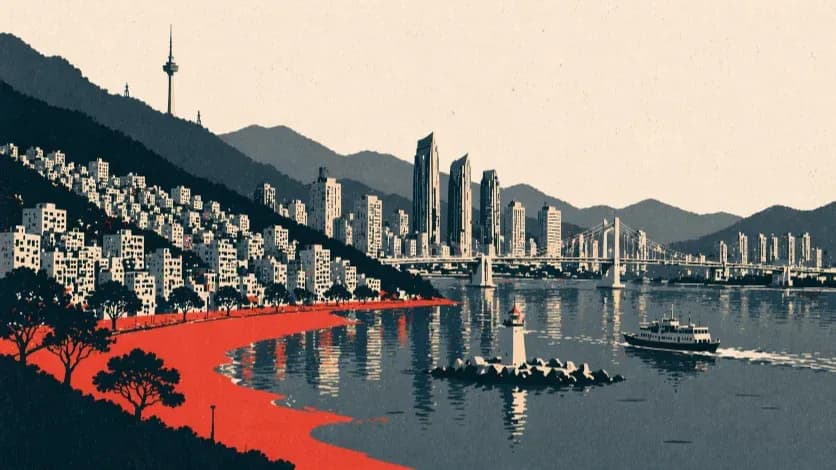
In Busan, climate risk is not abstract. It is built into the ground. Rain runs off the city’s steep edges, drops into basin-like neighborhoods, pushes against aging drainage networks and lingers in low-lying districts near the river and the coast. Exposure is uneven because the city itself is uneven.
Busan has not ignored that reality. The city is now preparing a new climate-crisis adaptation plan, and its 2040 Urban Master Plan already frames climate response as part of a larger remaking of urban space. That plan does more than invoke carbon neutrality. It reorganizes Busan around 10 functionally specialized cores and calls for a separate waterfront specialized basic plan for coastal and river areas — an acknowledgment that the city’s future growth will be tied to the same water geography that shapes its risk.
But the question hanging over Busan is no longer whether it has plans. It is whether those plans are being made against the city’s actual terrain. A 2025 study based on the 2040 plan modeled the effect of expanding urban parks and found that flood risk was highest in Gangseo-gu and Sasang-gu. It also found that increasing per-capita park area from 13.7 square meters in 2020 to 21.5 square meters by 2040 could significantly reduce that risk. That is more than an environmental argument. It suggests that in Busan, flood resilience is inseparable from land use.
The timing is not incidental. On April 20, Busan opened its annual Climate Change Week around Earth Day with exhibitions, a lights-off campaign and public outreach built around carbon-neutral lifestyles. The politics of that message are familiar: awareness, participation, everyday action. But for a city like Busan, the harder climate question is no longer whether residents can be encouraged to act. It is whether City Hall is reorganizing growth, public space and flood defense around the terrain that already decides where water goes.
The Systems Busan Has Built
Busan is not starting from scratch institutionally, either. On Feb. 2, 2026, the city launched pilot operations of “Busan Safety ON,” a platform designed to pull together disaster and safety information that had been scattered across departments and agencies. The site is organized into six categories: urban flooding; earthquakes and seismic reinforcement; nuclear safety; ground subsidence and landslides; heat waves and cold waves; and shelters. In the flooding section, users can check river levels, rainfall, tidal levels, and wind conditions in one place.
That matters, but not because dashboards are enough. It matters because it shows the city beginning to accept a basic fact: residents do not experience flood, heat, subsidence and evacuation as separate bureaucratic files. They experience them as overlapping conditions.
Busan has added other pieces as well. In March, the city said it had strengthened its citizen safety insurance and became the first metropolitan government in Korea to include ground-subsidence coverage. That is a narrow policy detail, but it is revealing. It shows that climate adaptation in Busan is not being framed only through rain and coastlines. It is also being framed through the failure points of built ground itself.
Still, information does not by itself reorganize the city. A better platform can tell residents where risk is gathering. It cannot, on its own, decide whether future growth avoids vulnerable land, whether drainage upgrades reach the right neighborhoods first, or whether green space is being used as real flood-defense infrastructure rather than aesthetic compensation.
The Waterfront Test
That tension sharpens at the waterfront. If Busan’s inherited vulnerabilities are written into slopes, low ground and drainage bottlenecks, its future vulnerabilities may be written into the places where it still chooses to build.
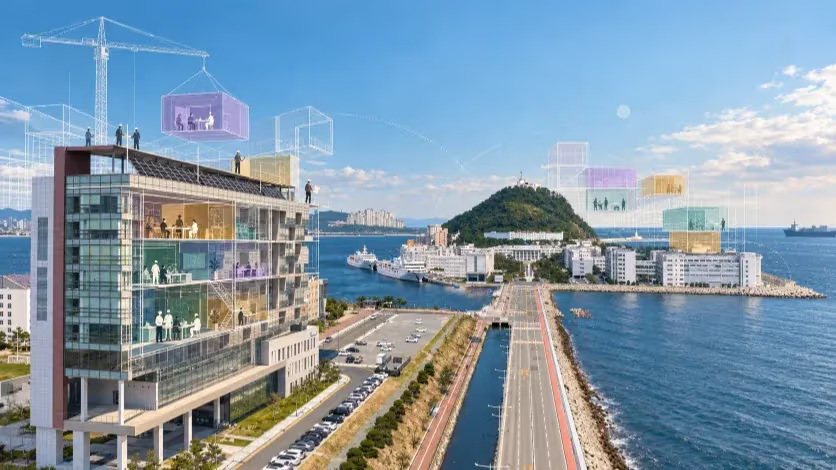
Few projects make that clearer than Busan Eco Delta Smart City in Gangseo-gu. Official material presents it as a city where nature, people and technology come together. The numbers are ambitious: 20% more renewable energy, 100% recycling, 28,000 new jobs, and blue-green access designed so residents are within five minutes of water and green space. Its “ten innovations” include smart water and zero-energy city concepts. The smart-water model is described as a system for restoring the urban water cycle through rain capture, treatment, wastewater reuse and water-related disaster response. The zero-energy model includes water thermal energy, fuel cells, energy storage systems and cross-city energy operation.
That is precisely why Eco Delta matters. It is not just a development story. It is the clearest test of what Busan means by resilience. Gangseo-gu is also one of the districts the 2025 flood-risk study identified as carrying the city’s highest flood risk. That does not make the project self-contradictory. But it does force a sharper question than official language usually allows: when a city builds a flagship waterfront district in a flood-sensitive landscape, is it reducing exposure, redistributing it, or simply insulating one part of the city better than another?
What Busan Still Has to Prove
Climate adaptation in Busan is not only a technical question. It is also a distributive one. Which districts get redesigned first? Which ones get better drainage, more absorbent surface, safer evacuation and more public space? Which ones get a future-oriented showcase district, and which ones get retrofit politics?
The danger in Busan is not that it lacks planning language. It has plenty: carbon neutrality, smart water, integrated safety, waterfront specialization. The danger is that those systems may be maturing faster than the physical city is being reorganized. A city does not become climate-resilient because it can describe risk more elegantly. It becomes climate-resilient when land use, drainage, public space and development decisions begin to work from the same map.
Busan has already moved beyond simple acknowledgment. It is planning, measuring and building. The unresolved question is whether those efforts will remain a collection of systems layered onto an unequal terrain, or whether they will become something harder and more consequential: a spatial strategy capable of reducing vulnerability where it is already deepest. In Busan, that will not be proved by Earth Day slogans, dashboards or pilot projects alone. It will be proved by whether the city starts changing the ground on which risk is made.
Continue this reporting
Reporting on the same issue
Related coverage selected from the article's desk, topics and newsroom relationships.
 NewsSep 22, 2026
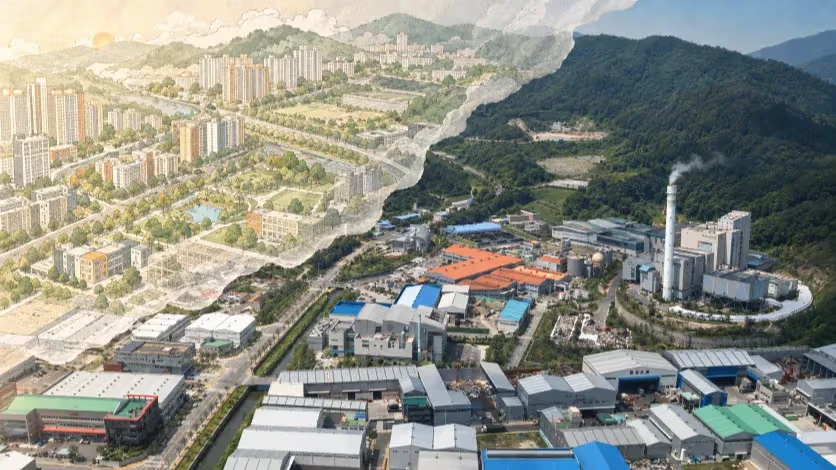
Busan Is Growing Westward as Its Waste Infrastructure Stays Put
Busan’s proposed Saenggok incinerator has moved from 800 to 500 tons a day. T...
 NewsAug 17, 2026
What South Korea’s 87% Drop in Aquaculture Heat Losses Really Measures
South Korea reported an 87 percent drop in aquaculture losses from high water...
 NewsAug 2, 2026
The City Built on Tomorrow’s Buyers
Busan’s apartment-led growth delivered housing and urban renewal at extraordi...
More from the author
More from this byline
Stay with the same line of reporting through more work from this byline.
- NewsSep 22, 2026
Busan Is Growing Westward as Its Waste Infrastructure Stays Put
Editorial Record
Corrections, sourcing notes and newsroom disclosures remain part of the published record. View Newsroom Notes →
Reader Signal
Community readWhat did this report leave you with?
Choose the signal that best reflects your reading. Select it again to remove it.
One response per article
No response selected
A moderated conversation about the reporting.
One-level replies and newsroom moderation keep the conversation anchored to this article.
Discussion Status
Open
Please sign in to join the discussion.
Newsletter
Weekly reporting and context from Busan and Korea.