Jeon Jae-soo’s Busan Reset Starts Inside City Hall
Jeon Jae-soo’s transition team is expected to focus on livelihood relief and maritime capital while reviewing key Park-era projects. The deeper question is how Busan City Hall will reorganize offices, budgets and inherited commitments.

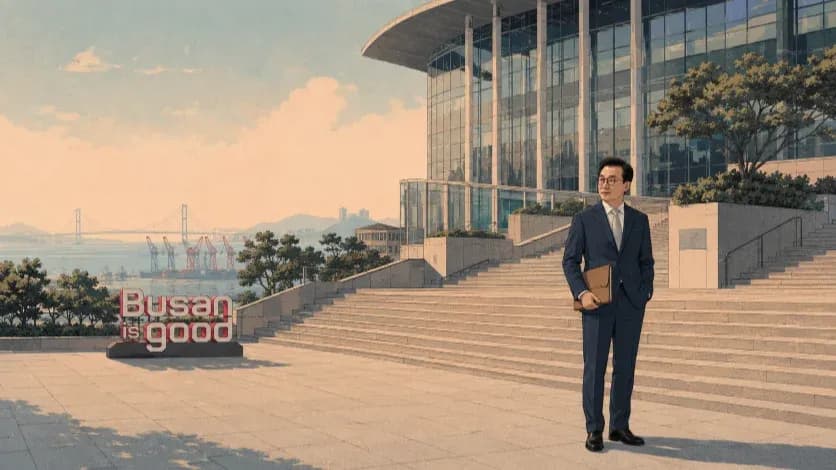
The mayor-elect inherits a city shaped by Park Heong-joon’s branding, design offices and prestige projects. His first challenge is to turn campaign promises on livelihood relief and maritime power into budgets, reporting lines and institutional authority.
Mayor-elect Jeon Jae-soo will take office in a Busan already shaped by Park Heong-joon’s governing language. The “Busan is Good” brand has entered public design and the city’s bus system, while the 15-minute city program, cultural landmark projects and design-focused offices remain inside the administrative structure. Park’s priorities now sit in budget lines, bureau names, public assets and agreements that cannot be removed through a change in rhetoric.
Jeon’s transition team is expected to focus on livelihood relief and a maritime-capital agenda. Those pledges will have to pass through the city’s existing machinery: a council still dominated by the People Power Party, Park-era projects at different stages of commitment and a bureaucracy where maritime, North Port, transport, design and neighborhood functions are split across separate offices. The early transition will show how quickly the incoming administration can turn campaign language into budget authority, reporting-line changes and a workable sequence for reviewing inherited projects.
Park’s administration left more than a visual legacy. It placed the city’s image inside government work. “Busan is Good,” adopted as the city’s official brand slogan in 2023, moved from civic promotion into public design. The BIG BUS redesign carried the same brand language into the transit system, with city materials describing a phased replacement of 2,517 buses through 2033. The slogan now belongs not only to speeches and promotional copy, but also to vehicle design, public-facing materials and procurement cycles.
The same pattern runs through the 15-minute city, global-hub branding, Pompidou Busan, La Scala at the Busan Opera House and the Future Design Bureau. Park’s Busan was organized around visibility: a city made easier to present, package and place on the global map. That model sharpened Busan’s public image, yet the election has put its administrative value under pressure. Jeon’s first months will test whether City Hall can shift from image production to verifiable delivery.
A constrained mandate
Jeon will enter office with the mayoralty but not the council majority, a constraint that will shape how far his transition team can move on budgets, ordinances and inherited projects. The next Busan Metropolitan Council will remain controlled by the People Power Party, with 37 of 48 seats. The Democratic Party’s presence has grown, but 11 seats leave Jeon dependent on negotiation for supplementary budgets, organization changes and major revisions to projects approved under the previous administration.
The transition committee also operates within a narrow formal role. In Korea’s local-government system, an incoming administration’s transition team reviews the city’s organization, functions and budget and prepares the policy direction of the new mayor. It does not replace the executive apparatus it studies. The short operating window places unusual weight on what the committee chooses to classify during its first reports from key departments.
That classification will matter more than early slogans. Projects tied to council approval, procurement, contracts or multi-year budgets require legal and fiscal review before money can be redirected. Programs carrying Park-era branding may still deliver practical neighborhood improvements. Design and promotion projects can lose political prominence while remaining physically present in the city. Maritime and livelihood pledges need offices with enough authority to move budgets, call in departments and negotiate with the central government.
A campaign promise becomes policy only when a bureau controls the budget line, an office leads the negotiation and a spending plan reaches the council. Jeon’s room for action will be widest where projects remain in planning, branding or negotiation. It will narrow where Park’s administration embedded programs inside multiple departments or advanced them through formal approval stages.
Early moves may appear modest: a livelihood task force, a review of cultural landmark projects, a lower profile for city-brand promotion, contract and budget requests from cultural and design departments, or a first map of maritime functions scattered across the bureaucracy. Busan’s recent administrative history gives those moves real significance. New mayors have often marked their priorities first through offices, reporting lines and renamed functions before larger policy change reached the full budget.
Park’s city of visibility
Park’s governing model gave unusual weight to city branding, design policy and globally legible projects, turning Busan’s image into a formal area of administrative work. The approach carried a strategic logic. Park’s administration tried to move Busan beyond the image of a declining industrial port and into a different frame: a global hub, a design city, a cultural destination, a city of branded public space and short-distance neighborhoods.
The official brand system became the clearest public surface of that effort. Busan described “Busan is Good” as an expression of civic pride and satisfaction, tying the word “Good” to claims that the city is global, original, open and dynamic. The slogan sits inside design forms, videos, street-banner guidance and official guidelines managed through the city’s design-policy structure. It functions as a public symbol with administrative life behind it.
The BIG BUS program turned that symbolic language into a daily public object. The redesign reaches beyond exterior color into route signs, destination displays, maps and advertising codes. Reversing that work would require cost estimates, replacement schedules and a decision that repainting public assets deserves early attention from an administration elected on livelihood relief. Jeon has little incentive to open his term with a fight over vehicle livery when household support, small-business stress and maritime policy are already competing for fiscal space.
Park’s visibility model also appears in the organization chart. The Future Space Strategy Bureau oversees the Urban Space Strategy Division, the 15-Minute City Division and the Living Space Innovation Division. A separate Future Design Bureau contains design-policy, public-design and design-industry functions. Design, neighborhood branding and spatial strategy were not side projects handled by a communications office. They were assigned to formal administrative units.
The 15-minute city followed the same pattern. It carried strong Park-era branding, but its Happy Challenge program also contains practical work: walkable access to daily facilities, shared community space and data-based urban management. Cancellation would risk discarding pedestrian links, school-zone safety, community facilities and neighborhood repairs. Full continuity would preserve Park’s political language. The more likely route is administrative stripping: keep the living-zone projects, reduce the brand and fold useful work into welfare, walkability, senior access and local infrastructure.
Cultural landmark projects sharpen the divide. Pompidou Busan and the La Scala opening program were not ordinary arts initiatives. They belonged to a governing style that used global names to lift the city’s image. Jeon has marked those projects for review and connected the review to livelihood spending. Contracts, council approvals, design work and sunk costs will determine how much room his administration has to slow, renegotiate or redirect them.
Park’s city should therefore be read as an administrative model rather than a bundle of slogans. It made Busan more legible to the outside world: cleaner in design, more global in cultural ambition and more packaged in urban branding. Jeon cannot remove that model in one act. His administration must decide where visibility still serves residents, where it has become political decoration and where City Hall should redirect capacity toward measurable delivery.
The first reset is organizational
The organizational problem facing Jeon is already visible in City Hall’s current structure: the functions needed for a maritime-capital strategy are split across maritime, redevelopment, transportation and design-related offices. Busan’s maritime work sits mainly in the Maritime, Agriculture and Fisheries Bureau, which includes the Maritime Capital Policy Division and the Shipping and Port Division. North Port redevelopment sits in the Urban Innovation and Balanced Development Office. Tri-port planning belongs to the Transportation Innovation Bureau. Design and neighborhood-space functions sit in separate future-space and future-design lines.
That dispersion will shape the incoming administration’s ability to act. Jeon’s maritime-capital agenda links the port, North Port, shipping headquarters, maritime finance, logistics, legal infrastructure and central-government negotiations. A slogan attached to the existing structure cannot coordinate those functions. City Hall needs a chain of command capable of deciding sequence, assigning responsibility and forcing departments to work across bureau boundaries.
A limited version could begin as a task force inside the existing maritime bureau. The route would be quick and politically safe, but a task force without budget authority, personnel leverage and access to North Port, transport and investment officials would add another layer of reporting without changing execution. A stronger model would expand the maritime-capital function into a cross-bureau command center, giving it authority over sequencing: which maritime institutions to pursue first, how North Port fits the industrial strategy, how shipping-company relocation connects to youth employment and which central-government negotiations require mayoral attention.
A more forceful reorganization would place maritime capital under a mayoral or deputy-mayoral line. That structure would mark a visible break from Park’s design-led hierarchy, though it would carry administrative costs and possible ordinance work. A large reorganization announced too early could also consume political attention needed for the first livelihood measures. The transition team therefore needs to distinguish speed from authority. A fast task force may help the opening weeks; a durable maritime-capital structure needs control over budgets, project sequencing and outside negotiations.
The livelihood agenda faces the same institutional problem. A 100-day relief program can begin as a mayoral task force, but a task force does not automatically move money. Fuel support, energy vouchers, local-currency incentives, fee relief and public jobs require eligibility rules, payment mechanisms, departmental coordination and fiscal space. The first serious test for a livelihood body will be whether it can obtain budget data, identify fundable programs and convert campaign pledges into payable relief.
Park-era offices form the other side of the reset. The 15-Minute City Division and Future Design Bureau contain staff, projects, contracts, guidelines and relationships with affiliated institutions. Immediate abolition would be blunt and costly. Role adjustment looks more realistic. The 15-minute-city program can be stripped of political branding and treated as walkability, school-zone safety, senior access and neighborhood infrastructure. The design bureau can be redirected from city-brand expansion toward public-space quality, accessibility and local design support.
Jeon changes City Hall when one office loses the power to define priority projects and another gains authority over money, personnel and negotiations. A maritime body without budget authority will become another slogan. A livelihood office without control over the first supplementary budget will become another announcement. A review of Park’s design and cultural projects without contract analysis will remain campaign language.
What survives, what is downgraded, what is reversed
The projects Jeon inherits cannot be handled as a single Park-era package, because each sits at a different stage of administrative commitment. Some are physical assets. Some are political brands. Some sit inside contracts or memoranda. Others are useful local work wrapped in Park-era language. The transition team’s work will depend on classification: what survives, what is downgraded, what is reviewed and what requires redesign.
The 15-minute city is likely to survive by losing its brand. Its official identity remains closely tied to Park, but the work underneath is closer to local infrastructure. A new mayor can stop speaking the language of the 15-minute city. He cannot easily tell residents that pedestrian links, school-zone improvements, local community spaces and neighborhood repairs should disappear because the previous administration named them. The more plausible move is to remove Park’s political ownership and absorb the usable parts into livelihood, welfare, walkability and local-infrastructure policy.
“Busan is Good” belongs to another category. It is not a service program. It is a visual system. The slogan can lose political prominence without physical removal. Buses already carrying the BIG BUS design will continue to run. Existing public materials can remain until replacement cycles arrive. New city promotion can rely less on Park’s brand language. Brand goods, campaigns and public-design expansion can face budget review. The slogan may stay on the street while leaving the center of mayoral speech.
Pompidou Busan and La Scala require a stricter review. The two projects sit closest to the political break Jeon campaigned on because they mark the collision between Park’s global-cultural strategy and Jeon’s pledge to prioritize household and small-business stress. Yet review does not equal cancellation. The transition team needs contract dates, council approvals, payment schedules, legal obligations, possible penalties and sunk costs. If Pompidou remains before a binding contract, the city has more room. If agreements have advanced, the cost of reversal rises. If La Scala has moved from council consent to enforceable commitments, the language of waste reduction must give way to the legal and diplomatic work of renegotiation.
Sajik Stadium and the North Port dome proposal belong to the redesign category. The stadium issue is often treated as a sports dispute, but the policy stakes are spatial. Park’s existing course centered on rebuilding Sajik. Jeon’s campaign language pointed toward a retractable dome at North Port and a different role for the current Sajik site. That would shift the city’s symbolic center of gravity toward the waterfront redevelopment zone and fold sports infrastructure into the maritime-capital narrative. The move would touch land, national funding, investment screening, team negotiations, transport access and the sequencing of North Port development. A transition committee can mark the issue for study. It cannot settle the geography of Busan’s next civic center in 20 days.
The inherited agenda therefore divides into four broad tracks. The 15-minute city can remain as local infrastructure and lose its political label. Busan is Good can stay as a public-design asset while losing priority. Pompidou and La Scala can be put through legal, budgetary and contract review. Sajik and the North Port dome idea require spatial redesign rather than simple approval or rejection.
That classification gives Jeon a route between two weak choices. A purge would waste money and invite institutional resistance. Passive continuity would make the election look cosmetic. The stronger route is narrower: keep what delivers, downgrade what only signals, renegotiate what remains reversible and redesign what belongs to a different city strategy.
The test of measurable government
The new administration’s break from Park will be measured less by the disappearance of old slogans than by the first supplementary budget, the authority of new offices and the evidence that relief and maritime policy reach residents and institutions.
Livelihood relief sits closest to households and will be judged first. Fuel support, energy vouchers, local-currency incentives, fee relief and public jobs sound immediate, but each item requires a target group, a payment mechanism, an appropriation and a timetable. A 100-day program without recipients, payment dates and budget lines will remain campaign language. A program that reaches small merchants, delivery workers, drivers and low-income households before the political honeymoon fades will give Jeon his first evidence of delivery.
The maritime-capital agenda will take longer and demand a higher standard of proof. Busan already has the port. The city’s unresolved task is to capture more of the institutional power around the port: ministry functions, maritime courts, shipping headquarters, finance, legal services, research, insurance, logistics planning and youth employment. Jeon’s promise to build a maritime capital requires a command line capable of negotiating with the central government, coordinating North Port, matching shipping-company relocation with local hiring and turning port volume into higher-value urban functions.
The same standard should apply to inherited projects. The 15-minute city should be judged by access, use and maintenance rather than brand recognition. Busan is Good should be judged by whether additional brand spending produces tourism revenue, local-business benefit, civic use or clearer public information. Pompidou and La Scala should be judged through a harder ledger: what can legally be stopped, what would cost more to cancel than to complete and what cultural value Busan receives if a project goes forward. A review that produces only denunciation will not be enough. A review that identifies contract exposure, sunk costs, alternative cultural spending and local-arts impact would show whether Jeon’s administration can turn campaign criticism into governing judgment.
The council will remain the final constraint on that judgment. Jeon can set the tone inside City Hall, but budgets and ordinances will run through a chamber dominated by the People Power Party. That structure does not prevent change. It changes the form of change. The new mayor will need supplementary budgets, committee briefings, negotiated revisions and selective continuity. Abrupt reversal may satisfy supporters. Durable change will require votes, documents and administrative sequence.
The first months should be read through a narrow set of indicators: which department leads the livelihood package; whether a maritime-capital body receives budget authority; how much of the first supplementary budget moves toward household and small-business relief; whether 15-minute-city projects are evaluated by access rather than branding; whether the Future Design Bureau is redirected from image expansion toward public-space quality; whether Pompidou and La Scala reviews include contract exposure rather than political language alone; and whether maritime relocation promises produce offices, jobs and institutional functions in Busan.
Those indicators will show whether the transfer of power has reached the machinery of government. Park’s visual legacy will remain on buses, public materials, neighborhood programs and cultural projects already moving through the system. Jeon’s break from the previous administration will be measured elsewhere: in who controls the first budget changes, which offices gain authority, which projects survive because they prove their value and whether maritime capital becomes an operating structure rather than a replacement phrase.
The election changed the mayor. The first test of the new administration is whether it can change the standard by which Busan governs itself.
Continue this reporting
Reporting on the same issue
Related coverage selected from the article's desk, topics and newsroom relationships.
 NewsSep 20, 2026
What It Takes for U.S. Navy Repair Work to Become a Busan Industry
HJ Shipbuilding has brought U.S. Navy maintenance work to Yeongdo. Whether it...
 NewsSep 17, 2026
Busan’s Finished Homes, Unfinished Projects
Busan’s unsold homes sit in one monthly total, but they belong to very differ...
 NewsSep 16, 2026
Busan’s Young-Adult Migration Turns Sharply at 25–29
Busan can still draw young adults into the city, but keeping them becomes far...
More from the author
More from this byline
Stay with the same line of reporting through more work from this byline.
Editorial Record
Corrections, sourcing notes and newsroom disclosures remain part of the published record. View Newsroom Notes →
Reader Signal
Community readWhat did this report leave you with?
Choose the signal that best reflects your reading. Select it again to remove it.
One response per article
No response selected
A moderated conversation about the reporting.
One-level replies and newsroom moderation keep the conversation anchored to this article.
Discussion Status
Open
Please sign in to join the discussion.
Newsletter
Weekly reporting and context from Busan and Korea.