Korea’s AI Boom Has a Geography Problem
Semiconductor exports are powering South Korea’s recovery, but the gains are concentrated in chipmakers, markets and production regions. Busan’s test is whether the boom can move into port logistics, factory productivity and local technical jobs.

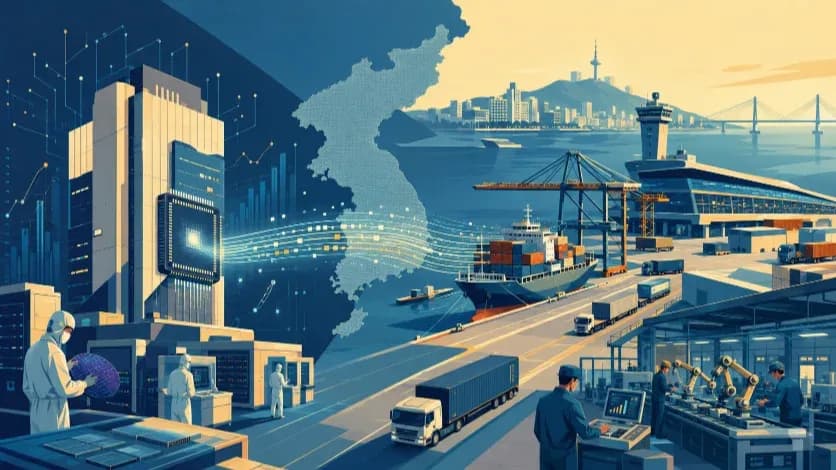
Chip exports are powering South Korea’s recovery, but the gains are concentrated in firms, markets and production regions. Busan’s test is whether the boom can move into port logistics, factory productivity and local technical jobs.
South Korea’s first $100 billion export month was built on memory chips for the global AI buildout.
Exports reached $102.25 billion in June, up 70.9 percent from a year earlier and above the $100 billion mark for the first time. Semiconductor shipments rose 199.5 percent to $44.8 billion, accounting for nearly 44 percent of the month’s exports. Computer exports also surged as demand for solid-state drives followed the same data-center investment cycle.
The record gave Seoul a strong headline at a difficult moment for the global economy. Energy prices, the conflict in the Middle East and weak domestic demand still weighed on the outlook, while trade data showed Korea benefiting directly from the rush to build AI data centers, train larger models and secure the memory chips that make those systems run.
Semiconductors now carry more than the export table. The same cycle affects corporate earnings, KOSPI valuations, tax expectations and the political case for new industrial spending. A rise in AI infrastructure investment can make Korea’s recovery look broad; a slowdown in that spending would move back through the same companies, markets and public accounts.
OECD economists had identified the structure before the latest market volatility. Semiconductor exports were driving growth in early 2026 while construction and other manufacturing sectors lagged behind, the OECD’s latest Korea survey said. The same section described the chip cycle as a source of volatility in output and tax revenues, as well as strategic vulnerabilities.
Korea’s AI-led recovery is appearing first in the accounts that move fastest: export ledgers, equity prices and corporate investment announcements. Busan belongs to the slower measure of the same economy. Its evidence will come from container terminals, logistics networks, machinery suppliers, manufacturing SMEs and the technical jobs created around systems that local firms can actually use.
Growth engine, volatility channel
OECD economists gave Korea’s semiconductor cycle a double reading.
Memory chips were carrying the recovery in early 2026. Exports and investment were accelerating, consumption had begun to recover with fiscal support, and the current-account outlook had strengthened. The survey projected GDP growth of 2.6 percent in 2026, up from 1.0 percent in 2025, before slowing to 1.9 percent in 2027. Exports were expected to rise 6.0 percent in 2026 and then slow to 1.9 percent the following year.
The forecast did not treat the chip cycle as a clean expansion. Construction and other manufacturing sectors were still struggling, and the OECD linked the recovery to a narrow export engine exposed to global demand for advanced semiconductors. The report’s broader warning was that deeper dependence on semiconductor exports can raise growth and tax revenue while increasing exposure to external shocks and cyclical volatility.
A memory-chip upswing does not stop at the customs ledger. Higher shipments lift corporate profits, strengthen equity valuations, improve expectations for tax receipts and give government officials more room to argue for industrial support. When the same cycle weakens, pressure can move through the same accounts in reverse.
The fiscal stakes are larger because Korea is ageing quickly. The OECD notes that public debt has moved from below 10 percent of GDP in the late 1990s to almost 50 percent, while ageing-related spending pressure is rising. A temporary surge in chip-related revenue can ease the near-term budget picture, but it does not create a stable tax base for pensions, healthcare, regional investment or skills policy.
The risk is not the success of semiconductors. Korea’s position in memory chips remains one of the country’s strongest industrial assets. The risk comes from asking the AI cycle to support too many accounts at once: exports, growth, stocks, tax expectations, regional investment promises and long-term fiscal demands.
A broader AI economy would have to show gains beyond chip exports. Logistics systems would need to move faster. Factories would need to lower defects and downtime. Public agencies would need to use data for decisions rather than dashboards. Smaller firms would need a path from pilot projects to operating systems.
The same concentration appears in stocks and fabs
Korea’s export concentration has a market price.
Samsung Electronics and SK Hynix have become the main listed proxies for Korea’s exposure to AI infrastructure demand. Reuters reported in late May that SK Hynix had joined the $1 trillion market-value club after a rally driven by high-end memory chips, while Samsung and SK Hynix together led a KOSPI surge that made the index one of the world’s strongest performers in 2026.
Market concentration turned quickly into market risk. Investor concern over excess AI computing capacity helped push Korean chip shares lower in early July, with SK Hynix and Samsung falling as the market reassessed how long AI data-center spending and memory pricing could keep rising together.
Memory-chip demand gives Korea’s stock market an unusually direct link to the global AI buildout. Stronger orders for high-bandwidth memory, NAND and data-center components can lift the country’s largest companies, index valuations and household expectations around equities. Doubts over AI infrastructure spending can compress the same trade in a matter of days.
The investment map shows the same pattern in physical form. SK Hynix said it would spend 100 trillion won on new semiconductor facilities in Cheongju, including a NAND flash memory plant and advanced packaging capacity. Reuters described the plan as part of a wider national push to spread the benefits of the AI boom beyond Seoul, while noting that the investment remains exposed to changes in global market conditions.
Samsung and SK Hynix are tied to a much larger chip-building agenda. Reuters reported that South Korea’s three major chip and AI initiatives include semiconductor fabs, high-bandwidth memory facilities, AI data centers and physical AI projects, with Samsung and SK Group outlining investment plans across Gwangju, Cheonan, Onyang, Pyeongtaek, Yongin and other production corridors.
Large semiconductor projects create jobs, local tax expectations and supplier demand around the places that host fabs, memory lines and packaging facilities. They also give regional policy a production map. Cheongju, the Seoul metropolitan industrial belt and new semiconductor corridors can compete for facilities connected directly to chip output. Port cities enter the same AI economy through another route.
Busan’s published plans do not place the city inside the main fabrication geography. Its link to the AI cycle runs through port logistics, machinery suppliers, factory diagnostics, quality testing, public data systems and the ability of smaller firms to use shared computing infrastructure. Export-led chip growth can strengthen Korea’s national accounts without reducing a truck queue at a container gate or helping a machinery supplier detect defects earlier.
Semiconductor investment clarifies the regional question. Korea’s AI cycle is being built in fabs, priced through its largest chipmakers and supported by national industrial policy. Busan’s claim will have to be proven in adoption: whether the computing power financed by the chip cycle changes the operating costs of ports, logistics firms and manufacturing SMEs outside the semiconductor belt.
Busan’s clearest AI project is a port operating plan
Busan Port Authority has placed the city’s most concrete AI project inside the movements that already define the local economy: trucks entering terminal gates, vessels waiting for berths, cranes moving containers and logistics firms trying to price delays before cargo arrives.
The authority’s Busan Port AX plan sets 38 implementation tasks through 2030, with a total project scale of 892.1 billion won and 435.1 billion won from BPA’s own budget. The stated targets are operational rather than promotional: raise container-terminal productivity by more than 30 percent and eliminate fatal accidents inside the port.
The plan gives Busan a different entry point into Korea’s AI economy. Semiconductor cities compete for fabrication lines, memory capacity and advanced packaging. Busan’s strongest case begins with port data — vessel schedules, gate reservations, yard congestion, crane movements, equipment conditions, safety footage and weather disruptions.
BPA’s existing logistics platforms show where the next layer would be added. Chainportal links port logistics information through services including integrated information sharing, a transshipment shuttle system and a vehicle booking system. The AX plan would push that operating base further, using AI to improve arrival predictions, recommend truck visit times, detect abnormal situations and support decisions when cargo flows are disrupted.
Port safety gives the project a harder measure than software adoption. AI video analytics, collision-risk prediction, robotic support for dangerous work and defect detection in equipment would have to appear in incident rates, maintenance schedules and work assignments. A dashboard alone would not show whether the port has become more intelligent. Fewer stoppages, fewer injuries and faster recovery from disruption would.
Shared computing capacity is another test. BPA plans to build AI infrastructure for port and logistics users, including high-performance AI servers, a GPU farm and data-center capacity that smaller logistics firms could use jointly. The logic is clear: a global shipping line or terminal operator can buy computing power; a small logistics company serving the same port usually cannot.
Busan’s citywide AI strategy follows the same adoption logic. The city has announced 487.7 billion won over five years for four AI flagship projects and five AI-based infrastructure programs, alongside a goal of attracting 758.7 billion won in private investment. Manufacturing, logistics and healthcare are named as strategic industries for AI transformation, while public services, infrastructure and talent programs are included in the plan.
Those commitments will matter only if operational data can move across institutional boundaries. Terminal operators, shipping companies, truckers, logistics brokers, manufacturers and city agencies all hold pieces of the information needed to make port AI useful. Commercial control, cybersecurity, liability and public accountability will determine how much of that data can be shared.
Busan’s evidence will be visible first at terminal gates and in control rooms. Truck queues, vessel scheduling, equipment failures, yard congestion and safety incidents will show whether the city’s AI spending changes port operations. The export boom is recorded in chip shipments. Busan’s version will have to be recorded in minutes saved, defects prevented, accidents avoided and smaller firms able to use systems they could not build alone.
AI arrives first as an adoption bill
Smaller manufacturers face a different calculation from port authorities and chipmakers.
Busan’s export base is broad, industrial and SME-heavy. The city exported $1.357 billion in April, up 6.5 percent from a year earlier. Steel products accounted for 20.9 percent, transport machinery 13.2 percent, basic industrial machinery 7.4 percent, fishery products 7.1 percent and electronics 6.0 percent. Small and medium-sized companies supplied 56.7 percent of export value and 96.3 percent of exporting firms.
An export economy built around steel processors, machinery suppliers, fisheries exporters and parts manufacturers will not absorb AI the way a semiconductor cluster does. Chipmakers can measure the cycle through capacity, yields, memory prices and orders from data-center customers. Busan’s firms will look for smaller gains that determine margins: fewer defects, faster quotations, better inventory forecasts, lower energy use, shorter customs delays and less idle time between production and shipment.
The city’s AX Clinic program shows the early stage of that transition. Busan AX Lab describes the program as an initial consulting effort for local companies seeking AI transformation and for AI solution startups, with support focused on pre-diagnosis, needs analysis, expert matching and on-site consulting. The listed demand companies are small and medium-sized manufacturers hoping to introduce AI.
Consulting can identify where AI might help. It does not pay for sensors, clean production records, machine-to-software links, worker retraining or model maintenance after a pilot ends. Manufacturers already dealing with raw-material costs, export paperwork and uncertain overseas demand may treat AI as another capital expense unless the return is visible inside normal production schedules.
The first invoice is likely to come before the productivity gain. A factory has to collect machine data, digitize inspection records, choose a vendor, pay for cloud access or local servers, train workers and change routines on the floor. A seafood exporter has to connect demand forecasts to cold-chain costs and shipping slots. A machinery supplier has to decide whether predictive maintenance or defect detection reduces enough downtime to justify the system.
Busan’s SME structure makes shared infrastructure more important. A large terminal operator can finance its own data team. A smaller exporter may need public computing capacity, subsidized consulting, common data standards and trusted vendor lists before it can move beyond a demonstration project. The difference between an AI pilot and an operating system will depend on maintenance budgets, worker training and whether firms can keep using the tools without outside consultants in the room.
The adoption problem changes the meaning of public support. A grant that produces a dashboard may have little effect if the company cannot update the data. A factory pilot may disappear if no worker is trained to maintain it. A port-linked AI service may fail to scale if logistics firms cannot afford access or do not trust how commercial data will be handled.
Busan’s next evidence will come from conversion rates: how many diagnosed firms install systems, how many pilots survive a full production cycle, how many SMEs share port or logistics data, and how many workers are trained to operate the tools after the first contract ends. The chip cycle gives Korea capital and confidence. In Busan’s factories, AI still has to pass through the narrower gate of cost, trust and everyday use.
Data access will decide whether the projects scale
Busan’s AI plans now depend on a less visible layer of infrastructure: who can use the data.
Port operators, terminal companies, truckers, logistics brokers, manufacturers and city agencies all hold fragments of the information needed to make AI useful. Vessel schedules sit in one system. Truck reservations sit in another. Factory inspection records, equipment conditions, customs paperwork, weather disruptions and labour-market data often remain separated by ownership, format, security rules or habit.
OECD researchers identified the same problem at the national level. Korea has strong data governance and open-data foundations, and public institutions already use administrative data for planning and operations. AI tools are emerging in areas such as risk prediction, labour inspection and automated navigation. Regional development, however, has barely used that capacity: text mining of 350,000 public procurement contracts found that only 0.8 percent of AI public procurement in 2023 was dedicated to regional development.
Municipal capacity is uneven. The OECD survey says larger cities and ministries are piloting AI for urban planning, including Ministry of Land, Infrastructure and Transport projects in Busan, Cheonan and Damyang. Many municipalities, especially those facing depopulation and ageing, lack the data infrastructure, analytical capacity and financial resources to design, buy and operate AI-enabled regional development tools.
Those findings matter for Busan because the city’s strongest AI projects are not stand-alone apps. Port scheduling, logistics prediction, factory diagnostics and data-driven administration require shared standards, negotiated access and contracts that define who updates data, who can use it, who is liable when an automated recommendation fails, and how commercial information is protected.
Procurement will shape the outcome. OECD examples point to secure data exchanges, AI-ready territorial data layers, reusable municipal AI services and challenge-based procurement as ways to help local governments use AI without building every model from scratch. The same section warns that Korea’s centralized procurement system, while strong on transparency and risk management, can limit experimentation when municipalities need smaller digital solutions tailored to local conditions.
Busan’s execution problem is therefore administrative as much as technological. Shared GPU capacity, port AI platforms and factory diagnostics all require contracts that define data access, update responsibilities, cybersecurity, pricing and maintenance after the first deployment. Without those rules, AI spending can produce isolated dashboards rather than systems that ports, firms and workers use every day.
The next evidence will be procedural before it is dramatic: data-sharing agreements between terminal operators and public agencies, common standards for logistics and factory data, procurement terms that require local maintenance capacity, and published metrics on delays, defects, safety incidents and SME adoption. Korea’s chip cycle can supply capital and computing power. Busan’s data systems will determine how much of that power reaches the city’s operating economy.
Productivity gains need a hiring path
OECD labour-market data add a constraint to Busan’s port and factory ambitions.
AI-exposed industries in Korea have been creating jobs in areas such as computer programming, professional services, publishing, information services and research and development. The gains, however, have gone mainly to workers aged 30 and above. Workers aged 29 or younger have faced net job losses in several of the same high-exposure sectors, according to the OECD survey. The report cautions that the pattern cannot yet be attributed to AI alone, since Korea’s economy also weakened around 2022 and younger workers tend to suffer more during downturns.
The warning fits the structure of many local AI projects. A terminal can use AI to predict vessel arrivals without adding many entry-level jobs. A manufacturer can install defect-detection software while leaving the technical knowledge with a vendor. A public GPU farm can reduce computing costs for logistics firms without creating a path from a Busan university or vocational program into skilled industrial work.
OECD researchers point to a task-level divide inside Korean firms. Junior employees often handle codified, book-learning-based work that AI systems can execute quickly. Senior workers are more likely to hold tacit knowledge, organisational judgment, contextual understanding and coordination skills that remain harder to automate. The survey says employers still have a long-term interest in hiring young workers, even as some tasks traditionally assigned to new hires are absorbed by AI.
Busan’s AI spending will therefore carry two sets of indicators. Terminal waiting times, crane incidents, vessel scheduling and factory defect rates will show whether the systems work. Hiring data, apprenticeship programs, maintenance contracts and in-house technical teams will show whether the systems become part of the local economy.
Port and manufacturing projects can build that ladder only if labour requirements are written into the work. A logistics AI contract could include local maintenance teams and training for technicians who understand terminal operations. A factory-diagnostics program could require post-pilot support, worker instruction and documentation that remains with the company. A university lab could be tied to live port scheduling, safety video, energy-use or defect-detection problems, rather than general AI coursework.
Regional universities and vocational programs become more important under that model. A container terminal using AI video analytics needs workers who understand safety rules, equipment movement and data quality. A machinery supplier using predictive maintenance needs technicians who can read sensor data and production records. A seafood exporter using demand forecasting needs staff who can connect model output to cold-chain costs, inventory and shipping schedules.
Busan’s youth-employment question will not be answered by the number of AI projects announced. The evidence will appear in job postings, internships, procurement terms, maintenance budgets and the share of pilot systems that become permanent operations inside local firms.
A semiconductor cycle can lift national income without rebuilding the first rung of the labour market. Busan’s AI strategy will carry more weight if a young worker can enter through the port, a factory, a logistics firm or a public data team and learn the systems the city is now paying to install.
From chip cycle to regional productivity
Korea’s AI boom has already delivered what moves first in an export economy: shipments, market value and investment promises.
The slower work begins in cities like Busan. A chip cycle can finance public projects, lower the cost of computing power and give policymakers confidence to talk about industrial renewal. It cannot, by itself, shorten a truck queue at a container terminal, clean a factory’s inspection data, train a technician to maintain a predictive-maintenance system or persuade a small exporter to trust a shared platform with commercial information.
Busan’s position in the AI economy will be measured through those frictions. The city has a major port, a dense logistics base, machinery and transport-equipment suppliers, fishery exporters, manufacturing SMEs and public plans for data-driven administration. Those assets give Busan a plausible role outside the semiconductor belt. They also make the work harder, because the gains must be assembled across many firms, datasets and operating routines rather than captured through a single production line.
The national numbers will keep pointing first to memory chips. Export records, Samsung Electronics and SK Hynix valuations, and new fab investments will remain the fastest indicators of Korea’s AI exposure. Busan’s indicators will be less dramatic and more useful: minutes saved at terminal gates, fewer safety incidents, lower defect rates, more SMEs moving from consulting to operating systems, more procurement contracts that require local maintenance, and more young workers entering jobs tied to real port and factory data.
The distinction matters for Korea’s broader regional policy. An AI economy built only around chip production would deepen the same concentration the OECD identified in exports, tax revenue and regional opportunity. A wider AI economy would show up in places that do not make semiconductors but still move goods, operate factories, manage infrastructure and train workers.
Busan’s claim will depend on proof rather than positioning. The city does not need to imitate Cheongju or the semiconductor corridors to benefit from the AI cycle. It needs port operators willing to share operational data, manufacturers able to afford adoption, universities tied to live industrial problems, procurement rules that prevent vendor lock-in and public metrics that show whether delays, defects and costs are falling.
Korea’s chip cycle has made the country a winner in the first phase of the AI infrastructure race. The next phase will be judged in a different set of places. In Busan, the evidence will not come from the value of chips shipped overseas. It will come from whether computing power reaches the terminal gate, the factory floor, the logistics office and the first skilled job a local graduate can enter.
Continue this reporting
Reporting on the same issue
Related coverage selected from the article's desk, topics and newsroom relationships.
 NewsSep 24, 2026
Taiwan’s AI Boom Is Surging, but Wealth Follows a Different Map
Taiwan’s semiconductor boom is lifting output and incomes at extraordinary sp...
 NewsSep 10, 2026
Busan Records 1.3 Percent Unemployment as Male and Female Employment Diverge
Busan’s 1.3 percent unemployment rate reflects real job growth, but not a bro...
 NewsSep 4, 2026
Korea Moves Deeper Into the Global Market for Long-Term Capital
Japanese yields are rising, Korean bonds are entering the WGBI and American p...
More from the author
More from this byline
Stay with the same line of reporting through more work from this byline.
 NewsSep 16, 2026
Busan’s Young-Adult Migration Turns Sharply at 25–29
 NewsSep 1, 2026
What Lee Jae Myung Thinks a Minister Can Fix
Editorial Record
Corrections, sourcing notes and newsroom disclosures remain part of the published record. View Newsroom Notes →
Reader Signal
Community readWhat did this report leave you with?
Choose the signal that best reflects your reading. Select it again to remove it.
One response per article
No response selected
A moderated conversation about the reporting.
One-level replies and newsroom moderation keep the conversation anchored to this article.
Discussion Status
Open
Please sign in to join the discussion.
Newsletter
Weekly reporting and context from Busan and Korea.