Korea’s AI Boom Enters Through Chips Before Households
South Korea is already benefiting from the global AI infrastructure boom through semiconductors, HBM and chipmaker valuations. Yet the income created by that boom still has to travel through wages, suppliers, small businesses and household balance sheets before it becomes broad economic resilience.

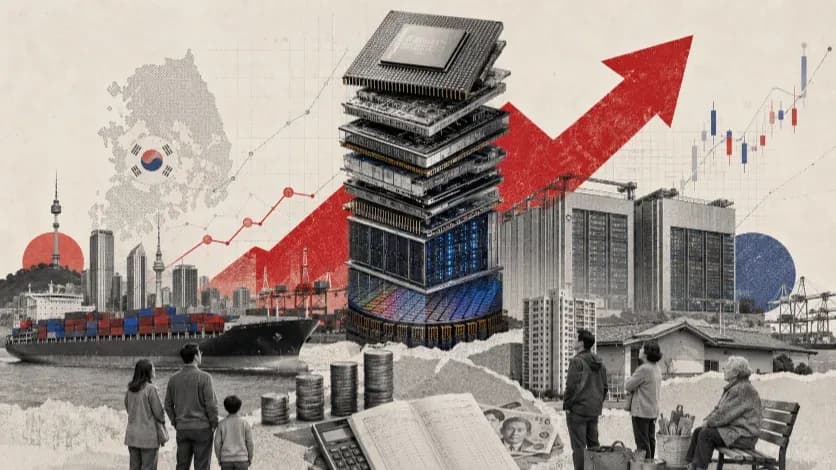
Memory exports and market value show how powerfully Korea is tied to the AI buildout. The harder question is whether a hardware-led cycle can widen into household income before gains settle in assets, bonuses and speculative finance.
South Korea’s AI boom is easiest to see before it reaches the consumer. It appears first in customs data, chipmaker valuations and the market’s repricing of memory as infrastructure for the global data-center buildout. In the first 20 days of June, exports reached $62 billion, the strongest figure ever recorded for the period. Semiconductors alone accounted for $25.5 billion, more than 40 percent of all outbound shipments. A month earlier, chip exports had already set a monthly record, lifted by memory prices and the rush to build AI servers.
Market value tells the same story in another column. SK Hynix’s rise past Samsung Electronics in market capitalization on June 22 marked more than a rotation between two Korean technology companies. The shift reflected a deeper change in the way investors now price high-bandwidth memory. A component once treated as part of the volatile memory cycle has become scarce infrastructure for artificial intelligence. The company that spent years inside the commodity swings of DRAM now sits close to the center of the global AI buildout because the largest technology platforms need its chips to train and run larger models.
The order of arrival matters. AI demand reaches Korea first as export revenue, stronger chipmaker margins, capital spending plans, equity gains and, in selected firms, large performance bonuses. Wider wages, tax receipts, supplier income, neighborhood sales and household savings come later, if the income travels far enough. The distance between the first ledger and the last one explains why the same boom can look powerful in the national account and faint inside a monthly budget.
Export data can respond quickly when U.S. and global technology companies accelerate orders for memory and server components. Household cash flow moves through slower channels: wage bargaining, employment mix, prices, loan payments and fixed expenses. A chip-led surge can lift headline growth while many households encounter the same cycle through higher costs, tighter credit and a thinner margin of safety.
That gap gives Korea’s AI economy its central tension. The country has already shown that AI demand can raise exports. It has yet to show that a hardware-led boom can become broad household resilience before the next turn in the chip cycle.
Korea’s Hardware Exposure
Korea’s exposure to AI runs through hardware before it runs through software income. The country does not command the largest platform rents from search, advertising, model subscriptions or enterprise AI applications. Its first claim on the boom comes through memory chips, components, manufacturing capacity and the export income generated by global data-center investment. The structure makes the AI cycle visible in trade statistics and equity markets long before it appears as a general rise in living standards.
Different forms of AI exposure move through an economy at different speeds. A platform company can convert user demand into recurring software revenue. A cloud provider can sell computing capacity. A chip supplier receives the cycle through orders, prices, inventories, production constraints and investment schedules. Korea sits closest to the third channel. When hyperscalers accelerate AI spending, Korean exporters benefit quickly. When those budgets slow, weakness can pass back through shipment volumes, memory prices and expected margins.
That position gives Korea a powerful first-round advantage, though a concentrated one. Semiconductors can lift GDP forecasts, improve the trade balance and support corporate earnings without immediately changing the income position of most households. The gains first gather around firms with direct exposure to HBM, advanced memory and AI server supply chains. They then move outward through supplier contracts, employee compensation, public revenue, investor wealth and local spending. Each step widens the circle, while each step also slows the movement of income.
A hardware-led AI boom also carries a different risk profile from a software-led one. Demand is already visible in exports, factory activity and chipmaker valuations. The harder question concerns duration. Data centers require memory, power equipment, cooling systems, land and financing before the services built on top of them generate stable returns. Korea can benefit early from global AI infrastructure spending while remaining exposed to any delay in the payback period.
The structure helps explain why the boom feels national in one account and selective in another. A rise in semiconductor exports strengthens headline growth because the industry is large, productive and globally connected. Broader household relief requires a second movement: higher wages outside the chip complex, stronger margins for smaller firms, steadier service-sector demand and lower pressure from prices and debt. Korea’s AI exposure begins as industrial strength. The social and economic question is whether industrial strength can become economic breadth.
From Export Revenue to Household Income
A dollar of AI demand enters Korea through a sequence of ledgers. It appears first as an export order, then as chipmaker revenue, operating profit, investment, equity value and, in some cases, performance pay. Broader income sits farther down the chain. Before the boom reaches ordinary wages or neighborhood spending, corporate pricing power, supplier contracts, tax receipts, investment plans and wage negotiations all have to carry part of the load.
That sequence creates a delay inside the headline boom. Export receipts can rise within weeks when global technology companies increase orders for memory and server components. Corporate earnings can follow within quarters. Share prices can move faster still, especially when investors treat HBM capacity as scarce infrastructure. A household budget changes at another pace. Pay, job security, mortgage payments, rent, food prices, education costs and loan rates determine whether the month ends with room to save or another reason to borrow.
The gap becomes sharper in a high-debt economy. A stronger export cycle can improve national income, while many households meet the cycle through interest rates and prices before they see it through wages. A weaker won can raise the local-currency value of export revenue and lift the cost of imported energy, food, travel, education and raw materials. Higher market rates can support financial-sector margins and restrain inflation expectations, while raising the monthly burden on borrowers. The same macroeconomic environment can strengthen one balance sheet and compress another.
Korea’s AI cycle should therefore be read through incidence as much as growth. Exporters closest to the chip supply chain receive the boom as demand, margin and valuation. Households with savings or equity exposure may receive it as asset appreciation. Families with little financial room may encounter the same cycle as higher living costs, more expensive credit and fewer ways to participate in the rally. The national account can show acceleration while the household ledger records a thinner buffer.
The transmission path will shape the politics of the boom. If export income spreads through wages, supplier ecosystems, public revenue and lower household cost pressure, the AI cycle can become a broader growth story. If gains remain concentrated in corporate profits, market capitalization and specialized compensation while households absorb higher prices and debt-service costs, the boom will look less like a national dividend than a sectoral windfall.
The Household Test Starts With Surplus
The household ledger gives the AI boom a stricter test than the trade account. Exports can rise on the strength of a few globally dominant firms, while household resilience depends on the margin left after wages, prices, rent, debt service and essential spending have all passed through the month. Income alone is too blunt a measure. The more revealing figure is the amount left after consumption, and the ability of a household to absorb another shock or participate in an asset rally.
Korea’s first-quarter household data show why that margin matters. Average monthly household income rose from a year earlier, yet real income barely moved once inflation was taken into account. Consumption spending grew much faster. Beneath the headline recovery, households spent more, saved less and carried a thinner buffer into the next round of price, rate or employment pressure. A recovery that raises spending faster than real income may look like demand strength in the national accounts while weakening household balance sheets.
The pressure is distributed unevenly across the income ladder. At the bottom, households were already spending far beyond disposable income. The lowest-income quintile recorded average monthly consumption expenditure of about 1.46 million won against disposable income of less than 1 million won, leaving a monthly deficit of roughly 519,000 won. Its average propensity to consume reached 155.3 percent. Those households have little room to wait for export income to diffuse through wages or public revenue. Another rise in food, transport, rent or interest costs arrives immediately as a financing problem.
The upper end faces a different economy. The highest-income quintile consumed more in absolute terms, yet still retained a monthly surplus of more than 4 million won. That surplus creates options: savings, equity exposure, pension contributions, housing investment, private education, or simply the capacity to absorb a temporary rise in prices without borrowing. In an AI-led market rally, the distance between deficit and surplus becomes the distance between households that can participate in asset appreciation and households that encounter the same cycle through higher living costs.
That divide changes the meaning of the boom. A household with surplus can treat rising chip shares as an opportunity. A household without room experiences the broader macro environment through grocery prices, loan payments and the inability to defer essential consumption. The export cycle may be national, yet the capacity to convert it into security remains private and uneven. The same semiconductor rally that lifts market value can widen the practical gap between households with balance-sheet flexibility and households operating without it.
Bubble Risk Starts With Payback
The bubble question enters through the same divide. The useful comparison with the dot-com era concerns timing rather than technological value. Infrastructure can be built faster than the economy can monetize it, and markets can price a productivity revolution before the cash flows behind it become broad, stable and measurable.
That distinction matters for Korea because the country’s AI exposure is tied to the buildout itself: memory chips, servers, components, power-hungry data centers and the capital budgets of global technology companies. When those budgets rise, Korean exporters receive the benefit early. When investors begin to question the payback period, the same exposure can turn quickly through memory prices, shipment volumes and equity valuations. A boom built on physical infrastructure gives suppliers real revenue, while leaving them sensitive to any delay between construction and monetization.
The current AI cycle has stronger fundamentals than many of the companies that defined the late-1990s internet mania. The largest buyers and builders are profitable firms with large cash flows, and the demand for advanced chips is visible in orders, export data and capacity constraints. HBM is a scarce input for data centers, and Korea’s leading memory producers sit close to that scarcity. A simple bubble label misses the industrial reality behind the rally.
The risk sits elsewhere. AI infrastructure spending has become so large that even a real technology can produce financial excess. Data centers require chips, cooling, power contracts, land, debt, leases and long depreciation schedules before the services built on top of them can generate durable returns. If the spending cycle outruns enterprise adoption, model revenue or productivity gains, the adjustment will begin in capital budgets, supplier orders, chip inventories and the valuations of firms closest to the buildout.
For Korea, the bubble debate is therefore not an abstract argument about Silicon Valley. It is a question about the durability of the export cycle now lifting national growth. A slowdown in AI capital expenditure would reach Korea through the same channels that delivered the boom: fewer chip orders, weaker memory prices, lower expected margins and a reversal in market value. The country benefits from being close to the infrastructure layer, yet that proximity also shortens the distance between global investor doubt and domestic economic exposure.
The more precise risk is that markets have already capitalized too much future productivity into today’s asset prices and investment plans. If the technology keeps scaling into profitable use, Korea’s hardware-heavy exposure can remain a powerful advantage. If the payback takes longer than expected, the same exposure could reveal how much current optimism gathered inside a narrow industrial and financial channel before reaching the household economy.
AI May Narrow the Career Ladder
The labor-market risk from AI is often described as a question of jobs lost. Korea’s sharper question is which workers can stand close enough to the AI cycle to benefit from it. The first rewards are likely to accrue to engineers, chip specialists, data-center suppliers, AI-literate managers and workers inside firms with the capital to deploy new tools. Pressure falls more quietly on workers whose tasks can be standardized, whose employers cannot afford adoption, or whose careers depend on routine work that once served as training.
AI does not enter the labor market evenly. A semiconductor engineer working on advanced memory sits inside the export cycle. A software worker who can use AI to raise output may become more valuable to the firm. A manager in a large company may receive training, new systems and productivity tools. A junior office worker in a smaller firm may face the opposite problem: tasks that once justified hiring an entry-level employee can be automated or compressed into the workload of fewer people. The result is a change in the ladder.
The lower rungs are where pressure can appear first. Routine drafting, basic research, scheduling, translation, customer response, simple coding and document processing have long been part of how younger workers learn judgment. When those tasks become cheaper to automate, employers may ask for higher-level judgment earlier in a career. Workers are then expected to supervise systems before they have had enough time to learn the work those systems are replacing. A labor market can remain statistically strong while becoming harder to enter.
AI also strengthens the advantage of firms that already have scale. Large companies can purchase computing capacity, build data infrastructure, train employees, integrate tools into workflows and absorb failed experiments. Smaller firms often face a different calculation. They need productivity gains but lack the capital, data, technical staff or managerial time to reorganize work around AI. If the technology raises output mainly inside firms that can already afford adoption, productivity gains may widen the gap between large employers and smaller businesses before they lift the wider wage base.
For workers, exposure to AI can raise wages when the technology complements scarce skills. The same exposure can weaken wages when it replaces routine tasks or reduces the need for junior labor. A worker who can direct AI tools, interpret their output and connect them to revenue may gain leverage. A worker whose tasks are easily codified may lose the training ground on which future leverage would have been built.
The connection to household income is direct. A chip-led surge can raise compensation for workers closest to semiconductors and advanced technology, while leaving service workers, clerical employees and small-business staff dependent on second-round demand. If those second-round effects remain weak, the labor market can reproduce the pattern already visible in household data: concentrated gains for those near the boom, limited financial room for those outside it, and a growing premium on access to the firms and skills that define the AI economy.
Busan Sees the Cost Side First
Busan offers a different view of the cycle. The city is not where high-bandwidth memory is priced, designed or traded at scale. Its role in the story is less direct, and for that reason more revealing. A hardware-led export boom may lift national growth through firms concentrated elsewhere, while Busan’s households and small businesses encounter the same macroeconomic cycle through freight rates, fuel, imported food, rent, tourism prices and operating margins.
The city’s economy is built around movement: ports, logistics, tourism, restaurants, education, hospitals, small retailers and service work. Those sectors do not receive the first round of income from an AI chip rally. They absorb many of the costs that travel with a high-rate, weak-currency, import-dependent economy. A weaker won can help exporters translate dollar revenue into higher local-currency sales, while raising the price of imported ingredients, energy, overseas education, travel and equipment. For a port city with a dense service economy, that exchange-rate channel becomes a line item.
Freight and food make the connection visible. When fuel prices, shipping costs or imported raw materials rise, pressure moves through distributors before reaching restaurants, cafes, hotels and neighborhood shops. Some firms can pass the increase to customers. Others absorb it through thinner margins, shorter staffing hours or delayed investment. Korea may record stronger export earnings, while many small businesses face a cost structure that tightens before new demand arrives.
Tourism adds another layer. A weaker won can make Korea more attractive to foreign visitors and improve revenue for parts of the hospitality sector. The gain, however, does not spread evenly across the city. Hotels, transport operators and businesses in visitor corridors may benefit first. Smaller shops outside those routes still face higher input costs, rent pressure and wage competition. The same currency movement can support inbound demand while raising the everyday cost base for residents and firms that do not sell directly to tourists.
Busan belongs in the story as a cost-side test case. The city does not need to be recast as a chip hub to matter in the AI economy. Its relevance lies in the way national growth filters through an urban economy exposed to trade, consumption, services and household debt. If Korea’s AI export gains begin to support broader wages, stable prices and healthier small-business margins, Busan will show that diffusion. If gains remain concentrated while costs keep moving through food, freight, rent and credit, Busan will show that as well.
For a city that lives by connection, the question is how much of the AI cycle can travel beyond the firms closest to the chip supply chain. The answer will not appear only in export figures. It will appear in restaurant margins, logistics invoices, hotel occupancy, household budgets and the confidence of small firms deciding whether they can hire, invest or simply hold their line through another price cycle.
The Test Is Whether Gains Travel
Korea has already proved that AI demand can raise exports. The harder test begins after the shipment data. For the current cycle to become more than a concentrated semiconductor windfall, three conditions have to hold together: global AI infrastructure spending must continue long enough to support chip demand; the income generated by that demand must spread beyond the firms closest to the cycle; and prices, interest rates and debt service must stop absorbing gains before they reach household balance sheets.
The base case remains favorable for exporters. Data-center investment is still large, demand for advanced memory remains strong, and Korea’s leading chipmakers occupy a valuable position in the hardware layer of the AI economy. A continued buildout would support exports, corporate earnings, tax revenue and investment. It could also pull more suppliers, engineers, equipment makers and service firms into the cycle. Under that path, the AI boom would begin as a narrow export story and gradually widen into a stronger income base.
That widening is not automatic. A semiconductor upcycle can raise national output without creating broad household relief if its gains remain concentrated in corporate margins, market value and specialized compensation. If lower- and middle-income families continue to spend most of their disposable income on essentials, debt service and rent, they will have little capacity to participate in the asset side of the boom. A stronger KOSPI or larger chip bonus can coexist with weaker household resilience when gains and costs land in different places.
The downside scenario would not require AI to fail as a technology. It would only require the spending cycle to slow before income effects have diffused. If global technology firms delay data-center projects, if enterprise adoption takes longer to monetize, or if chip prices soften after a rush of capacity, Korea would feel the adjustment through exports, inventories, margins and equity valuations. Households might then face the second half of the cycle without having received much of the first half as stable income.
A more durable path would require diffusion. Semiconductor profits would need to support supplier ecosystems, wages, public revenue and domestic investment rather than remain concentrated in a small circle of firms and investors. AI adoption would need to reach small and medium-sized companies in ways that raise productivity without cutting off entry-level career paths. Policy would need to protect household balance sheets from the channels that weaken confidence: volatile energy prices, high debt service, imported inflation and housing pressure.
Busan’s role in that outlook is practical. The city will not determine the price of HBM or the pace of global AI capital expenditure, but it can show whether the boom is spreading into local resilience. Stronger logistics demand, healthier small-business margins, steadier tourism revenue and wage gains that outpace rent and food costs would suggest that export income is traveling. Persistent pressure in freight, fuel, imported ingredients and household budgets would suggest that the local economy is still meeting the AI cycle through costs before income.
Korea’s AI test is therefore no longer whether chips can lift exports. They can. The test is whether the income created by those exports can move far enough before the cycle turns. If it travels through wages, suppliers, public revenue and household balance sheets, the AI boom can become a broader economic upgrade. If it remains locked in market value, corporate profits and specialized pay while households absorb prices and debt, Korea will have experienced the AI age first as an export success and later as a distribution problem.
Continue this reporting
Reporting on the same issue
Related coverage selected from the article's desk, topics and newsroom relationships.
 NewsSep 24, 2026
Taiwan’s AI Boom Is Surging, but Wealth Follows a Different Map
Taiwan’s semiconductor boom is lifting output and incomes at extraordinary sp...
 NewsSep 10, 2026
Busan Records 1.3 Percent Unemployment as Male and Female Employment Diverge
Busan’s 1.3 percent unemployment rate reflects real job growth, but not a bro...
 NewsSep 4, 2026
Korea Moves Deeper Into the Global Market for Long-Term Capital
Japanese yields are rising, Korean bonds are entering the WGBI and American p...
More from the author
More from this byline
Stay with the same line of reporting through more work from this byline.
- NewsSep 24, 2026
Taiwan’s AI Boom Is Surging, but Wealth Follows a Different Map
Editorial Record
Corrections, sourcing notes and newsroom disclosures remain part of the published record. View Newsroom Notes →
Reader Signal
Community readWhat did this report leave you with?
Choose the signal that best reflects your reading. Select it again to remove it.
One response per article
No response selected
A moderated conversation about the reporting.
One-level replies and newsroom moderation keep the conversation anchored to this article.
Discussion Status
Open
Please sign in to join the discussion.
Newsletter
Weekly reporting and context from Busan and Korea.