How Subscriptions Reshaped Everyday Spending in South Korea
In South Korea, subscriptions now reach far beyond entertainment, spanning streaming services, shopping memberships, appliance rentals and AI tools. Together, they have become a structural part of daily life, steadily lifting the baseline cost of participation, especially for younger consumers.

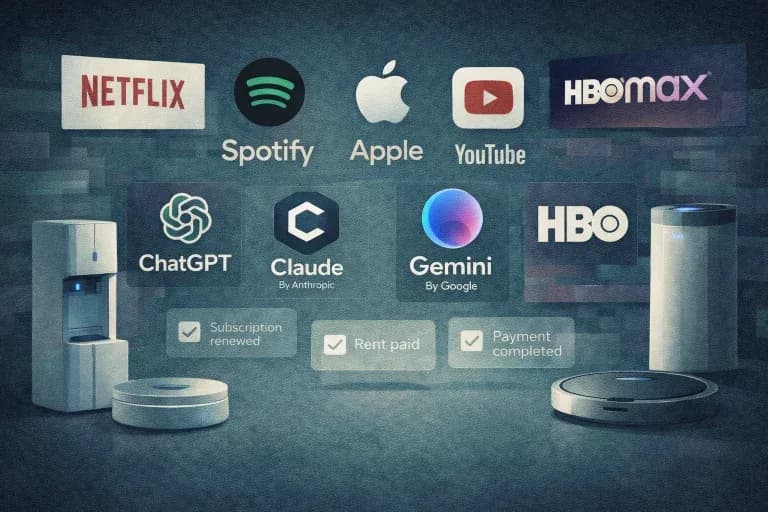
Money leaves bank accounts in South Korea with little notice.
The withdrawals are small and recurring: video streaming services, music platforms, e-commerce memberships, food delivery subscriptions, cloud storage, and, increasingly, paid artificial intelligence tools used for work. No single charge appears significant. Together, they form a steady outflow that now accompanies everyday life.
For a growing share of consumers, these payments are no longer perceived as discretionary spending. They function as baseline expenses. Canceling a subscription is less often framed as saving money than as accepting reduced convenience, slower access, or diminished productivity. Decisions that were once revisited monthly have shifted into the background, sustained by automatic renewal.
Government surveys indicate that subscription use among adults has become nearly universal, with average monthly spending estimated at roughly ₩40,000. These figures primarily reflect digital services — entertainment platforms, music streaming, shopping memberships and software tools — that are widely recognized as subscriptions.
Recurring payments themselves are not unfamiliar to Korean households. Monthly fees for water purifiers and household appliances have long accompanied independent living, particularly among families managing their own homes. These arrangements normalized automatic billing and long-term service relationships well before digital subscriptions became widespread.
What has changed is the scale. Payments once limited to a small number of household services now extend across entertainment, commerce, delivery, cloud storage and workplace tools. Charges that sit behind app icons and those tied to physical appliances now coexist within the same household budgets.
As a result, recurring payments span both digital and physical spaces. They are attached to phones and laptops, but also to kitchens and living rooms. Some are associated with leisure, others with household maintenance, and increasingly, with work and productivity. The line between optional consumption and fixed expense has grown less distinct.
South Korea’s experience reflects a broader shift in how consumption is organized. High digital adoption, frictionless payment systems and long familiarity with rental-based services have made monthly payment models easy to accept. What has changed is not the presence of subscriptions, but their density and reach. An increasing share of daily life now operates on payments that renew automatically, quietly shaping how much consumers spend — and how often those costs are reconsidered.
How Subscriptions Became the Default
The shift did not begin with excess. It began with replacement.
Streaming services entered the South Korean market offering an alternative to cable television, DVD rentals and irregular pay-per-view purchases. A single monthly fee promised predictable costs and broad access. For many households, the calculation appeared straightforward: one payment in place of several. Early adoption was driven less by novelty than by the appeal of simplification.
That logic changed as platforms multiplied. Broadcasters and studios launched their own services, withdrawing content from shared catalogs and placing it behind exclusive paywalls. Viewers who wanted to maintain access to familiar programs faced a new choice. Few replaced one service with another. Most added.
This pattern reshaped entertainment spending. Individual subscription fees remained modest, often framed as affordable when considered in isolation. The larger change lay in how decisions were made. Once subscribed, payments renewed automatically. The moment of choice shifted from the present to an indefinite future, deferred until cancellation felt necessary.
Automatic renewal proved decisive. Signing up required little effort. Maintaining access required none. Canceling, by contrast, demanded attention and intent. As long as the service was used occasionally, the cost rarely triggered action. Over time, subscriptions moved from items that were actively chosen to services that were passively maintained.
The normalization of this arrangement extended beyond entertainment. Shopping memberships adopted the same structure. Monthly fees absorbed delivery and return costs that were once calculated with each purchase. For frequent users, the model appeared economical. For others, it altered behavior without requiring deliberation. Orders became smaller and more frequent. Price comparison receded as convenience took priority.
Food delivery subscriptions followed a similar trajectory. By flattening delivery fees into monthly plans, they reduced the friction that once limited usage. Ordering food no longer required weighing the additional cost of delivery. The decision was effectively prepaid. What changed was not appetite, but frequency.
Across these categories, subscriptions did not displace existing spending. They reorganized it. Payments that were once tied to individual transactions became detached from specific moments of consumption. Costs moved into the background, recurring regardless of use, sustained by default settings rather than repeated choice.
South Korea’s payment infrastructure accelerated the process. High smartphone penetration, widely adopted digital wallets and near-instant payment authorization removed friction at each step. The time between decision and payment narrowed to seconds. The time between payment and reconsideration stretched indefinitely.
By the time cloud storage, software tools and other digital services adopted subscription models, the underlying logic was already established. Paying monthly no longer required justification. It was understood as the standard condition of access. What began as a means of simplifying consumption became a framework that supported accumulation.
Subscriptions, in this sense, did not change what people wanted. They changed how often decisions were made — and how rarely they were revisited.
Rental as a Familiar Precedent
The rapid spread of subscription-based consumption in South Korea was not driven by digital platforms alone. It rested on a structure that had already been in place.
For decades, households have paid monthly fees for products that were neither fully owned nor casually replaceable. Water purifiers, air purifiers, bidets and large household appliances were commonly rented under multi-year contracts. These arrangements reduced upfront costs and bundled maintenance, repairs and regular servicing into a single monthly payment. Once installed, the product remained in use while the charge continued, largely unquestioned.
This model shaped consumer expectations. Payment was ongoing rather than transactional. Service mattered more than ownership. Reliability took precedence over flexibility. Early termination was possible, but rarely without penalties. As a result, the decision to enter a contract carried weight, while the decision to remain in one faded from view.
Unlike discretionary purchases, rental payments became part of the background of household expenses. They were treated similarly to utilities, factored into monthly budgets and seldom revisited unless a problem arose. Over time, consumers grew accustomed to automatic billing and long-term service relationships that prioritized continuity over choice.
This familiarity distinguished South Korea from markets where subscription models arrived as a sharper break from ownership. When digital services adopted monthly billing, they did not introduce a new concept. They extended a known one. The logic of paying for access, maintenance and ongoing service had already been normalized within domestic spaces.
What differed was visibility. Physical rentals occupied space in kitchens and living rooms. Their presence was tangible, their purpose clear. Digital subscriptions, by contrast, left no physical trace. They were attached to accounts rather than objects, renewed silently in the background. As they multiplied, their cumulative cost became harder to perceive.
The coexistence of both forms altered household budgets. Rental contracts anchored monthly obligations in the physical home. Digital subscriptions layered additional payments across screens and services. Each followed the same structural principles — recurring fees, automatic renewal and limited interruption — but operated in different domains of daily life.
This overlap accelerated accumulation. Consumers who were already managing long-term rental payments were less resistant to adding digital subscriptions. The mental barrier to monthly charges had been lowered. What once felt exceptional became routine.
By the time newer subscription categories emerged, the underlying relationship between consumers and recurring payments had shifted. Monthly billing was no longer associated with ownership or permanence. It was associated with access, service and continuity. The transition did not require persuasion. It required only expansion.
When Subscriptions Stopped Feeling Optional
The expansion of subscriptions into artificial intelligence marked a shift that previous categories had not.
Entertainment subscriptions altered how people spent leisure time. Shopping and delivery memberships reshaped convenience. Rental contracts normalized monthly payments for household goods. AI subscriptions changed something else entirely: the perceived cost of opting out.
Generative AI services entered daily use through work and study. They were adopted not as lifestyle upgrades but as productivity tools — for drafting documents, summarizing information, coding, translation and research. In offices and classrooms, their use spread informally, driven by speed rather than policy. Once integrated into routines, they were difficult to remove.
Unlike streaming services, AI subscriptions accumulate value through use. Documents are stored, preferences inferred and workflows adjusted. Over time, the service becomes tailored to the user. Canceling does not simply reduce access; it disrupts processes that have been shaped around it.
This alters the meaning of the monthly fee. For entertainment services, cancellation implies inconvenience or reduced choice. For AI tools, it raises concerns about efficiency and competitiveness. Users describe the decision less in terms of saving money than of losing capability. The cost of leaving is framed not only in financial terms, but in time, output and performance.
The distinction matters because it shifts subscriptions from consumption to infrastructure. AI tools are increasingly treated as part of the working environment, alongside cloud storage and software platforms. Their fees are justified as necessary expenses, absorbed into personal or professional budgets with little scrutiny once established.
This perception accelerates accumulation. AI subscriptions do not replace existing services; they add another layer. Consumers who already maintain multiple digital subscriptions and long-term rental contracts incorporate AI fees as an extension of an established pattern. The decision to subscribe feels less like a choice and more like a requirement.
Automatic renewal reinforces the effect. Payments continue regardless of intensity of use, while data and familiarity deepen dependence. Over time, the threshold for cancellation rises. What began as an optional tool becomes embedded, its absence increasingly difficult to imagine.
In this way, AI subscriptions amplify a broader shift already underway. Monthly payments are no longer confined to entertainment, convenience or household maintenance. They now reach into productivity and performance, shaping how people work as well as how they live.
The result is not a sudden increase in spending, but a structural one. Each new subscription sets a higher baseline. What was once optional becomes expected. What was once visible becomes routine.
A Higher Baseline for a Younger Generation
The cumulative effect of subscriptions is not evenly felt.
Younger consumers in South Korea carry fewer forms of traditional fixed costs. Home ownership is rare, long-term assets are limited, and many remain renters in housing as well as in consumption. Yet their exposure to recurring payments is broader. Digital subscriptions form a larger share of everyday spending, concentrated in areas that shape social life, work and identity.
For this group, subscriptions are less likely to replace existing expenses than to fill structural gaps. Streaming services substitute for leisure spaces. Food delivery replaces time-intensive routines. AI tools compensate for competitive pressure in education and employment. Each addresses a constraint, but each adds another monthly charge.
This is why the idea of “digital rent” resonates most strongly among younger users. The payments are not tied to property or ownership, but to participation. Access to culture, convenience and productivity depends on continued payment. Opting out carries social and professional costs that extend beyond personal preference.
The structure differs from traditional rental expenses. Water purifiers and appliances are visible, finite and tied to a household. Digital subscriptions are diffuse. They follow individuals rather than homes, accumulating across devices, platforms and accounts. Their boundaries are less clear, and their total cost is harder to calculate.
Over time, this creates a higher baseline for participation. The question is no longer whether to subscribe, but how many layers of access are required to function normally. Each additional service raises expectations — faster delivery, constant availability, higher productivity — without reducing existing obligations.
The result is not a crisis driven by excessive consumption, but a shift in how necessity is defined. What previous generations treated as discretionary spending increasingly operates as infrastructure for younger ones. The payments renew quietly, but their implications are lasting.
South Korea offers an early view of this transition. A society accustomed to rental-based living has extended monthly payment logic into digital life, and now into cognitive labor. The accumulation is gradual, often unnoticed, but its effect is clear: everyday life now rests on a growing stack of obligations that must be maintained, not chosen.
What remains unresolved is how much further this baseline can rise — and who bears the cost as more aspects of work and daily life move behind recurring fees.
Continue this reporting
Reporting on the same issue
Related coverage selected from the article's desk, topics and newsroom relationships.
 NewsSep 21, 2026
Europe’s Electrical-Steel Safeguard Now Reaches Inside the Transformer
A new EU safeguard follows electrical steel into certain finished transformer...
 NewsSep 14, 2026
Foreign Tourist Spending Is Reshaping Busan’s Nampo District
Foreign spending is making long-empty commercial space valuable again in Namp...
 NewsSep 11, 2026
Busan-Jinhae’s New Industrial Strategy Meets a Jobs Divide
As BJFEZ prepares to add AI, data and advanced energy to its industrial prior...
More from the author
More from this byline
Stay with the same line of reporting through more work from this byline.
 NewsSep 16, 2026
Busan’s Young-Adult Migration Turns Sharply at 25–29
 NewsSep 1, 2026
What Lee Jae Myung Thinks a Minister Can Fix
Editorial Record
Corrections, sourcing notes and newsroom disclosures remain part of the published record. View Newsroom Notes →
Reader Signal
Community readWhat did this report leave you with?
Choose the signal that best reflects your reading. Select it again to remove it.
One response per article
No response selected
A moderated conversation about the reporting.
One-level replies and newsroom moderation keep the conversation anchored to this article.
Discussion Status
Open
Please sign in to join the discussion.
Newsletter
Weekly reporting and context from Busan and Korea.