The Cheap Alliance Era Is Over
The alliance must remain the core, but it can no longer be the whole architecture. That is where multilateralism stops being a slogan and starts becoming a hedge, giving Seoul more room to absorb shocks from Washington without weakening deterrence.

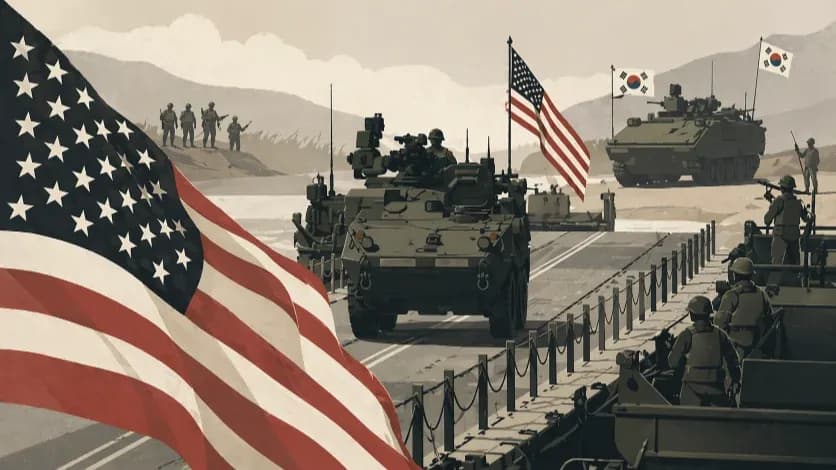
For a long time, South Korea could treat the U.S. alliance as a fixed fact of strategy. Washington was the stabilizer, the guarantor, the force that underwrote deterrence on the peninsula while giving Seoul room to grow economically, argue politically and expand diplomatically. That certainty has not disappeared. But it has narrowed. What is changing in 2026 is not the formal existence of U.S. alliances. It is their political meaning. The alliance is no longer merely a promise of protection. It is increasingly a mechanism through which Washington redistributes burdens, disciplines supply chains and asks partners to absorb more of the cost of American strategic competition. The shift is visible in Washington’s own language: the White House says allies should assume “primary responsibility for their regions,” while the Pentagon’s 2026 National Defense Strategy says allies in some theaters should take the lead, with the United States providing “critical but more limited support.”
That matters for South Korea because the old alliance debate in Seoul was built for a different American era. It was built for a United States that might pressure its allies, demand more money and occasionally overreach, but that still broadly understood alliance leadership as part of its own international role. The current mood in Washington is harder than that. It is more conditional, more openly transactional and less embarrassed about saying so aloud. Recent reporting shows this is not a matter of tone alone. It now extends into trade, industrial policy and critical-minerals strategy, with allies told they may need to pay what U.S. Trade Representative Jamieson Greer called a “national security premium” for supply chains redirected away from China.
The result is a new and uncomfortable reality for allied capitals. The central problem is not that America has become weak. It is that America has become harder to read, and therefore harder to rely on in the old way. Reuters reported earlier this year that middle powers were beginning to “de-risk from America,” not because they were defecting from the United States, but because they no longer wanted all of their exposure concentrated in one political center. That phrase captures the structural adjustment now underway: allies still want the United States close, but they no longer want their own room for maneuver to depend entirely on the rhythms of U.S. domestic politics.
South Korea sits directly inside that problem. It cannot replace the alliance. It cannot pretend geography has changed. North Korea remains a live military threat. U.S. extended deterrence still matters. Combined defense still matters. But none of that erases the fact that the American alliance system is now being repriced around Seoul. More responsibility in regional defense. Greater exposure to U.S.-China strategic competition. More pressure to align industrial policy with American geopolitical priorities. Less confidence that the old distinction between security cooperation and economic autonomy will hold. In that sense, the question facing South Korea is no longer whether it should remain allied with the United States. The sharper question is whether South Korea can remain firmly allied while becoming less strategically vulnerable to the internal volatility of American power.
An Alliance System Kept Intact, but on Harder Terms
What Washington has changed is not the existence of alliances, but the terms under which they are expected to function. Too much commentary still swings between two exaggerations: either the United States is supposedly retreating from the world, or it is preserving the alliance system more or less intact. Neither description is precise enough. The more accurate reading is that the United States is keeping the alliance system while altering its operating logic. Protection remains on offer, but no longer in the old political language of stewardship. It is now framed in the language of contribution, discipline and price. The White House’s 2025 National Security Strategy and the Pentagon’s 2026 defense guidance make that point in unusually direct form: allies are expected to carry more of their local burdens, while U.S. support becomes more selective and more explicitly tied to wider strategic priorities.
That doctrinal shift is not decorative. It is now visible in policy behavior across several fronts at once. In trade and industrial strategy, the administration has made clear that allied solidarity will not be treated as a discount. Reuters reported that Greer urged allies to accept a higher-cost sourcing model for critical minerals outside China, explicitly invoking a “national security premium.” Security, in other words, is no longer treated as separate from cost structures. It is itself becoming a cost structure.
Once that shift is understood, a range of apparently disconnected developments line up. What looks at first like episodic pressure on allies is in fact part of a broader repricing logic. The same administration that asks allies to shoulder more of their own defense burden also expects them to absorb higher costs in supply-chain diversification, align more openly in competition with China and accept that access to U.S. strategic protection may come with narrower political room on trade and industrial policy. The alliance is not being dissolved. It is being made more conditional, more measurable and more openly transactional.
Europe has understood the change quickly, perhaps because it has been forced to. Reuters reported in early April that Spain’s foreign minister said recent U.S. remarks about NATO were pushing Europe to consider alternative security arrangements. Later in the month, Reuters reported that EU leaders were discussing how the bloc’s mutual-assistance clause could be made more operational amid doubts about President Donald Trump’s commitment to NATO. That does not mean Europe is preparing to replace the United States tomorrow. It means Europe is beginning to prepare for the possibility that Washington may no longer be willing, or no longer be predictable enough, to perform the old stabilizing role on the old terms.
This matters for South Korea because the repricing of alliances is not only military. It is financial, industrial and psychological. Reuters reported on April 22 that Treasury Secretary Scott Bessent said Gulf and Asian allies had requested U.S. currency swap lines as the Iran war disrupted markets. Even in that moment of allied anxiety, the structure of dependence was unmistakable: when crisis widens, allies still look to Washington as the ultimate supplier of strategic liquidity and dollar stability. The United States remains indispensable. But that indispensability is precisely what allows Washington to ask for more, to condition more and to assume that partners will continue to come back for support when the system tightens.
Seen from Seoul, this matters more than any slogan about alliance strength. South Korea has long operated under an alliance model in which security dependence on the United States coexisted with significant room for national economic strategy. That room is narrowing. If Washington increasingly treats alliances as channels for strategic coordination against China, then Korean decisions on semiconductors, batteries, shipbuilding, critical minerals and even financial resilience cannot be kept neatly outside the alliance frame. The American message is becoming more explicit: allies are not simply protected entities; they are participants in a wider geopolitical supply system.
The Most Unsettling Variable Is Now American Politics Itself
The deeper problem for U.S. allies is no longer simply the distribution of American power. It is the distribution of American uncertainty. Conventional alliance analysis still tends to measure durability through force posture, treaty language or institutional depth. Those still matter. But they are no longer sufficient. What now unsettles allied capitals is the growing realization that the most immediate source of disruption may come not only from Beijing, Moscow or Pyongyang, but from the way U.S. domestic politics now spills directly into alliance management. The issue is not that Washington has become absent. It is that Washington has become less stable as a strategic center, even while remaining indispensable.
That distinction is critical. During earlier periods of tension, allies often worried that the United States might ask too much of them. Now they worry that Washington may revise the terms of cooperation abruptly, repeatedly and in response to domestic political impulses that have little to do with allied interests themselves. The logic behind “de-risking from America” is not ideological rebellion. It is a response to concentration risk. When one political system can change the price, scope and meaning of alliance cooperation from one electoral cycle to the next, prudence begins to look like diversification.
One reason this matters more now is that the line between domestic politics and alliance policy has thinned almost to the point of disappearance. Trade, industrial policy, great-power competition and ideological signaling are no longer managed in separate boxes. Reuters reported in April that the Trump administration was lobbying allies to support a “trade over aid” push at the United Nations, part of a broader effort to recode America’s external role in explicitly transactional terms. A few days later, Reuters reported that allies were being told they should be ready to pay a “national security premium” for critical minerals sourced outside China. These moves suggest a Washington in which alliance expectations are no longer confined to defense spending or military coordination. They now extend into the political vocabulary through which the United States defines its role in the world.
That changes how allies calculate risk. A treaty can remain in force while the political terms of alliance cooperation become less predictable from one quarter to the next. This is why the central anxiety in allied capitals is not always formal abandonment. More often it is erratic repricing. The United States may remain militarily committed while simultaneously threatening tariffs, demanding new concessions, redefining burden-sharing or shifting policy toward China in ways that leave allies scrambling to determine what is durable and what is contingent. The issue is not whether U.S. power still matters. It plainly does. The issue is whether allied governments can still assume a stable political meaning behind that power.
For South Korea, this changes the strategic equation in a way that is easy to underestimate. Seoul does not simply need to ask whether the alliance remains necessary. It does. The more difficult question is how to remain securely anchored in that alliance while preventing Korean policy from becoming too exposed to the oscillations of American domestic conflict. If U.S. political volatility increasingly determines the price, scope and political meaning of alliance cooperation, then South Korea must think more deliberately about insulation: where to align fully, where to diversify, where to retain room for delay or ambiguity and where to build external partnerships that reduce the cost of sudden shifts in Washington.
Seoul’s Real Task Is Not Distance, but Insulation
If the United States is repricing alliances and U.S. politics is making alliance management less predictable, South Korea’s problem is not whether to loosen the alliance. That is the wrong argument for the wrong moment. Seoul does not face a meaningful choice between alignment and nonalignment. It faces a harder and more adult question: how to remain tightly anchored to the United States in security terms while reducing the degree to which Korean strategy can be whipsawed by shifts in Washington. The task is not distance. It is insulation. The alliance must remain the core, but it can no longer be the whole architecture.
That distinction is often lost in Seoul’s domestic debate because alliance questions are still framed in inherited ideological language. One side warns that any widening of diplomatic options risks weakening deterrence. The other speaks as if greater autonomy could be achieved by a simple act of political will. Both positions are too shallow. In a period when Washington is asking allies to absorb more military, industrial and strategic costs, overconcentration becomes a liability. A country whose security, economic coordination and supply-chain positioning all run through one external political center leaves itself overly exposed to the internal fluctuations of that center.
This is where multilateralism needs to be rescued from vagueness. For South Korea, multilateralism should not mean soft diplomatic scenery, nor should it be treated as a moral alternative to alliance politics. It has to function as a practical hedge. Carnegie’s recent “middle power moment” argument is useful not because it imagines middle powers replacing great powers, but because it recognizes that a more fragmented order gives capable secondary states a larger role in preserving cooperation and reducing dependence on any single pole. For Seoul, that means using multilateralism not as an escape from the United States, but as a way of lowering the cost of U.S. volatility.
Recent Korean diplomacy already points in that direction. In India this week, President Lee Jae Myung and Prime Minister Narendra Modi agreed to push bilateral trade toward $50 billion by 2030, while widening cooperation in semiconductors, shipbuilding, energy, steel and critical minerals. The agreement also included a ministerial-level economic cooperation mechanism and renewed effort to update the 2010 trade framework. This was not routine commercial diplomacy. It was a concrete attempt to deepen ties with another major Asian power whose scale, market size and geopolitical position can give Seoul greater room for maneuver in an era of supply-chain stress and strategic fragmentation.
Vietnam tells a similar story in a different register. Reuters reported this week that South Korea and Vietnam expanded cooperation in nuclear energy, high-tech industries and supply chains, while Korean and Vietnamese firms signed 73 business agreements in technology, energy and infrastructure during Lee’s visit to Hanoi. These steps do not replace the U.S. alliance. They do something more realistic: they widen South Korea’s economic and strategic room for maneuver.
Seen this way, a more mature Korean foreign policy begins to look less like balance for its own sake and more like diversification with a clear hierarchy. The U.S. alliance remains the anchor because nothing else can currently replace its deterrent value, intelligence depth or nuclear umbrella. But around that anchor, South Korea needs a wider ring of strategic relationships that give it economic flexibility, diplomatic reach and industrial alternatives. India matters because it is a large democratic market with geopolitical weight. Vietnam matters because it sits at the heart of manufacturing relocation and regional production chains. Europe matters because it is both a normative partner and an increasingly relevant security and technology actor in its own right. None of these relationships displace Washington. Together, they reduce the strategic penalty of relying too heavily on it.
Values and National Interest Are Not Rival Languages
One of the laziest habits in South Korean foreign-policy debate is to pretend that values and national interest belong to opposing camps. In one telling, values are the language of the self-righteous; in the other, national interest is treated as a harder and cleaner realism. Neither position survives serious scrutiny. States do not navigate an unstable order by choosing between values and interest as if they were rival doctrines. They navigate it by deciding which values strengthen their interests, which interests can be defended without hollowing out their credibility and which principles are worth carrying because they expand their room for action rather than merely decorate it.
That older Korean binary is losing explanatory power. Carnegie’s recent analysis of South Korean progressive foreign policy argues that the Democratic Party’s instincts have moved away from engagement-centered idealism and toward a more strategic pragmatism shaped by North Korea’s nuclear maturity, intensifying U.S.-China rivalry and generational change inside South Korea itself. That does not mean the language of values has disappeared. It means values are being forced into closer contact with hard strategic constraint.
That shift should be welcomed, but only if it is understood properly. Strategic pragmatism is not the same thing as opportunism. South Korea cannot protect its interests simply by speaking the language of flexibility more often. It needs to understand what kind of asset values actually are in a fragmented international system. They are part of the country’s usable capital. South Korea’s democratic legitimacy, legal reliability, technological sophistication and reputation as an open, rules-respecting society shape how other states, firms and institutions are willing to work with it. Brookings has made a similar point in describing South Korea as a “global pivotal state,” arguing that Korea’s influence rests not only on material capabilities but on the credibility attached to its political model and international conduct.
This is especially true for a country whose international weight does not rest on sheer military scale or resource abundance. Seoul’s strength lies in the combination of advanced manufacturing, democratic legitimacy, alliance centrality and middle-power credibility. Remove one of those pillars and the larger structure weakens. That is why a foreign policy built on pure transaction would be self-defeating. South Korea does not become more strategic by acting as though norms, law and political reputation are optional. It becomes more strategic by knowing when and how to spend those assets, and when not to. In a world of contested supply chains, competing coalitions and selective alignment, credibility itself has become a form of power.
At the same time, there is equal danger in treating values as a substitute for choice. Once values become a recital rather than a strategic instrument, they stop clarifying action and start obscuring it. The question is never whether democracy, openness or the rule of law are desirable. The question is what concrete political and economic position South Korea is trying to secure through them. A values-based foreign policy that leaves Seoul with no practical room to manage Washington, Beijing, Southeast Asia and Europe simultaneously is not principled statecraft. It is merely declaratory diplomacy.
This is where “national interest” needs to be rescued from its own vulgarization. Too often in Korean debate, the phrase is reduced to a gesture of skepticism toward ideals, as if interest began where values ended. Properly understood, national interest is a hierarchy of priorities. It tells a government which commitments are central, which are negotiable, which risks are tolerable and which dependencies are too dangerous to deepen further. In the present moment, that should mean something quite concrete for Seoul: the alliance with the United States remains indispensable for deterrence, but U.S. political volatility now creates real secondary risk; widening ties with India, Vietnam, Europe and other partners is not an abandonment of values, but a way of strengthening the conditions under which those values can be defended without strategic panic.
So the more serious formula is this: values provide legitimacy, trust and coalition-building capacity; national interest decides how those assets are used. One without the other is either sentimentalism or drift. Together they form a strategy suited to a country allied to the United States, economically entangled with China, increasingly active with India and Southeast Asia and ambitious enough to matter beyond its immediate neighborhood. “Universal values with national interest first” is not necessarily a contradiction. It is a test of whether Seoul can build a foreign policy disciplined enough to carry both at once.
The Alliance Remains Essential, but It Can No Longer Be the Whole Strategy
South Korea is not entering an age in which it can dispense with the United States. It is entering an age in which reliance on the United States must be managed more deliberately, more coldly and with fewer illusions. The alliance remains indispensable because no other partner can replace what Washington still provides: deterrence, intelligence reach, strategic lift and the wider architecture of security that still underwrites the Korean Peninsula. But indispensability is no longer the same thing as sufficiency. The fact that the alliance remains essential does not mean it remains complete. What the last several months have shown, from Washington’s own strategic documents to the recent behavior of other U.S. allies, is that the old model of easy dependence is fading. The United States still leads, but it now leads more conditionally, more transactionally and under the pressure of a more volatile domestic political system.
That is why the right Korean response is neither estrangement nor nostalgia. Estrangement would be strategically unserious. Nostalgia would be strategically blind. The harder task is to preserve the alliance while adapting to a world in which alliances themselves have become more expensive political instruments. That requires Seoul to think in layers. The U.S. alliance remains the first layer because deterrence still begins there. But the second and third layers have to be built more consciously than before: wider economic partnerships, broader diplomatic coalitions, stronger regional ties and a more disciplined understanding of where South Korea’s own room for maneuver begins and ends. Lee’s recent moves with India and Vietnam matter in exactly this sense. They do not amount to a pivot away from Washington. They are better understood as the beginnings of a strategy designed to reduce concentration risk inside the alliance itself.
This is also why the familiar Korean dispute between values and national interest now looks increasingly exhausted. In a more fragmented and less predictable order, the useful question is not which language Seoul should choose. It is whether the country can turn both into instruments of statecraft at the same time. Values without strategic discipline become recital. National interest without normative credibility becomes a narrower and lonelier form of maneuver. South Korea’s challenge is to avoid both failures. It has to remain a country that is trusted because it is democratic, open and legally reliable, while also behaving like a state that understands how power is now organized: through supply chains, coalition networks, industrial resilience and carefully ranked priorities.
In the end, the most important question for Seoul is not whether the alliance with the United States is still worth keeping. It plainly is. The more difficult question is whether South Korea can prevent that alliance from becoming the sole container of its strategy. The countries most likely to navigate this period well will not be those that break with Washington, nor those that continue speaking as though nothing fundamental has changed. They will be the countries that remain close to the United States while building enough independent strategic depth to withstand the shocks of American volatility. That is the real test now facing South Korea: not whether it can choose between values and interests, or between alliance and autonomy, but whether it can keep all three in productive tension without surrendering control of its own direction
Continue this reporting
Reporting on the same issue
Related coverage selected from the article's desk, topics and newsroom relationships.
 NewsSep 1, 2026
What Lee Jae Myung Thinks a Minister Can Fix
President Lee Jae Myung says reform should be judged by results rather than c...
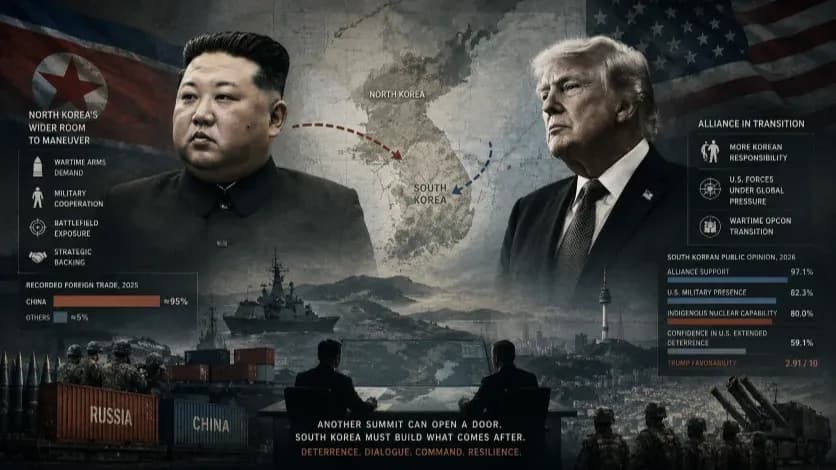 NewsAug 21, 2026
The Korean Peninsula Trump Is Returning To
Another Trump-Kim summit would unfold on a peninsula where North Korea is har...
 NewsAug 16, 2026
What Makes a North Korea Policy Survive a Change of Government?
From Kaesong to military agreements, South Korea’s history shows why some Nor...
More from the author
More from this byline
Stay with the same line of reporting through more work from this byline.
 NewsSep 16, 2026
Busan’s Young-Adult Migration Turns Sharply at 25–29
- NewsSep 1, 2026
What Lee Jae Myung Thinks a Minister Can Fix
Editorial Record
Corrections, sourcing notes and newsroom disclosures remain part of the published record. View Newsroom Notes →
Reader Signal
Community readWhat did this report leave you with?
Choose the signal that best reflects your reading. Select it again to remove it.
One response per article
No response selected
A moderated conversation about the reporting.
One-level replies and newsroom moderation keep the conversation anchored to this article.
Discussion Status
Open
Please sign in to join the discussion.
Newsletter
Weekly reporting and context from Busan and Korea.