Who Learns From War
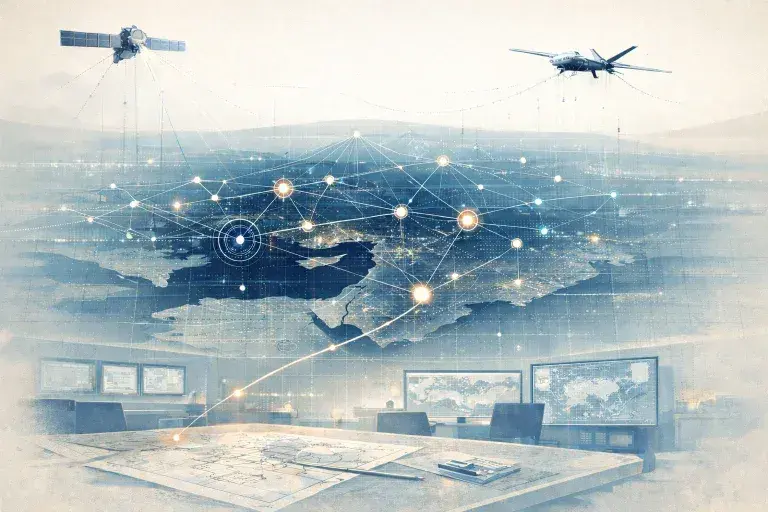
AI systems are entering the core of military planning. U.S. operations against Iranian-linked targets reveal how intelligence analysis, targeting decisions, and operational data now flow through platforms built jointly by the Pentagon and private technology companies.

Key Points
• Modern U.S. military operations increasingly rely on digital intelligence platforms capable of processing vast streams of satellite imagery, signals intercepts, and field reporting.
• Many of those systems combine classified government data environments with software, cloud infrastructure, and AI models developed by private technology companies.
• The growing role of commercial AI has introduced new tensions inside the defense establishment. Pentagon officials argue operational software must remain available for any lawful military mission, while several AI developers maintain restrictions on how their systems can be used.
• Every strike generates a detailed operational archive — intelligence signals, analytical assessments, command approvals, and post-strike evaluations — all preserved inside military data systems.
• AI-assisted analysis tools increasingly draw on that expanding archive to identify patterns in communications, infrastructure development, and operational behavior across regions.
• The result is a new operational cycle in which intelligence collection, data analysis, and military action feed continuously into one another.
• Modern warfare still depends on human authorization at every stage of the kill chain. Yet the analytical environment shaping those decisions now rests on software platforms and data architectures extending well beyond the traditional military chain of command.
A U.S. strike sequence begins long before the aircraft or missiles appear on radar. Intelligence feeds accumulate first: satellite imagery, intercepted communications, drone surveillance, human reports. Analysts sort the fragments into working hypotheses about location, intent, and opportunity. Commanders review those hypotheses, weigh risks against mission objectives, and decide whether a target merits action.
Recent operations against Iranian-linked networks in the Middle East unfolded inside a planning environment that had begun to change. Software platforms designed to integrate intelligence streams and operational records had moved from experimental programs into routine use. Engineers and contractors had spent years building systems capable of assembling enormous volumes of data into a coherent operational picture. Military planners now encountered target lists, probability estimates, and scenario drafts generated with the assistance of advanced AI tools.
War rooms have always depended on machines to manage information. Radar, signals intercept systems, and reconnaissance satellites transformed modern military decision-making decades ago. Yet the arrival of large-scale AI systems altered the character of analysis itself. Instead of presenting raw intelligence for human interpretation, new platforms produced synthesized judgments: ranked target candidates, projected outcomes, and structured operational plans.
A commander reviewing such material still issues the final order. Legal responsibility for the strike remains firmly within the military chain of command. The structure of the decision, however, begins earlier—inside the data environment that organizes intelligence and proposes options. Software determines which fragments of information appear first, which correlations appear significant, and which scenarios seem operationally feasible.
Control over that environment does not rest entirely with the military.
Private technology companies design and maintain much of the infrastructure now used to analyze intelligence and plan operations. Cloud providers host the computing systems. AI developers build the models that interpret language, summarize reports, and generate analytical output. Contractors assemble those components into the platforms used by military planners.
Contracts govern the relationship between the armed forces and those suppliers. Within the technical language of procurement agreements lie clauses that determine how software may be used, what functions remain restricted, and what kinds of operations fall outside approved use.
Those clauses became the center of a dispute inside Washington.
Defense officials argued that military AI tools must remain available for any operation permitted under U.S. and international law. Several AI developers insisted on maintaining safeguards that prohibited certain uses of their models, including direct participation in lethal targeting systems. Negotiations hardened quickly. Pentagon leadership warned that reliance on companies imposing operational restrictions could create vulnerabilities in wartime supply chains.
A designation followed: “supply-chain risk.”
The label normally appears in discussions of foreign technology providers, not domestic AI firms working with the U.S. government. Applying it to an American developer signaled how sharply the conflict had escalated. Technology companies warned that the precedent could allow the government to pressure private firms into removing internal safeguards. Defense officials responded that operational tools cannot depend on corporate policies that might interrupt mission planning during a conflict.
The argument surfaced publicly at the same moment military planners had begun integrating AI-assisted analysis into real operational cycles.
Strikes carried out against Iranian-aligned targets therefore unfolded amid a deeper contest. One side sought unrestricted access to software capable of accelerating the identification and prioritization of targets. The other sought to preserve limits on how far privately developed AI systems should enter lethal decision processes.
Combat operations continued while the dispute intensified. Intelligence feeds kept flowing into digital platforms. Target candidates kept appearing on command screens.
Behind each recommendation stood a stack of systems: military data networks, contractor-built software, and privately developed AI models operating under negotiated rules.
Control over the modern kill chain had begun to pass through a contract.
Inside the Decision Loop
A strike recommendation rarely arrives as a single piece of information. Intelligence officers assemble fragments gathered over hours or days. A vehicle appears repeatedly near a storage facility. Encrypted traffic increases along a known command network. A drone camera records unusual nighttime movement around a compound previously flagged in earlier reporting. Analysts connect the signals and assign an initial assessment: the site may support weapons transfers or command activity.
In earlier planning environments that assessment moved slowly through a chain of desks. Analysts drafted memoranda, intelligence summaries circulated among different units, and staff officers prepared briefing materials for the command group. Several rounds of review followed before a target could be placed on an operational list.
Digital command platforms altered that rhythm. Intelligence streams arriving from satellites, reconnaissance aircraft, signals intercept stations, and partner agencies are now aggregated inside a common operational interface. Software aligns location data, timestamps, and source reliability ratings before analysts begin writing a formal assessment. A site that once required hours of cross-checking appears immediately alongside historical records from previous operations.
Large AI models entered the same environment as analytical tools rather than independent decision makers. Analysts submit a mixture of structured data and free-text intelligence reporting. The system condenses hundreds of pages of incoming reports into brief operational summaries. Language models sort communications intercepts, extract references to locations or individuals, and flag possible links between otherwise unrelated intelligence files.
Output arrives as structured recommendations rather than raw data. A screen may present several potential targets with accompanying confidence scores, references to supporting intelligence, and predicted operational outcomes. One entry might describe a warehouse believed to contain rocket components; another might highlight a safehouse connected to a logistics network. Supporting evidence appears alongside each entry: imagery references, communications intercepts, and earlier intelligence assessments.
Human analysts remain responsible for reviewing every recommendation before it reaches operational planners. Officers verify sources, examine imagery directly, and consult other intelligence units when inconsistencies appear. Command staff then evaluate the operational feasibility of the strike. Weather conditions, available aircraft, air defense risks, and political considerations all enter the final calculation.
Yet the order in which potential targets appear is no longer accidental. Software determines which intelligence fragments appear together and which patterns receive attention first. Analysts rarely begin with a blank dataset. They begin with an ordered field of possibilities.
Operational tempo magnifies the effect. Reconnaissance platforms produce constant streams of imagery and signals data across multiple regions. Analysts responsible for monitoring hostile networks may confront hundreds of potential leads during a single shift. Prioritization becomes unavoidable. Systems designed to highlight probable threats therefore shape the first layer of human attention.
Command decisions still require explicit authorization from military officers. Strike approval passes through legal review and senior command channels before execution. A pilot, drone operator, or missile crew carries out the order only after that authorization arrives.
The environment in which the authorization forms has changed. Intelligence synthesis, target ranking, and operational summaries now emerge from systems built through a partnership between military agencies and private technology firms. Cloud computing providers maintain the infrastructure that stores the data. Defense contractors assemble the operational platforms used in command centers. AI developers supply the models capable of interpreting the vast volume of text and signals moving through the system.
Each layer contributes to the structure of the decision environment.
When a target recommendation reaches a commander’s desk, a long chain of digital processes has already shaped the information that appears on the screen.
The Guardrails Dispute
The integration of AI-assisted analysis into operational planning produced an argument far removed from the battlefield. Officials at the Pentagon insisted that any software used in military planning must remain available for every operation permitted under U.S. and international law. Lawyers and procurement officers summarized the principle in contract language: “all-lawful use.” If a military commander could legally authorize a strike, the tools used to analyze and plan that strike should not be constrained by a vendor’s internal policy.
Several AI developers resisted that formulation. Executives at Anthropic, a leading developer of large language models used in analytical applications, declined to remove safeguards embedded in the company’s licensing terms. Those safeguards prohibited direct involvement in autonomous targeting systems and restricted several other forms of military use. Company officials argued that certain boundaries had to remain intact even when the customer was a government.
Negotiations between the company and the Department of Defense deteriorated quickly. Defense officials warned that reliance on software governed by corporate restrictions could expose military planning systems to unacceptable operational risk. If a contractor could disable functionality, withdraw support, or block particular uses during a conflict, the entire analytical environment inside a command center might change without warning.
A designation followed. Pentagon leadership identified Anthropic as a “supply-chain risk.” The phrase normally appears in reviews of foreign semiconductor manufacturers or telecommunications equipment suppliers. Applying it to a domestic artificial intelligence firm signaled the seriousness of the dispute. The designation triggered internal reviews across the defense procurement system and raised questions among prime contractors about their own exposure to the company’s software.
Industry groups reacted immediately. Technology executives and venture investors warned that such a designation could transform procurement policy into a mechanism for forcing private firms to abandon internal safeguards. A precedent allowing the government to penalize companies for maintaining usage restrictions, they argued, would reshape the relationship between the national security apparatus and the commercial AI sector.
Defense officials offered a different view. Military planning systems cannot depend on software that may refuse lawful operational tasks. In their view, procurement agreements must guarantee uninterrupted access to analytical tools during combat operations. The same reasoning applies to satellites, aircraft components, and encrypted communications systems. AI software, once integrated into command infrastructure, becomes part of the operational supply chain.
The confrontation exposed a structural shift in modern warfare. The analytical backbone of military planning now rests on digital systems built largely outside the armed forces. Data platforms, cloud infrastructure, and AI models originate in private industry. Contracts determine how those systems can be used.
Legal responsibility for military action still rests with the state. Yet the technical environment in which operational decisions take shape now depends on companies that design software according to their own internal policies. Command authority and platform governance increasingly intersect inside procurement agreements rather than on the battlefield.
Strike operations against Iranian-aligned targets continued while that conflict unfolded in Washington. Intelligence analysts kept receiving AI-generated summaries. Target candidates continued to appear on operational dashboards. Each recommendation reached commanders through software governed by terms negotiated between the Department of Defense and private developers.
Operational planning proceeded while the rules governing those systems remained under dispute.
Data After the Strike
Missiles or aircraft complete the visible portion of an operation. The analytical work begins again immediately afterward. Surveillance platforms return to the same locations within hours. High-resolution satellite imagery replaces earlier reconnaissance photographs. Drone cameras revisit the strike site, recording structural damage, vehicle movement, and any surviving activity. Signals intercept stations monitor communications networks connected to the target area.
Analysts gather the resulting material inside the same operational systems used during the planning phase. The procedure carries a formal name inside the U.S. military: battle damage assessment, or BDA. Officers determine whether the intended target was destroyed, whether additional strikes are required, and whether the attack produced unintended effects.
Digital command platforms now record every stage of that process in structured form. The intelligence used to nominate a target remains stored alongside the operational decision that approved the strike. Surveillance images taken after the attack attach directly to the earlier data record. Communications intercepts collected before and after the operation remain linked to the same entry in the database. A single strike therefore produces a continuous chain of digital records beginning with the first intelligence hint and ending with the final damage assessment.
Such records extend far beyond narrative reports written by analysts. Databases contain geographic coordinates, time stamps, source classifications, reliability scores assigned to individual intelligence streams, and operational details describing how the strike unfolded. The system also records the sequence of reviews that preceded authorization, including the officers who evaluated the intelligence and the legal advisers who examined the proposed action.
Accumulation of those records creates an expanding archive of operational behavior. Intelligence analysts can compare hundreds of earlier operations to determine which indicators most often corresponded with genuine threats. Communications patterns observed before one strike may reappear months later in a different region. Satellite imagery from previous operations provides reference points for identifying disguised facilities or recurring construction patterns.
AI-assisted analysis tools operate directly on that archive. Language models scan written intelligence reports and extract references to locations, individuals, or organizations. Pattern recognition systems evaluate similarities among surveillance images collected across different operations. Algorithms designed for predictive analysis estimate the probability that a new intelligence signal matches earlier cases associated with hostile activity.
Military planners describe the result in practical terms: a continuously expanding operational memory. Every strike contributes new evidence about how adversaries move personnel, conceal equipment, and rebuild infrastructure after an attack. Analysts use the archive to refine threat indicators and improve the speed with which future targets can be identified.
Ownership of that data remains a sensitive matter. Operational records generated during military campaigns belong to the government and fall under strict classification rules. Yet many analytical systems processing those records depend on software developed and maintained by private companies. AI developers improve their models through evaluation pipelines that require large volumes of real-world examples.
Contracts attempt to draw a boundary between government-controlled operational data and the systems used to analyze it. Sensitive intelligence remains confined within classified environments, while developers maintain the software frameworks that allow analysts to process the information. The distinction, however, becomes harder to maintain as AI tools rely increasingly on large data environments to refine their performance.
Military operations therefore generate two parallel outputs. One output consists of the physical consequences of the strike itself—destroyed infrastructure, disrupted networks, or eliminated personnel. The other output takes the form of detailed digital records describing how intelligence signals translated into operational action.
The archive grows with every campaign. Analysts return to the data repeatedly as new intelligence arrives. Each additional entry sharpens the analytical tools used to interpret the next set of signals.
Combat operations conclude at the moment a weapon reaches its target.
The data produced by those operations continues to circulate through the systems that shape future decisions.
The Tempo Race
Military planners have long described combat operations as a sequence of linked decisions: identify a target, verify its significance, authorize action, and execute the strike. The process is commonly called the kill chain. Each stage depends on the speed with which intelligence can be interpreted and translated into operational orders.
For decades the slowest element of that chain lay in analysis. Surveillance satellites, reconnaissance aircraft, and signals intercept systems produced far more information than human analysts could evaluate in real time. Intelligence units often required hours or days to correlate imagery, communications intercepts, and field reports before presenting a coherent assessment to commanders.
Digital analysis systems began compressing that interval well before the arrival of large AI models. Software capable of aggregating satellite imagery, geolocation data, and intercepted communications allowed analysts to compare multiple intelligence streams inside a single interface. Commanders gained access to operational dashboards that displayed patterns of movement and infrastructure development across entire regions.
Large AI models extended the same compression into textual intelligence. Signals intercepts, field reports, and intelligence briefings generate enormous volumes of written material. Language models process those documents in minutes, extracting references to individuals, locations, and operational activities. Analysts receive condensed summaries rather than thousands of pages of raw reporting.
Speed changes the character of operational planning. A warehouse suspected of storing missile components can move from initial detection to a fully documented strike proposal in a fraction of the time required under earlier procedures. Surveillance data enters the analytical system, relevant reports appear automatically, and the platform assembles a preliminary assessment before a human analyst begins the final review.
Operational planners place heavy emphasis on that acceleration. An adversary network that moves personnel or equipment quickly can evade detection if intelligence analysis lags behind events on the ground. Faster interpretation allows commanders to act before a target relocates or disperses.
Several major military powers have pursued that advantage. U.S. defense programs have invested heavily in systems capable of integrating intelligence sources and producing rapid operational assessments. Chinese military research institutions describe a similar objective under the concept of “intelligentized warfare,” which emphasizes automated analysis of battlefield data to accelerate command decisions. Israeli defense planners have incorporated AI-assisted analysis into targeting systems designed to process large volumes of intelligence from surveillance networks.
Each effort addresses the same constraint: the volume of modern intelligence far exceeds the capacity of human analysts to examine it manually. Satellite constellations observe thousands of locations simultaneously. Drone patrols stream continuous video. Signals intercept stations capture vast quantities of digital communications. Without automated assistance much of that information would remain unexamined.
AI-assisted platforms therefore act as filters inside the decision cycle. They collect the incoming signals, assemble relevant intelligence records, and produce preliminary interpretations for human review. Commanders retain the authority to approve or reject each recommendation, yet the time available for evaluation becomes shorter as the analytical process accelerates.
Military planners increasingly treat decision speed itself as a strategic asset. A command structure capable of interpreting intelligence quickly enough to act on fleeting opportunities may gain an advantage even without superior weapons. Faster analysis produces earlier decisions, and earlier decisions alter the tempo of the entire campaign.
Competition over military AI reflects that calculation. Governments invest in software platforms, data infrastructure, and machine learning models in order to shorten the interval between detection and action. The objective is not to remove human authority from the decision loop but to ensure that commanders receive coherent intelligence assessments before an opportunity disappears.
Operations against Iranian-aligned networks unfolded within that accelerating environment. Intelligence analysts, command staff, and operational planners relied on digital systems designed to compress the time between observation and decision. Each strike therefore formed part of a larger contest over how quickly modern military organizations can interpret the signals flowing through the battlefield.
The Question of Learning
Combat operations generate more than destroyed facilities and disrupted networks. Every stage of a strike produces records describing how intelligence signals led to operational action. Surveillance images, intercepted communications, analytical judgments, command approvals, and post-strike assessments remain stored in the digital systems used to manage the campaign.
Those records form the raw material for future intelligence work. Analysts routinely revisit earlier operations to examine which indicators proved reliable and which signals produced false alarms. Communications traffic that once seemed routine may acquire new meaning when compared with later events. A warehouse structure destroyed in one campaign may reappear elsewhere under slightly different construction patterns. Patterns become visible only after multiple operations accumulate inside the same database.
AI-assisted analytical systems interact directly with that growing archive. Language models scan written intelligence reports and extract references to individuals, locations, and organizations. Image-analysis tools compare satellite photographs collected months apart to identify new construction or concealed infrastructure. Pattern-matching algorithms evaluate whether newly intercepted communications resemble earlier traffic linked to hostile activity.
Analysts do not treat those tools as independent decision makers. Officers examine the evidence behind every recommendation before incorporating it into operational planning. Yet the tools rely on the archive of earlier operations to generate their assessments. Each completed campaign therefore expands the set of examples used to interpret future intelligence.
Questions emerge over how far that process extends. Military intelligence records remain tightly controlled government assets. Access to raw operational data requires security clearance, and most records remain confined to classified networks. Private technology companies supplying AI models do not automatically gain access to that material.
Nevertheless, the analytical systems themselves depend on extensive evaluation and testing. Engineers measure how accurately a model identifies relevant signals inside complex intelligence reporting. Developers adjust system behavior when analysts discover patterns the software fails to detect. Performance improves as additional real-world cases enter the testing environment.
Operational campaigns inevitably produce such cases. Intelligence signals collected before a strike, together with the confirmed outcome afterward, create a complete record of how particular indicators corresponded with real activity. Those records provide unusually precise examples for evaluating analytical software.
Military officials describe the arrangement as an iterative process. Analysts document the sequence of intelligence cues that preceded each operation. Engineers refine the analytical tools used to interpret those cues. Updated systems then assist analysts during the next cycle of intelligence gathering.
No evidence suggests that operational data from strikes automatically becomes training material for commercial AI models available to the public. Security restrictions surrounding classified intelligence would make such a transfer extraordinarily difficult. Yet operational experience continues to shape the analytical systems used inside military planning environments.
Combat operations therefore feed a feedback loop within the institutions that conduct them. Intelligence signals trigger analysis. Analysis leads to operational action. Post-strike assessment produces new records that alter how future signals are interpreted.
Military organizations have refined that cycle for decades through doctrine and training. Digital platforms and AI-assisted analysis extend the same cycle across far larger volumes of data. Every campaign leaves behind a detailed operational archive that informs the next round of decisions.
Strikes against Iranian-aligned targets added new entries to that archive. Intelligence gathered before the operations, together with the damage assessments afterward, joined a growing collection of cases used to interpret hostile activity across the region.
Future analysts confronting unfamiliar signals will search the archive for precedents. The analytical tools assisting them will do the same.
Corporate Power in War
Military command systems once relied almost entirely on technology designed within the defense establishment or by traditional weapons manufacturers. Aircraft builders produced combat platforms, radar companies developed sensors, and specialized defense contractors delivered the communications networks linking commanders to forces in the field. The companies involved in those projects operated inside a procurement structure built specifically for military programs.
Digital warfare has introduced a different industrial landscape. Intelligence analysis, data storage, and large-scale computing capacity now depend on infrastructure originally developed for the commercial technology sector. Cloud computing providers operate the data centers that store intelligence records. Software firms design the platforms that organize surveillance feeds and operational databases. AI developers supply the models capable of interpreting the enormous volume of written reports and signals passing through intelligence networks.
Military planners encounter those systems not as isolated tools but as components of a technical stack assembled from several private sources. A single analytical platform may combine cloud infrastructure operated by a major technology company, data integration software written by a defense contractor, and language models created by a separate AI developer. Engineers working under government contracts integrate those components into the interfaces used inside command centers.
Reliance on commercial infrastructure expanded rapidly during the past decade as military organizations struggled to manage the scale of modern intelligence data. Satellite constellations, drone patrols, and signals intercept systems produce information continuously across multiple theaters of operation. Building dedicated government computing systems capable of storing and processing that volume proved prohibitively slow and expensive. Defense agencies therefore turned toward the computing resources already operating inside the commercial technology sector.
Major cloud providers soon began competing for large defense contracts designed to support classified data environments. Those contracts allowed military organizations to store intelligence records, run analytical software, and distribute information securely across operational networks. Once those environments existed, AI developers began adapting language and data analysis models for use within them.
The resulting ecosystem brought private companies directly into the architecture of military planning. Engineers employed by technology firms design the software frameworks that allow analysts to process intelligence. Updates to those systems arrive through vendor-maintained development cycles rather than internal military engineering programs. New analytical capabilities appear as software revisions rather than new pieces of hardware.
Government procurement rules attempt to maintain clear authority over such systems. Contracts specify performance requirements, data protection standards, and operational availability. Military agencies retain control over the classified information flowing through the platforms. Private companies provide the software and infrastructure needed to interpret that information.
The relationship nevertheless differs from traditional weapons procurement. A missile or aircraft remains under military control once delivered to the armed forces. Digital platforms depend on continuous maintenance from their developers. Security patches, performance improvements, and compatibility updates arrive through software revisions prepared by the companies that created the systems.
Operational planners therefore depend on a technical environment maintained partly outside the military chain of command. Cloud providers ensure that computing infrastructure remains available during military operations. Software firms update the platforms used to analyze intelligence. AI developers refine the models capable of interpreting vast collections of text and signals data.
Commercial competition now shapes the same environment. Technology companies vie for government contracts that place their systems inside defense networks. Firms capable of offering faster analytical tools or more efficient data infrastructure gain a significant advantage in that competition. Defense agencies encourage such rivalry in order to accelerate innovation and reduce costs.
Operations against Iranian-aligned networks unfolded within that industrial framework. Intelligence analysis relied on platforms assembled from commercial computing infrastructure, contractor-developed software, and privately created AI models. Commanders reviewing operational recommendations saw the output of a system built through partnerships between government agencies and private technology firms.
Modern military planning no longer occurs entirely within the walls of the defense establishment. The technical foundation supporting intelligence analysis and operational decision-making now extends across a network of commercial companies whose software forms the backbone of the digital battlefield.
The Accountability Gap
Military doctrine places responsibility for the use of force squarely within the chain of command. A strike requires authorization from officers who carry legal authority under U.S. law and international humanitarian law. Commanders must determine whether a target qualifies as a legitimate military objective, whether the anticipated damage remains proportional to the expected advantage, and whether civilian harm can be minimized. Legal advisers review those judgments before operational approval moves forward.
Digital analytical systems do not alter that formal structure. A commander still approves or rejects a strike recommendation, and the individual issuing the order remains accountable for the decision. Yet the process leading to that moment now involves layers of software that organize and interpret intelligence before human review begins.
Intelligence analysts rarely encounter raw data streams alone. Operational platforms gather satellite imagery, signals intercepts, reconnaissance footage, and written intelligence reporting into unified dashboards. AI models summarize the material, extract references to locations or individuals, and propose relationships among otherwise separate reports. The system often presents analysts with a ranked set of possible targets accompanied by supporting evidence.
Human officers examine the recommendations carefully. Analysts verify sources and consult additional intelligence units when doubts arise. Command staff evaluate operational risks and potential consequences. The strike cannot proceed until those steps are complete.
The analytical environment nevertheless shapes the decision long before a formal order appears. Software determines which intelligence fragments appear first on the analyst’s screen. Algorithms group related signals together, highlighting certain correlations while leaving others buried in the data archive. Systems designed to manage vast quantities of information inevitably establish priorities within that flow.
Responsibility for those priorities does not reside entirely within the command structure. Engineers design the algorithms that sort intelligence signals. Software developers determine how information appears inside operational dashboards. AI models interpret language contained in intercepted communications or field reports. Each technical layer influences the organization of the evidence that commanders ultimately review.
Military lawyers continue to examine the legality of each strike. Operational commanders remain accountable for approving the action. Yet the structure of the analytical process rests partly on software architecture produced outside the military hierarchy.
The relationship complicates traditional assumptions about responsibility in warfare. Commanders exercise judgment based on the information presented to them. That information arrives through systems shaped by developers, engineers, and contractors working within commercial technology firms. Those firms do not authorize military action, yet their software contributes to the environment in which military decisions take form.
Combat operations against Iranian-aligned targets therefore unfolded within a complex chain of influence. Intelligence signals entered digital platforms operated across classified networks. AI-assisted analysis transformed those signals into operational summaries. Human officers reviewed the resulting recommendations and decided whether to authorize a strike.
Legal accountability remains concentrated within the command structure that issues the final order. The analytical systems shaping the decision environment extend far beyond that structure, reaching into the commercial technology sector that now forms a critical layer of the modern battlefield.
Who Learns From War
Military institutions have always studied their own campaigns. Officers examine earlier operations to understand how intelligence signals revealed hostile activity, how adversaries concealed equipment or personnel, and how quickly networks recovered after a strike. Lessons drawn from those examinations gradually enter doctrine, training programs, and planning procedures. The process has historically unfolded over years, sometimes decades, as archives accumulate and historians reconstruct events long after the fighting ends.
Digital warfare alters the tempo of that institutional learning. Intelligence records generated during a campaign enter centralized databases almost immediately. Surveillance imagery, intercepted communications, operational summaries, and post-strike assessments remain stored together inside analytical systems used by intelligence units. Analysts searching for clues about a newly emerging network can retrieve examples drawn from earlier operations without waiting for formal historical studies.
AI-assisted tools accelerate that process further. Pattern-recognition systems compare fresh intelligence signals against the archive of previous operations, highlighting similarities in communications behavior, infrastructure development, or personnel movement. Language models examine thousands of pages of reporting and extract references that might connect a current investigation to earlier activity. Analysts reviewing a new lead therefore encounter not only the immediate intelligence surrounding a location or organization but also echoes of previous cases preserved inside the data environment.
Operational planning absorbs those comparisons quickly. A facility displaying construction features associated with earlier weapons storage sites may receive closer scrutiny. Communications traffic that resembles patterns observed before previous attacks may elevate the urgency of an investigation. Analysts incorporate those historical parallels into assessments presented to commanders considering potential action.
The feedback cycle does not stop at the intelligence level. Engineers responsible for maintaining analytical systems review how those platforms perform during real operations. Instances in which the software overlooked relevant signals or emphasized misleading patterns receive close attention. Updated models and analytical methods attempt to correct those shortcomings before the next cycle of intelligence analysis begins.
Combat operations therefore generate a continuous stream of examples through which analytical systems improve their performance. Each operation adds another case describing how particular intelligence indicators corresponded with real events on the ground. Future analysts confronting similar signals will examine those earlier records as reference points.
The presence of commercial AI developers within the military technology ecosystem introduces a new dimension to that process. Engineers employed by private firms build and refine the models used to interpret intelligence reporting and communications intercepts. Government agencies operate the classified environments in which operational data resides, yet the analytical capabilities available within those environments originate partly from software designed outside the defense establishment.
War thus produces two forms of learning. Military organizations refine their understanding of adversary behavior through the traditional study of campaigns. Analytical systems evolve through exposure to the complex signals generated during real operations. Engineers adjust software behavior in response to those experiences, improving the ability of future systems to interpret similar intelligence.
Strikes against Iranian-aligned networks contributed to that evolving record. Intelligence gathered before the operations, the analytical judgments that led to action, and the assessments recorded afterward now reside within the same operational archives that guide ongoing intelligence work across the region.
Military planners reviewing a new signal in the future may search those archives for precedent. Analytical systems will perform the same search automatically, comparing fresh information against thousands of earlier records.
War once produced knowledge slowly distilled into doctrine manuals.
Modern campaigns store their lessons directly inside the analytical systems used to plan the next operation.
Continue this reporting
Reporting on the same issue
Related coverage selected from the article's desk, topics and newsroom relationships.
 NewsSep 1, 2026
What Lee Jae Myung Thinks a Minister Can Fix
President Lee Jae Myung says reform should be judged by results rather than c...
 NewsAug 21, 2026
The Korean Peninsula Trump Is Returning To
Another Trump-Kim summit would unfold on a peninsula where North Korea is har...
 NewsAug 16, 2026
What Makes a North Korea Policy Survive a Change of Government?
From Kaesong to military agreements, South Korea’s history shows why some Nor...
More from the author
More from this byline
Stay with the same line of reporting through more work from this byline.
 NewsSep 18, 2026
The Other AI Race Is for the Freedom to Change Course
 NewsSep 5, 2026
How a Political Appointment Becomes a Judgment of Character
Editorial Record
Corrections, sourcing notes and newsroom disclosures remain part of the published record. View Newsroom Notes →
Reader Signal
Community readWhat did this report leave you with?
Choose the signal that best reflects your reading. Select it again to remove it.
One response per article
No response selected
A moderated conversation about the reporting.
One-level replies and newsroom moderation keep the conversation anchored to this article.
Discussion Status
Open
Please sign in to join the discussion.
Newsletter
Weekly reporting and context from Busan and Korea.