G7 Backs Trump’s Iran Ceasefire, With Doubts
Trump brought an Iran ceasefire to the G7, but the summit exposed a wider order of dependence: Hormuz energy routes, European mistrust, Korean shipyards and African mineral value.

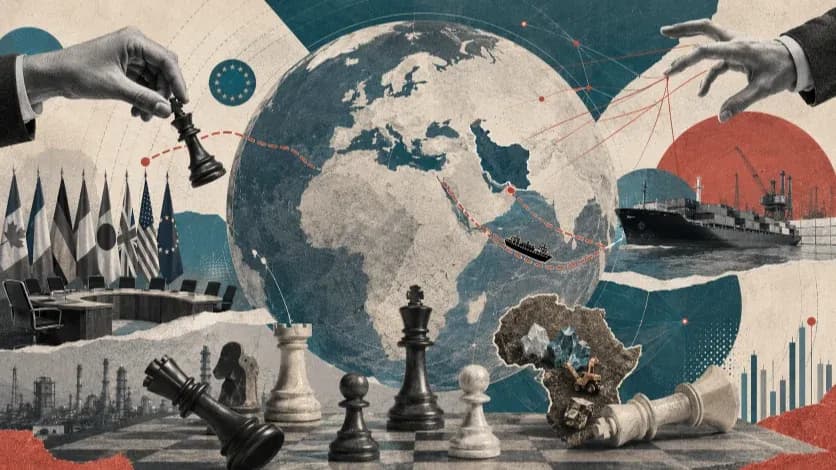
Trump brought an Iran ceasefire to Europe. But the summit exposed a wider order of dependence: energy routes through Hormuz, European mistrust of U.S. guarantees, Korean industrial capacity and African demands for mineral value.
Donald Trump arrived at the G7 with a ceasefire in hand, but the settlement had not yet caught up with the war.
The interim U.S.-Iran memorandum gave the summit what it urgently needed: a way to stop the fighting from driving another shock through oil markets, shipping lanes and allied politics. It promised a reopening of the Strait of Hormuz, a 60-day diplomatic clock, relief for Iranian oil exports and a path toward nuclear verification. It also carried the harder truth of the moment. Washington could still force a crisis to pause. Turning that pause into order would require more than American pressure.
That was the deeper story behind the leaders’ carefully managed welcome in Evian. European governments had little reason to treat Trump’s Iran deal as a final settlement, and less reason to mistake it for the restoration of old Atlantic confidence. Yet the alternative to endorsing the deal was worse: a wider Gulf crisis, higher energy risk, more pressure on Ukraine’s war economy and another test of whether the West could absorb a crisis that began with American force but quickly demanded allied management.
The ceasefire therefore arrived at the G7 as both achievement and warning. It lowered the temperature of one conflict while exposing the machinery now required to manage what came next: oil cargoes, naval routes, sanctions sequencing, uranium inspections, Russian war financing, Korean shipyards and African mineral value chains. The summit did not gather simply to applaud the end of a war. It gathered around the costs of making the pause last.
A pause before a settlement
The 14-point memorandum did its most urgent work in the space between war and settlement. It stopped the momentum of escalation, sketched a path toward a final agreement and placed a 60-day clock over questions that had already moved beyond the control of any single battlefield. In diplomatic terms, the document opened a channel. In strategic terms, it was a holding structure, designed to keep the most dangerous pieces of the conflict from moving at once.
Its immediate promises were practical. Fighting would stop. The American maritime blockade would be lifted. Commercial traffic through the Strait of Hormuz would resume. Iranian oil exports would receive limited relief. Frozen assets would move back into discussion. Nuclear questions would return to a monitored process, with high-enriched uranium and verification left for the next stage. The agreement gave every side something to claim before it gave any side a settlement to enforce.
The war’s pressure had already outrun its original frame. A U.S.-Iran confrontation could be described in Washington as a question of coercion, nuclear limits and deterrence. In Europe, it arrived as another threat to inflation, Ukraine financing and political unity. In Asia, it arrived through the possibility of disrupted crude and LNG flows. In the Gulf, it arrived through insurance, tanker movements and the unresolved question of who could guarantee safe passage once the shooting stopped.
Hormuz made the memorandum global. The International Energy Agency estimates that around a quarter of the world’s seaborne oil trade passed through the strait in 2025, with about 80 percent of that oil and oil products moving toward Asia. More than 110 billion cubic meters of LNG also passed through the same corridor, including the overwhelming majority of LNG exports from Qatar and the United Arab Emirates. A regional war pressing on Hormuz therefore carried consequences far beyond the Gulf: energy prices, shipping schedules, fertilizer inputs, petrochemical feedstocks and the industrial rhythms of economies that never fired a missile.
The ceasefire lowered that pressure without removing the source of it. Tankers could move again only if shipowners, insurers, naval commanders and energy buyers believed the passage had become more than legally open. A strait can be declared safe in a communiqué long before it becomes safe in the calculations of the firms that send cargo through it. That gap between diplomatic language and commercial confidence is where the first test of the memorandum will take place.
The same gap runs through the nuclear provisions. The memorandum reaffirms that Iran will not acquire a nuclear weapon, but the harder questions sit inside the sequencing. Which comes first: oil relief or uranium dilution, asset access or verification, sanctions easing or proof of compliance? A deal can survive vague language at the moment of signing. It rarely survives vague timing once each side begins measuring concessions against domestic pressure.
For Trump, the memorandum offered an exit from a conflict that risked becoming more expensive than decisive. It allowed him to claim that American pressure had forced Tehran into a deal, while avoiding the deeper costs of an open-ended war around Hormuz. The document also narrowed the definition of success. The goal had shifted from the clean removal of Iran’s strategic capabilities to de-escalation, access, monitoring and time.
Iran’s politics of avoided defeat
Iran emerged from the war damaged, constrained and still standing. That combination gave the ceasefire its most difficult political meaning. The attacks had exposed weaknesses in Tehran’s air defenses, missile networks and economic resilience. The blockade had pressed oil exports toward levels that threatened the state’s fiscal breathing room. Yet the interim memorandum did not read like the document of a defeated power. It returned Iran to the table with its most valuable files still open: oil, frozen assets, nuclear procedures, sanctions relief, Hormuz and the regional networks Washington had sought to weaken.
The distinction between damage and defeat runs through the agreement. A defeated state accepts terms written around the removal of its leverage. Iran accepted a diplomatic clock. High-enriched uranium would be dealt with through a monitored process rather than an immediate public surrender. Sanctions relief would be sequenced rather than erased, leaving room for argument over timing. Oil would begin to move again before the final nuclear settlement had been written. Each item gave Washington a mechanism of pressure, but each also gave Tehran a reason to remain in the process.
For Trump, the deal allowed a claim of coercive success. American force had brought Iran to the table, forced a pause and opened the route back through Hormuz. Yet the war had been framed around the removal of strategic threats; the memorandum settled for managing them. That shift gave Tehran space to describe survival as resistance, and negotiation as the result of endurance rather than capitulation.
Inside Iran, the distinction matters. A government that had absorbed military blows and economic disruption could still tell its domestic audience that it had avoided surrender, preserved the nuclear question as a sovereign negotiation and compelled the United States to discuss oil access and assets. Material relief may be slow, conditional and vulnerable to reversal. The political story moves faster. A state under pressure had held long enough for the world’s leading powers to turn from escalation to management.
The same geography that made the war dangerous also protected some of Iran’s bargaining power. Tehran did not need permanent control over Hormuz to turn it into leverage. It needed the world to remember how much of the global economy passes through a narrow maritime corridor within reach of Iranian pressure. Once oil prices, LNG cargoes, ship insurance and Asian energy security entered the calculation, the war could no longer be measured only by military damage. Tehran’s position weakened on the battlefield while the geography around it strengthened its hand at the negotiating table.
Lebanon and Hezbollah deepen the problem. They sit outside the narrow nuclear bargain yet remain inside its political gravity. Any final settlement that leaves Iran’s regional networks untouched will be criticized in Washington and Jerusalem as incomplete. Any settlement that tries to dismantle them too directly risks giving Tehran a reason to slow or abandon nuclear concessions. The interim memorandum moves these questions into the same diplomatic chamber without resolving the order in which they must be handled.
Iran’s gain therefore needs careful measurement. Tehran did not emerge stronger in any simple sense. Its economy had been hit, its military posture tested, its export routes exposed and its internal legitimacy placed under strain. It achieved something narrower but politically valuable: it prevented Washington from defining the end of the war as an Iranian defeat. In the politics of this ceasefire, survival became leverage.
Europe’s endorsement without confidence
Europe’s welcome for the Iran ceasefire carried the discipline of necessity. The leaders gathered in Evian had little incentive to challenge Trump in public over a deal that could reopen Hormuz, cool energy markets and prevent a regional war from cutting across the rest of their agenda. A prolonged Gulf crisis would have reached Europe through fuel prices, shipping insurance, inflation expectations and the political cost of sustaining Ukraine. The summit’s language of support rested on a colder calculation: an imperfect pause was easier to manage than a widening war.
That calculation did not restore confidence in American leadership. Across Europe, the public basis of the old Atlantic bargain has been weakening. The European Council on Foreign Relations reported this month that only 11 percent of respondents in a 15-country survey now consider the United States an ally, down from 16 percent half a year earlier and 22 percent in November 2024. A quarter described the United States as either a rival or an adversary. The G7 photograph showed leaders standing together. The polling underneath it showed societies learning to separate dependence from trust.
European governments have had to govern inside that gap. They cannot build Ukraine’s defense, manage Russia’s war economy, stabilize energy routes and compete with China without the United States. They also cannot assume that American decisions will arrive through consultation, predictability or the older habits of alliance management. Trump’s Iran diplomacy sharpened that contradiction. The war had been driven by American force and American timing, yet its consequences demanded European participation once oil, shipping and regional escalation became harder to contain.
Evian became an exercise in absorbing Trump’s diplomacy into a wider frame. The G7 did not leave the Iran memorandum as a bilateral American achievement. It placed it beside language on nuclear verification, maritime security, Lebanon, energy diversification, Ukraine and Russia’s war financing. The effect was subtle but important. Europe gave Trump room to claim leadership on Iran while surrounding that claim with the instruments of collective management.
Ukraine gave that strategy its hardest test. European leaders understood that a G7 consumed by Iran could weaken pressure on Russia, especially if Trump used the ceasefire as proof that personal diplomacy could settle wars faster than allied coalitions. The summit moved in the opposite direction. Its statements tied support for Kyiv to the broader task of preventing coercive states from profiting from disorder. Europe’s endorsement of the Iran deal came with an implicit demand: if Trump wanted recognition for stopping one war, he would have to remain attached to the collective effort to sustain another country under attack.
The two theatres did not align neatly. Iran required de-escalation. Ukraine required endurance. In the Gulf, Europe wanted the fighting to stop before it spilled further into markets and shipping lanes. In Ukraine, Europe wanted pressure to continue until Russia’s war economy faced higher costs. Trump’s diplomacy had to be praised in one theatre and disciplined in another. The G7’s achievement, if it can be called that, was to hold those tensions inside the same communiqué.
For European leaders, public mistrust now limits the emotional vocabulary of alliance. Cooperation with Washington can still be justified through security, energy and economic necessity. American-led initiatives can still be supported when the alternative is worse. What has become harder is to present American leadership as naturally stabilizing. The Iran ceasefire illustrated why. It reduced a danger that American power had also helped intensify.
That operating style also explains why the summit looked beyond its own membership. If trust had weakened inside the club, capacity had to be found outside it.
Capacity outside the club
South Korea entered the G7 from a different doorway. It was not a member of the club that wrote the main communiqué, and it did not arrive with the military reach of the United States or the diplomatic weight of Europe. Its relevance lay in the parts of the new order that cannot be declared into existence: ships, batteries, defense systems, semiconductors, supply chains and the industrial depth needed to turn allied strategy into usable capacity.
That role was easy to miss in a summit dominated by Iran, Ukraine and Trump’s return to the center of the diplomatic stage. Yet South Korea’s presence pointed to one of the quieter changes in global politics. The old hierarchy treated non-G7 partners as participants in someone else’s agenda. The new security economy is making some of them operationally indispensable. A communiqué can promise maritime security, energy diversification or supply-chain resilience. It still needs shipyards, ports, factories, engineers, financing and firms willing to build under political risk.
For Seoul, the Iran ceasefire was never only a Middle East story. A war around Hormuz touches the Asian energy system directly. South Korea, like Japan, China and India, lives with the consequences of any disruption to Gulf crude and LNG flows. The reopening of the strait therefore carried practical meaning for Korean refiners, utilities, shipping firms and industrial exporters. A diplomatic pause in the Gulf becomes real in Asia only when cargoes move, insurance rates settle and energy buyers believe the corridor will stay open long enough for contracts to matter.
The same logic applies to shipbuilding. If the United States wants to reduce maritime vulnerability, rebuild commercial and naval capacity, secure LNG transport and maintain a credible presence across contested waters, it needs industrial partners whose shipyards still operate at strategic scale. South Korea’s shipbuilding sector gives Seoul a role that is neither symbolic nor purely regional. It connects the Gulf, the Indo-Pacific, energy transport and American industrial weakness in a single chain of dependence.
That chain has become more visible as Washington looks for partners beyond traditional diplomacy. American power can deploy carrier groups and sanctions. It cannot quickly recreate the shipbuilding ecosystem it allowed to shrink over decades. South Korea, by contrast, sits at the intersection of commercial shipping, LNG carriers, naval support, offshore engineering and industrial manufacturing. In a world where sea lanes carry both energy security and geopolitical pressure, shipyards become part of foreign policy.
The Korean angle also reaches back to the peninsula. President Lee Jae Myung’s appeal for Trump to lead peaceful diplomacy with North Korea was more than a bilateral request. It tested whether the same president who framed the Iran ceasefire as proof of coercive dealmaking might be drawn toward another unresolved nuclear file. For Seoul, Trump’s diplomacy carries risk, but also possibility. A leader willing to break diplomatic routines can unsettle allies; he can also reopen channels that conventional policy has left frozen.
Africa entered the summit through a different pressure point: value. Critical minerals have given the continent a new place in the diplomacy of the energy transition, defense production and industrial security. The question facing the G7 was no longer only how to secure access to lithium, graphite, nickel, cobalt, copper or rare earths. It was where those materials would be processed, who would finance the infrastructure around them, and how much of the value would remain in the countries where they are found.
The old development bargain has lost much of its political force. Western governments still speak about aid, reform and investment, but public aid budgets have been shrinking while the language of private capital, guarantees and risk-sharing has grown louder. OECD data cited during the summit period showed official development assistance falling sharply in 2025, with the United States making especially deep cuts. The G7’s new partnership vocabulary emerged in that space. It promised a move beyond donor-recipient habits, but it also reflected a fiscal reality: the old aid model no longer carries enough money, legitimacy or speed to compete for influence in a world of mineral nationalism and Chinese infrastructure finance.
African governments understand that opening. They are trying to move the bargaining point from the mine gate to the refinery, the power grid, the transport corridor and the tax base. Raw exports alone leave the most valuable stages of the supply chain somewhere else. Processing creates jobs, infrastructure demand, technical learning and political leverage. That is why the language of local value creation has become more than a slogan. It is a challenge to the structure that long allowed outside powers to treat Africa as a source of inputs rather than a site of industrial strategy.
Kenya’s message at the G7 reflected that change. Its push for a critical minerals agreement with the United States was framed around processing at home, not merely access for outside buyers. Rare earths, niobium, lithium, graphite, copper and nickel become politically different when the question turns from extraction to domestic transformation. The same mine can support very different orders depending on whether the host country exports raw material, hosts refining capacity, builds related industries or remains dependent on foreign technology and finance.
Korea and Africa entered the G7 story from opposite ends of the same supply chain: one as an industrial state seeking secure inputs and maritime capacity, the other as a resource region demanding that value be created closer to the ground. South Korea’s battery, semiconductor, defense and shipbuilding industries need stable mineral flows. African states need partners willing to finance processing, power, transport and skills. The G7 needs both if its ambition to reduce dependence on China is to move beyond announcements.
That ambition is difficult. G7 leaders have agreed to a critical minerals alliance and a coordination platform meant to reduce reliance on dominant suppliers, beginning with lithium and nickel and expanding over time. Yet China still dominates processed rare earths and magnets, and processing capacity cannot be replaced by diplomatic language alone. Mineral independence is not simply mined. It is financed, permitted, refined, powered and connected to industrial customers.
For Seoul, this creates an opening narrower than the rhetoric suggests but still real. Korea is less burdened by the direct colonial memory that shadows Europe, and less defined by great-power rivalry than Washington or Beijing. That does not make it neutral or automatically trusted. It gives Seoul a chance to present itself as an industrial partner capable of connecting mineral supply to processing, manufacturing and technology transfer. Whether African governments accept that offer will depend less on summit language than on project terms, financing costs, local employment, training, power infrastructure and ownership structures.
For African states, the opportunity carries its own warning. Mineral diplomacy can reproduce old extraction in updated language. A processing plant that imports most equipment, repatriates most profit, strains local power supply and leaves environmental damage behind does little to change the structure of dependence. Loan guarantees and private capital can mobilize investment, but they can also shift risk back onto states that already face high borrowing costs. Partnership becomes meaningful only when it changes where value, skills, revenue and decision-making accumulate.
That is why the G7’s outreach to countries outside the club mattered. The group was not only widening the guest list. It was admitting, through the structure of the agenda, that the next phase of crisis management requires capacities and resources it does not fully possess.
The G7 after trust
By the end of the summit, the Iran ceasefire had become more than a Middle East file. It had passed through the layers of a wider system: energy routes through Hormuz, European doubts about American leadership, Ukraine’s dependence on sustained pressure against Russia, Korean industrial capacity, African mineral bargaining and the shrinking fiscal space behind Western development promises. The summit did not resolve those pressures. It arranged them into a working order.
That order is more fragile than the language of unity suggests. The old G7 was built around the confidence of rich democracies that assumed their economic weight, military alliances and institutional habits could set the terms of global management. The new G7 looks more like a crisis platform. It still carries the vocabulary of shared values, but its practical work increasingly moves through emergency coordination: keeping sea lanes open, funding Ukraine, reducing Chinese processing dominance, managing debt stress, protecting energy flows and finding partners outside the club who can provide what the club itself lacks.
Trump’s G7 appearance should therefore not be read only through his performance. He arrived with a ceasefire and left with the image of endorsement. Yet the summit’s deeper message was that even a president who can force a crisis onto the world stage must rely on others to make the aftermath governable. A blockade can be lifted by American decision. A shipping corridor becomes reliable only when insurers, navies, buyers and ports believe the risk has changed. A mineral strategy can be announced by the G7. It becomes real only when mines, refineries, power grids, local politics and industrial customers align.
The same pattern runs through Ukraine. The G7 could not allow Iran to consume the summit so fully that Russia benefited from diplomatic distraction. European leaders folded the ceasefire into a broader security conversation, keeping Ukraine, Russian war financing and defense capacity inside the same frame. The summit was not simply approving one deal. It was preventing one crisis from weakening the management of another.
For countries outside the formal G7, this creates openings and risks. South Korea can become more than a loyal U.S. ally if it uses its industrial capacity to shape the terms of maritime security, supply-chain resilience and defense production. It can also become a subcontractor of other powers’ strategies if it fails to define its own. African states can use mineral demand to demand processing, infrastructure and better financing terms. They can also be drawn into another cycle in which strategic competition raises the language of partnership without changing the distribution of value.
This is where the G7’s future will be tested. The group can no longer rely on the assumption that Western leadership is accepted because it is Western, or that American power automatically produces allied confidence. It has to show that its coalitions can deliver visible capacity: safe shipping, credible deterrence, reliable energy, diversified minerals, fairer financing and local value creation. The summit’s documents pointed in that direction. The harder question is whether the projects, money and political patience will follow.
The Iran ceasefire offered a temporary answer to a military crisis. The G7 revealed the larger question that follows every temporary answer in the current order: who has the capacity to make the pause last? Washington still has force. Europe still has diplomatic and regulatory weight. South Korea has industrial depth. African states have resources and a growing claim over value. None of them alone can turn crisis management into order.
The old Atlantic bargain rested on trust backed by American power. The emerging bargain is being assembled with far less trust and far more visible dependence. It is built through tankers, sanctions, debt instruments, shipyards, batteries, uranium inspections, mineral processing plants and defense contracts. Its logic is not confidence, but necessity.
That may be enough to keep the system working. It is not enough to make it stable.
Continue this reporting
Reporting on the same issue
Related coverage selected from the article's desk, topics and newsroom relationships.
 NewsSep 1, 2026
What Lee Jae Myung Thinks a Minister Can Fix
President Lee Jae Myung says reform should be judged by results rather than c...
 NewsAug 21, 2026
The Korean Peninsula Trump Is Returning To
Another Trump-Kim summit would unfold on a peninsula where North Korea is har...
 NewsAug 16, 2026
What Makes a North Korea Policy Survive a Change of Government?
From Kaesong to military agreements, South Korea’s history shows why some Nor...
More from the author
More from this byline
Stay with the same line of reporting through more work from this byline.
 NewsSep 18, 2026
The Other AI Race Is for the Freedom to Change Course
 NewsSep 5, 2026
How a Political Appointment Becomes a Judgment of Character
Editorial Record
Corrections, sourcing notes and newsroom disclosures remain part of the published record. View Newsroom Notes →
Reader Signal
Community readWhat did this report leave you with?
Choose the signal that best reflects your reading. Select it again to remove it.
One response per article
No response selected
A moderated conversation about the reporting.
One-level replies and newsroom moderation keep the conversation anchored to this article.
Discussion Status
Open
Please sign in to join the discussion.
Newsletter
Weekly reporting and context from Busan and Korea.