South Korea Has Outgrown Washington’s Nuclear Rules
The U.S. once constrained South Korea’s nuclear fuel cycle over real proliferation risks. As Seoul seeks greater uranium-enrichment latitude, those old rules now face a different Korea, a different fuel market and a changing American nuclear policy.

Washington once had compelling reasons to constrain Seoul’s nuclear fuel cycle. Five decades later, South Korea is a major nuclear exporter operating under stringent safeguards, while confidence in global fuel markets and fears of setting a proliferation precedent no longer support those restrictions as comfortably as they once did.
In January, four U.S. senators warned President Donald Trump that relaxing nuclear restrictions on South Korea would make it harder to restrain Saudi Arabia. Seoul had long sought greater freedom to enrich uranium and reprocess spent fuel for civilian purposes, and the senators argued that allowing it to acquire what they described as a greater “latent” nuclear weapons capability would weaken Washington’s position in negotiations with Riyadh. “Agreeing to weaker nonproliferation measures with South Korea,” they wrote, “would make it harder to hold the line on Saudi Arabia.” Their warning captured an argument that had shaped American policy for more than a decade: limiting sensitive capabilities even in a technologically advanced ally could make comparable demands elsewhere easier to resist.
Six months later, the United States signed a civilian nuclear agreement with Saudi Arabia under a more flexible set of political and commercial assumptions. On July 22, Energy Secretary Chris Wright and Saudi Energy Minister Abdulaziz bin Salman signed a Section 123 cooperation agreement alongside a separate bilateral safeguards agreement. The Department of Energy described a decades-long, multibillion-dollar relationship that would give American companies “great access” to the Saudi nuclear program while advancing U.S. industry, supply chains and strategic interests. The agreement submitted to Congress in August is classified, leaving the precise treatment of future sensitive fuel-cycle activities outside public view. Nothing publicly available establishes an autonomous Saudi right to own and operate an enrichment industry. Even within those limits, the agreement demonstrates how readily nuclear-control arrangements can be redesigned when nonproliferation objectives intersect with commercial competition and geopolitical influence.
For Seoul, the significance runs deeper than a complaint about unequal treatment. American restrictions on South Korea originated in a genuine weapons problem in the 1970s. By the 2010s, the stated rationale had evolved: concern about Korean weapons intent gave way to fears about proliferation precedent, while confidence in diversified foreign supply provided an economic argument against domestic enrichment. South Korea itself had become a major nuclear operator and exporter under a far more intrusive safeguards regime. The alliance now faces a question that its existing rules do not answer clearly: which risks still require American discretion over Korean fuel-cycle decisions, and which restrictions survive largely because the institutional settlement has changed more slowly than the country it governs?
The Rule Was Written for Another Korea
The original American case for restraint was stronger than contemporary Korean debate sometimes allows. In February 1975, the National Security Council concluded that the Republic of Korea had “entered the initial stage of nuclear weapons development.” President Park Chung-hee’s government was exploring a weapons option while confidence in the durability of the American security commitment was weakening. The Nixon Doctrine, reductions in the U.S. military presence in Asia and doubts about Washington’s willingness to carry the long-term burden of defending South Korea all entered strategic calculations in Seoul. Under those circumstances, Korean interest in sensitive fuel-cycle technology could not be evaluated as an ordinary extension of a civilian power program. A government considering nuclear weapons while seeking technologies capable of producing weapons-usable material presented a proliferation problem in addition to an industrial one.
That concern soon acquired a concrete object. Seoul sought to purchase a pilot reprocessing facility from France capable of separating plutonium from spent reactor fuel. Korean officials described the project in civilian terms, but U.S. policymakers had ample reason to connect the proposed acquisition with the government’s broader nuclear ambitions. An interagency consensus emerged around persuading South Korea to abandon the French purchase, and officials considered using other instruments of the alliance—including financing for the Kori-II reactor and the terms of future peaceful nuclear cooperation—as leverage. The intervention was forceful because the underlying problem was serious: an allied government with an active interest in nuclear weapons was seeking technology that could shorten the route from civilian nuclear activity to a bomb.
The danger, as understood in Washington, extended across Northeast Asia. Officials expected a Korean weapons program to intensify Pyongyang’s own nuclear calculations, provoke reactions in Beijing and Moscow and alter the political balance in Japan. One National Security Council assessment warned that a South Korean program “could tip the balance on proliferation in Japan.” The regional-cascade argument that would later be applied to Saudi Arabia was already present, although Tokyo then occupied the place Riyadh would assume decades later. Japan possessed an advanced scientific and industrial base, yet American officials judged its political setting differently. Strong postwar anti-nuclear norms constrained Japanese policy, while South Korea faced an immediate military threat across a fortified frontier and was governed by an authoritarian leadership increasingly doubtful that an external guarantee would remain sufficient indefinitely.
The history places an important limit on any modern Korean argument. The restrictions were not born from an arbitrary refusal to recognize a loyal ally’s technological maturity. They addressed a real combination of weapons intent, sensitive technology acquisition and regional instability. During the decades that followed, however, South Korea abandoned the weapons effort, democratized, developed one of the world’s most sophisticated civilian nuclear industries and accepted progressively stronger international verification. The relevant policy question gradually changed with the country. By the time the two governments renegotiated their civilian nuclear relationship in the 2010s, American officials were no longer publicly centering the possibility of a clandestine Korean bomb program. Their concern had shifted toward the consequences that greater Korean fuel-cycle latitude might have for other states.
From Intent to Precedent
South Korea’s position within the global nonproliferation system had also been transformed. It remained a non-nuclear-weapon state under the Nuclear Non-Proliferation Treaty, operated under comprehensive International Atomic Energy Agency safeguards and joined the principal multilateral export-control arrangements through which nuclear suppliers seek to restrict the spread of sensitive technology. In February 2004, an Additional Protocol entered into force, giving the IAEA broader tools to verify the absence of undeclared nuclear material and activities. The same year exposed an uncomfortable part of Korea’s record. Previously undisclosed laboratory-scale experiments involving uranium enrichment and plutonium separation came to light, and the agency treated both the activities and the failures to report them in a timely manner as matters of serious concern. Its investigation found “no indication that the undeclared experiments have continued.” The episode remains relevant because it demonstrates why intrusive verification must remain central to any future expansion of Korean fuel-cycle authority. It also differs materially from the sustained weapons effort that alarmed Washington under Park.
Another historical commitment sits in the background. The 1992 Joint Declaration on the Denuclearization of the Korean Peninsula states that neither South nor North Korea shall possess uranium-enrichment or nuclear-reprocessing facilities. North Korea’s subsequent nuclear programs shattered the political bargain the declaration was meant to sustain, but the document remains part of the diplomatic record maintained by Seoul. Any serious Korean move toward domestic enrichment would therefore require the government to explain how it understands that earlier commitment in a security environment fundamentally different from the one in which the declaration was signed.
By 2013, American officials were explaining bilateral restrictions in different terms. Robert Einhorn, who had recently served as the State Department’s special adviser for nonproliferation and arms control, argued publicly in Seoul that distrust of South Korean intentions was no longer the central issue. U.S. policy sought instead to discourage additional countries from acquiring enrichment and reprocessing capabilities that could shorten a future path to nuclear weapons. Japan and several European states already possessed sensitive fuel-cycle capabilities under arrangements shaped by earlier history; allowing another technologically advanced state to move further in that direction, Einhorn argued, could make future restraint more difficult. Saudi Arabia, Jordan and Vietnam were among the governments likely to watch the Korean negotiations. A policy originally built around Korean weapons intent was increasingly being defended through the consequences of Korean precedent.
The Obama administration’s 2015 Nuclear Proliferation Assessment Statement made that evolution difficult to miss. Submitted to Congress with the new bilateral agreement required under Section 123 of the U.S. Atomic Energy Act, the assessment described South Korea as having a “strong track record on nonproliferation,” extensive IAEA safeguards and membership in the principal multilateral export-control regimes. The agreement nevertheless preserved reciprocal American consent rights over subsequent enrichment and reprocessing involving nuclear material subject to the bilateral arrangement. It did not create a blanket territorial prohibition on every conceivable enrichment activity in South Korea; rather, U.S.-obligated material remained subject to the consent structure of the agreement, with further written arrangements available through bilateral consultation. South Korea therefore entered the new agreement as an advanced and trusted nuclear partner while an important upstream capability remained dependent on a later political decision.
That structure was easier to defend because Washington also offered Seoul a practical economic answer. Korean reactors, U.S. officials argued, did not require a domestic enrichment industry to obtain secure fuel. A sufficiently diverse international market could perform that function at lower political and commercial cost.
The Market Washington Reconsidered
The 2015 assessment praised Korea’s procurement strategy explicitly. South Korean utilities obtained conversion and enrichment services from Canada, Germany, France, Russia, the United Kingdom and the United States, while KHNP held a 2.5 percent interest associated with France’s Georges Besse II enrichment plant. The American government called the approach “a model of using the market to ensure reliable supply of nuclear fuel.” Enrichment is only one stage between mined uranium and finished reactor fuel, and Korea had already developed substantial capability in reactor design, construction, operation and fuel fabrication. A competitive group of established foreign suppliers appeared capable of providing the missing stage without the additional proliferation sensitivity associated with a Korean centrifuge industry.
KHNP organized its procurement accordingly. Long-term contracts, purchases distributed among several suppliers and equity investment in foreign capacity substituted for domestic commercial enrichment. When geopolitical risk began to complicate the market, the response was to broaden that portfolio further. In February 2025, KHNP signed a ten-year enriched-uranium supply agreement with Centrus Energy, adding the United States to its supplier base. Six months later, KHNP and POSCO International agreed to explore investment in new Centrus enrichment capacity in the United States while KHNP expanded the volume covered by its supply relationship with the company. Korean fuel-security policy was still following the model Washington had encouraged: diversify suppliers, deepen allied investment and secure access to capacity abroad.
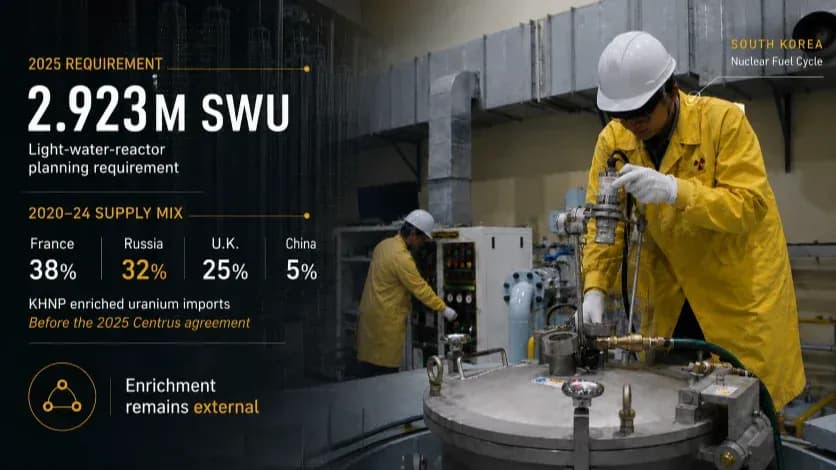
Procurement data show both the strength and the limitation of that strategy. Between 2020 and 2024, France accounted for 38 percent of KHNP’s enriched-uranium imports, Russia 32 percent, Britain 25 percent and China 5 percent. Korea was plainly not dependent on a single supplier, yet nearly one-third of its enriched uranium still came from Russia during a period in which Moscow’s relationship with the United States and its allies underwent its deepest rupture since the end of the Cold War. Long-term contracts, inventories and alternative suppliers reduce the consequences of disruption. They cannot place sanctions policy, export controls, supplier capacity or political decisions in foreign capitals under Korean control.
The size of the Korean nuclear system raises the stakes. KHNP’s published 2025 fuel-requirement table assigns 2.923 million separative work units, or SWU, of annual enrichment work to its light-water-reactor requirements. The planning table includes units that were still under construction, so the figure should not be confused with actual annual purchases. It nevertheless indicates the scale of the industrial requirement. SWU measures the work needed to raise the concentration of uranium-235 to the level used in reactor fuel. South Korea operates 26 nuclear power reactors with 25.6 gigawatts of generating capacity, and nuclear power supplied about 31.7 percent of its electricity in 2024. Enrichment is therefore a large and recurring upstream requirement for a national power system, whatever commercial model Korea ultimately chooses to meet it.
Russia’s role in the enrichment market has meanwhile pushed the same supply-security problem into American energy policy. The Department of Energy estimates that Russia supplies roughly 44 percent of global uranium-enrichment services and 20 to 30 percent of enriched uranium product used in the United States and Europe. Washington is now spending billions of dollars to expand domestic low-enriched-uranium and high-assay low-enriched-uranium capacity and reduce exposure to Russian supply. Foreign suppliers will remain important to American utilities, but diversified international purchasing is no longer treated as a complete strategic answer to dependence.
That policy shift cannot establish the commercial case for a Korean centrifuge plant. Enrichment facilities require large upfront investment, economies of scale are substantial, and established suppliers possess mature technology and decades of operating experience. Imported services may remain cheaper for many years. The important change lies in the value governments now assign to control over the upstream supply chain. In 2015, reliable access to foreign enrichment helped justify keeping Korean production offshore. A decade later, the United States is investing heavily at home because it considers comparable dependence strategically consequential. The economics of a Korean plant remain open to debate; the assumption that foreign supply alone settles the strategic question has become considerably harder to defend.
Japan reveals a second assumption embedded in the Korean arrangement. Sensitive nuclear cooperation is shaped not only by what an ally may do, but also by how often it must return to Washington for political approval.
Predictability and Precedent
By the late 1980s, U.S. officials understood that Japan possessed advanced scientific expertise, a sophisticated nuclear industry and access to substantial quantities of sensitive nuclear material. Their assessments did not depend on the belief that Tokyo lacked the technical foundations from which a weapons program could eventually emerge. The policy problem was whether a major civilian nuclear industry could receive long-term certainty while safeguards, intelligence and political monitoring supplied adequate warning of any change in purpose.
Tokyo had strong industrial reasons to seek that certainty. Under the earlier U.S.-Japan cooperation system, sensitive activities involving U.S.-obligated material were subject to individual American decisions. Japanese government accounts warned that prevailing judgments in U.S. nuclear policy could therefore affect the stable operation of Japan’s long-term fuel-cycle plans. The arrangement that entered into force in 1988 introduced comprehensive advance consent for specified activities—principally storage, retransfer, reprocessing and alteration in form or content—when agreed facilities and conditions were used. Its scope should not be mistaken for an unrestricted Japanese right to conduct any sensitive nuclear activity. Its institutional importance was that agreed categories of activity no longer required a fresh case-by-case political decision each time they occurred. Japanese planners gained a longer and more predictable horizon for the fuel-cycle program.
The Reagan administration made that choice after examining Japanese nuclear latency in detail. Assessments reviewed Japan’s scientific and industrial capabilities, access to special nuclear material, safeguards performance and broader political indicators. State and Energy Department officials argued that movement from civilian activity toward a weapons program would require observable changes in personnel, procurement, facilities and resource allocation, providing what U.S. law described as “timely warning.” The Government Accountability Office disagreed that such confidence could be sustained across a 30-year arrangement, especially as technologies, political relationships and safeguards conditions changed. GAO concluded that the broad advance approvals at issue did not satisfy its reading of the statutory timely-warning standard. The dispute clarifies the nature of the policy choice: greater predictability was granted despite acknowledged proliferation risk because the executive branch believed that risk could be managed.
Japan and South Korea are not interchangeable cases. Japan’s postwar anti-nuclear norms and Three Non-Nuclear Principles gave American policymakers reasons to judge political intent differently, while South Korea has spent decades under direct pressure from a nuclear-armed North Korea. The contemporary Korean debate over an independent deterrent widens that political distinction. The Japanese precedent is therefore institutional rather than identical in technical scope. It demonstrates that American nonproliferation policy has previously treated technological latency, verification and long-term predictability as factors that can coexist within a negotiated arrangement.
Saudi Arabia now puts pressure on the other rationale used to restrain Seoul. Riyadh appeared in the American argument more than a decade ago as a government whose future demands could become harder to resist if South Korea received greater latitude, and the same concern returned in the senators’ January letter. The new Saudi agreement leaves critical details unknown, and its classified status makes confident claims about future enrichment especially unwise. What is already clear is that Washington has chosen to negotiate a tailored bilateral safeguards mechanism rather than insist that only one pre-existing model can serve nonproliferation. Commercial competition and the preservation of American influence form part of the administration’s own case for the agreement.
That willingness changes the force of the precedent argument. Saudi Arabia and South Korea differ sharply in nuclear history, alliance structure, industrial capacity and safeguards practice, so identical terms would make little policy sense. Those differences provide reasons to negotiate different controls; they do not establish that flexibility toward Seoul would itself make the wider regime unmanageable. Technology ownership, enrichment levels, operational control, safeguards performance, political commitments and warning time all provide possible grounds for differentiation. Each can be articulated and tested. Once Washington itself begins designing partner-specific arrangements, a generic appeal to precedent becomes less persuasive than an explanation of the concrete risk that a Korean proposal would have to address.
The Korea Washington Is Negotiating With
The country asking for that explanation occupies a very different place in the nuclear order from the South Korea of 1975. Its 26 reactors provide nearly a third of national electricity. Korean firms design and build large reactors, operate nuclear plants, fabricate fuel assemblies and compete for projects abroad. The APR1400 program and subsequent exports have moved Korea well beyond the technology-recipient role that defined the early decades of cooperation with the United States. Its institutional position has evolved alongside the industry. Seoul has operated under the Additional Protocol since 2004, participates in the major multilateral export-control regimes and, as a nuclear supplier, increasingly has to defend safeguards and nonproliferation standards in its own overseas partnerships.
The remaining dependence at the enrichment stage consequently carries a different meaning than it did when Korea’s nuclear industry was young. Korean companies can fabricate reactor fuel after enrichment, hold or pursue interests in foreign enrichment projects and invest in additional American capacity. Operating centrifuges on Korean territory would plainly create a different proliferation risk: equity investment abroad conveys neither centrifuge technology nor operational control. The distinction is substantive and should remain so. Yet it also illustrates the trajectory of the relationship. Seoul followed the American prescription of diversified procurement and allied investment at the same time that the United States began attaching greater strategic value to enrichment capacity located within its own borders.
American policy toward Korean nuclear responsibility has already moved in other sensitive areas. The November 2025 U.S.-ROK joint fact sheet stated that, consistent with the bilateral 123 agreement and subject to U.S. legal requirements, the United States “supports the process that will lead to” Korean civilian uranium enrichment and spent-fuel reprocessing for peaceful uses. The same document approved South Korea’s construction of nuclear-powered attack submarines and committed the two governments to work on fuel sourcing. Formal bilateral consultations held in Seoul on June 2 and 3, 2026, launched follow-up work on those commitments, with both sides promising tangible outcomes and milestones for reviewing progress during the year.
Naval nuclear propulsion does not create an automatic case for domestic civilian enrichment. Australia provides the obvious counterexample under AUKUS: nuclear-powered submarines can be pursued without building a national enrichment or reprocessing industry. Korea’s submarine decision matters for a narrower reason. Washington has already accepted a category of sensitive nuclear responsibility that would have been politically difficult to contemplate under the assumptions of the earlier bilateral relationship. The enrichment discussion is therefore taking place inside an alliance that is already revising the distribution of nuclear responsibilities, rather than between an experienced supplier and an inexperienced recipient.
Any argument for further change must nevertheless confront South Korea’s domestic nuclear politics. In the Asan Institute’s 2026 survey, 80 percent of respondents supported acquiring an indigenous nuclear-weapons capability, the highest level recorded in the series. Support remained above a majority even when respondents were asked to consider international sanctions, possible withdrawal of U.S. forces or the domestic costs of building nuclear infrastructure. Civilian enrichment for reactor fuel is technically and legally separate from a weapons program, but an operating centrifuge industry would increase the industrial capability available to a future government if national policy changed. American nonproliferation officials have legitimate grounds to take that political environment seriously when deciding how much verification and warning a new arrangement would require.
The political signal is more complicated than a turn away from the United States. The same survey recorded support for the ROK-U.S. alliance at 97.1 percent and support for the U.S. military presence at 82.3 percent. Confidence that Washington would use nuclear weapons in response to a North Korean nuclear attack on South Korea rose to 59.1 percent. Indigenous nuclear armament and alliance commitment therefore coexist in public opinion rather than occupying opposite poles. For many Koreans, a national deterrent appears to function as additional insurance against a deteriorating threat environment rather than as a substitute for the United States.
That coexistence makes the language surrounding civilian enrichment especially consequential. Seoul weakens its own case whenever politicians present fuel-cycle capability as preparation for a future bomb. Any request for greater civilian authority should establish a visible separation between energy policy and weapons hedging in law, doctrine and operating practice. Agreed enrichment limits, designated civilian facilities, comprehensive IAEA safeguards, the Additional Protocol, explicit exclusion of highly enriched uranium and weapons-related applications, and predetermined consequences for violations could make that boundary more credible. Naval-propulsion fuel should remain under a separate legal arrangement. Safeguards cannot erase the scientific knowledge or industrial capacity of an advanced country; their purpose is to make an unauthorized change in purpose difficult to conceal and costly to pursue.
A New Nuclear Bargain
The next U.S.-ROK nuclear bargain should establish a path toward programmatic consent for safeguarded civilian low-enriched uranium under conditions negotiated in advance. In practical terms, the governments would define the facilities, enrichment limits, safeguards and circumstances under which U.S. consent concerning covered nuclear material could be exercised without reopening the underlying political decision at every subsequent stage. Seoul would acquire a predictable legal option. A future Korean government could then decide whether economics, supply security and industrial policy justified exercising it.
The conditions should be demanding enough to reflect Korea’s political environment. Enrichment could be confined to designated civilian facilities and an agreed ceiling appropriate for reactor fuel, with comprehensive IAEA safeguards and the Additional Protocol fully applicable. Material accountancy, verification of enrichment levels, additional access where justified and predetermined consultation or suspension mechanisms could be incorporated before construction began. Highly enriched uranium and weapons-related applications would remain outside the authorized program. Reprocessing deserves a separate negotiation. Plutonium separation presents materially different problems involving economics, waste management, material security and proliferation, and bundling it automatically with low-enriched-uranium production would obscure the stronger supply-security argument available for civilian enrichment.
Separating legal authority from construction also produces a more credible economic policy. Commercial enrichment is capital intensive and strongly affected by scale, while existing suppliers operate mature centrifuge technology in established plants. Korea could secure a predictable consent framework and still conclude that imported enrichment offers better value for many years. A later government might instead choose a mixed model in which limited domestic output insures against the loss of a major supplier while long-term foreign contracts continue to satisfy most demand. At KHNP’s current planning requirement of approximately 2.9 million SWU a year, one million SWU of annual capacity would correspond to roughly one-third of the requirement. The ratio illustrates the scale of a possible strategic floor; it is not a recommendation for the capacity or construction of a Korean plant. Commercial viability would have to be demonstrated independently.
A negotiated regime could also give the United States something the current ambiguity cannot provide as effectively: detailed safeguards agreed before capability is built. American officials could obtain extensive visibility into a future Korean program, establish an institutional barrier between civilian fuel policy and weapons politics and define the consequences of noncompliance before large investments created political pressure to tolerate ambiguity. Clear limits would also reduce the likelihood that every future enrichment question becomes another argument over sovereignty or alliance status. Deeper Korean participation in the Western nuclear-fuel chain could support the broader effort to reduce exposure to Russian and Chinese supply while keeping Korean capacity embedded in an allied safeguards structure.
Much of the legal foundation already exists. The 2015 agreement gives the United States and South Korea reciprocal consent rights over subsequent enrichment and reprocessing of material covered by the agreement and provides mechanisms for further bilateral arrangements. The 2025 joint fact sheet moved the politics further by publicly supporting a process leading toward peaceful Korean enrichment and reprocessing, subject to the existing agreement and American law. The consultations begun in June 2026 mean the two governments are already debating implementation. The remaining choice concerns the character of the eventual settlement: a sequence of discretionary permissions negotiated as circumstances arise, or conditions sufficiently precise that continued compliance can generate predictable authority.
The historical comparisons suggest what a more durable standard might contain. Japan demonstrates that the United States has previously combined long-term predictability over specified sensitive fuel-cycle activities with safeguards and political warning in a technologically advanced non-nuclear ally. Changes in the enrichment market have weakened the assumption that international procurement alone settles Korea’s fuel-security question. Saudi Arabia shows that American nuclear diplomacy still creates tailored arrangements when strategic circumstances make flexibility valuable. Korean public support for an independent deterrent supplies the necessary caution: any expansion of civilian authority must preserve enough transparency and warning to make a change in political purpose visible before it can become a fait accompli.
Seoul’s strongest request is consequently neither an exemption from nonproliferation rules nor a claim to abstract nuclear sovereignty. It is a demand for conditions that can be known before the next political negotiation begins. Washington should identify the safeguards, transparency requirements, enrichment limits and political commitments under which programmatic consent for civilian low-enriched uranium would become acceptable. If South Korea cannot meet those requirements, the deficiency should be specific enough to identify. Sustained compliance should provide an equally clear basis for greater predictability.
The United States had compelling reasons to stop South Korea’s nuclear ambitions half a century ago. Seoul subsequently abandoned the weapons effort, accepted progressively stronger safeguards, built a globally competitive civilian nuclear industry and followed Washington’s prescription to secure fuel through diversified international markets. The rationale for restriction evolved as those circumstances changed, moving from weapons intent toward proliferation precedent and confidence in foreign supply. American energy policy has since reassessed the strategic value of domestic enrichment, while U.S. nuclear diplomacy continues to accommodate different partners through different institutional arrangements. South Korea’s own weapons debate means that civilian enrichment must remain visibly separated from nuclear hedging and subject to rigorous verification. An alliance capable of defining those risks in advance should also be capable of governing them through enforceable conditions, preserving verification without making permanent dependence its substitute.
Editorial Context
"Independent journalism relies on radical transparency. View our full log of editorial notes, corrections, and project dispatches in the Newsroom Transparency Log."
Reader Signal
Community readWhat did this report leave you with?
Choose the signal that best reflects your reading. Select it again to remove it.
Anonymous One response per article
No response selected
Join the discussion
A more thoughtful conversation, anchored to the story
Atlantic-style discussion for this article. One-level replies, editor prompts, and moderation-first participation are now powered directly by Prisma.
Discussion Status
Open
Please sign in to join the discussion.
The Weekly Breeze
Independent reporting and analysis on Busan,
Korea, and the broader regional economy.