After the Ministry and Shipping Lines Moved, Will the Maritime Economy Follow?
Busan has concentrated maritime administration, shipping companies, public finance and research. Its next test is whether finance, insurance, shipbroking, law and data can turn proximity into recurring business.


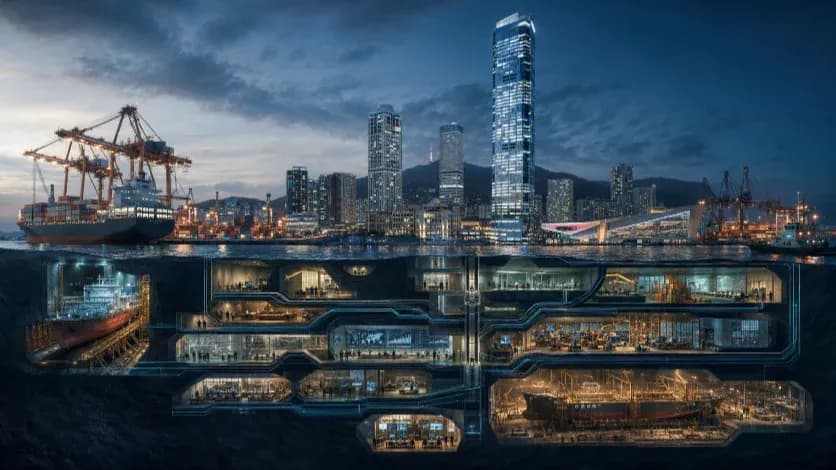
Busan already has the port, the technology and much of Korea’s maritime industrial base. With the Ministry of Oceans and Fisheries, major shipping companies and a handful of specialised service firms now converging in the city, the harder test is whether finance, insurance, shipbroking, law and data will follow the customers and create a market capable of sustaining itself.
Sixty-three floors above Busan’s Munhyeon financial district, a small group of incoming firms has given the city a new way to test an old ambition. Busan Metropolitan City selected Clarksons Korea and Waterline Partners for space at D-space, its financial innovation hub at the top of the Busan International Finance Center, alongside firms working in digital and investment finance. Clarksons, part of the global maritime services group, plans to expand its Busan presence around shipping-market information and advisory work, while Waterline Partners, an investment manager specialising in maritime assets, is pursuing a phased headquarters relocation from Seoul and investment activity involving shipping, ports and related infrastructure.
For Busan, the significance of those moves lies in the kind of businesses now entering the city’s maritime economy. Shipping companies earn revenue by operating vessels and carrying cargo. Shipbrokers earn fees by connecting owners, charterers, buyers and sellers, while investment managers decide which vessels, terminals and logistics assets deserve capital and how transactions should be structured around them. Their business sits in a different layer of the industry from container handling, ship operation or vessel repair, relying on market information, customer relationships and the repeated flow of deals. Busan has spent years assembling public maritime institutions, financial infrastructure and research capacity; the arrival of private intermediaries now provides an early opportunity to examine whether that concentration is beginning to influence where commercial maritime work is performed.
The customer base for those services has changed quickly. South Korea’s Ministry of Oceans and Fisheries now operates from Busan. H-LINE Shipping and SK Shipping have established headquarters in the city, HMM has changed its registered headquarters to Busan while maintaining corporate functions across Busan and Seoul, and Heung-A Shipping has announced plans to relocate its headquarters organisation south. The resulting geography is more complicated than a simple corporate migration from the capital to the port city. Public administration, legal headquarters and some operational functions are concentrating in Busan, while other corporate teams, financial relationships and customer networks continue to span Busan and Seoul.
Shipping has always operated across such distances. A vessel can be managed from one city, financed in another, insured through markets in a third and covered by contracts drafted somewhere else. A shipowner considering a new vessel may need a broker to find the asset, a lender or fund to structure the financing, an insurer to price the risk, lawyers to draft the contracts, surveyors and classification societies to assess its technical condition and analysts to evaluate freight rates and asset values. The presence of ships and shipping companies therefore does not determine where the surrounding fees will be earned. The commercial advantage of concentration emerges when enough of those relationships operate within the same labour market: brokers hear about transactions earlier, lawyers accumulate specialised work, insurers gain access to clients and claims, and analysts can build careers across more than one employer.
Busan already has much of the industrial base required to support such a market. Its port handles the physical movement of cargo; ship managers, equipment suppliers and logistics companies operate across the city and the wider southeast; public maritime finance has a substantial institutional presence at BIFC; national maritime research institutions are concentrated in and around Yeongdo; and the shipbuilding centres of Ulsan, Geoje and Changwon provide one of the world’s deepest production bases within the wider industrial region. The recent relocations therefore enter a city with considerable maritime capabilities. The unresolved question is whether those capabilities can now produce a denser commercial market connecting the port, shipping companies, financial institutions, professional advisers and research base.
Clarksons Korea and Waterline Partners are worth watching because they provide an early test of that possibility, though their presence alone cannot answer it. The useful evidence will emerge through staffing, authority and transactions: how many revenue-generating professionals work from Busan, which mandates are won and executed there, where vessel deals are structured, how much private maritime capital is managed from the city and whether local teams gain enough authority and business to recruit analysts, brokers and investment professionals for long-term careers. Busan can now point to a denser map of ministries, shipping companies, financial institutions and incoming service firms. Whether that map changes the geography of maritime business will depend on the ordinary commercial decisions that follow.
The Customer Base Is Moving
Long before the latest headquarters relocations, Busan had already accumulated the physical industries of a maritime city. Its maritime economy includes tens of thousands of businesses working across shipping, port logistics, ship management, marine equipment, fisheries, technology and related services, giving the city a scale of employment and industrial activity that predates the current maritime-capital campaign. Busan is not trying to create a maritime economy from an empty base. It already has workers, suppliers, vessels, cargo and technical institutions; the weaker link has been the concentration of commercial authority around the industries that finance ships, arrange transactions, insure risk and sell specialised advice.
The division can be seen across the city. At Busan Port, terminal operators and logistics companies move containers through one of Asia’s major transshipment systems. Across Yeongdo, maritime universities and national research institutions work on ocean science, shipping policy, marine technology and professional training. Several kilometres inland, the Busan International Finance Center anchors a separate concentration of financial institutions and public maritime-finance functions. Cargo, knowledge and capital already have identifiable centres in Busan, although the commercial relationships among them have been more difficult to trace.
A vessel may be operated from Busan while its financing is arranged in Seoul. A local shipowner may purchase insurance through brokers based elsewhere. A company may participate in a research project in the region while paying its legal, advisory and information fees to firms with little meaningful presence in Busan. Ports determine where cargo moves, but they do not automatically determine where treasury decisions are made, where chartering contracts are negotiated or where professional fees accumulate. For decades, Busan could claim much of Korea’s physical maritime activity without necessarily controlling the full commercial chain surrounding it.
Public policy attempted to narrow part of that gap before the latest relocation wave. Busan was designated as a financial centre specialising in marine and derivatives finance, and BIFC subsequently gathered maritime-finance functions connected to state institutions. The Korea Ocean Business Corporation, headquartered in Busan, added a national institution dedicated to supporting shipping-company liquidity, vessel acquisition and broader industry restructuring, while the Busan Marine Finance Development Council brought public agencies and industry organisations into a shared forum. The city now has a substantial policy-finance base, although public finance and a private financial market remain different things.
An asset manager must raise capital, identify projects, negotiate returns and convince investors that its team can manage risk. A securities firm needs enough mandates to support analysts and deal teams. A bank can maintain client-facing personnel in Busan while leaving the authority to approve a large transaction in Seoul. Where a meeting takes place therefore reveals less than where a deal originates, where the structure is designed, who can approve the risk and which office records the fees. Those distinctions matter increasingly as more shipping companies establish a corporate presence in Busan.
The latest relocations add customers to institutions and suppliers that were already in the city. The Ministry of Oceans and Fisheries now works from Busan, while HMM and other shipping companies have shifted headquarters or corporate functions south in different forms and at different speeds. The depth of those moves varies and will require company-level scrutiny, especially across treasury, strategy, chartering, legal and procurement functions. For the broader services economy, however, the immediate change lies in the growing number of shipping executives, public officials and corporate teams whose work gives financial firms, brokers, advisers and technical specialists more reason to spend time in Busan.
Commercial services often respond in stages. A Seoul-based insurer may begin sending staff south more frequently as important shipping clients become concentrated there. A law firm may assign lawyers to recurring Busan work before opening a permanent team. A broker can begin with a small client-facing office and later add research or advisory staff if the local mandate flow justifies expansion. Financial firms may start with relationship managers and add analysts, credit specialists and investment professionals only after enough transactions originate nearby. A services market can therefore deepen through changes in staffing, authority and revenue long before corporate registries show a dramatic wave of relocations.
Clarksons Korea and Waterline Partners belong in that context. Their presence brings commercial maritime information, broking-related services and private investment activity closer to shipping clients and financial institutions already operating in Busan. The central questions concern whether those offices can win and execute mandates locally, whether the teams receive authority over transactions and whether maritime professionals can build careers across several employers in the city. One meeting with a shipping company has limited economic meaning; a sequence of mandates handled by Busan-based teams begins to show a different pattern.
That is also why the economic effect of a headquarters cannot be measured through direct employment alone. Shipping companies buy legal advice, market data, insurance, auditing, technology, recruitment and financial services. They commission surveys, arrange vessel purchases and sales, negotiate charter contracts and manage increasingly complex requirements involving emissions, fuel systems and digital technology. When more of those expenditures are captured locally, one company’s presence becomes another company’s revenue. When the work continues to be purchased almost entirely elsewhere, a headquarters can remain economically isolated from the city surrounding it.
The southeast gives Busan an advantage that cannot be reproduced by attracting office tenants. Ulsan, Geoje and Changwon provide shipbuilding, machinery, equipment, energy and engineering capacity within the wider regional economy, creating a production base very different from maritime centres built primarily around finance and professional services. The opportunity for Busan lies in connecting that industrial depth with the commercial functions that decide how ships are financed, insured, contracted and upgraded. The region already builds and repairs much of the hardware; a deeper maritime services market would allow a larger share of the decisions and fees surrounding that hardware to remain close to the industrial base.
The concentration of shipping customers gives this possibility a more concrete foundation than Busan had several years ago, while also raising the standard by which the city should be judged. The next stage cannot be measured only through the number of institutions assembled around the port and financial district. Evidence will have to come from private capital committed to vessels and infrastructure, broking mandates handled from Busan, insurance and claims work generated by local clients, legal teams built around recurring maritime business and technology firms that turn demonstrations into repeat contracts. The customer base is becoming denser; the larger economic question is how deeply the services market responds.
The Services That Move Last
Shipping finance rarely follows the same geography as the ships it finances. A vessel registered in one country may be owned through a company in another, financed by lenders across several jurisdictions and insured through markets that have spent generations accumulating specialist knowledge. Bankers, fund managers, brokers and lawyers build businesses around relationships that survive individual transactions. Credit teams learn the financial histories of particular owners, lawyers become familiar with the financing structures and charter arrangements of repeat clients, and brokers accumulate information about buyers, sellers and freight demand. Those relationships create an inertia that office incentives alone cannot easily overcome.
Busan enters that market with more institutional weight than the recent relocation headlines might suggest. KOBC is headquartered in the city and provides financial support across vessel acquisition, liquidity and shipping-industry restructuring, while the wider financial district contains maritime-finance functions linked to state financial institutions. The Busan Marine Finance Development Council brings public agencies and industry organisations together, giving shipping companies access to policy finance, guarantees and public support close to Korea’s main port. The harder test concerns whether private capital can grow around that base.
Waterline Partners gives Busan an opportunity to examine the question in practice. Its planned relocation places a maritime-focused private investment business closer to shipping companies, KOBC and other institutions at BIFC. The significance of the move will become clearer through the value of assets managed from Busan, the number and seniority of investment professionals based there, the authority delegated to the local team and the extent to which transactions involving ships, ports and logistics infrastructure are originated and structured in the city. A financial centre becomes deeper when professionals can move between competing firms, investors can choose among multiple managers and one transaction creates work for lawyers, valuers, insurers and advisers nearby.
Marine insurance presents a harder test because the industry depends on accumulated underwriting records, claims expertise and relationships with reinsurers and brokers. Underwriters judge vessels, routes, cargoes, management quality and loss histories, while P&I clubs deal with liabilities arising from collisions, pollution, cargo claims, crew injuries and other events that often require lawyers, surveyors, correspondents and technical experts in several jurisdictions. Korea P&I Club remains headquartered in Seoul, and the broader geography of Korean marine insurance still reflects relationships built around the capital.
The response of insurers and claims specialists to a larger concentration of shipping clients in Busan will therefore be one of the clearest indicators of market depth. A marine insurer can serve a Busan shipowner from Seoul for years, especially when customer contact does not justify a full local underwriting team. More frequent client meetings may first bring dedicated account staff, followed by claims specialists, surveyors or insurance brokers if the volume of work continues to grow. International P&I clubs may strengthen correspondent networks where members and operating activity become denser. These decisions are commercially reversible and are therefore especially informative: firms will maintain the teams only if the work continues.
Insurance may consequently become a lagging measure of cluster formation. Brokers and investment managers can enter a city with small teams, whereas underwriting and claims functions require recurring premium volume, specialist labour and enough work to support professionals across economic cycles. Surveyors and adjusters also depend on a continuing flow of assignments that often arrive irregularly and under severe time pressure. A city capable of sustaining those occupations across several employers has moved beyond institutional concentration toward a functioning professional-services market.
Maritime law follows a similar pattern. The Busan Maritime and International Commercial Court is scheduled to open on March 1, 2028, giving the city a major new judicial institution. The larger economic effect will depend on the work that develops around proceedings and transactions: law firms assigning experienced maritime lawyers to Busan, shipping companies expanding in-house legal teams, insurers retaining local counsel, surveyors providing technical evidence and accountants analysing losses in complex commercial disputes.
Maritime disputes rarely remain inside one professional category. A collision can involve navigation, hull damage, cargo liability, charter-party obligations and insurance coverage. A shipbuilding dispute may require engineers, classification records, expert witnesses and large volumes of technical evidence. Financing disputes can bring banks, asset managers and corporate lawyers into the same case. The commercial value of a specialised court therefore extends through the businesses that prepare evidence, advise clients and manage risk long before a judgment is issued.
Busan will also compete within a dispute-resolution market whose strongest domestic professional networks are already established elsewhere. Shipping parties do not select lawyers, arbitrators or dispute venues solely because they are physically close to a port. They consider expertise, language ability, procedural reliability, industry reputation and previous experience with similar disputes. A sustainable maritime legal market in Busan will require enough work to support specialists during the years between major cases, while junior lawyers need experienced practitioners and recurring transactions through which they can develop expertise. Foreign clients will expect English-language capability and familiarity with contracts governed by foreign law, and insurers and shipowners will look for advisers who understand commercial practice as deeply as maritime legislation.
Much of the legal market can develop through work that never reaches a courtroom. Shipping companies require advice on charter parties, ship purchases, financing agreements, sanctions compliance, environmental regulation, casualty response and insurance coverage. Alternative-fuel projects add agreements involving technology developers, fuel suppliers, shipyards, lenders and certification bodies. A single vessel project may require financing documents, security arrangements, construction contracts, fuel agreements and insurance provisions for technical risks that do not have long operating histories. Transactional work of that kind can sustain legal teams before litigation volumes increase and can tie the legal market more closely to finance and insurance.
The commercial geography of these services will reveal more about Busan’s progress than the address of any single institution. A shipping executive may work from Busan while a company’s largest financing advisers remain in Seoul. A vessel transaction may involve a broker in Busan, an investment team nearby and a credit committee elsewhere. A casualty in Busan waters may still send most of its legal and insurance fees outside the city. Each arrangement is commercially plausible. The pattern across many transactions will show whether the concentration of customers is beginning to change where companies buy specialised work.
Professional services tend to move through many smaller commercial decisions rather than a single relocation order. A shipowner retains a Busan lawyer for a second mandate; an insurer assigns a claims specialist to local accounts; an analyst leaves one maritime company for another without moving to Seoul; an investment manager expands because enough transactions are available nearby. As those decisions accumulate, they create a market in which companies are drawn by existing customers, workers and counterparties rather than primarily by subsidies.
Public policy can accelerate that process, although its limits are clear. Subsidised space can reduce the cost of entry, public financial institutions can help anchor transactions, the ministry can bring regulators and industry representatives into more frequent contact and the future court can generate legal work. Shipping companies supply customers, while research institutions and universities can train specialists. Commercial firms will still decide whether the resulting volume of work is sufficient to justify permanent teams with real authority.
The strongest evidence will come from industry activity: maritime assets managed from Busan, vessel loans originated and approved by local teams, marine premiums serviced from the city, P&I claims handled by Busan-based professionals, sustained demand for surveyors, maritime legal employment, transactional mandates, broking commissions and commercial research revenue. Finance, insurance and law occupy different parts of the shipping economy, yet all depend on clients repeatedly purchasing specialised work. The ministry and shipping companies have enlarged the potential customer base. The next question is whether enough of their spending, decision-making and professional demand remains in the city to support businesses that are free to choose where they locate.
Can Busan Turn Proximity Into Transactions?
Consider what must happen before a shipping company can place a new low-emission vessel into commercial service. Engineers have to develop or adapt propulsion, fuel-storage and control systems, and the technology must be tested at sea and certified for commercial use. A shipowner must decide whether the operating savings and regulatory advantages justify the higher capital cost, lenders and investors have to finance the vessel, insurers must assess unfamiliar technical and operational risks, and lawyers have to allocate those risks among the yard, owner, fuel supplier and technology providers. The vessel then has to be built by a shipyard and equipment makers, while ports require infrastructure capable of supplying the fuel and operating it safely.
Much of that chain can already be found within the industrial region around Busan, although rarely under one roof or within one municipal boundary. The Korea Institute of Ocean Science & Technology and Korea Maritime Institute are based in Yeongdo alongside other maritime research and education institutions. Busan Port provides a large operating environment for logistics technology and automation, while national programmes cover greener vessels, alternative fuels, autonomous shipping and digital logistics. Ulsan, Geoje and Changwon provide the manufacturing depth required to turn technical concepts into commercial vessels.
The pieces are geographically close enough to collaborate, but commercial integration requires more than proximity. A research institute can complete a funded project without a shipping company buying the resulting technology. A pilot vessel can prove that a system works without convincing a lender to finance the next ten installations. A port demonstration can end when the public programme ends, and an equipment company can supply a local shipyard while the finance, insurance and contract work surrounding the same vessel continues elsewhere. The distance between laboratory and market is ultimately measured through procurement decisions, financing agreements and repeat orders.
Busan’s 2026–2030 marine-industry plan recognises the need to connect functions that have often developed separately. The programme covers shipping and port logistics, marine finance, environment and safety, marine science and technology, and shipbuilding and offshore plants, while its projects include maritime and port technology demonstration, digital innovation for shipbuilding and marine equipment, energy infrastructure and support for maritime-finance startups. Public programmes can finance laboratories, demonstration centres and infrastructure; private investment enters when companies expect returns from assets and services that customers are prepared to buy.
The challenge is one of sequencing. Technology developers need early customers, shipping companies need evidence that new systems can work at commercial scale, banks need credible cash-flow assumptions and insurers need operating data from which to assess unfamiliar risks. Equipment makers need enough orders to justify production. When each participant waits for the others to move first, geographical concentration creates little commercial value.
Busan Port can shorten part of that process because it is already an operating system rather than a planned industrial park. Busan New Port has moved further into terminal automation, giving technology firms access to real cargo flows, terminal equipment and operational constraints that cannot be reproduced in laboratories. Even so, a working port becomes a commercial test market only when technology companies have a clear path from demonstration to procurement. Terminal operators must decide that a pilot improves productivity or reduces costs enough to justify a contract, shipping companies need sufficient regulatory certainty to deploy systems at scale, and procurement structures must allow smaller suppliers to move beyond publicly funded trials. The critical measure is how many technologies survive the transition from a demonstration budget to a customer’s operating budget.
The green-shipping transition makes those connections more urgent. A future vessel using a new fuel illustrates how the regional economy could work. Researchers in Busan may develop navigation, environmental or marine systems, while a shipping company headquartered in the city becomes the first customer. Busan New Port can provide a setting for testing some technologies, and energy infrastructure elsewhere in the southeast can support deployment. A shipyard in Ulsan or Geoje can integrate the systems into a vessel, equipment suppliers across the region can manufacture components, BIFC-based institutions can finance the asset and classification, survey, insurance and legal specialists can determine whether the technical risk is acceptable on commercial terms.
No single city in the region performs every one of those functions, and concentrating all of them inside one municipal boundary would neither reflect the existing industrial geography nor necessarily improve the industry. Busan’s strongest potential role is commercial coordination. The city has the port, an expanding concentration of shipping customers, national maritime agencies, research institutions and financial organisations, while Ulsan and South Gyeongsang provide much of the heavy manufacturing capacity. A stronger maritime market would allow more projects to be initiated, financed, contracted and monitored through professional teams in Busan while production remains distributed across the wider industrial region.
This gives Busan a route different from maritime centres built primarily around finance and professional services. The city does not have to create an industrial hinterland through policy because one already exists. Its difficulty lies in turning industrial scale into demand for high-value commercial work. A ship built in Geoje can be financed through a syndicate managed elsewhere, insured through brokers outside the region and sold through an intermediary whose principal Korean operations remain in Seoul. Physical production alone does not guarantee local fee income. Busan gains more from its proximity to shipyards and suppliers when local financial, legal, data and advisory firms participate in the same projects.
The city’s spatial structure adds another challenge. North Port can place administrative officials, corporate teams and maritime organisations closer together; BIFC can concentrate financial services several kilometres away; Yeongdo can continue to house research and education; Busan New Port can support large-scale operations and technology deployment; and the wider southeast can build ships, engines and equipment. Such a structure is polycentric by necessity. Its success will depend on whether information, contracts and people move easily enough among those centres for the whole regional economy to work more effectively than its separate parts.
Transport matters, although institutional routines may matter just as much. Researchers need access to procurement managers before project specifications are fixed. A lender evaluating an alternative-fuel vessel needs engineers capable of explaining technical performance and insurers able to price operational risk. A shipowner considering new technology needs comparable market data and suppliers with reliable maintenance capacity. A lawyer drafting a financing package must understand how technical warranties, fuel agreements and insurance exclusions interact. Bringing organisations into the same metropolitan economy reduces travel time; recurring business relationships determine whether that advantage has commercial value.
Busan’s research base faces one of the clearest tests. National maritime institutions in the city have missions extending well beyond the local economy, and their presence cannot automatically be counted as local commercial output. The more useful figures would follow research into demonstrations with private companies, track how many demonstrations result in procurement, measure follow-on revenue earned by technology firms and identify whether shipping companies become repeat customers. Busan already has expertise. The harder task is to establish commercial pathways through which companies repeatedly buy it.
The labour market will determine whether those connections survive individual projects. A mature maritime services market requires more than senior executives transferred by large corporations. Shipbrokers need junior brokers who can build client relationships, insurers need underwriters and claims specialists, investment firms need analysts who understand vessel economics as well as capital markets, law firms need associates who can develop maritime expertise over years and technology companies need engineers who can move among research institutions, ports, shipping companies and suppliers without leaving the region.
The practical test is whether a specialist can build an entire career in Busan. One shipping company can recruit an analyst through a relocation package, but a deeper market allows that person to move later to an asset manager, broker, insurer or another shipping company while remaining in the city. One maritime lawyer can be assigned from Seoul to serve a major client; a durable legal market offers several employers and a continuing stream of transactional and dispute work. Labour-market depth emerges when firms compete for the same expertise and professionals no longer regard Busan as a single-company posting.
International professionals will make similar calculations. Shipping finance, marine insurance, shipbroking and maritime law operate through cross-border contracts and professional networks. A foreign specialist is more likely to remain in a city where several employers operate, international clients are accessible and professional advancement does not require returning to another market. English-language working environments, international schooling, air connectivity and professional communities therefore become part of maritime industrial policy even though none appears directly on a vessel-finance balance sheet.
A stronger commercial centre in Busan would add another layer to relationships that already connect Busan, Ulsan, Geoje and Changwon. Vessel construction can remain where shipyards and production networks are strongest, while a larger share of financing, data analysis, risk assessment and contract work develops around the customers and institutions gathering in Busan. The regional advantage would then come from the speed with which a technical problem can move through research, testing, financing and production.
The most revealing measures would follow individual projects across institutional boundaries. A technology begins with research funding, enters a demonstration, wins an order from a customer, receives financing for deployment, secures insurance coverage and contractual protection, then moves into production. Revenue returns to the firms and workers that made the project possible. Busan already contains many of the organisations required for that sequence, and the wider southeast contains much of the manufacturing capacity. The city’s maritime strategy gains economic depth when more projects can complete that chain without the commercial centre of gravity repeatedly moving elsewhere.
The Window and the Risk
Busan has had maritime institutions for decades. The present period differs because several changes are occurring within the same few years. The Ministry of Oceans and Fisheries has completed its move to the city, shipping companies have established or announced headquarters relocations of different scale and depth, Busan has begun bringing maritime-service and investment firms into BIFC, the city has adopted a five-year marine-industry plan extending through 2030 and the Busan Maritime and International Commercial Court is scheduled to open in 2028. Each initiative has its own history and institutional logic. Their wider economic significance will depend on whether they begin to alter one another.
A shipping company expanding its corporate presence becomes a potential client for financial firms and professional advisers. A ministry operating nearby can make Busan a more frequent destination for industry associations, regulatory teams and consultants. A specialised court can create additional work for lawyers, technical experts and claims professionals. Investment managers and brokers can serve companies already based there, while research institutions and port operators can work more closely with customers whose procurement decisions are increasingly made within the region. The unusual feature of the current period is that several of these relationships can develop at roughly the same time.
The first major risk is that Busan creates a dense geography of public institutions without a correspondingly deep private market. Korea has extensive experience relocating ministries and public agencies for regional development, and those moves can bring employees, procurement budgets and administrative activity. Maritime business services respond to different pressures. A broker needs mandates, an insurer needs premium and claims volume, a fund manager needs assets and investors, and a law firm needs clients willing to pay for specialised work. Public institutions can help create demand, but the volume and continuity of that demand will determine whether private firms build durable teams.
The Ministry of Oceans and Fisheries’ relocation should therefore be evaluated through the changes that occur around the ministry as well as within it. Administrative proximity can increase meetings between officials and industry, but a broader industrial effect would be visible when trade associations expand local operations, regulatory advisers assign staff to Busan, research contractors establish a permanent presence and shipping companies place more policy, legal or public-affairs functions near the ministry. Those responses would reveal whether administrative concentration is changing business geography.
A second risk lies within the headquarters relocations themselves. HMM, SK Shipping, H-LINE Shipping and Heung-A Shipping represent different corporate structures and relocation paths, while some continue to maintain significant offices or functions in Seoul as their Busan presence grows. That may reflect a transitional period, a permanent dual-centre model or the practical need to remain close to customers, financiers and other counterparties in the capital. The outcome should be judged through department-level evidence rather than assumptions about what a registered headquarters necessarily contains.
Treasury, strategy, chartering, legal work and major commercial negotiations are especially important. A company can employ hundreds of people in Busan while its largest financing decisions are still negotiated elsewhere, and a headquarters can generate regional payroll without producing much additional demand for specialised services when advisers, banks, insurers and brokers continue to serve the company primarily from Seoul. A smaller team can have a larger local multiplier when it controls procurement, financing and strategic decisions. The economic content of relocation depends on which functions move and what those functions purchase.
A third risk concerns the gap between research and customers. Busan has a substantial concentration of national maritime research and education institutions, while its port and the wider southeast provide operating and manufacturing environments that few cities can match. Research funding, however, can circulate through institutions without creating a durable commercial market. A public project may finance a prototype and demonstration, while the company involved still fails to win a major order. A shipping company observing the pilot may choose a foreign system, or a technology firm may move closer to capital after the programme ends. The research outcome remains legitimate even when the regional economic effect is limited.
The clearest way to evaluate that gap is to follow technologies after public support ends. A port automation system should be tracked from trial to procurement and then export. An alternative-fuel technology should be followed through engineering, classification, financing, insurance acceptance and repeat orders. A maritime-data platform should be evaluated by paying customers and recurring revenue. Those trajectories reveal whether research institutions, ports and companies are creating commercial relationships that survive individual programmes.
A fourth risk is that Busan succeeds in filling offices without moving sufficient authority. The D-space companies offer an early example of the distinction. Clarksons Korea plans to expand its local presence, while Waterline Partners is pursuing a phased headquarters relocation and maritime investment activity from Busan. Their arrival adds commercial capabilities that city officials have actively sought, although the economic weight of those moves will depend on staffing, transaction mandates, assets managed from Busan and the authority delegated to local teams. A client-facing office can be valuable; an office that originates, structures and controls transactions creates a different level of local economic activity.
The same issue will arise around the Busan Maritime and International Commercial Court. The institution gives lawyers, experts and claims professionals new reasons to consider the city, but a competitive legal market requires experienced practitioners, regular client demand and a labour market in which younger lawyers can develop through a continuing flow of transactions and disputes. The court can generate cases; the surrounding private market has to turn those cases and transactions into sustained professional employment.
A fifth risk concerns geography beyond the city. The maritime economy of southeastern Korea does not follow municipal boundaries. Shipbuilding in Ulsan and Geoje, machinery and equipment production in Changwon, port operations in Busan and research, finance and administrative functions across the region already depend on one another. A lender financing a vessel does not care whether the owner, yard, engine supplier and research partner are registered in different provinces. The project has to work as one commercial structure.
Busan’s strongest role may therefore lie in organising transactions across that industrial region rather than attempting to relocate every maritime function inside city limits. A vessel built in Geoje can involve equipment from Changwon, energy systems connected to Ulsan, finance structured in Busan and a shipping customer based near the port. The regional advantage grows when those businesses can find one another, exchange information and complete contracts more efficiently. Competition among local governments for corporate addresses can weaken that logic when the supply chain already operates across the region.
Fragmentation is also possible within Busan. North Port, BIFC, Yeongdo and Busan New Port serve different functions and operate through different institutions and working cultures. Their value depends on more than transport time. Procurement rules have to allow research teams and smaller technology firms to sell to major customers, financial institutions need access to technical expertise early in project development, shipping companies need reasons to expose operational problems to researchers and suppliers, and lawyers and insurers need enough technical information to price contractual and operational risk. Institutions can appear close together on a map while their decision processes remain separate.
Human capital adds another constraint because senior officials and executives can be transferred through organisational decisions, whereas specialist labour markets grow over longer periods. A shipbroker develops relationships over years, an underwriter builds a record of judgment across different risks, maritime lawyers acquire expertise through repeated transactions and disputes, and analysts learn vessel economics by working with companies and deals. Engineers and data specialists also need access to both technical projects and commercial customers. Busan’s ability to retain those workers will depend on whether they can change employers and advance professionally without leaving the city.
The issue becomes more demanding for international professionals. Shipping finance, marine insurance, shipbroking and maritime law operate through cross-border contracts and personal networks. An employer can recruit one specialist for a specific position, while a city becomes attractive as a long-term base only when that person sees several potential employers, international work and a credible career path. English-language working environments, international schooling, air connectivity and professional communities consequently become part of the economic infrastructure of a maritime services market.
Busan therefore faces a measurement problem alongside its development challenge. Government agencies can easily count transferred employees, occupied floors, signed agreements and announced investment. Those numbers describe the scale of intervention, but a deeper scorecard would examine the value of ship-finance transactions originated and approved in Busan, maritime assets managed from the city, broking and advisory revenue earned by local teams, marine-insurance premiums and claims work handled there, maritime legal employment and casework, private procurement of locally developed technology and the movement of specialised workers between employers within the region. The figures are harder to collect, partly because many are commercially sensitive, but they are closer to the outcome the maritime-capital strategy seeks to produce.
The years leading to 2028 matter because customers, regulators, financiers, researchers and legal institutions are becoming more concentrated within the same regional economy during a relatively short period. A broker arriving before clients are present has little reason to build a large team, a law firm expanding before there is enough maritime work will keep most specialists elsewhere and a technology company without access to port trials or shipping customers may move closer to capital. The current concentration has the potential to shorten several of those waiting periods simultaneously.
Each initiative can still meet its own administrative target while the larger market fails to deepen. The ministry can complete its relocation, a shipping company can change its registered headquarters, D-space can fill its offices, a demonstration centre can open and the new court can hear cases. Those achievements would leave the central economic question unresolved if financing decisions, insurance premiums, legal fees, broking commissions and technology purchases continue to flow predominantly through markets elsewhere.
Busan’s next few years should therefore be judged through the conversion of institutional proximity into repeated commercial relationships. A second mandate goes to the same Busan-based advisory team. An insurer hires a permanent claims specialist. A shipping company buys technology that it first tested at the port. An analyst leaves one maritime employer for another without moving north. A vessel project draws finance, technical advice and contract work from firms capable of meeting one another within the region. Those decisions are smaller than a ministry relocation and rarely produce ceremonial announcements, yet together they will determine whether Busan has assembled a collection of maritime institutions or a market capable of reproducing itself.
The Second Migration
The first migration was easy to see. Civil servants packed offices, shipping companies changed addresses and reassigned staff, financial firms signed agreements with the city and a specialised court acquired an opening date and an interim home. Employment figures, corporate filings, lease contracts and government announcements could record each step.
The next migration will be harder to photograph because it will emerge through commercial relationships rather than relocation ceremonies. A shipping company begins calling a broker in Busan for repeat mandates. An investment team at BIFC originates a vessel transaction and retains the work through closing. An insurer decides that enough marine business exists in the city to employ claims specialists or underwriters permanently. A lawyer builds a career around shipping contracts and disputes without depending on assignments sent from Seoul. A technology company survives the end of a public demonstration because a shipowner becomes a paying customer.
Those decisions determine whether proximity becomes an economy. The ministry can change the geography of regulation, shipping companies can enlarge the local customer base, the court can generate demand for specialised legal work, and research institutes and ports can provide knowledge and places to test it. The economic value of bringing them closer together will depend on how frequently one organisation creates paid work for another.
Busan enters that phase with advantages that many aspiring maritime centres would struggle to assemble. The city has a major port, a growing concentration of shipping clients, national maritime agencies, public financial institutions and a large research base. The surrounding southeast adds shipyards, machinery companies, equipment makers and energy infrastructure. Recent relocations have increased the number of people and organisations with reasons to meet and transact in Busan.
The gaps remain visible in the commercial record. Private maritime finance has to demonstrate depth through transactions and assets under management; marine insurance and P&I services require recurring business volume before larger specialist teams will follow; shipbroking and commercial market intelligence need enough clients and mandates to sustain permanent operations; the future court will need a market of lawyers, experts and claims professionals around it; and research institutions will increasingly be judged by whether technologies reach commercial adoption and repeat procurement.
No single policy can produce all of those outcomes. The more important work lies in making the existing parts of the regional economy transact more frequently with one another. A shipowner considering a new vessel should be able to discuss financing, insurance, classification, legal structure and technology within a commercial network that understands the same project. Researchers need access to shipping-company procurement teams before a project is designed, while fund managers need engineers who understand the assets being financed and lawyers handling maritime work need access to surveyors, insurers and technical specialists already active in the market.
The extent to which that network develops can be measured. Busan can track where maritime deals are originated and approved, how much private maritime capital is managed from the city, whether broking and advisory revenue grows, how many insurance and claims specialists work locally, whether maritime legal employment expands and how often technologies tested at the port become repeat commercial orders. Labour mobility provides another measure: specialists should be able to move among maritime employers while remaining in the region.
Over time, those numbers will say more about Busan’s maritime ambitions than the number of organisations carrying a local address. A city can accumulate institutions without changing the geography of business. A deeper market emerges when each new company encounters customers, suppliers, specialised workers and professional advisers already nearby, reducing the amount of public persuasion required for the next arrival.
Busan has not yet reached that point. Public maritime institutions are more concentrated than before, shipping companies are moving in different forms and at different speeds, a small number of service and investment firms are expanding their local presence, and the industrial and research base is substantial. Whether those developments create a private market capable of reinforcing itself remains an open question.
The answer will appear in recurring commercial decisions: who gets hired, where vessel deals are structured, where risk is assessed, which firms receive advisory mandates, which technologies win a second order and where the resulting fees and specialist jobs accumulate.
Busan’s first migration moved organisations. The next phase will be measured by how much of the business surrounding them begins to move as well.
Continue this reporting
Reporting on the same issue
Related coverage selected from the article's desk, topics and newsroom relationships.
 NewsSep 21, 2026
Europe’s Electrical-Steel Safeguard Now Reaches Inside the Transformer
A new EU safeguard follows electrical steel into certain finished transformer...
 NewsSep 14, 2026
Foreign Tourist Spending Is Reshaping Busan’s Nampo District
Foreign spending is making long-empty commercial space valuable again in Namp...
 NewsSep 11, 2026
Busan-Jinhae’s New Industrial Strategy Meets a Jobs Divide
As BJFEZ prepares to add AI, data and advanced energy to its industrial prior...
More from the author
More from this byline
Stay with the same line of reporting through more work from this byline.
 NewsSep 16, 2026
Busan’s Young-Adult Migration Turns Sharply at 25–29
 NewsSep 1, 2026
What Lee Jae Myung Thinks a Minister Can Fix
Editorial Record
Corrections, sourcing notes and newsroom disclosures remain part of the published record. View Newsroom Notes →
Reader Signal
Community readWhat did this report leave you with?
Choose the signal that best reflects your reading. Select it again to remove it.
One response per article
No response selected
A moderated conversation about the reporting.
One-level replies and newsroom moderation keep the conversation anchored to this article.
Discussion Status
Open
Please sign in to join the discussion.
Newsletter
Weekly reporting and context from Busan and Korea.