How Busan’s design-led planning keeps rewarding its strongest districts
Busan’s design-led planning has repeatedly expanded redevelopment room in districts that were already rich in value, access and infrastructure.

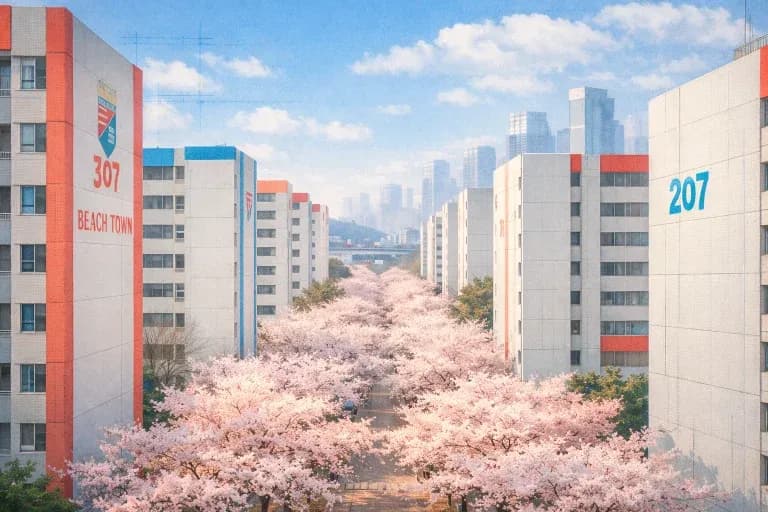
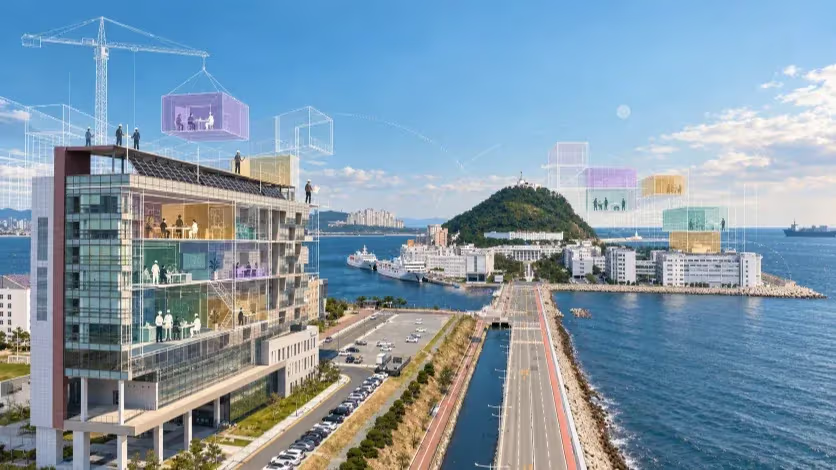
Busan’s latest redevelopment fight is not really about whether one housing complex should rise 59 stories or 99. The more important question is why the city keeps deploying planning tools and regulatory relief in places that already enjoy some of its strongest infrastructure, highest land values and most privileged public settings — its waterfronts, park edges and premium residential districts. In recent years, Busan has explicitly tied “design” and “architectural innovation” to special planning incentives that can relax height limits, increase floor-area ratios and streamline procedures. The effect is not merely aesthetic. It is to expand development room in locations the market already rewards.
That broader pattern matters far beyond Namcheon Samik Beach. From the legacy of Haeundae’s LCT to repeated high-rise pressure around Busan Citizens Park and now the ambitions once floated for Namcheon, the city has repeatedly treated public-facing landscape assets as sites where additional private residential value can be unlocked. Busan has also long relied on bridges, tunnels and urban expressways to overcome the constraints of its mountainous, fragmented geography. But that same public infrastructure has also made a narrow band of coastal and park-adjacent districts even more desirable — and more profitable.
The contradiction is becoming harder to ignore. Busan’s own planning documents speak of balanced regional development, old-downtown decline and the need to revive weaker districts. Yet some of the city’s most visible planning energy still flows toward places that are already expensive, already connected and already marketable. The real issue, then, is not whether Busan should keep building upward. It is whether the city will continue using public policy to deepen the value of its strongest districts while its more fragile neighborhoods age, empty out and fall further behind.
How “design” became a planning tool
Busan’s current planning language does not present these projects simply as high-rise real estate. It frames them as questions of design quality, urban identity and competitiveness. That framing matters because it changes how regulatory relief is understood. Under Busan’s Special Architectural District program, selected sites can receive relaxed height controls, increased floor-area ratios and streamlined procedures — benefits the city explicitly promotes as tools to realize more “innovative” design. In practice, those are not neutral design adjustments. They are development incentives with direct consequences for scale, timing and potential returns, especially in locations where land values and demand are already strong.
The city’s broader rhetoric has moved in the same direction. Busan has linked design more explicitly to city-making, including through its push toward World Design Capital 2028 and a wider agenda of urban design innovation. That official language emphasizes visibility, civic identity and urban transformation. But once those aspirations are paired with planning exceptions, the question is no longer only what kind of city Busan wants to look like. It also becomes a question of where the city is choosing to concentrate added development room.
That is where the tension in Busan’s policy becomes harder to ignore. The city also says it is trying to address widening regional disparities and long-term decline in its old downtown. Its own living-area planning documents describe the central area as facing deteriorating residential conditions, transport challenges, stagnant commercial districts and weakening vitality, while the city presents balanced development as a core planning objective. Yet the clearest and most politically legible incentives — special designation, visible design prestige and faster approvals — still appear most forcefully in places that are already connected, already valuable and already attractive to private capital.
Namcheon Samik Beach and the expansion of development room
Namcheon Samik Beach matters not because Busan ultimately approved a 99-story waterfront tower, but because the project shows how far the city’s incentive structure could stretch redevelopment expectations in one of Busan’s most valuable coastal districts. Busan’s October 2024 public presentation for its Special Architectural District pilot program included Namcheon 2 District among the showcased projects, and local reporting said the redevelopment plan being floated under that track reached 99 stories. The city’s own policy language around the program emphasized regulatory benefits tied to “innovative” design, including planning relief that could make larger schemes more feasible.
What matters for the story is how that ambition later broke down. According to Maeil Business Newspaper, the Namcheon 2 District union held a general meeting on April 5, 2025 on whether to proceed under Busan’s Special Architectural District framework, but the proposal failed to secure the required two-thirds support. The same report said the union then decided to abandon the special-district application and move forward with its existing 59-story plan instead.
The reason, according to the reporting, was not that the city drew a hard public-interest line against further vertical expansion. It was that the economics turned against the scheme. Maeil reported that the estimated member contribution for an 84-square-meter unit under the 99-story option had risen to 909 million won. The report also said the ultra-high-rise alternative would have increased the burden by roughly 100 million won over the existing plan and extended construction by more than 20 months. That sequence matters because it suggests the city’s role was less about dictating one final height than about creating a policy environment in which a much taller and more ambitious proposal became plausible in the first place. The project retreated when the numbers no longer worked for the union.
Even after that retreat, the project remained a major redevelopment. Yonhap reported on April 6, 2026 that the existing 3,060-unit complex is pursuing a 59-story rebuild, with a business-plan change expected in the first half of the year and management-disposal approval targeted for the second half.
Busan Citizens Park and the public-cost question the city already knew
Busan Citizens Park is crucial because it shows that the city already understood the public costs of high-rise residential development around a major civic asset. Busan’s own 2019 account of the compromise around the park’s surrounding redevelopment districts was unusually explicit. The city said it reduced the number of buildings above 35 stories from 29 to 22, while increasing those at 35 stories or below from one to 18. It also said the revised arrangement was intended to improve airflow and daylight conditions for the park.
The same official summary gave precise figures for each district. In Promotion District 1, Busan said the plan was cut from seven towers to five, including two towers reaching 69 stories, with an average height of 65 stories. In District 2-1, the city said the average height would be 64.4 stories. In District 3, Busan said the area would be designated a Special Architectural District, with 27 buildings including three above 50 stories and an average height of 35 stories. In District 4, the city said the project would be reduced from five buildings to three, at 35 to 45 stories with an average height of about 39 stories.
Just as important, the city framed the compromise not only in terms of skyline adjustment but also public access. Busan said all compounds would remove their fences and that east and west gates would be added, along with the existing north and south entrances, to make the park easier to reach. That is significant because it shows the dispute was not simply about design. It was about whether private residential compounds would harden into barriers around a major public asset.
That official account also made clear that Busan believed earlier planning had gone too far. The city said the 2019 compromise came after a year of difficulty in reconciling publicness and private property rights, and it described the revised plan as one that would lower building height and improve park accessibility. In other words, Busan was not unaware of the public-value problem. But the compromise also showed the limit of the city’s corrective instinct: even after acknowledging the risk, it still preserved substantial high-rise residential development around the park.
LCT, Marine City and the waterfront precedent
If Namcheon Samik Beach shows how Busan’s current incentives operate, Haeundae’s waterfront shows what that model can become once it hardens into urban form. LCT remains the clearest precedent. Yonhap reported in 2016 that the site originally lay within a scenic district where housing could not be built, but Busan changed the plan to allow residential use and removed the 60-meter height cap on seafront buildings. Those changes were presented as turning points in the project’s trajectory. The result was not simply taller buildings, but a fundamental reshaping of what private capital could do with one of the city’s most visible coastal sites.
Marine City helps explain the wider urban consequence. By the late 2000s, Busan was already discussing skyline guidelines for ultra-high-rise buildings amid concern over how large residential towers were reshaping the urban environment. The significance of Marine City is not merely that it became wealthy or visually distinctive. It is that it helped normalize a skyline in which some of Busan’s most visible horizons were no longer defined by civic or commercial landmarks, but by clusters of luxury residential towers on reclaimed or waterfront-adjacent land.
That skyline did not emerge in isolation from infrastructure. Busan’s long-term road-building strategy sought to overcome the city’s fractured coastal and mountainous geography through bridges, tunnels and ring-road links. Those projects improved connectivity in obvious public ways. But they also made already desirable waterfront districts easier to reach and easier to valorize. The result was a city in which public connectivity and public landscape increasingly fed private residential value at the top end of the market.
Read this way, LCT and Marine City are not just background examples. They are the historical backdrop that makes Namcheon easier to understand. They show that Busan’s recurring pattern is not simply vertical growth. It is the repeated conversion of public-facing coastal value — through planning exceptions, infrastructure access and skyline-making ambition — into private housing value that becomes difficult to reverse once it is built into the city’s physical form.
The other Busan: weaker districts, widening gaps
If Busan’s premium waterfront and park-adjacent districts reveal where the city’s most visible planning incentives tend to go, the old downtown shows what is left on the other side of that equation. Busan’s own planning documents describe balanced regional development as a core objective. The city’s recent living-area planning for the original downtown says the area faces deteriorating residential conditions, transport challenges, stagnant commercial districts and weakening vitality.
That contrast matters because Busan’s housing market has become markedly more unequal even as the city continues to direct high-profile planning attention toward districts that are already expensive and highly marketable. Yonhap reported in July 2025 that Busan’s apartment price quintile ratio had widened from 3.7 in 2015 to 6.3 in 2025, the highest among Korea’s six major metropolitan cities. The report said the average price of the top 20 percent of apartments in Busan had reached 825.38 million won, compared with 130.8 million won for the bottom 20 percent.
Meanwhile, Busan is not dealing only with uneven real-estate demand. It is also dealing with territorial fragility. The city’s latest population-policy materials present population decline and demographic stress as central challenges and lay out a multi-year response plan, while identifying several districts as population-loss or population-loss-concern areas. In other words, Busan is simultaneously confronting luxury concentration at one end of the urban system and demographic weakening at the other.
That is the deeper divide this story is really about. Busan does not simply have a debate over height. It has a debate over allocation. The city says it wants balanced development, but its strongest incentives still seem best suited to places the market already rewards. In that sense, the question raised by Namcheon Samik Beach is larger than one redevelopment project. It is whether Busan’s planning system is reinforcing the value of its strongest districts while asking its weaker ones to survive on a slower, lower-profile and less lucrative policy track.
Why the city’s case still leaves the central question unanswered
Busan’s defense of this approach is not hard to imagine. City officials can reasonably argue that design-led planning helps improve architectural quality, strengthen the city’s global image and unlock investment in a competitive urban environment. That case is embedded in Busan’s own policy language. The Special Architectural District program explicitly links regulatory benefits to more innovative design, and the city has tied design policy to its World Design Capital 2028 agenda and a broader effort to position itself as a city where identity and competitiveness are shaped through architecture and public design.
That argument should not be dismissed out of hand. Better design can matter. Faster procedures can matter. Premium districts are often where large private projects can move most quickly and visibly. But even if all of that is true, it does not resolve the more basic policy question raised by Busan’s recent development pattern. The issue is not whether the city should pursue design excellence. It is whether design excellence has been paired too consistently with incentives that enlarge development room in places the market already rewards, while weaker districts are more often addressed through the slower vocabulary of regeneration, demographic response and long-term local recovery.
This is where the city’s current model begins to look less like a neutral design policy and more like a choice about allocation. OECD research on place-based policy argues that persistent regional disparities require targeted, evidence-based intervention because spatial inequality carries economic, fiscal and social costs. That does not mean every high-value district should be frozen. It does mean governments need to ask whether scarce public interventions are going first to places that need correction most, or to places where they merely amplify existing advantage.
What Busan is really choosing to reward
In the end, this is not really a story about whether Busan should stop building tall. It is a story about what the city chooses to reward. Over the past two decades, Busan has repeatedly used planning changes, special designation and infrastructure-led urban expansion to enlarge development possibilities in places that were already among its most valuable. More recently, it has wrapped some of that approach in the language of design, innovation and global urban identity. The result is a city where waterfronts, park edges and highly connected districts continue to attract the strongest incentives, even as the old downtown and other weaker areas are described in a very different policy vocabulary — one of decline management, regeneration and demographic response.
That does not mean premium districts should be frozen, or that design should be treated as a public luxury. But it does mean Busan needs to confront a harder question than whether one project is elegant enough or iconic enough. If the city’s most powerful planning tools keep flowing first to places with the strongest land values, strongest infrastructure and strongest demand, then public policy is not just shaping the skyline. It is helping determine where additional private value can be created most easily. And once that value is built into the city in the form of high-rise residential clusters, widened land gaps and harder spatial hierarchies, it becomes difficult to undo.
The deeper issue, then, is distributive rather than aesthetic. A city serious about balanced development would not only ask how to make its most privileged districts more visually impressive or more globally marketable. It would also ask why those districts keep receiving the clearest and most valuable forms of planning relief while more fragile neighborhoods are left to slower, lower-profile tracks of recovery. If Namcheon Samik Beach now feels like a fight over one redevelopment project, that is only because the larger pattern has become so familiar that it can seem natural. It is not. The real question facing Busan is whether the city will continue using public planning tools to deepen private value where it is already strongest — or begin directing more of that political and regulatory energy toward the parts of Busan that need it most.
Continue this reporting
Reporting on the same issue
Related coverage selected from the article's desk, topics and newsroom relationships.
 NewsSep 20, 2026
What It Takes for U.S. Navy Repair Work to Become a Busan Industry
HJ Shipbuilding has brought U.S. Navy maintenance work to Yeongdo. Whether it...
 NewsSep 17, 2026
Busan’s Finished Homes, Unfinished Projects
Busan’s unsold homes sit in one monthly total, but they belong to very differ...
 NewsSep 16, 2026
Busan’s Young-Adult Migration Turns Sharply at 25–29
Busan can still draw young adults into the city, but keeping them becomes far...
More from the author
More from this byline
Stay with the same line of reporting through more work from this byline.
 NewsSep 22, 2026
Busan Is Growing Westward as Its Waste Infrastructure Stays Put
Editorial Record
Corrections, sourcing notes and newsroom disclosures remain part of the published record. View Newsroom Notes →
Reader Signal
Community readWhat did this report leave you with?
Choose the signal that best reflects your reading. Select it again to remove it.
One response per article
No response selected
A moderated conversation about the reporting.
One-level replies and newsroom moderation keep the conversation anchored to this article.
Discussion Status
Open
Please sign in to join the discussion.
Newsletter
Weekly reporting and context from Busan and Korea.