Before the Ballot, Busan’s Local Politics Loses the Young
Busan does not lose young voters only at the ballot box. Local elections often arrive as a difficult bundle of offices, names and slogans, while the questions shaping young lives — rent, work, transit, redevelopment and whether to stay — remain poorly translated into political choice.

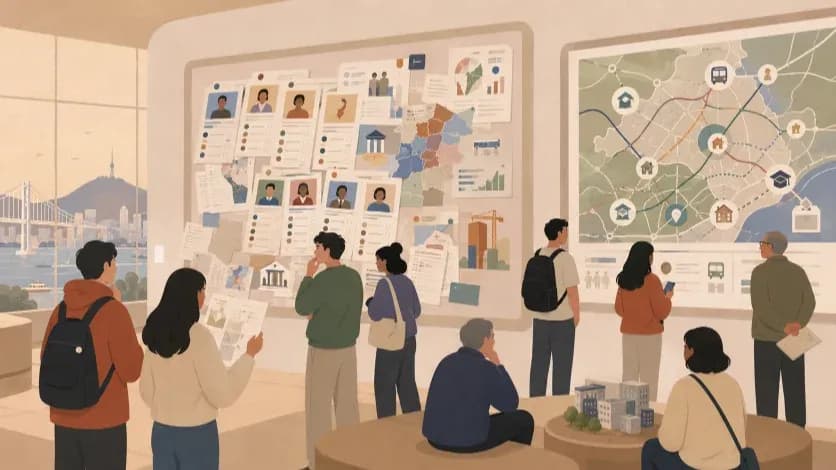
A local election does not ask voters to make one choice. It asks them to sort through several layers of government at once.
In this year’s local elections, voters are not only choosing mayors or governors. Depending on where they live, they may also be choosing education chiefs, district heads, metropolitan council members, basic council members and proportional representatives. The standard ballot structure can reach seven papers, while some areas receive fewer or more because of local circumstances or by-elections.
Basic council races add another layer of confusion: when multiple candidates from the same party appear on the same ballot, voters still mark only one. Education superintendent ballots remove party numbers and use a different visual arrangement. The election reaches the voter as a bundle of offices, rules and names before any policy choice becomes clear.
Busan shows the problem in local form. For the June 3 local elections, 456 candidates registered to compete for 248 elected positions, including mayor, education superintendent, 16 district and county heads, metropolitan council seats and basic council seats. The average competition rate was 1.84 to 1. That figure does not support a simple claim of candidate overload. The harder problem is more precise: voters face many offices and many names, but not always enough usable information to distinguish what each office can change, or which candidate has the capacity to change it.
Local elections are supposed to be the most practical elections in public life. District councils review budgets, pass ordinances, inspect local administration and shape the priorities that determine roads, schools, redevelopment, welfare programs, public facilities and neighborhood services. Yet the campaign language often arrives at a lower resolution than the work itself. “Regional development,” “communication,” “livelihoods,” “youth support” and “a better neighborhood” can appear in almost any district, from almost any party, without telling voters how a candidate would use budget review, ordinance power or administrative oversight.
The difficulty is not only the number of candidates. It is the weakness of differentiation. A voter may know the party color before knowing the policy capacity. A candidate biography may be easier to find than a record of local work. A slogan may travel farther than a concrete plan for housing, transit, public space, school governance or redevelopment. When the language of local elections stays vague, party labels and ballot order begin to do the work that policy should do.
The national candidate numbers point in the same direction. Across the country, 7,829 candidates registered for 2,349 electoral districts in the local elections and National Assembly by-elections, producing an average competition rate of 1.8 to 1. This is not a landscape of unlimited choice. In many places, the challenge is the opposite: limited competition, thin differentiation and a heavy reliance on party identity.
That structure matters before turnout is counted. A voter who cannot read the difference between candidates has little reason to treat the election as an urgent decision. A young voter weighing rent, work, transit, public space and the choice to remain in Busan may find that local government touches every part of that calculation. But the election itself often reaches her through a format that is crowded in procedure and thin in meaning.
The first barrier, then, is not the distance to the polling place. It is the distance between local power and the voter’s ability to understand it. Voting access still matters, but only after the election has become legible enough to be worth reaching.
Candidate Language Often Fails to Translate Daily Life
Local elections carry more practical authority than their campaign language often suggests. A district council member is not only a name on a small ballot. The office reviews budgets, passes ordinances, questions local administration and helps decide which neighborhood complaints become public priorities. A metropolitan council member works closer to the citywide budget, transport plans, school-adjacent issues, redevelopment pressure and public facilities. A district head controls the administrative machinery that residents encounter through welfare offices, permits, local safety, maintenance and public services.
The campaign language rarely arrives with that level of detail.
Voters can find information if they look for it. The National Election Commission operates a policy and pledge portal, posts party policies, provides candidate pledge materials and has built a “pledge issue tree” based on news-data analysis of local topics. The structure exists. The weakness lies in the way information reaches ordinary voters. A campaign leaflet, a candidate biography, a party slogan and a PDF list of pledges do not automatically become a usable comparison of governing ability.
The words used in local campaigns often stay wider than the offices themselves. “Regional development,” “communication,” “livelihoods,” “youth support,” “safety” and “a better neighborhood” can fit almost any district. The phrases are not false. They are insufficient. A voter trying to compare candidates needs to know how a promise would move through a budget, an ordinance, a committee, an audit, a redevelopment plan or a district office. Without that route, the promise remains a public mood rather than a governing plan.
The problem is not a shortage of campaign material. It is the low resolution of much of that material. A candidate may say “youth housing” without naming the land, budget line, ordinance authority or administrative partner. A candidate may promise “better transit” without showing where a district office ends and the city or national government begins. A candidate may speak of “revitalization” without saying who gains from redevelopment, who is priced out, and what public space remains after construction. The language of local elections often names the issue but not the lever.
When that happens, party labels carry more weight than they should. Research on party nomination in basic council elections has found that party labels can serve an information function in elections where voter interest and candidate-level information are limited, especially in large cities and strongly partisan regions. That finding does not make party labels illegitimate. It shows why they become so powerful. Where candidate information is thin, the party becomes a shortcut.
Ballot order can also matter when voters lack clearer grounds for comparison. A study of basic council elections under the multi-member district system found a strong effect for candidates marked with the first intra-party order, the so-called “ga” position, after parties were allowed to nominate multiple candidates in the same district. The details belong to election scholarship, but the public meaning is simple enough: when voters cannot easily distinguish candidates, the ballot’s own structure begins to shape choice.
Busan’s current election map adds another layer. The city registered 456 candidates for 248 positions, an average competition rate of 1.84 to 1. That is not a sign of uncontrolled candidate inflation. It points to a different problem. Voters must process many offices and names, while actual competition remains thin in many races.
Some races disappear before voters arrive. In Busan, 32 basic council candidates were reported as elected without a vote after the number of candidates matched the number of seats in their districts. The pattern shows the other side of voter confusion. One part of the local election asks voters to sort through many layers of office. Another part offers no contest at all. Both weaken the experience of meaningful choice.
This is where youth turnout should be read with care. Younger voters do not simply encounter politics as an abstract duty. They encounter a set of candidates, offices, slogans and party signs that must compete with work schedules, study, rent, job searches and the possibility of leaving the city. If the election cannot explain what a council seat can do about housing, transit, public space, wages, schools or redevelopment, the ballot becomes another document asking for trust without giving enough reason.
Local elections are supposed to bring government closer. In practice, they often bring more names, more offices and less clarity. The voter is not only asked to participate. The voter is asked to decode.
Youth Turnout Falls Inside That Information Gap
The turnout problem appears after the information problem, not before it.
South Korea’s 2022 local elections drew 50.9 percent turnout. The presidential election held earlier that year drew 77.1 percent, and the 2024 National Assembly election drew 67.0 percent. Local elections did not simply attract fewer voters than national contests. They attracted fewer voters in the election where candidate information is hardest to process and local authority is most fragmented.
The age pattern makes the weakness more serious. In the 2022 local elections, turnout among voters in their 20s and 30s stayed in the 30 percent range, while turnout among voters in their 60s and 70s exceeded 70 percent. The National Election Commission’s turnout analysis, carried through the national indicators system, also notes that age- and gender-group turnout figures come from post-election sample analysis rather than full-count turnout by age. The gap still gives the election a clear shape: younger voters were much less present in local contests than older voters.
Busan entered that pattern from a weaker position. Its 2022 local-election turnout was 49.13 percent, below the national average and the city’s lowest in 12 years. The rate fell from 55.6 percent in 2014 and 58.8 percent in 2018, bringing Busan back near the 49.5 percent level recorded in 2010. At the time, local political observers pointed to resignation on both sides: supporters of the dominant camp felt victory did not require much effort, while supporters of the losing camp doubted participation would change the result.
That explanation matters because it keeps the analysis away from a lazy reading of youth apathy. A low-turnout local election often begins before the campaign period. It begins when voters see little contest, weak candidate differentiation, vague promises and few signs that local offices can change the pressures closest to them. Rent, work, transport, public space, school policy and redevelopment remain local issues. The election does not always present them as local choices.
Busan’s case adds another layer. The city remains one of the country’s largest electorates, with 2,857,335 eligible voters for the June 3 local elections, behind only Gyeonggi and Seoul. The national voter roll stands at 44,649,908, with early voting scheduled for May 29 and 30 before election day on June 3. A city of that electoral size cannot treat weak youth participation as a peripheral problem.
The issue is not whether younger residents care about housing, jobs, transit or the future of the city. Those questions sit close to their daily lives. The issue is whether local elections turn those conditions into a choice that can be read, compared and acted on. When candidate language stays generic and local offices remain poorly understood, the ballot becomes less a tool of local power than a document of party alignment.
The turnout gap belongs inside that failure of translation. Younger voters are asked to participate in a system that often gives them many names but limited meaning, many offices but little clarity, and many promises but few visible routes from pledge to authority. Low participation is not proof that the city no longer matters to them. It is a warning that the election has not made the city legible enough as a political choice.
Polling Access Comes After Political Legibility
Polling places cannot repair a local election that voters cannot read.
A clearer polling map will not make vague candidates more specific. It will not turn party slogans into policy choices, or explain which council candidate understands budgets, ordinances and administrative oversight. It will not create competition in districts where the number of candidates already matches the number of seats. Voting access belongs later in the chain. Before voters decide whether a polling place is close enough, they first decide whether the election is worth the time.
That order matters. The weakness of local elections begins in political legibility: the difficulty of understanding what each office controls, how candidates differ, and whether a vote can reach the pressures of ordinary life. Polling access cannot solve that weakness. It can only reduce one cost after a voter has found enough reason to participate.
South Korea’s early voting system already recognizes one part of modern mobility. Voters do not have to return to their registered neighborhood before election day. During the early voting period, a voter can cast a ballot at an early voting station away from home. That design matters in a country where students, workers, caregivers and commuters often spend the day outside the district printed on their registration record.
The placement of early voting stations still begins from a more settled map. Under Article 148 of the Public Official Election Act, local election commissions must install and operate one early voting station in each eup, myeon and dong during the two-day early voting period. Additional stations are allowed only under limited conditions, including areas with concentrations of military units, reductions in the number of local administrative units after boundary changes, and certain infectious-disease management or isolation facilities.
That rule gives election administration a clear structure. It also shows the boundary of the current design. Campuses, transfer stations, commercial districts, industrial corridors, hospital clusters and work zones do not appear as ordinary categories in the law’s placement logic. They may be where younger voters, shift workers and mobile residents spend much of the day, but the default unit remains the administrative neighborhood.
The result should not be overstated. A polling station outside a student’s daily route does not by itself explain low youth turnout. A polling station near a transfer hub would not, by itself, solve distrust, weak candidate quality or low local-election urgency. The stronger claim is narrower. When local elections already struggle to command attention, election administration should not add avoidable distance.
Busan’s problem should be read in that limited but important sense. The city does not need to replace neighborhood early voting stations. Many voters, especially older residents and people with stable local routines, rely on them. The question is whether the current map is enough for a city where younger residents study, work, commute and search for opportunity across several districts.
A second layer of voting access would not treat convenience as the purpose of democracy. It would treat access as part of the public infrastructure of participation. A university district, a subway transfer area, a hospital zone or an industrial corridor is not merely a busy place. It is where public life collects before voters ever reach the neighborhood office.
Polling places do not explain why young voters leave local elections. They reveal how little election administration has adjusted to the voters local politics is already losing.
Busan Needs Two New Maps
Busan does not need a larger pile of campaign material. It needs a better way to read what is already there.
Official candidate information, party platforms, pledge documents and election notices exist, but most voters do not experience them as a clear comparison of local governing capacity. A campaign leaflet tells a voter who a candidate is. A party label tells a voter where the candidate stands in national politics. A pledge list tells a voter what the candidate wants to promise. None of these formats, by itself, shows how a district council candidate would use budget review, ordinance power, administrative questioning or local oversight to affect rent, transit, redevelopment, childcare, school conditions, public space or youth employment.
A candidate information map would start from those issues, not from candidate branding. It would compare candidates by the work local offices actually perform: housing and rent, transport and commuting, redevelopment and displacement, school governance, welfare delivery, public safety, climate risk, youth jobs, cultural space, budget oversight and ordinance capacity. It would show which promises fall within a city council’s power, which belong to a district office, which require metropolitan coordination, and which are closer to national politics than local administration. Voters should not have to guess whether a local pledge has a lever behind it.
That map would also make weak language more visible. A candidate who says “youth support” without a budget, site, ordinance path or administrative partner would look different from a candidate who identifies a housing mechanism, a transit link, a vacant public asset or a committee route. A candidate who promises “regional development” without naming who benefits, who may be displaced and what public value remains would be easier to separate from one who can describe the tradeoff. Better information would not guarantee better candidates. It would make vague candidacy harder to hide.
Busan also needs a second voting map. Neighborhood polling places remain necessary. They serve older residents, long-settled voters and people whose daily routines still move around the administrative district. Removing that layer would make no sense. The question is whether a city with weak youth turnout, mobile work patterns and large cross-district daily movement should rely on that layer alone.
A second voting map would follow where public life already gathers. Campuses around Pusan National University, Pukyong National University, Kyungsung University, Dong-A University, Dong-eui University and other university districts carry students, young workers and first-time voters who may not organize their day around the neighborhood office. Transfer and commercial areas such as Seomyeon, Sasang, Hadan, Deokcheon, Centum City and Nampo–Gwangbok concentrate commuting, part-time work, shopping, study, waiting and evening movement. Industrial and work corridors in Noksan, Sinpyeong–Jangnim, Sasang and Centum gather workers whose schedules do not fit neatly into ordinary administrative time. Hospital zones and accessible public buildings matter for patients, caregivers, older voters and disabled voters as much as for the young.
Other democracies offer examples, not templates. New Zealand has used voting places in shopping areas, transport hubs and community spaces. Some Japanese municipalities have placed early voting sites near stations, shopping centers and university campuses. Vote-center models in parts of the United States show another way to loosen the tie between a single assigned room and the act of voting. Busan does not need to copy those systems. Election law, ballot security, staffing and local administration differ. The useful lesson is narrower: voting access can be designed around the places where people already move.
Neither map would solve youth turnout alone. Better candidates, sharper local agendas and parties willing to treat local government as more than a branch office of national politics remain the harder work. A student will not vote because a polling station is nearby if every candidate sounds the same. A young worker will not study a council race if the race never explains how council power touches wages, housing, transport or redevelopment. Access can reduce distance. It cannot create meaning by itself.
Still, distance matters once meaning is already weak. A local election that asks voters to decode many offices, vague promises and limited competition should not also ask them to find the ballot outside the routes of their day. Busan’s challenge is to make local politics easier to understand before election day and easier to reach when election day comes.
The city’s youth-turnout problem begins before the polling place. It begins in the quality of candidates, the language of pledges, the structure of choice and the confidence young residents have in Busan as a place to build a life. Polling access belongs at the end of that chain, not the beginning. But the end still matters. A city trying to keep young voters cannot wait for them only at the old administrative map. It has to show them what local power can do, and then place the ballot closer to the lives that power is supposed to serve.
Continue this reporting
Reporting on the same issue
Related coverage selected from the article's desk, topics and newsroom relationships.
 NewsSep 20, 2026
What It Takes for U.S. Navy Repair Work to Become a Busan Industry
HJ Shipbuilding has brought U.S. Navy maintenance work to Yeongdo. Whether it...
 NewsSep 17, 2026
Busan’s Finished Homes, Unfinished Projects
Busan’s unsold homes sit in one monthly total, but they belong to very differ...
 NewsSep 16, 2026
Busan’s Young-Adult Migration Turns Sharply at 25–29
Busan can still draw young adults into the city, but keeping them becomes far...
More from the author
More from this byline
Stay with the same line of reporting through more work from this byline.
 NewsSep 22, 2026
Busan Is Growing Westward as Its Waste Infrastructure Stays Put

Editorial Record
Corrections, sourcing notes and newsroom disclosures remain part of the published record. View Newsroom Notes →
Reader Signal
Community readWhat did this report leave you with?
Choose the signal that best reflects your reading. Select it again to remove it.
One response per article
No response selected
A moderated conversation about the reporting.
One-level replies and newsroom moderation keep the conversation anchored to this article.
Discussion Status
Open
Please sign in to join the discussion.
Newsletter
Weekly reporting and context from Busan and Korea.