Memory Placement and the Hidden Economics of AI Devices
AI’s next phase is shaped less by smarter models than by where memory lives and how much it costs to keep close

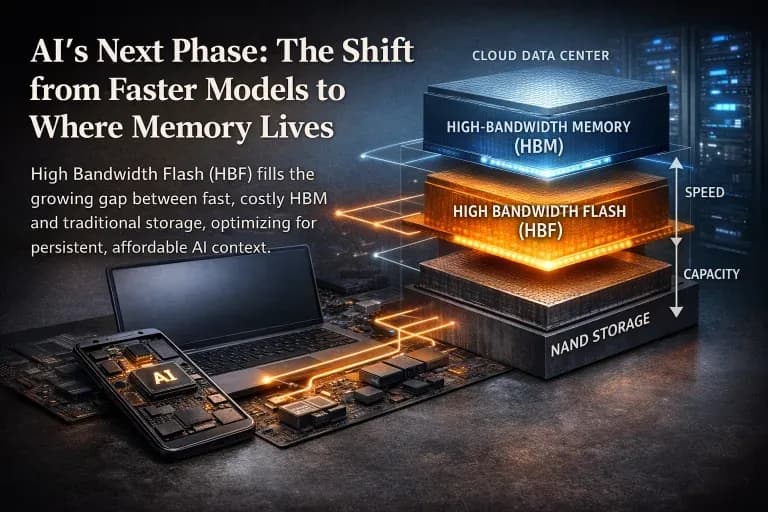
AI’s next phase is shaped less by smarter models than by where memory lives and how much it costs to keep close. HBM cleared the first bottleneck by feeding GPUs fast enough, but personalization turned memory into something that accumulates, returns unevenly, and persists across idle periods.
HBF absorbs this pressure by trading peak speed for persistent proximity at lower cost, marking a structural shift in which device pricing, algorithmic influence, and decision-making are quietly reorganized through memory placement.
When Apple introduced its latest on-device AI features, the emphasis shifted away from model size or cloud-scale inference and toward how much context could remain local. Around the same time, Nvidia’s future-facing roadmaps began to reveal a quiet imbalance: memory occupying a growing share of accelerator packages, expanding faster than gains in raw compute.
Together, these moves point to a change in where progress is being made. The next phase of AI will not be defined by larger models or higher benchmark scores. It will be defined by where memory sits, how long it persists, and how closely it follows the user.
The strain first appeared in large data centers. As neural networks expanded, faster processors stopped delivering proportional gains. Performance flattened not because computation slowed, but because data failed to arrive on time. Feeding models quickly enough proved harder than executing the calculations themselves. High-bandwidth memory (HBM) emerged as a response, pulling memory closer to accelerators and turning bandwidth into a decisive factor.
That same pressure now shows up under different conditions. As AI systems move beyond shared models and begin to operate as personalized agents, they stop relying on a single, uniform memory footprint. Each user accumulates a distinct working state—preferences, routines, prior interactions—that must remain available over time. Context drifts away from the behavior of a temporary cache and toward something that requires continuous management.
The effect no longer stays inside servers. Smartphones and PCs increasingly retain portions of an AI system’s working memory locally, tightening response times while reducing dependence on the cloud. Memory and storage, once supporting components, move to the center of device design. Costs rise, but unevenly, separating products by how much intelligence—and how much memory—they keep close at hand.
When GPUs Started Waiting
The architecture held while memory demand remained predictable. Large models pulled repeatedly from a shared set of parameters. The same data surfaced again and again across users. Memory cycled through short, regular loops—loaded, processed, released. Under those conditions, speed outweighed size, and proximity justified cost.
Over time, a different pattern emerged. Context began to linger. Information gathered from past interactions stayed resident—preferences, prior choices, partial histories—returning at uneven intervals. Long pauses separated bursts of activity. Memory footprints grew less transient and more cumulative.
As this footprint expanded, pressure shifted inside the system. Faster access still mattered, but space began to matter as well. Keeping every fragment close carried a rising cost, while pushing it too far away slowed responses in subtle but noticeable ways.
Compute behavior remained familiar. GPUs activated briefly, carried out inference or generation, and then fell quiet again. Between those moments, stored context continued to occupy space, waiting to be referenced when activity resumed. Gradually, system design moved away from peak throughput and toward placement.
Why the Conversation Is Moving Toward HBF
The growing pressure between fast memory and storage has a name. It is increasingly referred to as HBF (High Bandwidth Flash)—flash-based memory positioned between HBM and traditional storage, optimized for persistence and proximity rather than raw bandwidth.
In practical terms, this space sits between familiar tiers. Faster and closer than flash storage, but larger and more forgiving than traditional DRAM. It is often discussed alongside technologies such as CXL-based memory expansion or emerging high-density solutions, not as a replacement for HBM, but as a way to stretch the memory hierarchy without breaking it.
HBM solved the problem of feeding shared models at high speed. It kept GPUs busy during short, intense bursts of computation. HBF addresses a different strain. It sits where context accumulates and lingers, where access is frequent but uneven, and where memory must remain close without carrying the full cost of the fastest tier.
HBM is built around repetition: the same parameters accessed again and again, released once computation ends. HBF is shaped by persistence. Context stays resident across idle periods, returns in fragments, and competes for proximity over time. The demand is not constant throughput, but sustained availability.
Cost makes the distinction unavoidable. Keeping persistent, personalized context entirely in HBM quickly runs into limits—capacity, yield, and power among them. Pushing the same data all the way to distant storage introduces latency and breaks continuity. HBF occupies the middle, trading peak speed for scale, proximity, and endurance.
What makes HBF consequential is not raw performance, but placement. It determines which parts of an AI system’s memory remain immediately reachable, which drift a step further away, and which are allowed to fade—long before any output is produced. Unlike DRAM-based extensions, HBF remains block-oriented and optimized for scale, not latency parity with system memory.
When HBF Moves Into Personal Devices
The shift toward HBF becomes more visible once it leaves the data center. In personal devices, memory placement stops being an abstract design choice and begins to shape everyday experience.
Smartphones and PCs operate under tight constraints. Power budgets are fixed. Space is limited. Expectations around responsiveness continue to rise. Conversations feel sluggish when context has to be fetched from afar. Interactions lose continuity when state disappears between sessions.
HBF enters this environment as a practical compromise. It holds user-specific context near the processor without demanding the cost, power, and packaging complexity of the fastest tier. Preferences, recent activity, and fragments of interaction history remain within reach across active and idle states.
As more context stays local, device design begins to diverge. Some systems lean heavily on cloud infrastructure. Others absorb more responsibility on-device. Pricing follows this split, separating products by how much context they can afford to keep close—and how independent they can remain from the network.
Memory and storage no longer play supporting roles. They shape form factors, battery life, and the boundary between local and remote intelligence.
Memory, Algorithms, and Quiet Influence
As more context stays close, algorithms gain a different kind of leverage. Influence no longer depends on explicit recommendations or visible prompts. It begins earlier, in how memory is organized, refreshed, and allowed to persist.
Systems preload relevant information, rank priorities, and prepare responses ahead of interaction. Over time, patterns form. Certain topics surface more easily. Others require more effort to retrieve. Some fade simply because they are no longer kept nearby.
These shifts unfold gradually. Memory that remains close is reused more often. Memory that drifts outward is consulted less frequently. What disappears entirely leaves no trace to question. The result is not overt guidance, but a narrowing of what feels immediately available.
Algorithms act less as decision-makers than as custodians of context. Choices about retention and decay reflect optimization goals, but they also frame experience over time. What begins as convenience settles into expectation.
Cost, Constraint, and Direction
Memory placement carries a cost long before it appears on a price tag. Keeping context close requires silicon area, power, and thermal headroom. Pushing it further away saves on hardware, but introduces latency and dependence on the network. Every design choice shifts the burden somewhere else.
In data centers, cost is amortized across users. In personal devices, it is borne unit by unit. Each decision about memory becomes visible in pricing, battery life, and upgrade cycles.
HBF reduces the cost of proximity without eliminating it. It allows systems to carry more context forward without forcing everything into the fastest and most expensive tier. Over time, design priorities shift from peak speed to persistence—what to keep, where to keep it, and for how long.
A Shift in Kind, Not Just in Speed
Industrial transitions rarely announce themselves. They become visible only when everyday structures—work, cost, coordination—begin to rearrange at once.
Previous shifts mechanized labor or accelerated communication. This one reorganizes decision-making. Intelligence is embedded into memory, carried forward across interactions, and woven into ordinary devices. The change arrives gradually, but it settles deep.
Seen this way, the current moment resembles past turning points not in magnitude, but in structure. Memory—where it lives, how long it lasts, and who controls it—becomes the quiet hinge.
The infrastructure is already being laid. What remains unsettled is how deliberately it is shaped—and for whom.
Continue this reporting
Reporting on the same issue
Related coverage selected from the article's desk, topics and newsroom relationships.
 NewsSep 2, 2026
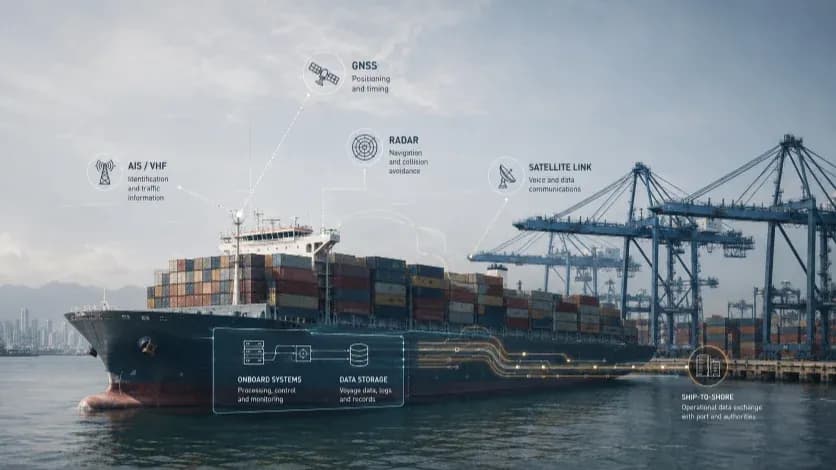
The Ship Is Already a Sensor
Modern merchant ships already carry dense networks of sensors, radios and com...
 NewsAug 23, 2026
When Smart Glasses Stop Looking Like Computers
The most successful smart glasses are learning to disappear. Their next chall...
 NewsAug 15, 2026
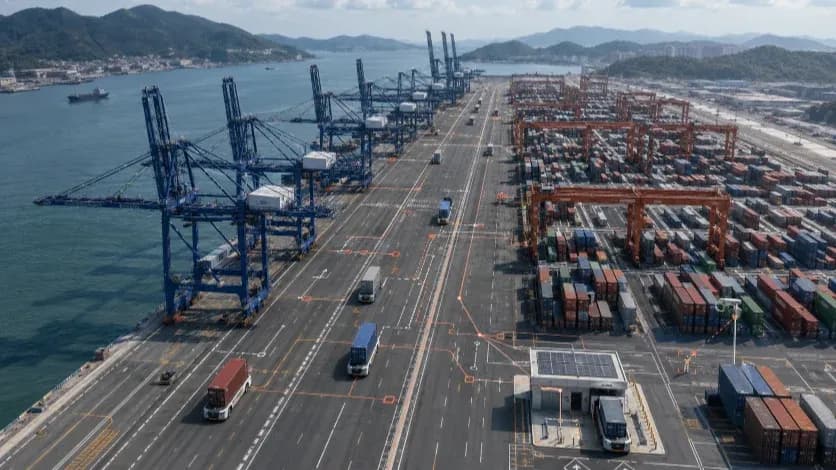
Busan Port’s Next Automation Challenge Lies Between the Machines
Busan New Port already runs driverless cargo transport. Its next automation p...
More from the author
More from this byline
Stay with the same line of reporting through more work from this byline.
- NewsAug 23, 2026
When Smart Glasses Stop Looking Like Computers
Editorial Record
Corrections, sourcing notes and newsroom disclosures remain part of the published record. View Newsroom Notes →
Reader Signal
Community readWhat did this report leave you with?
Choose the signal that best reflects your reading. Select it again to remove it.
One response per article
No response selected
A moderated conversation about the reporting.
One-level replies and newsroom moderation keep the conversation anchored to this article.
Discussion Status
Open
Please sign in to join the discussion.
Newsletter
Weekly reporting and context from Busan and Korea.