AI, White-Collar Work, and the Uncertain Future of Income
White-collar work is not disappearing overnight. Instead, entire professions are being reorganized into automated production, human verification, and algorithmic supervision.

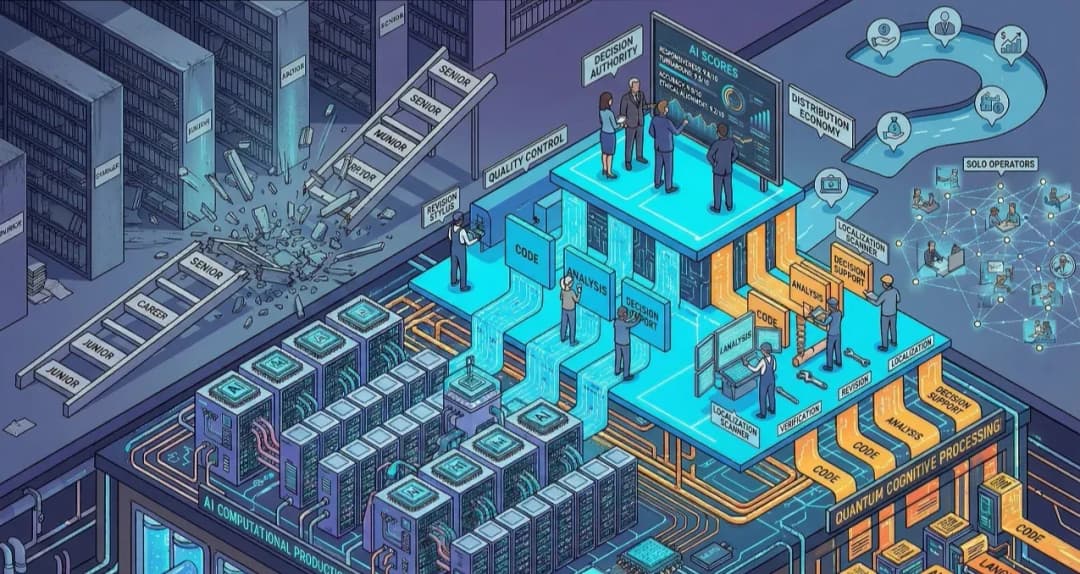
For decades the digital economy rested on a relatively stable technological architecture. Data centers stored information, network infrastructure transmitted it, and software platforms organized commerce, media, and financial activity across the internet. The rapid expansion of artificial intelligence is beginning to reorganize that architecture around a different function: large-scale computational production.
Hyperscale data centers increasingly operate less like repositories of information and more like industrial facilities designed for continuous machine computation. Dense clusters of specialized processors execute vast volumes of mathematical operations to train and run large AI models. Electricity, silicon, and data combine inside these facilities to generate a new form of economic output—machine-generated analysis, code, language, and decision support that can be integrated directly into business operations.
Corporate adoption patterns already reflect the shift. Automated systems now assist with software development, marketing analysis, document preparation, and translation across a wide range of industries. Tasks that once required teams of junior analysts, researchers, and technical specialists increasingly pass through computational systems capable of performing routine cognitive work at scale.
White-collar labor markets have begun adjusting accordingly. Professional work in fields such as translation, research, marketing, and planning increasingly divides between automated production and human oversight. Machine systems perform large volumes of preliminary analysis and document generation, while human workers supervise, interpret, and refine computational output.
Economic production therefore begins to rely less exclusively on human labor and more on computational infrastructure capable of generating knowledge-based output continuously. The resulting shift raises a broader structural question for advanced economies: how labor markets, income distribution, and professional work evolve when large segments of cognitive production migrate from offices to data centers.
AI Infrastructure Becomes an Industrial System
Artificial intelligence is rapidly expanding the scale of computing infrastructure across the global economy. Hyperscale data centers built for machine learning now operate less like traditional IT facilities and more like industrial production sites.
Facilities operated by companies including Microsoft, Amazon, Google, and Meta contain dense clusters of specialized processors designed to train and run large AI models. Thousands of graphics processing units operate simultaneously inside tightly connected computing networks. Training advanced models often requires weeks of continuous computation across those clusters.
Semiconductor supply chains sit at the center of that system. AI accelerators produced by companies such as NVIDIA and AMD have become the dominant hardware platform for large-scale machine learning. Servers equipped with multiple accelerators operate in parallel, allowing enormous volumes of data to be processed in real time.
Energy demand reflects the scale of the infrastructure. The International Energy Agency estimates that global data centers consumed roughly 415 terawatt-hours of electricity in 2024, about 1.5 percent of global power demand. Continued expansion of artificial intelligence systems could push consumption toward 945 terawatt-hours by the end of the decade.
Facilities designed for machine learning differ sharply from earlier generations of cloud computing. Conventional data centers handled storage and transactional workloads. AI infrastructure prioritizes computing density. Liquid cooling systems, high-bandwidth networking, and specialized chip architectures now define the physical layout of modern AI clusters.
Outputs generated by those systems increasingly feed directly into business operations. Large language models produce software code, marketing text, customer service responses, and analytical reports. Companies integrate those outputs into everyday workflows across software development, marketing, research, and logistics.
Automated systems are also evolving beyond single tasks. Software agents connected to internal databases and external services can retrieve information, generate reports, and execute operational procedures with limited human supervision. Several technology firms now deploy such agents to assist with internal workflows ranging from data analysis to technical support.
Large-scale computing infrastructure is therefore beginning to function as a new production layer inside the digital economy. Electricity powers processors. Processors run statistical models. Model outputs generate text, code, and analysis that organizations use in place of routine cognitive work.
Expansion of that infrastructure is reshaping how knowledge work is performed across industries.
White-Collar Work Breaks Into Tasks, Signals and Scores
Artificial intelligence is not entering the office by abolishing professions all at once. Far more often, software enters through smaller openings: a draft written faster than a junior associate could manage, a summary assembled before a researcher finishes reading, a translation delivered instantly at negligible cost, a presentation deck structured before a strategy meeting begins. Entire occupations rarely disappear in a single movement. Task bundles do.
That distinction matters. Professional work has long depended on a layered structure of apprenticeship. Junior employees handled the repetitive, lower-value parts of a workflow and gradually absorbed judgment from proximity to more experienced colleagues. Research assistants cleaned data before learning how to interpret it. Junior developers fixed bugs and wrote documentation before designing systems. Translators built careers through volume before moving into higher-value specialization. Marketers assembled reports and presentation materials before taking control of budget and strategy. Artificial intelligence is beginning to remove precisely those entry-level functions that once served as the training ground for future expertise.
Translation offers one of the clearest examples. For years, commercial translation operated on a straightforward model: human labor produced the first draft, and experience improved speed, tone and accuracy over time. Large language models and machine translation systems have inverted that sequence. Software now produces the first draft. Human workers increasingly revise, validate and localize machine output. Revenue shifts accordingly. Clients pay less for raw translation and more selectively for accuracy, legal liability, cultural nuance and brand sensitivity. A profession built around production starts to resemble one built around review.
A similar reordering is spreading through planning, marketing and administrative work. Research that once required hours of manual collection now begins with automated summaries. Presentation structures, market scans, competitor profiles, copy variations and email drafts can be produced within minutes. Corporate value therefore migrates away from assembling the first version of a document and toward deciding which version matters, what assumptions remain wrong, which risks remain hidden and which audience a message must persuade. Routine production falls in value. Selection, framing and institutional judgment become more important.
Such shifts do not merely reduce workload. They alter the internal economics of the firm. A department that once required a pyramid of junior and mid-level staff can increasingly operate with fewer people at the base and more software layered beneath a smaller number of senior decision-makers. Management does not need to eliminate a function outright for the structure to change. Recruitment slows. Promotion ladders narrow. Informal training weakens. Fewer early-career workers enter the pipeline. Fewer mid-career workers emerge from it later. A thinner professional hierarchy gradually replaces the broader one that dominated white-collar organizations for decades.
Pressure on entry-level roles may prove more consequential than headline layoffs. Most professional labor markets reproduce themselves through repetition. Repetition builds fluency; fluency becomes judgment; judgment eventually becomes authority. Artificial intelligence interrupts that sequence by absorbing the repetitive stages first. An economy can therefore preserve the appearance of professional employment while undermining the mechanism that once produced professionals in the first place.
Office work is also becoming more measurable in the process. Earlier generations of white-collar labor retained a degree of opacity. Managers could observe attendance, deadlines and broad outcomes, but large portions of daily intellectual work remained difficult to quantify. Digital workflow systems changed that gradually. Artificial intelligence is accelerating the process. Writing speed, revision patterns, response times, code acceptance rates, document production, meeting summaries, customer interaction quality and internal collaboration habits can all be captured, stored and compared at scale.
Performance therefore begins to migrate from managerial impression to machine-readable signal. A salesperson's responsiveness, a consultant's turnaround speed, a developer's output patterns, a support worker's language consistency and a planner's document cycle time all become measurable variables inside organizational systems. Monitoring no longer depends entirely on a supervisor reading final outputs. Monitoring increasingly takes place through workflow metadata, software logs and predictive scoring tools operating in the background.
Such systems extend managerial power in two ways. First, software widens visibility. Employers can observe more of the production process than before, not merely the final deliverable. Second, software standardizes comparison. Workers performing different tasks can still be ranked across shared indicators such as speed, consistency, utilization or client response. Professional discretion narrows when firms can convert diverse office activity into comparable data.
The consequence is not simply surveillance in the familiar sense of watching employees more closely. A more significant shift lies in the conversion of professional labor into a sequence of machine-legible events. Once that conversion takes place, management can optimize staffing, tighten deadlines, automate quality control and restructure compensation around measured outputs. Professional authority weakens when firms control not just the job description but the metrics through which performance is defined.
A deeper transformation follows from the same logic. White-collar work begins to separate into three layers. Automated systems handle first-pass production. Human workers validate, edit and escalate exceptions. Senior staff retain control over judgment, accountability and institutional risk. Such a structure rewards people who can direct systems, interpret ambiguous outcomes and take responsibility for consequential decisions. It punishes workers whose value once came from producing competent first drafts at scale.
That pattern helps explain why artificial intelligence often strengthens top performers while destabilizing the middle and the bottom. A senior lawyer can review machine-prepared material more efficiently than before. An experienced strategist can test more scenarios in less time. A veteran engineer can ship faster with automated coding support. A junior worker, by contrast, may lose the very assignments that once created a path into the profession. Productivity rises at the top while access narrows below.
Korea presents a particularly revealing case because digital adoption is fast, competition for white-collar employment is intense and many professional sectors remain heavily document-driven. Translation, content production, planning and administrative support have all felt early pressure from automation. Corporate teams increasingly use generative systems for drafting, summarizing and market scanning. Small firms that once outsourced language work or junior planning tasks can now internalize part of that workload with software. A freelancer who previously sold execution may find clients willing to pay only for correction, not creation.
Such changes also encourage a different organizational model. Lower barriers to production make one-person firms and very small teams more viable in fields that once required junior support staff, external agencies or freelance subcontractors. Artificial intelligence can generate copy, suggest product names, build prototypes, localize text, produce visual assets and handle customer messaging at low cost. Entrepreneurial activity may expand even as salaried entry-level employment contracts. Office work does not vanish under that arrangement. Office work becomes more individualized, more volatile and more unequal.
A post-bureaucratic office starts to come into view. Large organizations still matter, but internal staffing models begin to shift away from broad clerical and junior-professional layers. Smaller firms become more capable. Individual operators become more productive. Stable employment gives way, at least for some workers, to project-based income, micro-enterprise and solo commercial activity supported by software systems that replicate parts of a team.
Such a transition carries obvious appeal for highly capable workers with strong judgment, clear market sense and the ability to orchestrate tools efficiently. The same transition poses severe risks for workers who depended on institutional ladders, stable progression and protected learning time. Economic mobility becomes harder when firms demand judgment before giving workers the chance to acquire it.
Artificial intelligence, then, is not merely reducing headcount or improving productivity. A more structural shift is underway inside professional labor markets. Offices are becoming environments in which routine intellectual work is automated, performance is continuously rendered into data, and advancement depends less on experience accumulated gradually than on the ability to supervise machines, interpret outputs and claim responsibility for decisions software cannot safely own.
The result is not the end of white-collar work. The result is a new division of white-collar work: less apprenticeship, more verification; less opacity, more scoring; fewer ladders, more thresholds.
Toward a Post-Labor Distribution Economy
Artificial intelligence is unlikely to eliminate professional work in a single, abrupt wave. Offices will not empty overnight, and corporations will continue to require judgment, responsibility, and institutional memory. Yet a structural shift is beginning to emerge beneath the surface of white-collar employment. Production of routine intellectual output—documents, code, analysis, summaries, translation—has already begun migrating from human labor to computational infrastructure. Data centers increasingly generate the first layer of cognitive work, while human workers intervene later in the process.
Economic systems historically tied income to participation in production. Industrial economies paid wages for physical labor. The knowledge economy expanded that logic to intellectual work. Artificial intelligence begins to weaken that relationship by allowing a growing share of cognitive production to occur without direct human effort. Once organizations can generate documentation, analysis, and operational support through scalable computing infrastructure, the volume of output no longer rises in proportion to the number of employees.
Such conditions introduce a distribution problem rather than a productivity problem. Artificial intelligence may raise output while reducing the number of people required to generate that output. Productivity gains have always carried the potential to concentrate income, but previous technological transitions still relied heavily on labor to translate productivity into economic activity. A production system built around automated cognition shifts that balance toward capital ownership, infrastructure control, and intellectual property.
Several potential trajectories emerge from that shift. One path leads toward greater concentration of economic power around firms operating large-scale computing infrastructure. Data centers, semiconductor supply chains, and proprietary models could become the core productive assets of the digital economy, allowing a relatively small number of companies to control the systems generating automated cognitive output. Under such conditions, labor income may decline as a share of total economic value while returns to infrastructure ownership expand.
A second path leads toward fragmentation rather than concentration. Lower barriers to production allow individuals and very small teams to operate businesses that previously required large organizations. Artificial intelligence reduces the cost of design, research, software development, and marketing execution. A single entrepreneur supported by automated tools can produce work that once required an entire department. Employment contracts may therefore give way, in part, to networks of micro-enterprises and independent professionals operating alongside automated systems.
Both trajectories can coexist. Large technology firms may dominate infrastructure while individual operators capture opportunities created by low-cost production tools. The result resembles neither the industrial corporation of the twentieth century nor the gig platforms of the early digital economy. Instead, a hybrid structure may emerge in which economic activity flows simultaneously through centralized computational infrastructure and highly individualized production networks.
Distribution systems may eventually have to adjust to such an arrangement. Traditional welfare policies assumed that most adults participated in labor markets and therefore required temporary assistance between jobs. A labor market that produces fewer stable entry points and thinner professional hierarchies raises different questions. Public debate has already begun exploring alternatives ranging from basic income and universal services to broader forms of asset ownership that link citizens more directly to technological infrastructure.
Predicting the precise outcome remains difficult. Earlier technological revolutions produced both disruption and entirely new industries that absorbed displaced labor. Artificial intelligence may follow a similar pattern. Yet the distinctive feature of the present transition lies in the nature of the work being automated. Industrial machines replaced physical strength; algorithmic systems now perform portions of analysis, language production, and decision support once considered uniquely human.
Economic systems built around human labor must therefore adapt to a production environment in which cognitive output can be generated at industrial scale. The defining policy challenge of the coming decades may not center on employment alone, but on how societies distribute income, opportunity, and economic security when productive capacity increasingly resides inside computational infrastructure rather than the workforce itself.
Continue this reporting
Reporting on the same issue
Related coverage selected from the article's desk, topics and newsroom relationships.
 NewsSep 2, 2026
The Ship Is Already a Sensor
Modern merchant ships already carry dense networks of sensors, radios and com...
 NewsAug 23, 2026
When Smart Glasses Stop Looking Like Computers
The most successful smart glasses are learning to disappear. Their next chall...
 NewsAug 15, 2026
Busan Port’s Next Automation Challenge Lies Between the Machines
Busan New Port already runs driverless cargo transport. Its next automation p...
More from the author
More from this byline
Stay with the same line of reporting through more work from this byline.
- NewsAug 23, 2026
When Smart Glasses Stop Looking Like Computers

Editorial Record
Corrections, sourcing notes and newsroom disclosures remain part of the published record. View Newsroom Notes →
Reader Signal
Community readWhat did this report leave you with?
Choose the signal that best reflects your reading. Select it again to remove it.
One response per article
No response selected
A moderated conversation about the reporting.
One-level replies and newsroom moderation keep the conversation anchored to this article.
Discussion Status
Open
Please sign in to join the discussion.
Newsletter
Weekly reporting and context from Busan and Korea.