South Korea, Palestine and the Limits of Recognition
South Korea now speaks more plainly about Palestinian suffering than it once did. It still does not recognize Palestine. That gap — between language and decision — is where the real story begins.


In April, a post from South Korea’s president broke with a long habit of caution. Lee Jae-myung condemned Israeli violence in language that drew an immediate rebuke from Israel, which accused him of diminishing the Holocaust. Seoul answered that his remarks had been misunderstood and that they reflected concern for universal human rights and international humanitarian law. The exchange was easy to treat as a quarrel over tone. It was more than that. It showed, in public, a gap South Korea had managed for years without naming so plainly: Seoul had found stronger words for Palestine, but not the policy to match them.
The record is simple enough. South Korea voted for Palestine’s full UN membership bid at the Security Council in April 2024. It still does not recognize the State of Palestine, and it still has no diplomatic relations with it. That is Seoul’s position in its clearest form: a yes vote, but no recognition. South Korea is no longer merely silent on Palestine. It has moved, then stopped.
That position has become harder to defend because the world around it has changed. In July 2024, the International Court of Justice held that Israel’s continued presence in the occupied Palestinian territory is unlawful and that other states must neither recognize as lawful nor assist in maintaining the situation created by that presence. A January 2026 OHCHR report then described Israel’s administration in the occupied West Bank, including East Jerusalem, as a system of discriminatory laws, policies and practices of oppression and domination against Palestinians, explicitly linking that analysis to the prohibition of racial segregation and apartheid under international law. Reuters reported in April 2026 that Israel approved dozens of new West Bank settlements, underlining how current that structure remains. Once that standard is in place, caution no longer reads as it once did. What used to pass as prudence starts to look like refusal.
To understand why this matters in Seoul, it is not enough to begin with one president’s post. The argument reaches further back, into the history of Zionism itself. Any serious account has to start there. Zionism emerged in late nineteenth-century Europe under the pressure of antisemitism, exclusion and the repeated failure of Jewish safety. But that is only where the story starts. The harder question is what happened when that search for safety was turned into sovereignty in a land already inhabited by another people. In Palestine, what began as a politics of refuge was realized through settlement, exclusion, displacement and unequal rule.
South Korea enters that argument from an unusual place. Few modern states have made occupation, wartime abuse and unresolved grievance as central to public life as the Republic of Korea has. Yet memory does not travel simply because it is sincere. It can remain national for decades. It can explain the self, justify the state and organize grievance without becoming a standard applied abroad. That is what made the April episode larger than a passing controversy. For a moment, Korean historical memory moved beyond its usual domestic and bilateral frame and entered a wider argument about Palestine. The question is whether that was the start of a shift, or only the visible overflow of a policy still unwilling to act on what it now dares to say.
Foreign coverage made the split visible. Israeli outlets treated the episode first as a scandal of comparison — a South Korean president crossing a moral line by invoking the Holocaust, in some cases while amplifying dubious or politicized imagery. Arab coverage did almost the reverse, treating Lee’s remarks chiefly as a late but notable condemnation of Israeli abuses against Palestinians. International wire services sat between the two, reading the row as both a moral clash and a geopolitical one, tied to oil, shipping and a widening regional war. The difference mattered. It showed that the issue was never only what Lee said. It was what different publics were prepared to hear at the center of the story.
A Yes Vote, No Recognition
Before turning to Zionism, law or memory, the Korean record has to be stated plainly. South Korea’s position on Palestine is no longer one of silence. It is one of incompletion. In April 2024, Seoul backed Palestine’s bid for full UN membership at the Security Council. Yet the foreign ministry still states that the Republic of Korea does not recognize the State of Palestine as an independent state and has not established diplomatic relations with it. Those two facts matter more than any broad call for peace. They show that Seoul has moved, but only part of the way.
A vote and a recognition are not the same thing. A vote can signal sympathy, frustration or a limited shift in diplomatic mood. Recognition does something more binding. It fixes a legal and political position. It says Palestinian statehood is not merely a future possibility to be delivered, someday, by negotiations. South Korea has not crossed that line. It has accepted more of the language around Palestinian rights than the act that would anchor that language in policy. What remains is controlled ambiguity.
That ambiguity has a longer history than the current government. After the 1973 war and oil shock, Park Chung-hee’s government moved sharply toward the Arab position, calling for Israeli withdrawal from occupied territories and, later in the decade, exploring closer ties with the PLO. Research on Park’s late-1970s rapprochement with the PLO and on South Korea’s diplomacy during the first oil crisis shows that Seoul’s Middle East policy has long been shaped less by fixed moral doctrine than by the point at which strategic cost begins to force political speech. Korea has not always been quiet on Palestine. More often, it has spoken most clearly when material pressure changed the price of caution in one direction or another.
That matters now. South Korea’s hesitation is not best understood as ignorance. It is better understood as caution backed by alliance logic, energy exposure and bureaucratic habit. Reuters’ reporting on the Lee controversy noted South Korean concern over rising oil prices and disruptions to shipping as the wider regional conflict deepened. In that setting, caution is not just uncertainty. It is cost management. Recognition is not a phrase. It is a decision.
Zionism After Its Origins
A serious article cannot treat Zionism as a slogan. It has to begin where Zionism began: in late nineteenth-century Europe, under the pressure of antisemitism, exclusion and the repeated failure of Jewish safety. In that sense, its first language was not conquest but refuge. Jews could not rely forever on the tolerance of others; they would need sovereignty of their own. That history cannot be brushed aside. But it cannot settle the argument either. The issue is not whether Zionism had historical causes. The issue is what those causes became when translated into sovereignty in Palestine.
Once the story moves from Europe to Palestine, the language of refuge no longer means the same thing to everyone involved. What many Jews understood as safety and return, Palestinians experienced as settlement, displacement, exclusion and, over time, a political order built on unequal power. The history of persecution explains why Zionism emerged. It does not exempt what followed from scrutiny. That is why the argument over Zionism now turns less on its origins than on the institutions and legal realities that took shape in Palestine under its name.
This is also where Korean debate has often arrived late. South Korea has tended to meet Palestine either as distant tragedy or as immediate humanitarian outrage. Both frames miss the longer argument. The harder question is not simply whether Israeli conduct in Gaza is excessive or unlawful. It is whether the political project that produced the modern Israeli state in Palestine can still be described mainly in the language of refuge once international law speaks more directly about unlawful occupation, non-recognition and the obligations of third states.
Palestine Is Not Only a Conflict. It Is a System
For years, Palestine was discussed in the vocabulary of conflict: clashes, flare-ups, failed negotiations, cycles of violence. That language did useful work for governments that wanted the crisis to sound tragic, permanent and oddly ownerless. It suggested recurrence without structure. But what confronts Palestinians is not best understood as a string of eruptions. It is better understood as an order: one built through dispossession, maintained through military control, expanded through settlement and normalized through unequal law. The point is not just that violence recurs. The point is that violence has been organized into rule.
Seen that way, the Nakba does not sit in 1948 as a closed wound. It remains the founding act of a structure that never fully ended. Mass displacement was not followed by restoration, equality or ordinary political life. What followed instead was hardening: occupation after 1967, settlement growth, territorial fragmentation, separate legal regimes, blockade and repeated episodes of mass destruction. Reuters reported in April 2026 that Israel approved dozens of new West Bank settlements. The point of that report was not only the number of settlements. It was the reminder that the structure is still being built in the present tense.
The legal language has already moved beyond the old diplomatic vocabulary. The ICJ did not describe a tragic but balanced dispute. It described an unlawful presence and imposed obligations on third states not to recognize as lawful, or assist in maintaining, the situation arising from it. The OHCHR report did not describe a routine territorial dispute. It described discriminatory administration, oppression and domination, and tied those findings to international law’s prohibition on racial segregation and apartheid. These are not ordinary shifts in tone. They are shifts in what the status quo can still plausibly be called.
For South Korea, that distinction matters. It is one thing to answer Palestine as a distant humanitarian disaster. It is another to recognize it as a durable structure of rule. The first invites sympathy. The second demands judgment. Seoul has shown it can react to episodes of violence. It has been slower to address the structure that makes those episodes predictable. That is where its language begins to thin out.
Korea Remembers Occupation. It Has Not Fully Universalized That Memory
South Korea speaks about historical injury with unusual fluency. Occupation, forced labor, wartime sexual slavery and unresolved grievance are not peripheral themes in Korean public life. They shape school memory, public ritual, diplomatic conflict and the state’s own language about the past. What is less obvious is what that memory has not done. It has not automatically produced an outward-facing foreign ethic. It has remained, for the most part, national before it became international. Research on Korean memory politics around the “comfort women” issue underscores how central colonial violence remains to public discourse and identity formation.
A country can preserve its own wounds for decades and still hesitate when asked to recognize a similar structure elsewhere. Memory and solidarity are not the same thing. In South Korea, colonial history has traveled most forcefully through domestic politics and relations with Japan. It has been used to name injustice at home and contest denial abroad. It has been less consistently used to judge cases outside Korea’s own historical archive. That is one reason Palestine remained distant in Korean public language even while colonial injury stayed central to Korean political memory.
Park Chung-hee’s Middle East turn helps clarify the point. Under Park, memory and strategy could move together when oil dependence and Arab markets forced Seoul toward a sharper pro-Arab line. In the 2020s, memory and strategy pull in different directions. Korea can still speak in the language of occupation and historical abuse. What it hesitates to do is let that language determine recognition, alliance risk or diplomatic cost. Palestine exposes that limit. Korea’s memory has never been absent. The question is whether it remains bounded by national use, or whether it can become a standard applied beyond Korea’s own case.
This is what made the April 2026 episode larger than a bilateral quarrel. Seoul defended Lee’s remarks not as a technical foreign-policy statement but as an expression of universal concern for human rights. That response mattered. It suggested that even the government understood the episode as larger than one diplomatic row. Korean historical memory had, for a moment, entered a wider argument about Palestine. The problem was not a lack of language. It was the decision that still had not followed from it.
Why Palestine Long Remained Outside Korea’s Frame
For years, much of South Korean reporting on Palestine treated it as a foreign emergency rather than a political mirror. The coverage was not absent. It was narrow. Gaza appeared in moments of escalation, civilian death, ceasefire collapse and diplomatic confrontation. The reporting could be sympathetic. But sympathy is not the same thing as legibility. A story can be visible without becoming intelligible inside the frame through which a country understands itself. Palestine was often reported as distant suffering, not as a question that might reveal something about South Korea’s own diplomacy, historical memory and strategic caution.
The contrast with foreign coverage is instructive. Israeli coverage treated the April episode first as a scandal of comparison: a South Korean president crossing a moral line by invoking the Holocaust, and in some cases by amplifying misleading imagery. Arab coverage did almost the reverse. It treated Lee’s remarks chiefly as a late but notable condemnation of Israeli abuses against Palestinians and of the occupation that made such abuses legible. International wire services sat between the two, reading the controversy as both a moral clash and a geopolitical one, shaped by energy anxiety, shipping risk and a widening regional war.
That contrast matters because it shows what Korean journalism has often struggled to do. It has reported Palestine as suffering abroad more readily than it has translated Palestine into a question about Korea’s own diplomacy, strategic caution and historical language. The weakness was never only a lack of information. It was a failure of framing. To describe Palestine mainly as humanitarian catastrophe is already to narrow the argument. Humanitarian language draws attention to pain, but it can also detach pain from the political order that produces it. Reporting that relies only on the old language of conflict now lags behind the legal reality it is meant to interpret.
What April 2026 Exposed
By itself, the April 2026 dispute changed very little. South Korea did not recognize Palestine. It did not announce sanctions, suspend ties, revise doctrine or redefine its Middle East policy. Judged only by formal state action, the episode might seem minor. That would miss the point. What changed in April was not doctrine. It was exposure. The gap between South Korea’s language and its policy, long managed through caution and formula, was suddenly harder to disguise.
Seen from abroad, the dispute sharpened South Korea’s international profile. Israeli coverage treated Seoul as a state that had crossed a moral line. Arab coverage treated it as a state arriving late to a truth others had been naming for much longer. Both readings capture something real. South Korea is no longer fully outside the Palestine question. It has voted for Palestinian membership. Its president has spoken in stronger language than previous governments were willing to use. But it still refuses recognition. The result is not a new doctrine. It is a narrowing space between what Seoul will say and what it will do.
It is too simple to call the episode either a breakthrough or a blunder. It was neither. A breakthrough changes policy. A blunder passes as mere misjudgment. The April clash did something more revealing than either. It showed that South Korea’s existing position had become harder to maintain in silence. Between Israel’s outrage and Seoul’s defense sat the real political fact: a South Korean state testing language it had not yet decided to honor through action.
The real question is no longer whether South Korea can speak about Palestinian suffering. It has shown that it can. The question is whether a postcolonial democracy is willing to let its own historical memory carry diplomatic consequences. That choice has not yet been made. Seoul has found the language. It still has not made the decision.
Continue this reporting
Reporting on the same issue
Related coverage selected from the article's desk, topics and newsroom relationships.
 NewsSep 1, 2026
What Lee Jae Myung Thinks a Minister Can Fix
President Lee Jae Myung says reform should be judged by results rather than c...
 NewsAug 21, 2026
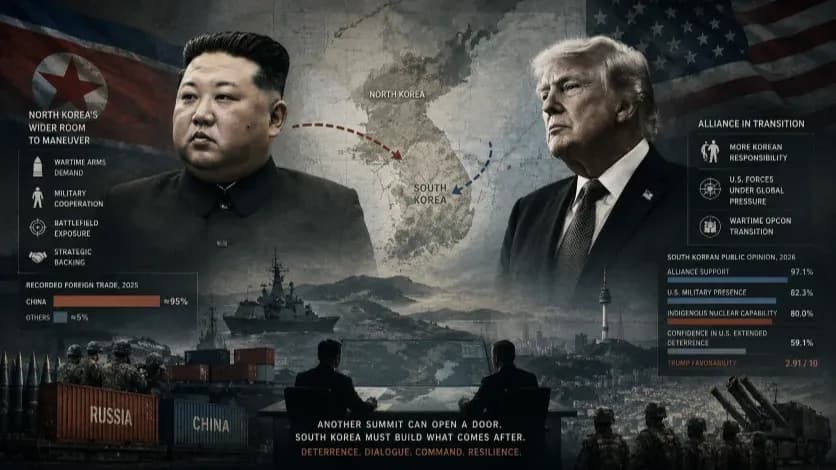
The Korean Peninsula Trump Is Returning To
Another Trump-Kim summit would unfold on a peninsula where North Korea is har...
 NewsAug 16, 2026
What Makes a North Korea Policy Survive a Change of Government?
From Kaesong to military agreements, South Korea’s history shows why some Nor...
More from the author
More from this byline
Stay with the same line of reporting through more work from this byline.
 NewsSep 16, 2026
Busan’s Young-Adult Migration Turns Sharply at 25–29
- NewsSep 1, 2026
What Lee Jae Myung Thinks a Minister Can Fix
Editorial Record
Corrections, sourcing notes and newsroom disclosures remain part of the published record. View Newsroom Notes →
Reader Signal
Community readWhat did this report leave you with?
Choose the signal that best reflects your reading. Select it again to remove it.
One response per article
No response selected
A moderated conversation about the reporting.
One-level replies and newsroom moderation keep the conversation anchored to this article.
Discussion Status
Open
Please sign in to join the discussion.
Newsletter
Weekly reporting and context from Busan and Korea.