The Apartment Nation Is Getting Old
South Korea’s aging apartment districts reveal the limits of a growth-era development model built on reconstruction, land-value gains and new-town expansion. From Seoul’s old complexes to Busan’s western new towns, the question is whether apartment cities can grow old without being erased.

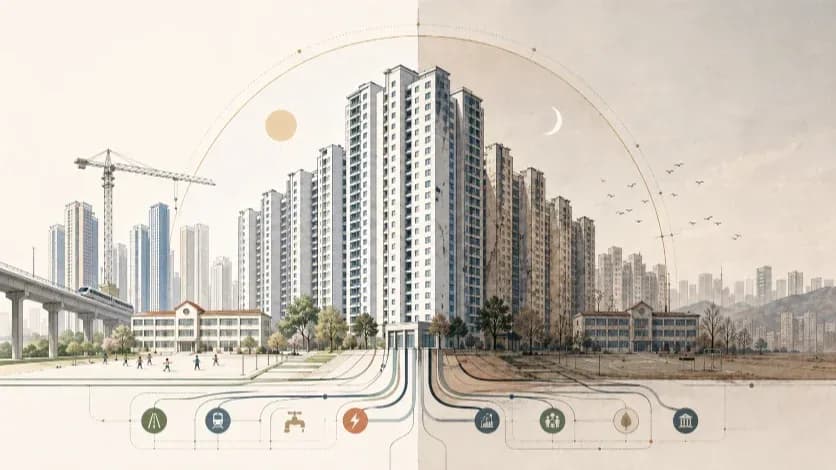
The apartment blocks that remade South Korea’s cities are beginning to show their age, even when their surfaces do not. Across the country, towers that once marked a family’s arrival into the middle class have been repainted, relandscaped and fitted with cleaner entrance halls, but behind the renewed façades lie aging pipes, elevators nearing replacement cycles, parking lots designed for a different era of car ownership, and management offices increasingly forced to ask residents for higher repair reserves.
For decades, those signs of aging were softened by one of the most powerful assumptions in Korean housing: an old apartment was not merely an old building, but a future reconstruction site. In the right location, deterioration did not necessarily reduce value; it could enhance expectation. A complex approaching 30 years of age could be read not as a long-term maintenance burden, but as land waiting to be reorganized into taller towers, more units and a new round of capital gains.
That expectation helped make the apartment Korea’s dominant housing form, but it also made the apartment carry more weight than any housing type reasonably should. It became a place to live, a savings vehicle, an inheritance plan, a school-district strategy, a retirement asset, a construction stimulus, a pre-sale financial product and a planning instrument for absorbing rapid urbanization. The arrangement matched the urgency of its time: standardized construction, large-scale land development, pre-sale finance and repeated apartment plans allowed the country to house millions, build a modern middle class and turn concrete towers into the most familiar landscape of urban Korea.
The system that built apartments so quickly is now being tested by the condition it rarely planned for: age. South Korea’s 2024 Population and Housing Census found that homes built at least 20 years earlier accounted for 54.9 percent of all housing units, while homes built at least 30 years earlier accounted for 28.0 percent. Even among apartments, the country’s defining housing type, 19.4 percent were already at least 30 years old.
The 30-year mark carries unusual weight in Korea’s apartment market. Buildings enter the political and financial language of reconstruction; residents, developers and local governments begin asking whether a complex should be repaired, remodeled or demolished. The old calculation is becoming less reliable as construction costs rise, financing tightens, residents age and regional housing markets weaken. Outside the most valuable districts, many aging complexes do not have the land value or market demand needed to turn demolition into profit, and the promise that old concrete will naturally become new capital is beginning to look less like a guarantee than a wager.
A quieter housing crisis sits behind Korea’s louder debates over prices, supply and affordability. The question is no longer only whether young people can buy homes, or whether Seoul can build enough apartments, but what happens when a country that treated reconstruction as the final chapter of apartment life discovers that many buildings may have to remain standing long after the economics of rebuilding have failed. Korea’s apartment crisis is not simply a problem of aging buildings. It is the crisis of a growth-era urban order that turned public infrastructure, household aspiration and rising land values into repeated cycles of construction — and now faces an older, smaller country that can no longer assume every aging district will become profitable redevelopment.
The machine that replaced the old city
The Korean apartment was not born as a lifestyle preference. It emerged as a machine for replacing an older city that industrialization had made inadequate. By the 1970s, factories, ports, offices and schools were pulling people into Seoul, Busan and other industrial centers faster than low-rise neighborhoods could absorb them. Much of the existing city had been built for another era: fewer cars, narrower streets, smaller shops, crowded rooms, informal settlements and infrastructure that lagged behind rising expectations for sanitation, heating and privacy.
The apartment offered a decisive contrast. It stacked households vertically, standardized construction, delivered modern utilities, bundled schools and playgrounds into planned districts, and turned housing supply into a repeatable collaboration among the state, builders, banks and buyers. The Housing Site Development Promotion Act was designed to promote residential stability and welfare by acquiring, developing and supplying housing sites for construction, creating the legal machinery for large-scale housing-site development.
The shift did more than improve housing conditions. Aging neighborhoods became redevelopment sites; low-rise districts became land reserves; public infrastructure became a way to unlock higher private land values. A KRIHS account of Korea’s urban policy history describes how housing and land-development laws in the late 1970s and 1980s institutionalized apartment-complex development and expanded redevelopment through large-scale clearance and private-public arrangements. The apartment did not merely house the modern city. It taught the city to solve decline through replacement.
The new towns of the late 1980s and 1990s scaled that grammar to the size of entire districts. Wider roads, planned schools, parks, commercial zones and apartment superblocks promised an escape from the disorder of the old city. The new towns did not break from the apartment order. They perfected it. Land was assembled, infrastructure installed, units sold and households moved in almost at once. Three decades later, the same synchronization has become a liability: buildings, schools, shopping areas, utilities and residents are aging together.
A conventional city ages unevenly. One street is renewed while another declines; one building is repaired while another is replaced; one generation arrives as another leaves. A planned apartment district ages as a system. Its physical stock, commuting pattern, school network, retail structure and first generation of residents reach a second cycle together. The problem is not simply old concrete. The original operating assumptions expire.
When old concrete no longer becomes new capital
For much of modern Korean housing history, reconstruction became part of the apartment life cycle itself. A complex was built, sold, occupied, aged and eventually reimagined as a redevelopment site. The expectation was financial as much as physical: old units would be exchanged for new ones, land would be used more intensively, additional apartments would be sold to outside buyers, and the gains would help pay for the transformation.
That logic was most persuasive where land value did much of the work. In expensive districts, particularly in parts of Seoul, the land beneath an aging apartment complex could be more valuable than the buildings standing on it. If planning rules allowed enough additional floor area, and future buyers were willing to pay high prices for new units, reconstruction could appear almost inevitable. Residents were not only homeowners. They were shareholders in a future project.
The case for reconstruction should not be dismissed. Old apartments often have real problems: poor insulation, deteriorating pipes, insufficient parking, outdated fire-safety systems, weak accessibility and layouts built for earlier household structures. Rebuilding can deliver safer buildings, better energy performance, more parking, new public facilities and additional homes in places where land is already urbanized. In strong markets, reconstruction may be a rational way to replace housing stock that would otherwise be expensive and difficult to upgrade.
The problem begins when reconstruction becomes the default language of urban policy. Demolition, relocation, financing and construction must be paid for before a new district exists. The reconstruction model begins to break when land value can no longer absorb the cost of rebuilding. Korea’s construction cost index reached 133.69 in February 2026, a record level cited in reporting based on Korea Institute of Civil Engineering and Building Technology data. Rising construction costs do not merely make new apartments more expensive. They weaken the economic engine that made reconstruction believable.
A complex can be old enough to require major repairs but not valuable enough to justify demolition. Its owners may have assets on paper but lack the cash flow to absorb large additional contributions. Its pipes, elevators, insulation, fire-safety systems and parking arrangements may need money now, while the future project remains financially uncertain.
The burden falls unevenly inside the same complex. Owners with savings, credit access or additional properties can wait through years of planning, litigation, relocation and revised cost estimates. Retired households living in the only home they own may not. Tenants live with the inconvenience of deterioration but rarely share in the redevelopment gains that justify the disruption. Small shops may serve the district’s daily life for decades, only to lose premises and customers during the construction cycle.
A city that relies on redevelopment to manage aging housing is outsourcing long-term maintenance to future market conditions. That approach can work when land values rise, demand expands and construction remains affordable. It becomes far less reliable when the population ages, regional growth diverges and the cost of rebuilding rises faster than the value that can be created. Under those conditions, reconstruction becomes selective: it rescues places where the market is strong enough and leaves weaker districts to manage decline with fewer tools.
Built for speed, not for old age
The weakness of Korea’s reconstruction-dependent housing system is not only financial. It is built into many apartments themselves.
Korean apartment complexes were often designed for efficient production before long-term adaptation. Standardized layouts, repeated floor plans, wall-bearing structures, vertically stacked utilities and tightly coordinated construction schedules allowed builders to deliver enormous numbers of units quickly. In the decades when the national problem was shortage, that efficiency mattered. The same qualities can make later change difficult.
The issue is not that a 30- or 40-year-old apartment is necessarily unsafe or unusable. Buildings in many countries last far longer. The more important distinction is whether a building was designed to be repaired, altered and upgraded without demolition becoming the most convenient answer. Pipes must be replaced, electrical systems upgraded, insulation improved, elevators renewed, accessibility added, parking reorganized and interiors adapted to smaller households and older residents. A building capable of absorbing those changes can grow old as part of the city. A building unable to absorb those changes becomes dependent on radical renewal.
Korea has long had a policy language for “long-life housing,” built around durability, variability and ease of repair. The Korea Real Estate Board describes long-life housing certification as a system for housing with structural durability, internal adaptability and repair convenience; the certification applies to apartment housing with more than 1,000 households after business-plan approval. Research on the certification system found that, as of September 2019, 99.81 percent of 647 certified cases had received only the general grade, with just one good-grade case. Korea developed the vocabulary of durable housing without making durability the default grammar of apartment construction.
The consequences are now becoming visible. A complex approaching 30 or 40 years is not only dealing with cosmetic deterioration. It is confronting the accumulated cost of a building system whose common facilities, mechanical systems and spatial assumptions were formed in a different era. Parking ratios that once seemed adequate no longer match car ownership. Unit layouts designed for larger nuclear families may not fit a society of smaller households, older residents and more diverse living arrangements. Entrances and public spaces may not serve aging bodies. Energy standards accepted decades ago now look inefficient.
The politics of repair becomes haunted by the promise of demolition. If residents believe reconstruction will come soon, spending heavily on pipes, elevators, insulation or accessibility can feel wasteful. If reconstruction is delayed or fails, deferred repairs become urgent and expensive. The older the building becomes, the more costly repair appears; the more costly repair appears, the more attractive reconstruction seems; the more attractive reconstruction seems, the easier it becomes to delay repair again.
A housing system built for first-cycle performance is now being asked to deliver second-cycle resilience. The first cycle rewarded speed, saleability and standardized construction. The second demands maintenance, adaptation, affordability and patience. Korea became exceptionally good at the first task. The second remains underdeveloped.
New towers, weak urban fabric
The limits of Korea’s apartment order extend beyond the buildings. A new apartment complex can look successful on the day it opens. The towers are clean, the landscaping manicured, the underground parking bright, the playgrounds new and the community facilities convenient. For buyers, the apartment is sold not only as a unit but as a managed environment: security, greenery, parking, childcare rooms, fitness centers and parcel delivery systems bundled into a private residential product.
A collection of successful residential products does not automatically make a successful city. The Korean apartment complex often performs well inwardly and poorly outwardly. Inside the boundary, it can provide order, privacy and amenities. At the edge, the same boundary can weaken street life, interrupt walking routes, separate housing from commerce and turn neighboring areas into spaces one passes through rather than places one inhabits.
Height is not the central problem. Tall buildings can support strong urban life when connected to active streets, mixed uses, transit, public space and fine-grained pedestrian networks. Isolation is the more important issue. Many apartment districts are organized around superblocks and self-contained complexes, with the meaningful life of the project turned inward. Ground floors are often separated from public streets by walls, landscaping, slopes, fences, parking ramps or internal roads. Shops are concentrated in designated commercial zones rather than woven into ordinary walking routes.
The older Korean city, for all its weaknesses, often had a denser everyday logic. Small shops sat below or beside homes. Markets, clinics, bus stops, schools and repair stores were embedded in short walking distances. Streets carried commerce as well as movement. Many such neighborhoods lacked parking, modern utilities and adequate housing quality, but they also contained an urban intimacy that the apartment complex has struggled to reproduce.
The new apartment district replaced that intimacy with separation. Housing moved into managed compounds. Commerce moved into planned strips or shopping centers. Roads widened to handle cars. Pedestrian routes became cleaner but less spontaneous. Public life was not eliminated, but rearranged into fewer, larger and more controlled spaces. The result was not simply a modern city. It was a city of residential islands connected by infrastructure.
Urban sustainability cannot be measured only by the age or energy performance of individual buildings. It also depends on whether a district can adapt as people age, household sizes change, work patterns shift, local businesses rise or fail, and mobility habits evolve. A neighborhood with many small connections can change incrementally. A superblock apartment district is harder to adjust. Its land uses are fixed in larger pieces. Its internal roads and pedestrian paths are governed by private or semi-private management. Its commercial life depends on designated zones.
Redevelopment can renew buildings while preserving the old urban weakness. If an aging new town is rebuilt mainly by replacing old apartment complexes with taller ones, the district may gain newer towers, larger parking structures and updated amenities while remaining dependent on long commutes, separated commercial zones, inward-facing complexes and limited street life. The physical stock is refreshed, but the operating system remains.
The growth machine meets a shrinking country
The old apartment bargain required growth. Public infrastructure raised land values; rising land values made reconstruction profitable; reconstruction produced new units; new units renewed household wealth and local construction activity. Housing supply, asset accumulation, municipal ambition and the construction economy moved in the same direction. A city could be judged by how much more could be built over it.
That bargain did not only produce homes. It produced a way of valuing the city. Roads, subway lines, schools, public parks and administrative services are collective investments, but their gains are often realized through private land and apartment ownership. Redevelopment then repackages those gains as branded towers, higher sale prices and reconstructed assets. The city creates the value; the apartment complex often captures it.
A shrinking and aging country cannot rely on the same arithmetic. Korea’s total fertility rate rose to 0.80 in 2025 from 0.75 in 2024, but the rate remained far below replacement level and deaths continued to outnumber births, leaving the country in natural population decline. Korea has also crossed deeper into a super-aged society: Ministry of the Interior and Safety figures cited in early 2026 put the population aged 65 or older at 10.84 million in 2025, or 21.21 percent of the total registered population.
Under those conditions, density can no longer mean only the number of units placed on a site. The more important measure is whether a district can keep a clinic, grocery store, bus route, school, care facility, park and street economy alive as households grow smaller and residents grow older. Growth-era density asked how many families could be housed on limited land. Aging-era density asks whether daily life remains viable when fewer children, older residents and weaker regional demand change the economics of services.
Apartment-led redevelopment has been far better at increasing floor area than at sustaining urban life. It can calculate additional units, future sale revenue, resident contributions and density incentives. It is less effective at asking whether a rebuilt district will support an older population, preserve affordable local services, reduce car dependence or maintain social life beyond the boundaries of a private complex. When reconstruction becomes urban policy, the city is valued less for how it works than for what can be built over it.
The OECD has begun to frame Korea’s demographic challenge as a spatial problem. Its 2025 work on shrinking regions describes a transition from growth-driven planning to more adaptive, place-based strategies and examines how spatial planning and housing policy can support urban regeneration, housing quality and more efficient land use. A separate OECD project on shrinking regions emphasizes smarter land use, better services and stronger governance for places facing population decline and aging.
The growth-era order leaves behind a difficult institutional habit. Local governments seek development because it promises tax revenue, jobs, political visibility and a temporary sense of momentum. Households seek apartments because ownership remains the safest claim on future urban value. Builders seek standardized projects because the market understands them. Even in places facing demographic decline, new development can appear attractive because it signals movement. The long-term costs arrive later: thinner settlement patterns, weakened older districts, higher infrastructure maintenance burdens and another generation of apartment stock that will age in turn.
Aging new towns, old redevelopment habits
The aging of Korea’s new towns makes the contradiction harder to avoid. The Special Act for the Maintenance and Support of Aging Planned Cities was designed around urban functions, settlement conditions and the transition to future cities, not simply around apartment reconstruction. Yet KRIHS found that, as of February 2026, the first five first-generation new towns with basic maintenance plans — Sanbon, Jungdong, Pyeongchon, Ilsan and Bundang — had designated 181 of 182 special planned maintenance zones as housing-complex maintenance types, leaving only one center-district maintenance type.
The numbers reveal the institutional pull of the old model. The law speaks the language of urban renewal; the plans are being written in the grammar of apartment reconstruction. A city-scale problem — aging infrastructure, changing demographics, weakened commercial functions, commuting dependence, public-service mismatch — is being filtered through the familiar project unit of the apartment complex.
Japan’s Tama New Town offers a warning, not a perfect analogy. KRIHS noted that Tama New Town, built in the 1970s as a large-scale apartment-housing complex, began facing serious aging-population issues in the late 1990s; Korea’s first-stage new towns had shown population decline since 2010 but, at the time of the study, still had lower aging rates and higher school-age populations than the Japanese case. The lesson is not that Korean new towns will mechanically repeat Japan’s path. The lesson is that a district built for young households can become organized around old age faster than its physical plan, commercial structure and public facilities can adapt.
Aging planned cities therefore require more than taller replacements for older towers. Streets, care facilities, retail structure, schools, transit, parks, energy systems and housing types have to be reconsidered together. A district does not become sustainable because its apartments become new again. It becomes sustainable when residents can age, move, shop, receive care, reach transit and remain socially connected without requiring the entire urban system to be erased and rebuilt.
Busan’s uneven apartment future
Busan is useful not because it is exceptional, but because several stages of Korea’s apartment order are visible in one city. Older central neighborhoods show the unresolved legacy of pre-apartment urbanization: narrow streets, aging low-rise housing, limited parking, weakened local commerce and an older population. Planned residential districts such as Haeundae’s apartment zones and Buk-gu’s Hwamyeong and Geumgok show the second cycle of the 1990s development order. Farther west, Myeongji and Eco Delta City show the continuing appeal of new apartment districts on newly organized land.
Busan’s aging apartment stock is no longer a distant issue. A Busan Ilbo report citing Real Estate R114’s analysis of the national apartment management information system found that 194,662 of Busan’s 815,502 apartment units were more than 30 years old as of June 2025, or 23.9 percent of the city’s apartment stock. The share had risen from 16.7 percent in December 2023.
Those numbers land differently in Busan than in Seoul’s strongest markets. In high-value parts of the capital, aging apartments may still be read as future redevelopment assets. In a regional city facing population decline, uneven demand and aging residents, an old apartment can more easily become a maintenance burden before it becomes a profitable project. Some complexes will attract reconstruction. Others will face slower decisions over repair reserves, partial upgrades, parking, elevators, fire safety and whether residents can afford the next phase of building life.
Haeundae offers one version of the question. Its coastal image can obscure the planned residential landscapes approaching middle age behind the postcard city. Renewal may bring new towers and higher density, but a skyline refreshed through reconstruction does not automatically solve mobility, public life, local services or affordability. Hwamyeong and Geumgok raise another question: can large apartment districts shaped by commuting and apartment-led planning support an older population and changing local commerce without treating reconstruction as the only serious form of improvement?
Myeongji and Eco Delta City press the issue forward. New apartment districts on Busan’s western edge are often presented as the future: planned, cleaner, greener and better suited to new industries and households. The harder question is whether those districts are breaking from the apartment development order or extending another cycle. A new district built around large complexes, separated land uses, car-dependent routines and buildings whose long-term adaptability is secondary to saleability does not solve the aging-apartment problem. It schedules the next version.
Busan’s question is not whether old districts can be replaced by new ones. Every new district eventually becomes an old district. The more urgent question is whether the city can stop using outward expansion and apartment replacement as substitutes for urban repair.
Demolition is not neutral
Redevelopment changes the skyline quickly, but it does not erase the cost of what it removes. Every apartment complex demolished for reconstruction carries with it the energy, concrete, steel, glass, labor and public infrastructure already invested in the building. When that material life is cut short after three or four decades, the loss is not only financial or sentimental. It is environmental.
The building and construction sector remains a major driver of climate pressure. UNEP’s 2024/2025 Global Status Report for Buildings and Construction states that the sector consumes 32 percent of global energy and contributes 34 percent of global CO₂ emissions; the sector also depends on cement and steel, materials responsible for a significant share of global emissions. Earlier UNEP reporting found that buildings were responsible for 34 percent of global energy demand and 37 percent of energy- and process-related CO₂ emissions in 2022.
A new apartment may perform better once occupied, especially if it has stronger insulation and more efficient systems. The operational improvement must still be weighed against the embodied carbon released by demolition and new construction. A city cannot call every new building sustainable simply because it is newer.
The reconstruction-dependent apartment model makes that accounting especially important. If an apartment is expected to be demolished after 30 or 40 years, the carbon cost of construction is spread over a shorter life. If similar buildings are repeatedly replaced in cycles of demolition and rebuilding, the city locks itself into a material rhythm that becomes difficult to reconcile with climate goals. Demolition will be necessary in some cases. Routine demolition as the default endpoint of apartment aging is a different proposition.
Beyond reconstruction
The answer to Korea’s aging apartment problem cannot be a simple rejection of reconstruction. Some buildings will have to be rebuilt. Some districts will need higher density. Some infrastructure will be too costly, unsafe or technically constrained to preserve. A serious housing policy cannot romanticize every aging complex as if repair were always cheaper, fairer or greener than demolition.
A serious urban policy, however, cannot continue treating reconstruction as the default answer to every form of aging. A structurally unsafe building is not the same as a repairable building with old pipes. A district with failing public infrastructure is not the same as a district whose apartments are merely approaching the age of redevelopment expectation. A high-demand complex in Seoul is not the same as a middle-income complex in a shrinking regional city. A new town with weak street life, changing school demand and aging residents is not simply a set of obsolete residential towers.
The first question should be what kind of aging is occurring. Structural safety, mechanical systems, energy performance, accessibility, parking, household change, commercial decline, weak transit, school mismatch and the loss of local services are different problems. Demolition may be the right answer in some places. In many others, repair, remodeling, selective rebuilding, energy retrofits, senior-friendly access, district-level commercial adjustment and public-space repair will matter more than another full construction cycle.
Making repair credible requires treating pipes, elevators, electrical systems, fire safety, insulation, accessibility and common spaces as long-term housing infrastructure rather than private inconveniences postponed until redevelopment. Repair reserves must become more realistic, but older and lower-income owners cannot be left to carry the entire cost of decades of deferred maintenance alone. Public financing, low-interest loans, targeted subsidies and transparent building assessments will be needed if aging complexes are to remain livable without waiting for demolition.
New construction requires a different standard as well. Long-life housing cannot remain a marginal certification category satisfied at the lowest level. Durability, accessible service shafts, replaceable systems, adaptable interiors, energy-retrofit capacity and realistic maintenance planning should become core expectations of apartment development, especially in large complexes and new towns. A building designed only for its first sales cycle is not sustainable, no matter how green its marketing language appears.
At the district scale, aging new towns need plans that begin with daily life rather than floor area. Older residents need walkable access to clinics, groceries, transit and care. Children need safe routes that do not depend on being driven everywhere. Local shops need construction phasing and rent structures that allow survival, not merely replacement retail space after redevelopment. Public infrastructure needs to be upgraded in sequence with housing, not treated as an afterthought to density incentives.
The same standard should apply to new apartment districts now being built for younger households. Large new towns often attract residents at similar life stages: newly married couples, families with small children and first-time buyers seeking newer apartments at prices lower than older central districts. Early success can be highly visible — crowded playgrounds, new schools, active academies, pediatric clinics and a noticeable influx of young families. Yet the same concentration creates a demographic trap. A district that imports one generation at once will eventually age one generation at once.
Schools make that trap visible. Across Korea, declining births are already closing schools, while new apartment districts continue to demand new classrooms. More than 4,000 schools have closed nationwide as the school-age population shrinks, and hundreds of closed school sites remain unused. At the same time, Busan’s western new-town districts, including Myeongji and Eco Delta City, are receiving new schools and transit support to relieve overcrowding and long commutes. The contradiction is not accidental. It is the spatial expression of Korea’s demographic imbalance: children are disappearing from some neighborhoods while being concentrated in others.
The school system in a new town often follows the first generation of residents like a wave. Elementary demand arrives first, followed by middle and high school pressure as the first children grow older. After that wave passes, the same facilities may face declining enrollment, while the district begins to need more clinics, care services, accessible streets and everyday support for older residents. School buildings, public facilities and commercial streets cannot easily move when the wave has passed.
Japan’s Tama New Town offers a warning. Built during a period of metropolitan growth to house young households outside Tokyo, the district later became a symbol of aging suburban new towns, where the built environment, population structure and public services struggled to adapt after the first generation aged. Korea’s first-generation new towns and newer apartment districts are not identical to Tama, but the underlying risk is similar: a district built around young families can become organized around old age faster than its schools, shops and public facilities can change.
The affordability of a new town is also less stable than it first appears. Lower entry prices may help young households leave older or more expensive districts, but commuting costs, car dependence, delayed services and weak local employment can shift the burden into daily life. If the district succeeds, public infrastructure and school reputation may be capitalized into apartment prices, reducing the affordability that justified the development in the first place. If the district struggles, residents inherit the cost of distance, thin services and future maintenance.
Busan’s western expansion makes the question concrete. New apartment districts may bring young households into Myeongji, Eco Delta City and other planned areas, but the same movement can deepen the age sorting of the city: older residents remaining in older neighborhoods, younger families clustering in new towns, and each district facing a different kind of future decline. The old city becomes older faster, while the new district begins a cycle that may produce its own synchronized aging decades later.
A durable urban policy would therefore judge new districts not only by how many apartments, schools and roads are delivered at the beginning of development, but by whether the district can change after its first demographic wave passes. School sites should be planned with future conversion in mind. Commercial zones should be able to shift from child-oriented services to care, health, culture, work and daily retail. Streets should be useful for people who cannot or do not drive. Housing types should allow more than one family model to remain in the district. Public infrastructure should be designed for adaptation, not only initial occupation.
The alternative to reconstruction is not stagnation. It is stewardship: the work of keeping buildings useful, districts connected and residents in place when the first cycle of development value has passed. Stewardship is slower than construction and less visible than a new skyline, but an aging country will be judged less by how quickly it can produce new districts than by whether older districts can remain habitable, mixed and socially alive.
In an aging apartment complex, the future is not only written in redevelopment renderings. It is written on the notice board: elevator inspections, pipe repairs, parking rules, reserve-fund meetings, fire-safety checks, school zoning debates, shop closures, resident votes. Those ordinary notices are where Korea’s apartment future is already being negotiated. Not in the promise of the next tower, but in the harder question of whether the tower, the street, the school and the neighborhood already standing can be made to last.
The apartment nation does not need another promise of endless reconstruction. It needs a way to grow old without sorting generations into separate districts, hollowing out older neighborhoods and repeating the same construction cycle on the urban edge. Korea’s next urban test is not whether it can build another new town for young families. It is whether that town can still function when those families age, when their children leave, and when the first promise of newness has worn off.
Continue this reporting
Reporting on the same issue
Related coverage selected from the article's desk, topics and newsroom relationships.
 NewsSep 18, 2026
The Other AI Race Is for the Freedom to Change Course
Korea’s HBM strength gives it unusual leverage inside the AI stack. The harde...
 NewsAug 27, 2026
South Korea Has Outgrown Washington’s Nuclear Rules
The U.S. once constrained South Korea’s nuclear fuel cycle over real prolifer...
 NewsAug 7, 2026
North Port’s New Ministry and the Unfinished Work of Busan’s Old Downtown
Busan has secured a permanent center of national maritime administration at N...
More from the author
More from this byline
Stay with the same line of reporting through more work from this byline.
- NewsSep 18, 2026
The Other AI Race Is for the Freedom to Change Course
 NewsSep 5, 2026
How a Political Appointment Becomes a Judgment of Character
Editorial Record
Corrections, sourcing notes and newsroom disclosures remain part of the published record. View Newsroom Notes →
Reader Signal
Community readWhat did this report leave you with?
Choose the signal that best reflects your reading. Select it again to remove it.
One response per article
No response selected
A moderated conversation about the reporting.
One-level replies and newsroom moderation keep the conversation anchored to this article.
Discussion Status
Open
Please sign in to join the discussion.
Newsletter
Weekly reporting and context from Busan and Korea.