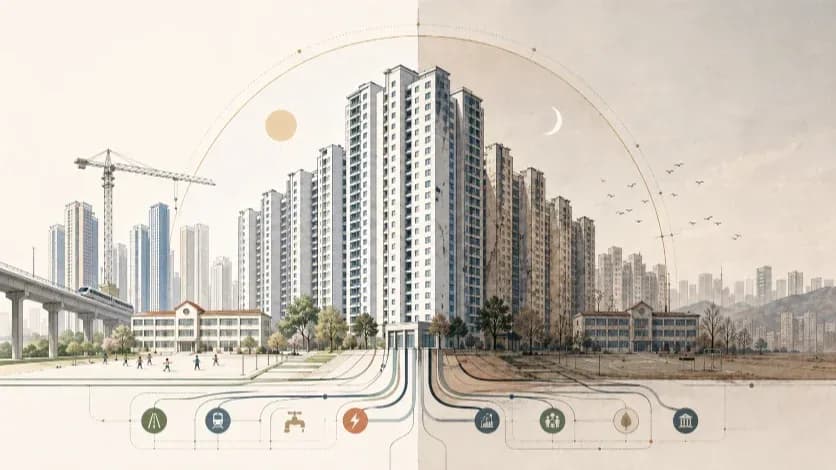
Can Classical Separation of Powers Still Explain South Korea’s Modern State?
South Korea’s 2026 legal reforms do more than curb prosecutorial power. Changes to criminal investigation, constitutional complaint, and the Supreme Court together reveal a deeper constitutional strain: the modern state no longer fits neatly inside the old three-branch model.


South Korea’s latest legal reforms were introduced as targeted corrections to specific institutional failures. One set of bills would complete the long effort to strip prosecutors of their old dominance over major-crime investigation by moving that function into a separate agency and narrowing the prosecution around public charging and legal review. Another reform, already in force, opens constitutional complaints against finalized court judgments, cutting into a boundary that had long shielded the judiciary from this form of review. A third change expands the Supreme Court itself over the coming years. Considered separately, each measure belongs to a familiar domestic debate. Considered together, they suggest something larger. South Korea is no longer merely revising one institution at a time. It is exposing the growing strain between a modern state and the older constitutional map through which that state still claims to govern.
That strain is no longer easy to miss. Under the revised prosecutorial framework finalized on March 17, prosecutors are being pushed further away from the command position they once occupied at the center of criminal procedure. The structure taking shape ahead of the October 2 transition separates the power to build a major-crime case from the power to sustain it in court, while narrowing prosecutorial intervention in ongoing investigations. At nearly the same moment, the Constitutional Court began operating under new rules that allow challenges to finalized judgments, unsettling the long-settled assumption that judicial finality ended within the judiciary itself. And with the National Assembly having passed a law to expand the Supreme Court from 14 to 26 justices beginning in 2028, the composition of judicial authority has entered the same national argument over how public power should be distributed, supervised, and legitimized.
This is why the familiar frame of prosecutorial reform is no longer large enough to contain the moment. For years, South Korea’s legal politics could be told through the excesses of a single institution: a prosecution service that investigated, indicted, filtered evidence, shaped political tempo, and exercised influence over a case before it ever reached open court. That history still matters. But once prosecutors are recast as something closer to public litigators than investigative masters, the deeper problem comes into view. The question is no longer only how to cut back one powerful office. It is whether the old tripartite grammar of legislature, executive, and judiciary still adequately describes where public authority now actually sits in a democracy governed through specialized agencies, constitutional review, hybrid institutions, and courts increasingly asked to absorb conflicts that politics has failed to settle.
That question lands with unusual force in South Korea because the Constitution remains both indispensable and overburdened. It still performs the essential work constitutions are meant to perform: protecting rights, defining legitimate authority, and setting legal limits on arbitrary power. Yet constitutional orders begin to stiffen when too many unresolved disputes over institutional design, political conflict, and democratic trust are pushed upward into constitutional language and downward into adjudication. South Korea’s 2026 reforms make that tension visible in concrete form. Prosecutors are losing their old grip on investigation. Courts are being drawn into a new cycle of constitutional exposure. The legal system is not simply being liberalized or fragmented. It is being forced to confront whether an inherited constitutional design can still organize a state whose real centers of power no longer fit neatly inside the categories that design presumes.
What Is Actually Changing in 2026
What is changing in South Korea in 2026 is not simply the size of the prosecution’s authority, but its location within the legal order. Under the revised framework released in March, prosecutors are being moved away from the institutional position that made them singular in the Korean system for decades. Their power did not rest only on the ability to indict. It rested on the ability to stand upstream from the case itself — to know early, intervene early, shape the evidentiary record early, and exercise influence before the matter ever reached open court. The proposed architecture begins to dismantle that position. Major-crime investigation is to be vested in a separate Serious Crimes Investigation Agency, while the prosecution is reorganized around public charging and legal review under a new prosecutorial structure tied to the October 2 transition.
That shift matters because criminal procedure is not merely a set of formal powers. It is also a sequence of institutional vantage points. Whoever sees the case first often shapes the case most decisively. In the older model, prosecutors were not just the state’s accusers. They were often in a position to supervise the early development of the file, influence whether an inquiry deepened or stalled, and impose legal direction before the evidentiary record had fully hardened. The revised plan aims to narrow that role. The March 17 final draft removed some of the most controversial residual powers that would have allowed prosecutors to intervene more aggressively in ongoing investigations, including provisions that critics said risked reproducing command authority by other means. The result is not the disappearance of prosecutorial power, but its compression into a later stage of the process, after facts have been assembled elsewhere.
In practical terms, this means the prosecution is being recast less as the institution that makes the case and more as the institution that tests whether the case can survive public adjudication. That is a narrower role, but not a trivial one. It places greater emphasis on legal sufficiency, evidentiary admissibility, and the discipline required to convert a fact pattern into a charge that can withstand trial. Yet it also means that prosecutors will no longer occupy the same command position over the investigative tempo of politically sensitive or complex criminal matters. A system once organized around vertical supervision is being redesigned around institutional separation and delayed legal review. Whether that produces cleaner accountability or more procedural friction is one of the central questions of the reform.
The judicial side of the legal order is shifting at the same time. With the amendment to the Constitutional Court Act taking effect on March 12, finalized court judgments are no longer insulated in the same way from constitutional complaint. This does not merely create another procedural avenue for disappointed litigants. It unsettles an old boundary in Korean public law: the idea that the finality of adjudication ended within the judiciary itself. Constitutional review is now positioned to reach further into the life of an already decided case, and that change carries both promise and risk. Supporters see it as a long-delayed expansion of rights protection. Critics see the possibility of a quasi-fourth-instance system that could weaken finality and intensify institutional tension between ordinary courts and the Constitutional Court. Either way, the reform marks a clear redistribution of legal authority rather than a technical adjustment at the margins.
The pending expansion of the Supreme Court belongs to the same story. On paper, increasing the bench from 14 to 26 justices beginning in 2028 can be framed as a response to caseload pressure and the need for broader judicial capacity. But in constitutional terms, it also reopens a more sensitive question: how quickly the composition of judicial authority itself can be reshaped in a polarized democracy. Court size is never just an administrative matter. It affects internal deliberation, institutional voice, and the pace at which interpretive authority may change. That is why the reform cannot be treated as a separate personnel issue detached from the wider legal restructuring now underway. When prosecution is narrowed, constitutional review is widened, and the apex court is enlarged within the same cycle of reform, the state is not merely recalibrating legal procedure. It is revising the channels through which coercive power, legal judgment, and constitutional legitimacy are distributed.
Taken together, the 2026 reforms are altering three distinct points in the life of public power. They change who builds the case, who certifies its legal sufficiency, and who gets the last word after judgment. That is why the usual vocabulary of piecemeal reform is no longer enough. These are not isolated amendments to investigation, prosecution, and appeal. They amount to a reordering of the institutional sequence through which the Korean state investigates, accuses, adjudicates, and constitutionally justifies its own use of power.
The Old Story No Longer Covers the Whole System
For years, South Korea’s legal reform debate was told as a story about one institution. The prosecution stood at the center of it because so much of the system had been built to pass through it. A major case did not simply end there in the form of indictment. It often began there in practical terms — in the early handling of evidence, in decisions over whether an inquiry would deepen or stall, in the quiet legal shaping of a record before it ever became visible in court. That was why every fight over legal reform eventually returned to the same point. Too much of the state’s coercive power had been allowed to gather in one office.
That account still explains an important part of the Korean system. It no longer explains enough of it. Once prosecutors are moved out of the upstream construction of major-crime cases, the old argument begins to narrow. The problem is no longer exhausted by the question of how to cut back one powerful institution. What comes into view instead is the larger design problem that institution had long obscured. Power in the modern state is no longer exercised only through the clean sequence imagined by classical constitutional doctrine — legislation first, administration second, adjudication last. It moves through specialized agencies, overlapping review bodies, constitutional procedures, and institutions whose authority is decisive even when their place in the old three-branch order is not.
That is what gives the current reform cycle its significance. The prosecution is being reduced, but the state is not becoming simpler. An investigative function removed from prosecutors does not vanish; it reappears elsewhere, carrying many of the same questions about coercion, discretion, and accountability. Judicial finality, once treated as largely self-contained within the ordinary court system, is now being reopened to constitutional complaint. And the Supreme Court itself is being drawn into a live argument over the scale and composition of judicial authority. These are not separate episodes loosely grouped under the heading of institutional reform. They are signs that authority is being redistributed across a legal order whose formal vocabulary has changed far less than its actual operation.
The familiar language of prosecutorial reform is therefore no longer quite adequate to the moment. It describes the first conflict well: how to break the concentration of investigative and accusatory power that had accumulated inside the prosecution. It does not fully describe the second conflict now emerging in its wake: how a constitutional democracy is supposed to govern institutions that are powerful, specialized, and not easily contained within the older geometry of legislature, executive, and judiciary. South Korea is still using that geometry to describe the state. The reforms of 2026 suggest that the state now operates through something more complicated.
What is being exposed, then, is not only prosecutorial excess but constitutional lag. The legal order still presents itself through inherited categories that once helped restrain power by separating it. Yet the most consequential public authority now often sits in institutions that blur those lines rather than obey them. The prosecution was the most visible example of that older distortion. The present reforms show it was not the only one.
The State No Longer Fits the Old Constitutional Diagram
The classical language of separated powers still carries enormous force in constitutional democracies because it names a basic political instinct that remains sound: power should not be allowed to gather unchecked in one place. Legislatures make law, executives administer it, courts interpret and apply it. The formula is familiar not because it is merely old, but because it still expresses an indispensable warning against concentration. South Korea’s current reforms do not invalidate that warning. What they expose is something more unsettling. The warning has survived more easily than the diagram built to enforce it.
That gap is visible across the present reform cycle. A major-crimes investigative body may sit within the executive branch in formal terms, yet the power it exercises is not reducible to ordinary administration. It gathers evidence, builds coercive cases, and makes decisions that can alter the legal and political fate of individuals long before a courtroom becomes involved. The prosecution, meanwhile, is being narrowed toward public charging and legal scrutiny, but that does not make it simply another bureau within the executive hierarchy. Its authority still turns on judgment, legal sufficiency, and the state’s decision to speak in the language of accusation. On the judicial side, constitutional review is reaching more deeply into what had once been treated as the judiciary’s own final domain. The system still describes these powers through inherited branch categories. The actual work of governing has already become harder to fit inside them.
This is the point at which the old constitutional picture begins to flatten reality rather than clarify it. In the classical account, public authority moves in a legible sequence: law is made, then executed, then judged. But the institutions now at the center of South Korea’s legal order do not operate in that clean temporal line. Investigative bodies exercise discretion before adjudication yet shape the legal world that adjudication will later inhabit. Prosecutors may no longer dominate investigation, but they still determine whether the evidentiary record assembled elsewhere can be converted into a public case. Constitutional review now reaches back into judgments once thought final, altering the old settlement between ordinary courts and the Constitutional Court. None of these functions is illegible. What has become unstable is the assumption that they can still be fully understood through the older constitutional geometry alone.
That instability matters because constitutional diagrams do more than classify institutions. They teach a society where to look for danger and where to expect accountability. If public debate still assumes that power is primarily concentrated in the traditional branches, it risks misreading the places where authority now accumulates in practice: in specialized agencies, in procedural gateways, in review bodies, and in institutions whose formal location tells only part of the story of what they do. South Korea’s long fixation on the prosecution made sense in precisely those terms. The prosecution had become the most visible site where legal authority overflowed its traditional container. The reforms now underway suggest that the overflow was never confined to that office alone.
This is why the present moment should not be read as a simple triumph of institutional dispersal. Breaking up concentrated authority is one constitutional task. Making sense of the institutions that emerge afterward is another. A state that fragments power without revising the concepts through which that power is understood may reduce one monopoly only to create a more opaque order in its place. South Korea’s reforms are forcing that problem into view. The country is not stepping outside constitutionalism. It is running up against the limits of a constitutional design whose categories remain authoritative even as the state itself has outgrown their original boundaries.
Judicial Reform and the Migration of Political Conflict
If prosecutorial reform is the most visible effort to break up concentrated power in South Korea’s legal order, judicial reform is where the consequences of that effort begin to settle. Power withdrawn from one institution does not disappear. In constitutional democracies, it tends to move — and it often moves toward the bodies asked to supply finality, legitimacy, and closure when politics has failed to do so. That is why the current reform cycle cannot be read as a story about prosecutors alone. As the prosecution is pushed away from its old command position over investigation, the judiciary is being drawn more deeply into the work of absorbing conflict that no longer ends where it once did.
The most immediate example is the new constitutional complaint procedure against finalized court judgments. When the amended Constitutional Court Act took effect on March 12, it did more than add one more procedural remedy for litigants who had exhausted the ordinary courts. It reopened a line that had long been treated as settled in Korean public law: the idea that judicial finality was, in practical terms, final within the judiciary itself. Under the new rules, finalized rulings can now be challenged on constitutional grounds in limited circumstances, including clear infringements of fundamental rights and departures from prior Constitutional Court doctrine. Supporters describe that as a long-delayed correction to a blind spot in Korean constitutional justice. Critics describe it as the beginning of a quasi-fourth-instance system that could weaken the authority of ordinary courts and prolong already overburdened litigation. The significance of the change lies in neither slogan alone. It lies in the fact that the judiciary is no longer the sole custodian of its own ending.
The speed of the early response underlines that point. Within days of implementation, dozens of constitutional complaints against court judgments had already been filed, a sign that the reform did not create a merely symbolic channel but activated a latent demand for review beyond the ordinary hierarchy of appeals. That matters not simply because more cases may now reach the Constitutional Court, but because it changes the psychological structure of adjudication itself. Once final judgments are understood to remain constitutionally vulnerable, the legal system begins to operate under a different sense of closure. Finality survives, but under pressure. And whenever finality comes under pressure, so does the authority of the institution that once embodied it.
The controversy over expanding the Supreme Court belongs to the same migration of pressure. On its face, the law passed in late February increasing the number of justices from 14 to 26 beginning in 2028 can be defended in familiar administrative terms: caseload, efficiency, capacity, breadth of review. But court size is never only a technical matter in a polarized democracy. It also determines how quickly judicial authority can be reshaped, how interpretive influence is distributed within the bench, and how visibly political power reaches into the composition of the court itself. That is why the fight over numbers has been inseparable from a deeper fight over legitimacy. A larger Supreme Court may promise greater capacity. It may also intensify suspicion that the judiciary is being structurally reset through ordinary legislation rather than through slower institutional evolution.
Seen together, these reforms suggest that South Korea’s judiciary is entering a different constitutional role. For years, the dominant anxiety in legal politics centered on the prosecution — the institution that could influence whether a case advanced, stalled, or changed character before reaching trial. That anxiety has not disappeared. But as prosecutors are pushed back, the courts are becoming the place where unresolved questions of legitimacy, rights, and institutional trust will increasingly land. The ordinary judiciary is being asked to retain authority while sharing finality with constitutional review. The apex court is being enlarged even as its symbolic independence becomes more contested. The bench is not simply being reformed. It is being repositioned as the next arena in which democratic conflict is processed through legal form.
This does not mean that South Korea is drifting toward rule by judges in any simple sense. The more precise point is narrower and more troubling. When elected institutions repeatedly fail to settle foundational disputes, they do not leave those disputes unresolved in practice. They relocate them. Some are moved into investigation, some into prosecution, and some — increasingly now — into courts and constitutional review. The present cycle of reform may therefore be remembered not only for breaking the prosecution’s old monopoly over criminal power, but also for accelerating the transfer of political conflict into judicial institutions already being asked to carry more than adjudication alone.
The Constitution Has Become the Place Where Too Much Must Be Settled
The latest reform cycle is not only redistributing legal authority. It is showing how much of South Korea’s unresolved institutional conflict now has to be carried in constitutional form. The prosecution is no longer being debated only as a matter of criminal procedure. The argument has widened into questions about where investigative power should sit, how far constitutional review should reach into final judgments, and how quickly the authority of the apex court itself may be reshaped by statute. These are not isolated design disputes. They are signs of a system in which too many of the hardest arguments about public power now have to be settled at, or near, the constitutional level.
That development should not be mistaken for the decline of constitutionalism. It is closer to its expansion under pressure. The Constitution still performs the work no democratic system can do without. It protects rights, marks the limits of arbitrary authority, and supplies the legal terms in which the state can be challenged by those it governs. But constitutional orders begin to stiffen when they are asked to absorb too much of the work that politics no longer resolves effectively on its own. Once struggles over institutional design, procedural legitimacy, and the distribution of public power are repeatedly pulled into constitutional language, the Constitution ceases to function only as a framework of fundamentals. It becomes the site where an increasing share of ordinary political failure is processed in elevated legal form.
That is the deeper pattern visible in South Korea’s current reforms. A dispute that began with prosecutorial concentration has not ended with the narrowing of prosecutorial power. It has spread outward. It now reaches the design of the agency that will inherit coercive investigative authority, the terms on which prosecutors may still test the legal sufficiency of a case, the degree to which judicial finality should remain insulated from constitutional challenge, and the question of how the Supreme Court itself may be reconstituted. Each issue can be described in technical legal terms. Together, they amount to something more revealing: the state is relying ever more heavily on constitutional and quasi-constitutional mechanisms to do the stabilizing work that ordinary politics has proved unable to complete.
That reliance has consequences. The more structural conflict is constitutionalized, the harder it becomes to distinguish between what must be entrenched and what ought to remain open to democratic revision. The more politically charged disagreement is routed into judicial and constitutional procedure, the more courts and review bodies inherit burdens that are legal in form but not only legal in substance. And the more often elected institutions defer their deepest conflicts into adjudicative channels, the less capable ordinary politics becomes of performing its own settling function. The result is not that politics disappears. It is that politics returns in legal costume, carrying all the same stakes under a different grammar.
This is why the present moment cannot be described simply as a victory for rights, or as a healthy correction of old institutional abuses, though it contains elements of both. It is also a sign of constitutional overload. The Constitution is being asked to remain a charter of rights, a limit on public coercion, a vocabulary of legitimacy, and increasingly a structural repair mechanism for institutions that no longer fit comfortably inside the categories through which the constitutional order still describes them. That is a great deal for any constitutional system to carry. South Korea’s current reforms make visible just how much of that burden has already shifted there.
The question, then, is not whether constitutionalism remains necessary. It plainly does. The question is whether too much of the country’s institutional adaptation is now taking place only once conflict has risen to a constitutional register. A democratic system that repeatedly needs constitutional complaint, judicial restructuring, and legally mediated redesign in order to adjust its own basic architecture is a system revealing something more than reformist ambition. It is revealing how narrow the space for ordinary political adjustment has become.
Accountability Versus Governability
Every major reform in South Korea’s current legal cycle is being justified in the language of dispersed power. That is not incidental. It is the animating promise of the moment. Prosecutors are to lose the command position that once allowed too much of a criminal case to pass through one office. Investigative authority is to be housed separately. Final court judgments are no longer to remain wholly insulated from constitutional complaint. The Supreme Court itself is to be enlarged rather than left untouched as a fixed institutional summit. At every point, the argument is the same: concentrated power must be broken up if public authority is to become more accountable.
That argument has real force because it answers a real history. South Korea did not arrive at this moment by accident. It arrived here through repeated experience with institutions that were too internally insulated, too vertically organized, or too capable of converting procedural advantage into practical dominance. In that sense, dispersion is not an abstract constitutional taste. It is a response to the accumulated suspicion that authority left too concentrated will eventually begin to govern in the dark. The effort to divide investigative power from prosecutorial judgment, to expose final judgments to constitutional challenge, and to reopen the structure of the apex court all draw legitimacy from that same instinct: no institution should be trusted simply because its formal place in the legal order once seemed secure.
But dispersed power is never costless. It is one thing to weaken a monopoly. It is another to build a system in which fragmented authority can still act with coherence, clarity, and speed. A prosecutor removed from the upstream construction of a case may be less capable of dominating the process, but also less capable of imposing unity on a complex record assembled elsewhere. An investigative body separated from the prosecution may be more insulated from legal interference at the outset, but it may also produce new friction when the case reaches the stage at which evidence must be converted into a charge that can survive trial. A constitutional complaint against a finalized judgment may deepen rights protection, but it can also place greater pressure on finality, extend litigation horizons, and draw more institutional weight toward review after adjudication rather than settlement before it. The Supreme Court may gain capacity through expansion, yet the very process of enlargement may sharpen public suspicion that judicial authority is being reorganized through politics even while being defended in the language of reform.
This is the tension the current reform cycle cannot escape. Accountability and governability do not always move in tandem. A system can become more transparent and less legible at the same time. It can make power harder to monopolize while also making responsibility harder to trace. It can multiply checks without guaranteeing institutional cooperation. Indeed, one of the risks of the new legal order taking shape in South Korea is that the country may succeed in breaking the old concentration of authority only to find itself governed through a denser field of overlap, delay, and mutual deflection. The prosecution may no longer dominate. That does not mean the state will automatically become easier to trust. It may simply become harder to read.
That danger should not be overstated, but it should not be ignored either. Constitutional democracies often discover, after the breakup of a dominant institution, that legitimacy cannot be produced by fragmentation alone. It must also be produced by intelligibility. Citizens need to know not only that power has been divided, but who now holds which part of it, who answers for failure, and where a case, a conflict, or a constitutional wrong is ultimately supposed to end. When those lines become too blurred, accountability begins to lose one of its practical conditions. A public cannot effectively supervise what it can no longer clearly locate.
That is why the deepest challenge in South Korea’s reform moment is not simply to weaken institutions that once held too much power. It is to construct a legal order in which dispersed authority remains governable, and in which governability does not become a pretext for rebuilding concentration under a different name. That is a harder task than reform rhetoric usually admits. It requires more than breaking up the prosecution, more than opening new channels of constitutional review, more than enlarging the bench. It requires an institutional design capable of distributing power without dissolving responsibility. The success of the current reforms will be measured not only by whether they restrain old monopolies, but by whether they leave behind a state that can still act, decide, and be understood under democratic conditions.
In that respect, the present reforms point beyond the legal sector that first gave rise to them. They pose a broader question for the modern state itself. How much fragmentation can a constitutional democracy absorb before it begins to trade one danger for another — replacing concentrated authority with a procedural maze in which no institution fully owns the outcome, and every institution can claim merely to have reviewed, transferred, narrowed, or delayed it? South Korea’s reforms do not yet answer that question. They place the country squarely inside it.
Not Abolition, but Redesign
The point, then, is not that South Korea has outgrown constitutionalism, or that the separation of powers has somehow become irrelevant to democratic government. The deeper problem is narrower and more serious than that. The classical architecture still names an enduring constitutional instinct: power must be divided if it is not to become arbitrary. What no longer holds as securely is the assumption that this instinct can still be fully expressed through the old institutional picture alone. A state now governed through specialized investigative bodies, expanded constitutional review, an increasingly contested judiciary, and overlapping sites of legal authority cannot be adequately understood by repeating the old diagram more forcefully. It has to be redescribed before it can be properly governed.
That is what makes the current reform cycle more consequential than its individual components. On the surface, the country is revising prosecution, adjusting constitutional complaint, and enlarging its highest court. At a deeper level, it is confronting the limits of a constitutional vocabulary that still presumes a cleaner distribution of public authority than the modern state can now sustain in practice. The prosecution is no longer meant to dominate the making of a case. The judiciary is no longer left entirely to police the finality of its own judgments. The apex court is no longer treated as an institutional constant beyond structural revision. Each development can be defended on its own terms. Together, they reveal a legal order being forced to revise not only its institutions, but the categories through which those institutions have long been understood.
If there is a constitutional lesson in this moment, it is not that limits on power matter less than they once did. It is that the form of those limits can no longer be assumed in advance. For too long, South Korea’s legal politics were able to treat institutional reform as a matter of correcting excess within one office at a time — first the prosecution, then the courts, then some other site of concentrated authority. The current moment is harder to contain that way because it reveals a problem that runs beneath all of those disputes. The issue is not only where power has become too strong. It is whether the state’s inherited design still makes power visible in the places where it now actually accumulates.
That is why the language of abolition is too crude for the task ahead. South Korea does not need less constitutional restraint. It needs a more accurate constitutional account of the institutions through which restraint must now operate. It does not need to abandon the separation of powers as a democratic principle. It needs to recognize that the old tripartite grammar no longer captures the full circuitry of public authority in a state shaped by independent agencies, judicialized conflict, constitutional complaint, and institutional mistrust. The challenge is no longer to defend the old map out of habit, or to discard it out of impatience. It is to redesign the legal order so that dispersed power remains intelligible, reviewable, and politically answerable under modern conditions.
That work will not be finished by the reforms of 2026, and it may not even be made easier by them in the short term. Breaking up concentrated authority often leaves behind a more difficult question than the one it resolves: what kind of state emerges after monopoly is dismantled, and by what concepts can that state still be understood? South Korea has now entered that question in earnest. The significance of the present reforms lies not only in what they take away from old institutions, but in what they disclose about the constitutional order itself. The country is no longer simply arguing about prosecutors, or even about judges. It is confronting the widening distance between an inherited structure of government and the more complex state that has already come into being beneath it.
In that sense, the most important question left by the current cycle of reform is not whether one institution has finally been cut down to size. It is whether South Korea can build a constitutional order capable of matching the state it already has: one in which power is less concentrated, but also less neatly contained; more distributed, but not necessarily more legible; more accountable in aspiration, but still in search of a structure through which accountability can be made durable. The reforms of 2026 do not settle that question. They make it unavoidable.
Editorial Context
"Independent journalism relies on radical transparency. View our full log of editorial notes, corrections, and project dispatches in the Newsroom Transparency Log."
Reader Pulse
The report's impact signal
Be the first to provide a reading pulse. These collective signals help our newsroom understand the impact of our reporting.
Join the discussion
A more thoughtful conversation, anchored to the story
Atlantic-style discussion for this article. One-level replies, editor prompts, and moderation-first participation are now powered directly by Prisma.
Discussion Status
Open
Please sign in to join the discussion.
The Weekly Breeze
Independent reporting and analysis on Busan,
Korea, and the broader regional economy.