When Eating Alone Becomes the City’s Problem
The university cafeterias of Busan have shown that cheap meals can restore everyday eating habits. What remains unclear is how a city built around solitary living can sustain those habits outside campus walls.

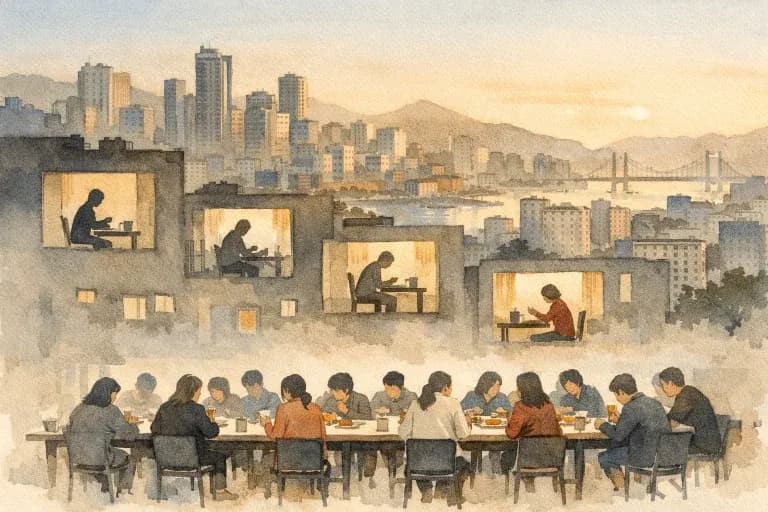
BUSAN — Busan has put more money into its ₩1,000 breakfast program this year, raising the city budget to 328.6 million won while keeping the scheme in place at 12 universities. That alone says something. A policy does not usually get bigger unless it is being used. In Busan, the student breakfast subsidy has already moved past the stage of symbolic welfare and into something more practical: a cheap meal people actually build into the start of the day.
The appeal is easy to read on campus. At Pukyong National University, where the program resumed at the Daraerak cafeteria in the Nabi Center, breakfasts priced above 5,000 won — including rice bowls and gukbap — have been sold for 1,000 won during the morning service period. The point is not only that the meal is cheap. It is that it is there, on time, in a place students already pass through. That is usually where food policy succeeds or fails — not in the slogan, but in the routine.
The city is expanding a meal subsidy at a moment when more people are living alone, eating alone and letting breakfast drop out of the day altogether. Last year’s student survey in Busan found satisfaction with the program above 86 percent, but the more important result may be simpler than that.
The scheme has shown that when price, timing and access line up, demand appears quickly. The harder question now is whether a model that works this well for students can be widened into something larger: not just a university benefit, but the first piece of a city-level breakfast system built for a place where regular meals are becoming harder to hold onto.
Why It Worked on Campus
The strength of the ₩1,000 breakfast program in Busan is that it solved a problem students already had without asking them to change much else. Breakfast had been easy to skip because it sat in the weakest part of the day — too early to prioritize, too ordinary to become a major policy issue, and too easy to replace with coffee or convenience-store food. Once a hot meal was offered on campus for 1,000 won, the choice became much simpler. It was not just cheaper. It was easier.
That helps explain why the program has moved quickly from a limited subsidy into a settled part of student life at participating campuses. In Busan, students pay 1,000 won per meal, while the Ministry of Agriculture, Food and Rural Affairs provides 2,000 won and universities cover the rest with city support. The structure matters because it turns the program into a working system rather than a symbolic one. The meal is not occasional. It is repeatable.
The university setting also gives the policy an advantage that is easy to miss. The kitchen already exists. The users are concentrated in one place. The timing is fixed. At Pusan National University, the program runs during a set morning window before classes, and at Pukyong National University the service was restarted at the Daraerak cafeteria in the Nabi Center with breakfast offered during the morning hours. Those details are not incidental. They are the reason the subsidy can attach itself to an existing routine instead of trying to create a new one.
That is why the popularity of the program in Busan should not be read only as a response to higher food prices. Price matters, but routine matters more. A subsidized meal works best when it appears exactly where daily life already passes. On campus, that means before class, in a cafeteria students already know, at an hour they are already moving through. The real achievement of the ₩1,000 breakfast program is not that it made breakfast cheaper. It made breakfast ordinary again.
Living Alone, Eating Narrower
What gives the Busan program its wider meaning is the city around it. South Korea’s one-person households reached 8.05 million in 2024, or 36.1 percent of all households, the highest share on record. Busan accounted for 6.8 percent of that national total. At the same time, the city’s population is ageing faster than most major urban areas. As of this year, residents aged 65 and older make up about 25.3 percent of Busan’s population — one in four people. Put those two trends together and the pressure on everyday eating becomes easier to see. More people are living without the household routines that once kept meals regular.
That pressure does not show up only as hunger. More often, it appears as a slow narrowing of the meal itself. For younger adults living alone, breakfast is the first thing to go — replaced by coffee, bread or whatever is available on the way out. A 2025 Korean study of middle-aged adults living alone found that the main reason for skipping meals was not money but the hassle of preparing them. The same group consumed fewer vegetables, fruits and milk than recommended. That matters because it shifts the policy question. The problem is not simply whether people can afford food. It is whether they can sustain the work of eating properly when every meal has to be organized alone.
The pattern is sharper among older adults. A Korean survey of elderly people living alone found that 42.7 percent said they had enough food but could not eat a wide variety of foods. Only 2.9 percent said they ate more than four side dishes in a meal. Nearly one in five said they ate alone every day, and more than half said they ate alone twice a day. Another study, based on 2,896 older adults living alone in Korea, found nutritional risk to be closely tied to physical function and depression. A separate frailty study found that older people who both lived and ate alone faced a significantly higher risk of depressive symptoms. The issue, in other words, is not just caloric intake. It is repetition, isolation and nutritional thinning over time.
Students and older residents do not live under the same conditions, and they should not be folded into a single category. What they do share is structural. Meals once organized inside households are now pushed back onto individuals. For students in one-room housing, the result is breakfast skipped or replaced by convenience-store food. For older residents, it is a diet that becomes easier to prepare, easier to repeat and harder to balance. The university breakfast program matters because it has shown, in one concentrated setting, what happens when price, timing and access are brought back into alignment.
Seen from Busan, the real issue is not whether one food policy can serve every group. It cannot. The issue is that the city’s demographic reality is producing the same weakness in different forms: regular meals are becoming harder to hold in place. That is what makes the ₩1,000 breakfast program worth watching beyond campus. It has worked for students because the routine was still there to be repaired. The harder question for Busan is where else that repair is still possible — and where the city may have to build a different model altogether.
From Campus Subsidy to Urban Breakfast Access
The next issue for Busan is not simply who should receive meal support after students. It is where the city still has the conditions to make such support work. The university program succeeded because several elements were already in place: kitchens were operating, students were moving through the same spaces at the same time, and breakfast could be folded into a routine that already existed. The subsidy did not have to create demand from scratch. It met demand where daily life was already concentrated.
What began as a university meal subsidy has already started to move beyond campus. The government expanded the model to industrial-complex workers, first through pilot sites and then through a wider 2026 rollout covering 34 industrial complexes and about 900,000 meals. The payment structure remained close to the university version: users pay 1,000 won, the central government pays 2,000 won, and the rest is covered locally. The significance of that shift is practical rather than symbolic. It shows the model can travel when the same operating logic survives.
For Busan, that does not automatically mean the next step should be a simple campus-to-factory copy. It means the city now has a clearer test. A subsidized breakfast is most likely to work where four conditions already overlap: a place to cook, a fixed morning schedule, a concentrated group of users and a route people already move through every day. Industrial complexes meet some of those conditions better than a scattered citywide program. The city’s existing commuter-bus network across multiple industrial complexes points to the same underlying reality: workers are already moving in concentrated flows through predictable corridors. A meal policy has a better chance of taking hold where that kind of daily concentration already exists.
But the larger Busan question goes beyond industrial complexes. If the city is serious about treating breakfast access as part of urban life rather than a narrowly targeted welfare scheme, the real challenge is to think in terms of infrastructure. That means asking where Busan already has public or semi-public spaces that could support cheap, regular morning meals without the cost of building a new system from the ground up. The lesson from the universities is not simply that people want cheap food. It is that meal support becomes durable when it attaches itself to spaces and routines that already organize the day.
That also explains the limit of the model. The groups with the greatest nutritional risk are not always the easiest to reach. Older adults living alone may have a stronger need for regular meal support than students or industrial workers, but they do not arrive at one cafeteria at one hour of the day. Their routines are more fragmented, their isolation is greater, and the city cannot assume that a model built on concentration and repetition will transfer cleanly.
In that sense, the next phase for Busan is likely to be selective rather than sweeping. The question is not whether the city should expand meal support everywhere at once. It is where the city can still find enough routine, access and shared space to make the support part of ordinary life rather than another policy that looks good on paper and fades in practice.
The Cost of Letting Meals Collapse
What Busan’s ₩1,000 breakfast program has proved is not simply that students respond to cheap meals. It has proved that regular eating returns when price, timing, access and routine are brought back into alignment. That may look like a small lesson inside a university cafeteria. In a city like Busan, it is not.
Busan faces the problem earlier and more sharply than many other cities. South Korea moved deeper into a super-aged society in 2025, with people aged 65 and older making up 21.21 percent of the population. One-person households made up 36.1 percent of all households in 2024, and by resident-registration count rose to about 42 percent in 2025. In that setting, the real problem is not simply whether people can pay for food. It is whether they can keep meals going at all.
That is the point policy often misses. For people living alone, especially in an ageing city, the burden lies less in the price of one meal than in the repeated work of planning, cooking and sustaining meals over time. What disappears first is not always calories. It is variety, balance and routine. Breakfast is skipped. Ingredients are wasted. Meals become repetitive. Convenience food takes over not because it is preferred, but because it is manageable. Over time, the cost of that shift does not remain private. It returns later as poorer health, deeper isolation and heavier care burdens.
That is why the significance of the Busan program lies beyond campus welfare. The universities have shown that meal support works where daily routine, shared space and existing kitchens already make regular eating possible. The next question for Busan is whether the city is willing to apply the same logic more broadly — not as a slogan about free meals, but as a practical effort to prevent meal routines from collapsing in a city where more people now live and eat alone. In Busan, food is becoming more than a matter of private habit. It is becoming a matter of urban capacity.
Continue this reporting
Reporting on the same issue
Related coverage selected from the article's desk, topics and newsroom relationships.
 NewsSep 20, 2026
What It Takes for U.S. Navy Repair Work to Become a Busan Industry
HJ Shipbuilding has brought U.S. Navy maintenance work to Yeongdo. Whether it...
 NewsSep 17, 2026
Busan’s Finished Homes, Unfinished Projects
Busan’s unsold homes sit in one monthly total, but they belong to very differ...
 NewsSep 16, 2026
Busan’s Young-Adult Migration Turns Sharply at 25–29
Busan can still draw young adults into the city, but keeping them becomes far...
More from the author
More from this byline
Stay with the same line of reporting through more work from this byline.

Editorial Record
Corrections, sourcing notes and newsroom disclosures remain part of the published record. View Newsroom Notes →
Reader Signal
Community readWhat did this report leave you with?
Choose the signal that best reflects your reading. Select it again to remove it.
One response per article
No response selected
A moderated conversation about the reporting.
One-level replies and newsroom moderation keep the conversation anchored to this article.
Discussion Status
Open
Please sign in to join the discussion.
Newsletter
Weekly reporting and context from Busan and Korea.