The Language of Busan City Hall
City branding is not unusual. What makes Busan worth examining is how closely branding, public language and broader policy messaging came to overlap, raising harder questions about visibility, priorities and the cost of future revision.

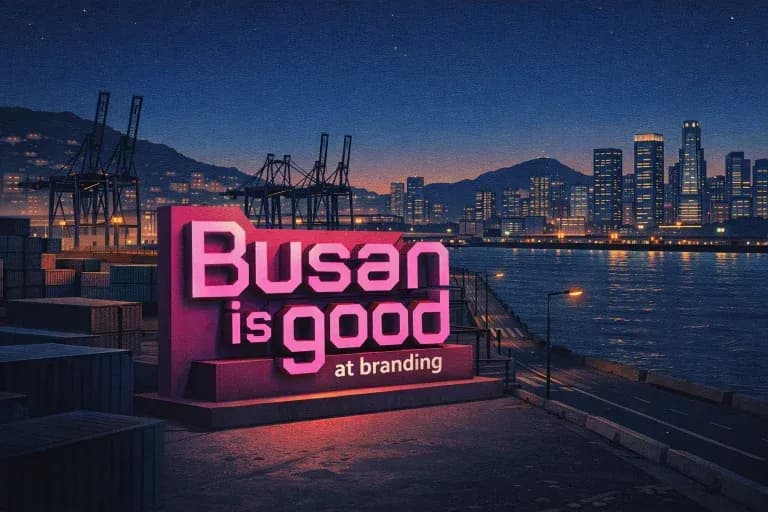
For much of the current administration, Busan has been narrated through a tightly managed vocabulary of ambition: a global hub city, a design-conscious city, a 15-minute city, a city that is simply “good.” Those phrases did not sit at the edge of municipal communication. They occupied the center of how City Hall chose to present Busan to residents, visitors and outside audiences. What emerged was not just a set of promotional lines but a disciplined public script: a way of making very different agendas sound as though they belonged to one coherent urban project. The question, then, is no longer whether Busan had a vision. It is whether that vision became more visible in language than in results.
That is the larger significance of Busan is Good. Official city materials framed the brand around “Global,” “Original,” “Open” and “Dynamic,” giving the phrase enough elasticity to absorb investment language, civic pride, tourism-facing identity and broader claims about Busan’s future direction. The slogan mattered not because it was singular, but because it became the most compact expression of a wider governing language. Over time, that language did not remain rhetorical.
City materials show Busan is Good spreading into official web surfaces, branded retail, partner merchandise and city-linked promotional activity, while council minutes show a city official acknowledging a 1.5 billion-won development cost for the brand after lawmakers questioned the project and related spending. That figure still has to be handled carefully as a documented acknowledgment of development cost rather than a fully audited total lifetime expenditure. Even so, it establishes something important: Busan’s image-making push carried a meaningful public price tag from the outset.
The weakness in this model is not that it floated above an empty administration. That would be too easy, and inaccurate. The city did pursue real structural agendas, and the 15-minute city is the clearest example. But the city’s own presentation of that agenda reveals the deeper imbalance. What is easiest to see in official materials is not always a before-and-after shift residents can point to at street level, but a steady chain of advisory meetings, pilot expansion, design recognition and international awards. That is not the same as failure. It is, however, one reason the administration’s preferred vocabulary often traveled farther in public memory than the policy substance beneath it. In Busan, image did not replace policy. It often arrived first, looked cleaner and proved easier to repeat.
This is what makes the Busan case worth closer scrutiny. City branding is not unusual, and Busan is hardly alone in seeking a more legible civic identity. Seoul, too, introduced a new city slogan in 2023 through a large public vote, with the Seoul government emphasizing that more than 650,000 people had participated. That comparison is useful precisely because it keeps the argument disciplined. The issue in Busan is not that the city had a brand. It is that branding appears to have become unusually entangled with the city’s larger public language — global ambition, design consciousness, neighborhood transformation and international positioning — until the brand ceased to look like one layer of governance and began to resemble governance’s most visible form.
A City Explained in Repeated Terms
What defined Busan in recent years was not one slogan but a repeated language of ambition. Across official messaging, the city returned again and again to a narrow cluster of terms: Busan as “global,” “open,” “dynamic,” design-led, innovation-oriented and neighborhood-centered. Busan is Good was the clearest condensation of that structure, but it sat alongside other high-level frames, among them the 15-minute city and the global hub city agenda.
What mattered was not merely the frequency of those words, but the work they did. They allowed very different policies — branding, urban design, local-living reform, legislative lobbying and English-facing city promotion — to sound like parts of one internally consistent transformation. In that sense, Busan was not only governed through projects. It was also explained through a disciplined vocabulary that made the city sound more unified, more future-facing and more internationally legible than municipal government usually does.
That coherence was politically useful. Local governments often struggle to project one recognizable voice because policy moves unevenly, institutional interests differ, and results arrive at different speeds. Here, that problem was largely solved at the level of presentation. Busan is Good was designed as a flexible umbrella rather than a narrow tagline, and the city’s official explanation made that explicit by attaching multiple values to a single word. The 15-minute city was likewise framed less as a technical planning instrument than as a statement about what daily urban life should become.
The global hub city push functioned in a similar way: not just as one bill in one legislature, but as a horizon through which Busan’s status and future were to be understood. This is why the article should not be reduced to a complaint about branding style. The more serious issue is that the city’s greatest coherence may have existed first in language. Busan was repeatedly told what it was becoming in terms that were easy to circulate, easy to remember and difficult to test at the same speed.
How Busan is Good Grew Beyond a Slogan
That is where Busan is Good becomes more than a slogan story. The phrase did not remain confined to speeches, ceremonial backdrops or a one-off communications rollout. City materials show it moving into official web surfaces, downloadable brand assets, public exhibitions, branded retail, partner merchandise and design-linked promotional infrastructure. BIG Shop was promoted not as a novelty but as a city-brand platform, and later city materials highlighted a growing network of partner firms and branded products linked to the Busan identity project.
By late 2025, the city said the shop had collaborated with 53 companies. This is the point at which language hardens into system. A slogan remains lightweight only so long as it can be removed without consequence. Once it is built into retail concepts, partner goods, public campaigns and derivative design activity, it acquires institutional weight. At that point, the right question is no longer whether the city has a brand, but how deeply the brand has been allowed to structure the city’s public face.
The council record gives that expansion a harder edge. In the 325th Busan Metropolitan Council regular session, a lawmaker explicitly raised the cost of the city brand and asked whether the development cost alone for Busan is Good had been 1.5 billion won. The head of the city’s Future Design Headquarters answered yes. That exchange does not by itself settle the full question of total lifetime spending. It does not tell us how much later applications, revisions, retail concepts, exhibitions or related design extensions cost in aggregate. But it does establish a crucial baseline. Busan is Good was not a costless surface treatment. It was a serious public project from the beginning. Once that is combined with its later spread across civic and quasi-commercial surfaces, the discussion moves out of the realm of aesthetics and into the realm of governance. The issue becomes one of administrative scope, fiscal priority and institutional reach.
Why Policy Was Harder to See
The central weakness in this model is not that City Hall spoke in slogans instead of policy. That would be too easy. The administration did pursue real agendas, and the 15-minute city is the clearest example. Official materials show advisory bodies, continuing policy development and staged implementation around the concept. But this is exactly where the imbalance comes into focus. When the city explains the 15-minute city publicly, it often does so through the language of advisory meetings, expansion plans, design recognition and international awards. Those are real milestones, but they are not the same thing as immediately recognizable change in the everyday texture of urban life. What the administration made easiest to see was not always lived transformation itself, but the validation structure surrounding the promise of transformation.
That asymmetry matters because branding and policy do not travel at the same speed. Branding is fast. It is portable, repeatable and visually efficient. A slogan can be absorbed in seconds, a visual system can spread across websites and physical surfaces almost at once, and a city can sound newly coherent long before it becomes recognizably different. Structural policy is slower, more uneven and harder to identify unless one is directly affected by it. This is why the administration’s repeated language — global, design, 15-minute city, Busan is Good — became so politically powerful. It moved through the public sphere faster than the material changes behind it. The same logic applies to the global hub city push. The city continued to insist on the centrality of the special law to Busan’s future, but the rhetoric of global ambition often reached the public more clearly than the delayed and externally dependent legislative process itself. The problem, then, was not the absence of policy. It was that policy remained less publicly visible than the language used to describe it.
What Makes Busan Different
Any serious version of this argument has to acknowledge that Busan is not unusual for having a city brand. Seoul, My Soul shows that large Korean cities also rely on slogans, image systems and public-facing identity structures. Seoul emphasized citizen participation more heavily than Busan did, saying its slogan was finalized after roughly 650,000 votes. That comparison is useful not because it weakens the argument, but because it disciplines it. The issue in Busan is not the existence of branding in itself. It is that branding seems to have been more tightly fused with the city’s wider public language than in the usual case. Busan is Good did not float above policy as an isolated campaign. It sat inside a much larger script that also included global-city rhetoric, design-led recognition, neighborhood-scale reform and English-facing civic presentation. That makes the Busan case narrower than a generic anti-branding complaint, but also stronger.
Comparison also helps clarify what should and should not be claimed. The article does not need to argue that Busan alone engaged in image politics, or that every city slogan is inherently wasteful. Korean metropolitan governments routinely manage civic identities, and branding can be legitimate. What appears distinctive in Busan is how completely branding came to organize the city’s public face. The brand did not merely accompany governance. It helped organize the way governance itself was seen. That is a more precise argument than “Busan overbranded itself,” and it is harder to dismiss.
A Debate Larger Than a Tagline
The branding push did not unfold in a vacuum. From the beginning, Busan is Good was visible enough, broad enough and tonally generic enough to invite argument outside City Hall. The city did present the slogan as citizen-informed, and local reporting at the time made clear that preference surveys were part of the selection process. But procedural participation is not the same thing as public conviction. The deeper issue was that the slogan’s vague positivity seemed out of proportion to the amount of symbolic work it was being asked to do.
A phrase as open-ended as Busan is Good could, in theory, carry tourism, investment, civic pride and international positioning all at once. It could also sound thin, generic and strangely detached from the actual texture of Busan. That tension matters because a slogan can survive aesthetic indifference if it remains politically secondary. It becomes much more exposed when it is asked to bear the symbolic weight of an entire governing era. In Busan’s case, the discomfort was never only about whether the English sounded awkward. It was also about whether a city facing structural demographic pressure, uneven development and long-running questions of economic reinvention was being represented through language too polished and too frictionless for the reality beneath it.
Council scrutiny sharpened that unease into a governance question. Once lawmakers began raising the cost of the brand and questioning associated spending, the subject ceased to be merely one of wording or design judgment. It became a question about public priority and administrative emphasis. That matters because council minutes do more than give the article a useful cost-related line. They show that Busan is Good had already become politically legible as a project large enough to defend, contest and justify.
Many slogans provoke passing commentary. Fewer become substantial enough to draw sustained scrutiny over scope, spending and institutional logic. In that sense, Busan’s branding project had already crossed the line from communications accessory to visible governing practice. Even without extensive resident interviews, the public record is enough to show that the branding push was socially legible from the start: seen, debated and tied to broader judgments about how the city was being governed.
When Branding Becomes a Future Burden
The final issue is what happens after a branding system has been built deeply enough to outlive the certainty that produced it. City branding is always easiest to defend at launch, when it can be described as renewal, modernization or a necessary reset in public identity. The harder problem emerges only after the brand has spread. In Busan’s case, Busan is Good did not remain a light communicative layer. It moved into official websites, exhibitions, retail concepts, partner goods and follow-on design activity. That matters because it changes the nature of revision.
A future administration would not be deciding whether to keep or discard a line of copy. It would be deciding what to do with a public-facing system already normalized across multiple civic surfaces. At that point, revision is no longer symbolically simple or administratively free. The broader the brand’s footprint, the more redesign work, coordination, replacement decisions and political explanation any later change is likely to require. Even without a complete audited estimate of future expense, the governance principle is clear enough: once branding becomes infrastructure, it creates switching costs.
That is what turns the Busan case into an accountability story. The strongest criticism of over-branding is not that it looks excessive in the present. It is that it can quietly transfer burdens into the future. One administration builds a highly visible civic identity; the next inherits not only the image but the constrained menu of low-cost choices around it. Keep it, and one accepts the symbolic architecture of the previous era. Replace it, and one risks spending public money to revise what public money already built. This is why the argument cannot remain at the level of whether Busan is Good sounds elegant or generic.
A city brand is supposed to outlast the administration that introduced it, but it can do so legitimately only if it comes to belong to the city more than to the governing style that produced it. The unresolved issue is not whether Busan needed a slogan. It is whether the city became easier to narrate than to recognize as transformed — and whether the systems built to support that narration will now outlast the certainty that produced them. If so, the public cost of branding will not end with launch expenditures. It will continue in the burden of deciding what to preserve, what to revise and what to admit was easier to say than to build.
Continue this reporting
Reporting on the same issue
Related coverage selected from the article's desk, topics and newsroom relationships.
 NewsSep 20, 2026
What It Takes for U.S. Navy Repair Work to Become a Busan Industry
HJ Shipbuilding has brought U.S. Navy maintenance work to Yeongdo. Whether it...
 NewsSep 17, 2026
Busan’s Finished Homes, Unfinished Projects
Busan’s unsold homes sit in one monthly total, but they belong to very differ...
 NewsSep 16, 2026
Busan’s Young-Adult Migration Turns Sharply at 25–29
Busan can still draw young adults into the city, but keeping them becomes far...
More from the author
More from this byline
Stay with the same line of reporting through more work from this byline.
 NewsSep 24, 2026
Taiwan’s AI Boom Is Surging, but Wealth Follows a Different Map

Editorial Record
Corrections, sourcing notes and newsroom disclosures remain part of the published record. View Newsroom Notes →
Reader Signal
Community readWhat did this report leave you with?
Choose the signal that best reflects your reading. Select it again to remove it.
One response per article
No response selected
A moderated conversation about the reporting.
One-level replies and newsroom moderation keep the conversation anchored to this article.
Discussion Status
Open
Please sign in to join the discussion.
Newsletter
Weekly reporting and context from Busan and Korea.