Test for Jeon’s North Port Dome Is Outside the Stadium
A dome at North Port could fit Busan’s maritime-capital agenda, but its value will depend on whether cruise passengers, KTX arrivals, baseball fans and concertgoers leave spending and movement in the old downtown.

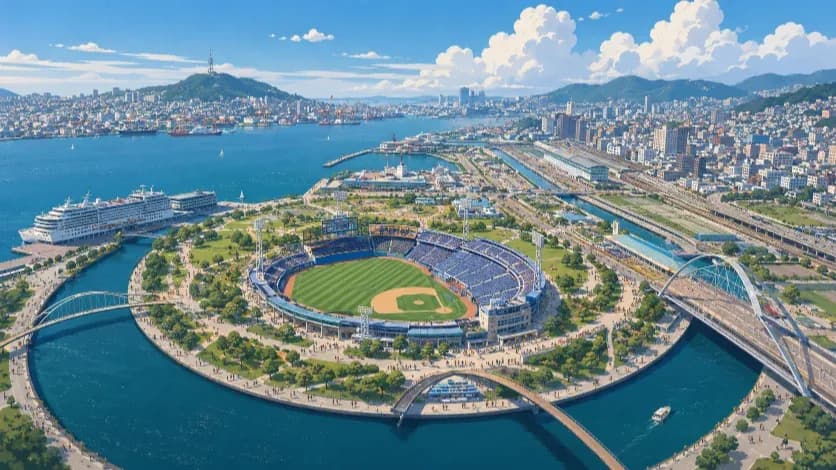
Jeon Jae-soo’s North Port dome pledge fits Busan’s maritime-capital agenda. Its harder test lies in the streets around the venue — whether cruise passengers, KTX arrivals, baseball fans and concertgoers can leave value in Choryang, Jungang-dong, Nampo-dong, Jagalchi and Yeongdo.
Busan Station gives the North Port dome proposal its strongest argument. Few places in the city connect rail, port, cruise and ferry passengers, hotels, old commercial streets and waterfront redevelopment so directly. A stadium or concert venue placed there would stand at one of Busan’s most visible hinges.
After the election, that geography moved back into politics. Mayor-elect Jeon Jae-soo’s North Port dome pledge has begun to shift from campaign imagery into transition review, where Busan Metropolitan City, Busan Port Authority, the Ministry of Oceans and Fisheries and local lawmakers may have to sort through land, cost, governance and timing.
The proposal appears to answer several problems at once. Sajik Baseball Stadium is aging. Busan has long sought a larger all-weather venue for baseball, concerts and global events. North Port still needs a public anchor strong enough to connect waterfront redevelopment to the city behind it. Jeon’s maritime-capital agenda gives the idea a larger political frame.
That combination also raises the standard.
A dome at North Port would place a large event machine beside some of Busan’s oldest and fastest-aging neighborhoods. Jung-gu, Dong-gu, Seo-gu and Yeongdo-gu need more than another crowd on event nights. They need people to walk into nearby streets, spend beyond the venue, use the waterfront when no game is scheduled and leave value in Choryang, Jungang-dong, Nampo-dong, Jagalchi and Yeongdo.
North Port already has part of that audience. Busan Port International Passenger Terminal sits in Choryang-dong at North Port Pier 3 and Pier 4, within walking distance of Busan Station. Cruise and ferry passengers do not arrive in Busan as an abstract tourism market. They step into the same corridor that a dome would try to use: the route between rail, port, hotels, old commercial streets and the waterfront.
The North Port dome has moved from a campaign image to a transition file. That shift makes the proposal easier to discuss and harder to excuse. Busan’s question no longer stops at whether a roof beside the sea would look convincing in a rendering. The harder question is whether the city can build the streets, services, shops, homes and daily reasons that make people stay after the lights go out.
Jeon’s Pledge Enters the Waterfront
A ballpark promise becomes much larger at North Port because the site belongs to Busan’s port future, waterfront redevelopment and search for a new civic stage. Jeon’s campaign placed the dome inside a wider maritime-capital agenda, with stronger city-level coordination on port policy, closer work with the Ministry of Oceans and Fisheries and a broader effort to turn Busan’s waterfront into an economic and cultural front door.
Baseball gives the project emotional force. North Port gives it political scale.
A retractable-roof dome could give the Lotte Giants a modern home and Busan a venue for concerts, exhibitions and international events. It could also become a waterfront anchor for a city that has spent years trying to turn former port and rail land into public urban space. Those arguments explain why the idea has survived beyond the campaign.
Jeon’s transition process now has to give the idea a harder filter. A dome cannot be treated only as a sports facility or a tourism asset. It would involve port land, public agencies, private capital, inherited planning decisions and the future of an existing stadium district in Sajik. Supporters will have to explain who controls the land, who pays for the infrastructure, who carries the risk and how the benefits reach streets beyond the venue.
That question matters more because North Port already functions as an arrival district. Busan expects hundreds of cruise calls this year and has been trying to turn cruise tourism into a stay-oriented market rather than a brief stop between pier, bus and ship. A dome could support that effort if it gives visitors another reason to remain near the old downtown. It could also waste the opportunity if passengers, fans and concertgoers move through managed shuttles, terminal corridors and private retail zones without entering the streets around them.
The dome’s strongest political argument comes from Jeon’s maritime-capital agenda rather than baseball alone. That wider frame raises the burden of proof. A stadium beside North Port would have to serve Busan’s waterfront strategy, not simply occupy its most symbolic site.
North Port Already Has a Job
North Port already comes with a plan, agencies and public obligations. Phase 2 of the Busan North Port Redevelopment Project carries a public assignment: reconnect port land, rail land and the old downtown after decades in which the waterfront worked more for logistics than for daily city life.
The official project area shows why a dome proposal cannot be judged as a standalone venue. Phase 2 reaches across Jaseongdae Wharf, Busan Station, Busanjin Station CY and Jwacheon Beomil-dong. Busan Metropolitan City, Busan Port Authority, LH, Busan Metropolitan Corporation and KORAIL are listed as developers. The geography is administrative, industrial and residential at once. Any major facility placed there would enter a plan already tied to rail corridors, port governance, public land, old neighborhoods and future waterfront access.
The city’s redevelopment language gives the site more than a commercial role. North Port is supposed to support international exchange, maritime industry, cultural facilities, residential space and links with the old downtown. Those promises set a standard for the dome. A roof, scoreboard and concert calendar would not be enough. The venue would have to strengthen the public connections that made North Port redevelopment politically defensible in the first place.
The passenger terminal adds a practical test to that promise. Busan Port International Passenger Terminal has the capacity to handle large cruise and passenger vessels, and conference venues at the terminal already describe a short walk from Busan Station through the skywalk connection. North Port is therefore not waiting to become connected. The connection exists. The weakness lies in what happens after arrival.
Jeon’s campaign added another layer to that standard. His pledge to underground the Gaya-Busanjin section of the Gyeongbu Line and create a green pedestrian axis toward North Port gives the dome proposal a corridor to answer to. The venue would sit poorly inside that promise if people can enter it only through managed gates, parking decks and private retail paths. The stronger version of the project would let people move through North Port, not only into it.
Choryang, Jungang-dong, Nampo-dong, Jagalchi and Yeongdo would not benefit simply because a large building rises nearby. They would benefit if the redevelopment plan makes walking outward natural, keeps public space open when no event is scheduled and allows nearby streets to receive some of the money and movement that a dome would concentrate.
A dome could give North Port an anchor. It should not become the whole plan. The city has already described the area as a place where the port, the old downtown and future urban life should meet. Jeon’s transition process now has to decide whether the dome would serve that meeting point or narrow it.
An Aging Downtown Changes the Test
Jung-gu, Dong-gu, Seo-gu and Yeongdo-gu would feel a North Port dome differently from the newer districts that usually absorb Busan’s development language. These neighborhoods already carry the weight of an older city: steep streets, small households, vacant homes, old housing stock and local services that have thinned as residents moved out or aged in place.
That reality changes the meaning of revival. A concert crowd may fill a waterfront at night. Baseball fans may add pressure to restaurants, hotels and transit stations. Cruise passengers may add another wave of movement through terminal gates and shuttle routes. Yet the old downtown’s daily problems begin much earlier in the day, with older residents moving between bus stops, clinics, markets, welfare offices, pharmacies and hillside homes. For them, a large venue nearby matters only if the redevelopment around it improves ordinary access rather than adding another district to navigate around.
Busan’s old downtown already receives people. Busan Station, hospitals, markets, port work, ferry links, offices, guesthouses, tourist streets and the international passenger terminal keep bodies moving through the area. The weakness lies in conversion. Passage does not always become staying. Staying does not always become spending in local streets. Spending does not always become housing repair, small-business stability or neighborhood renewal.
Living-population data matters for the North Port debate because it complicates the usual story of decline. Dong-gu, Seo-gu and Yeongdo-gu are classified as population-decline areas, yet they still draw large numbers of temporary stayers. The old downtown is not a sealed-off decline zone. People arrive, transfer, work, visit, pass through and leave. A dome would add another source of movement. Busan has to show whether that movement can become slower, wider and more useful to the streets behind the waterfront.
Vacant homes make the same point from the other direction. Empty houses and old residential pockets are not solved by a busy event calendar. They require repair, reuse, access, safety and reasons for younger households or small operators to return. A stadium district that raises land expectations without connecting to housing and neighborhood services could widen the gap between the waterfront and the hillside blocks behind it.
Tourism can sharpen or soften that gap. A cruise passenger who boards a shuttle at the pier, spends two hours at a scheduled attraction and returns to the ship may count as a visitor without touching the old downtown. A KTX arrival who walks through North Port, eats in Choryang, crosses into Jungang-dong, spends time near Nampo-dong or returns to Yeongdo changes the local economy in a different way. The dome debate should be measured against that difference.
For Choryang, Jungang-dong, Nampo-dong, Jagalchi and Yeongdo, the dome’s value would depend on what happens after people leave the building or the terminal. If they cross into nearby streets, stay for meals, return on non-event days and support businesses that already exist, North Port could become part of a wider old-downtown circuit. If they disappear through parking decks, subway gates, shuttle buses and private retail corridors, the old downtown may receive the crowd’s noise and traffic without receiving much of its value.
Sajik and the Cost of Moving a Rhythm
Sajik Baseball Stadium gives the North Port proposal its hardest counterweight. The ballpark is old enough to require a long-term decision, and Busan has already spent years trying to move its reconstruction through planning, funding and investment review. A city that ignores the facility problem at Sajik would only postpone a decision that baseball fans, the Lotte Giants and nearby businesses have lived with for years.
Sajik also does something a new waterfront venue has not yet done. It brings people back to the same district again and again. Lotte Giants home games create a rhythm that restaurants, bars, convenience stores, parking operators and small retailers around Dongnae can plan around. A sellout or a large crowd is not a single burst of attention. Over a season, it becomes a calendar for labor, inventory, late-night sales and street activity.
That rhythm is why the Sajik question cannot be reduced to nostalgia. The stadium’s age matters. So does the economy that has formed around it. A North Port dome could create a new event economy near the old downtown, but the move would also weaken one that already exists in another part of the city. Busan would be shifting repeat demand, not simply discovering it.
Jeon’s campaign framing tries to solve that tension by giving each site a future: a retractable-roof dome at North Port, and Sajik Baseball Stadium converted into a living-sports center. The division sounds tidy. It still needs proof. A living-sports center can serve residents, schools, amateur teams and neighborhood health. It does not automatically replace the evening and weekend spending that professional baseball brings dozens of times a year.
The existing Sajik reconstruction track adds another layer. National funding and administrative review have already attached public money and institutional expectations to the current stadium site. Changing course would require more than a new rendering at North Port. It would require Busan to explain what happens to secured funding, the previous planning process, the Lotte Giants’ role, Dongnae’s local economy and the timeline for fans who still need a safe and modern ballpark.
Stadium economics gives Busan a useful warning here. New venues can concentrate crowds, raise land expectations and create a stronger image for a city. Broad public benefits are harder to prove. The question is where the spending goes, who captures it, how much of it is new to the city and how much is moved from one district to another.
A dome may bring baseball closer to Busan Station, international visitors, ferry passengers and the waterfront. It may also pull a recurring economy away from Sajik and ask Dongnae to accept a different kind of public use in return. The city should make that trade visible before it asks residents to treat the project as revival.
Moving baseball to North Port would create a new event economy in one district while weakening one that already exists in another. That does not make the move wrong. It makes the evidence heavier.
The North Port Dome Spillover Standard
A North Port dome should not be judged first by its roofline, capacity or rendering. Those details would matter later. The first standard is whether the building can serve the city around it.
Attendance would show whether Busan can fill the venue. Spillover would show whether the venue belongs to North Port, the old downtown and the streets behind the waterfront. That standard should begin with access. A dome beside Busan Station and Busan Port International Passenger Terminal would have a rare transport advantage, but rail and pier access alone would not solve the problem. Busan would still have to move people through Jungang Station, Choryang Station, buses, pedestrian decks, ferry links and nearby streets without turning the district into a traffic funnel.
Flow would be the second measure. Fans, concertgoers and cruise passengers can move through a city in very different ways. They can leave through parking decks, subway gates, shuttle buses and private retail corridors, or they can cross into Choryang, Jungang-dong, Nampo-dong, Jagalchi and Yeongdo. The first path creates a controlled event and transfer district. The second path begins to make North Port part of the old downtown.
Stay would be the third measure. A crowd that arrives late and leaves immediately gives the city a short surge and a long cleanup. A cruise passenger who returns quickly to the ship leaves a similarly thin trace. A visitor who arrives early, eats nearby, walks the waterfront, crosses into old commercial streets and returns for another visit begins to change the district’s rhythm. Busan should be asking whether a dome would create a 30-minute exit, a three-hour visit or an overnight stay.
Spread would be the fourth measure. Spending that remains inside the venue, terminal or an attached commercial complex would help operators capture value. Spending that reaches old restaurants, markets, guesthouses, bars, cafes and small shops would make the project more defensible as an old-downtown strategy. The difference is not cosmetic. It decides whether the public language of revival has a public result.
Daily use would be the fifth measure. North Port cannot be measured only on baseball nights, concert weekends, cruise-call mornings or festival dates. Weekday mornings, winter afternoons and non-event days will reveal whether the district works as part of Busan or only as a place to enter when something is scheduled. Older residents, office workers, tourists, small merchants and families need public space that remains useful when the scoreboard is dark and the cruise pier is quiet.
Protection would be the final measure. New crowds and rising land expectations can help a district, but they can also price out the people and businesses used to justify redevelopment in the first place. Busan would need safeguards for small merchants, traffic and noise management, access for older residents, public seating, public toilets, shaded walking routes and open waterfront space that does not require a ticket, a boarding pass or a purchase.
Jeon’s transition process gives the city a chance to ask these questions before the project hardens into a political trophy. A rendering can show a roof beside the sea. It cannot show whether older residents can use the waterfront, whether small merchants receive spending, whether cruise passengers enter the old downtown, whether Sajik’s lost rhythm is replaced or whether North Port remains open when the event calendar is empty.
The dome may become a symbol of Busan’s next waterfront era. Jeon’s harder task is to make it part of a working city. A roof, a scoreboard and a concert calendar can give North Port an image. The old downtown will need the harder parts of a city: streets that lead outward, services that work in daylight, shops that receive spending, homes that can be repaired and reasons to return when the event is over.
Continue this reporting
Reporting on the same issue
Related coverage selected from the article's desk, topics and newsroom relationships.
 NewsSep 20, 2026
What It Takes for U.S. Navy Repair Work to Become a Busan Industry
HJ Shipbuilding has brought U.S. Navy maintenance work to Yeongdo. Whether it...
 NewsSep 17, 2026
Busan’s Finished Homes, Unfinished Projects
Busan’s unsold homes sit in one monthly total, but they belong to very differ...
 NewsSep 16, 2026
Busan’s Young-Adult Migration Turns Sharply at 25–29
Busan can still draw young adults into the city, but keeping them becomes far...
More from the author
More from this byline
Stay with the same line of reporting through more work from this byline.
Editorial Record
Corrections, sourcing notes and newsroom disclosures remain part of the published record. View Newsroom Notes →
Reader Signal
Community readWhat did this report leave you with?
Choose the signal that best reflects your reading. Select it again to remove it.
One response per article
No response selected
A moderated conversation about the reporting.
One-level replies and newsroom moderation keep the conversation anchored to this article.
Discussion Status
Open
Please sign in to join the discussion.
Newsletter
Weekly reporting and context from Busan and Korea.