Gwangandaegyo Toll Waiver Expands Busan’s Rush-Hour Relief Program
Busan’s toll network is moving in several directions at once. Traffic data from earlier waivers, new road connections and different financing structures will shape the next phase of the city’s toll policy.

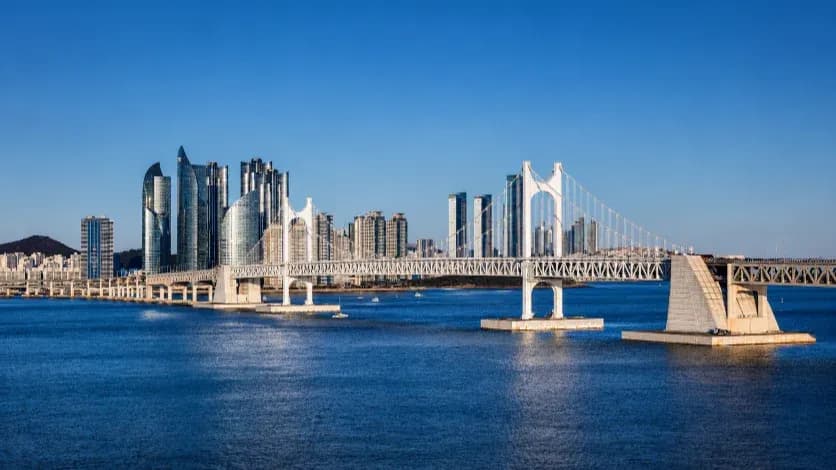
The July 8 waiver brings Gwangandaegyo into a toll-relief program first tested on Eulsukdodaegyo Bridge and Sanseong Tunnel, while the new Mandeok-Centum Urban Expressway follows a different time-based tariff. The policy changes give Busan a larger test of how tolls affect traffic, household costs and public finances across a connected road network.
At 8 a.m. on Wednesday, July 8, a driver crossing Gwangandaegyo will pay no toll. A motorist making a full trip through the Mandeok-Centum Urban Expressway during the same hour will pay 2,500 won, the highest passenger-car fare under the new road’s time-based schedule. The comparison does not mean the two roads should have identical prices: they were built in different periods, under different financing arrangements and for different transport functions. It does, however, place two distinct approaches to road pricing inside the same morning commute.
Busan will waive Gwangandaegyo tolls on weekdays from 6 a.m. to 9 a.m. and from 6 p.m. to 8 p.m., replacing the previous 50 percent discount during commuting hours. The measure follows the November 2025 introduction of rush-hour exemptions on Eulsukdodaegyo Bridge and Sanseong Tunnel, where the city said it would begin with routes serving areas with relatively weak public transport access, evaluate the effects and then consider further expansion.
The city’s first figures showed a clear response. During a 2025 Busan Metropolitan Council hearing, a city official said traffic on Eulsukdodaegyo and Sanseong Tunnel had increased by about 8 to 10 percent after the waivers began. The number established that more vehicles were using the two roads, although the publicly disclosed figure did not separate new trips from route changes, shifts into the free periods or broader growth in traffic demand.
That distinction will become more important as the policy moves to Gwangandaegyo, one of Busan’s busiest and most prominent transport corridors. During a council review in June, city officials estimated the annual effect of the waiver at about 3 billion won and acknowledged that the move was proceeding somewhat faster than the stage the administration had originally envisaged. The same hearing also referred to an ongoing study of the bridge’s future management and operation, expected to be completed later this year, as the current tolling framework approaches another decision point in May 2028.
The expansion therefore begins with more evidence than the first two-road trial, but also with a more complicated transport environment. Gwangandaegyo moved to full smart tolling in February 2025, allowing vehicles to pass without stopping at conventional booths, while new connections and the opening of Mandeok-Centum in February 2026 have continued to change route choices around eastern Busan. Those changes mean that the effect of the July waiver cannot be isolated simply by comparing bridge traffic with figures from several years earlier.
The immediate policy is straightforward for commuters: the toll disappears during specified hours. The larger analytical question is more demanding. Busan is expanding toll relief on established routes at the same time that its newest expressway operates a tariff that varies by time of day, and the city will now have to determine how those separate decisions affect traffic movement and public cost across roads that remain financially and contractually different.
From a Targeted Trial to a Larger Commuter Policy
Busan presented the Eulsukdodaegyo and Sanseong Tunnel waivers as a phased intervention. Both roads became free for all vehicles on weekdays from 6 a.m. to 9 a.m. and from 5 p.m. to 8 p.m. on November 1, 2025, after earlier measures that included a network-wide continuous-trip discount and the removal of tolls from Baegyang Tunnel. City material published at the time said the government would start with areas where public transport access was relatively difficult, review the outcome and expand the policy sequentially to other toll roads.
The two initial routes offered a plausible case for targeted relief. Eulsukdodaegyo serves movement between the western part of the city and employment and residential areas around Saha and Gangseo, while Sanseong Tunnel provides an important east-west route between northern Busan and the central and eastern side of the city. During the council hearing, the city said the two roads had particularly high shares of commuting traffic, which was one reason they were selected first.
The early 8 to 10 percent increase in traffic, however, should be treated as a starting point for analysis rather than a complete measure of success. A vehicle appearing on a newly free route may previously have used another road, travelled at a different time or not made the trip at all. Those responses have different consequences: route substitution can relieve one corridor while loading another, time shifting can create traffic concentrations around the boundaries of the free period, and genuinely induced trips can increase total road demand.
The available public discussion has not yet separated those effects. The city official who reported the increase interpreted the early response positively, while council members asked the administration to review expansion to other roads. Gwangandaegyo has now entered the program less than a year after the first waivers began, making the quality of the next evaluation more important than the initial traffic count alone.
Gwangandaegyo also differs from the first two roads in scale and operating history. It has a long series of traffic and toll data, but recent changes make a simple before-and-after comparison difficult. Smart tolling was introduced on February 1, 2025, allowing vehicles to pass without slowing for conventional collection, and the city has continued to modify connections around Centum and the bridge corridor while adding a major underground route through Mandeok-Centum.
A credible assessment will therefore need to stay close to the July 8 policy change and compare equivalent weekdays, directions and time periods while accounting for major accidents, severe weather and unusual events. Longer-term comparisons will still be useful, though only if the effects of smart tolling and new road capacity are treated separately from the waiver itself.
The June council proceedings add a second question to that evaluation. City officials said the new measure would reduce annual toll revenue by about 3 billion won, while a broader study of management and operation was still underway. The hearing does not establish that the waiver was adopted without analysis, and the longer-term study covers issues broader than a limited commuting-hour exemption. It does show that immediate toll relief and the bridge’s future operating model are now being considered on overlapping timelines.
One City, Different Toll Arrangements
Busan’s toll-road system was not built as a single financial or administrative model. City policy material in late 2025 referred to a network of seven toll roads, while Mandeok-Centum entered service in February 2026 under a separate tariff. Several roads were developed through private investment arrangements, Gwangandaegyo is publicly managed, and some facilities are closer than others to changes in their operating periods.
Those differences explain why toll policy cannot be reduced to a single question of whether a road should be free. Eulsukdodaegyo Bridge, Sanseong Tunnel and now Gwangandaegyo have moved toward commuting-hour relief. Council discussion has identified Sujeongsan Tunnel as approaching a change in toll status in 2027, while other roads continue under existing arrangements. Mandeok-Centum adds a newer pricing structure in which the amount paid changes according to the time of day.
For passenger cars travelling the full 9.62-kilometre Mandeok-Centum route, the city charges 2,500 won during the periods it identifies as morning and evening peaks: 7 a.m. to noon and 4 p.m. to 9 p.m. The expressway opened to traffic on February 10, with toll collection beginning on February 19, and the city has promoted the road as a route that can reduce the Mandeok-Centum journey from roughly 42 minutes to about 11 minutes.
The relevant difference is not simply that 2,500 won is higher than zero. Mandeok-Centum is longer than several of Busan’s older tolled tunnels, and a simple per-kilometre comparison does not make it the city’s most expensive route by every measure. Construction cost, concession period, traffic forecasts and the allocation of financial risk would also have to be considered before drawing conclusions about whether its tariff is high or low.
The clearer distinction is the structure of the tariff. Gwangandaegyo, Eulsukdodaegyo and Sanseong Tunnel remove the driver’s direct payment during selected commuting periods, while Mandeok-Centum applies its highest scheduled fare during designated peak periods. Official city material confirms the time-based structure, though the sources reviewed for this article do not establish that the tariff was designed as a formal congestion-pricing program. “Time-of-day pricing” or “peak-period tolling” is therefore the more precise description.
Different tariffs can be justified by different road functions and financing arrangements, but motorists respond to the full set of available choices rather than to individual contracts. A faster underground route toward Centum can draw vehicles from surface roads or other corridors, while a free commuting period on Gwangandaegyo can affect some of the same route and departure-time decisions. The network effect will depend on whether traffic is relieved, redistributed or concentrated around new bottlenecks.
Busan itself has treated the roads as physically connected in planning terms. Its official description of Mandeok-Centum places the new route within an inner ring corridor that includes Gwangandaegyo, Busanhangdaegyo and other major links, and the city has said it will monitor circulation around the new expressway’s entrances and exits after opening.
That makes network-level evaluation central to the toll debate. A city can maintain different prices for roads with different contracts, yet the policy outcome still has to be measured across the routes and intersections where those price differences change actual travel behaviour.
The Fiscal Effect Depends on the Road
The same need for road-by-road distinction applies to public cost. On Gwangandaegyo, a commuting-hour waiver reduces toll revenue collected on a publicly managed road. On a privately financed road, a toll reduction can interact with concession terms and financial-support mechanisms that vary by project. The fiscal effect therefore depends on the structure of the individual road rather than on the word “free” alone.
Busan’s 2024 audit of six privately financed toll roads and Gwangandaegyo illustrates why those arrangements require careful scrutiny. The audit found that value-added tax had been included in financial-support payments to private road operators when it should have been excluded; the city ordered the recovery of 6 billion won paid within the applicable legal period and estimated that correcting future payments through 2049 would avoid another 117 billion won, for a total expected budget effect of 123 billion won.
The audit does not show that the current rush-hour exemptions are financially unsound, and it does not mean that every waived trip leads to the same payment obligation. Its relevance is more specific: the fiscal effect of toll policy can depend on formulas and contract terms that remain in force for years, and similar-looking discounts may have different consequences for the city budget.
For that reason, public financial support, compensation associated with toll reductions and other contractual payments should be identified separately in the article and in the city’s own evaluation. The questions need to be asked road by road: which budget or revenue line changes when the driver pays less, how is any compensation calculated, and how sensitive is the public cost to higher or lower traffic volumes?
Gwangandaegyo requires a different accounting exercise. The council estimated the annual effect of the new waiver at about 3 billion won, but the final assessment should compare that estimate with actual toll collections after July 8 and set it against a consistent account of bridge revenue, existing discounts, operating expenses and maintenance spending. Council hearings have discussed the bridge’s toll income and management costs in several contexts, making it important to use the same fiscal year and accounting definitions before drawing conclusions about the affordability of further relief.
The fiscal analysis becomes more important if Busan continues to expand the program. The first waivers were introduced as a targeted measure for selected commuting routes. Once the policy reaches roads with different ownership, revenue and concession structures, estimating the benefit to drivers is only one part of the decision; the city also has to identify where the cost is recorded and how long that obligation lasts.
What July 8 Can Actually Show
The first post-policy figure is likely to be a change in traffic volume on Gwangandaegyo during the free periods. That figure will show whether use of the bridge increased, although it cannot by itself determine whether Busan generated more driving, attracted vehicles from alternative routes or shifted journeys into the exemption windows. The earlier 8 to 10 percent increase reported on Eulsukdodaegyo and Sanseong Tunnel shows why the distinction matters.
The timing of the new waiver creates a relatively clear first set of questions. The morning exemption begins at 6 a.m. and ends at 9 a.m.; the evening period runs from 6 p.m. to 8 p.m. Traffic measured immediately before and after those boundaries can show whether commuters adjust departure times to enter the free window, while direction-specific counts can distinguish dominant commuting flows from movements in the opposite direction.
The analysis also needs to extend beyond the bridge. Vehicles entering and leaving Gwangandaegyo move through approaches and intersections in Nam-gu, Suyeong and the Centum area, where additional traffic may have a different effect from traffic on the main span. Bridge speed can remain relatively stable while queues lengthen on connecting roads, which means average speed on Gwangandaegyo alone is an incomplete measure of the policy’s effect.
Travel-time reliability should be included alongside average speed. A route can retain an acceptable average journey time while becoming less predictable on the most congested mornings, so median travel times, upper-range delays and the duration of congestion can reveal effects that daily averages hide.
Route substitution is equally important. If Gwangandaegyo gains traffic while another corridor loses a similar amount, the policy may have redistributed existing trips. If volumes increase across several corridors at the same time, the interpretation is different. Mandeok-Centum makes that analysis more complicated because its February opening can independently change trips toward Centum and eastern Busan.
The city has already said it will monitor traffic after the Gwangandaegyo waiver begins and has indicated that measures may be considered if drivers create congestion around the exemption boundaries through unnecessary stopping or excessive slowing. That acknowledgement makes time-specific monitoring part of the policy itself rather than an external academic exercise.
A strong first assessment would compare similar weekdays over a narrow period before and after July 8, separate the two directions of travel and account for major weather events, crashes and exceptional traffic conditions. A longer series would then show whether early changes persist once commuters become accustomed to the new pricing pattern.
The fiscal result will take longer to establish. Traffic data can reveal immediate changes in volume and speed, while the full revenue effect will depend on actual collections over time and, on privately financed roads, any road-specific contractual consequences. Treating those measures together would give Busan a more complete basis for deciding whether and where toll relief should expand next.
Gwangandaegyo is the largest test so far of Busan’s current rush-hour toll-relief policy. The question after July 8 is therefore narrower than whether commuters welcome a free crossing and broader than whether bridge traffic rises: the city needs to determine where vehicles move, whether travel times improve, whether congestion shifts to connecting roads and how much the change costs under the relevant operating structure.
Those findings will matter before the next expansion. Busan began the program by saying it would examine the effects of the first exemptions and proceed in stages. With Gwangandaegyo now entering the scheme, the city has the opportunity to turn that commitment into a network-level evaluation rather than another isolated traffic count.
Continue this reporting
Reporting on the same issue
Related coverage selected from the article's desk, topics and newsroom relationships.
 NewsSep 20, 2026
What It Takes for U.S. Navy Repair Work to Become a Busan Industry
HJ Shipbuilding has brought U.S. Navy maintenance work to Yeongdo. Whether it...
 NewsSep 17, 2026
Busan’s Finished Homes, Unfinished Projects
Busan’s unsold homes sit in one monthly total, but they belong to very differ...
 NewsSep 16, 2026
Busan’s Young-Adult Migration Turns Sharply at 25–29
Busan can still draw young adults into the city, but keeping them becomes far...
More from the author
More from this byline
Stay with the same line of reporting through more work from this byline.
Editorial Record
Corrections, sourcing notes and newsroom disclosures remain part of the published record. View Newsroom Notes →
Reader Signal
Community readWhat did this report leave you with?
Choose the signal that best reflects your reading. Select it again to remove it.
One response per article
No response selected
A moderated conversation about the reporting.
One-level replies and newsroom moderation keep the conversation anchored to this article.
Discussion Status
Open
Please sign in to join the discussion.
Newsletter
Weekly reporting and context from Busan and Korea.