Growth No Longer Guarantees Street-Level Recovery in Busan
Busan has crossed a threshold where vacancy is no longer episodic but embedded in the operating environment.

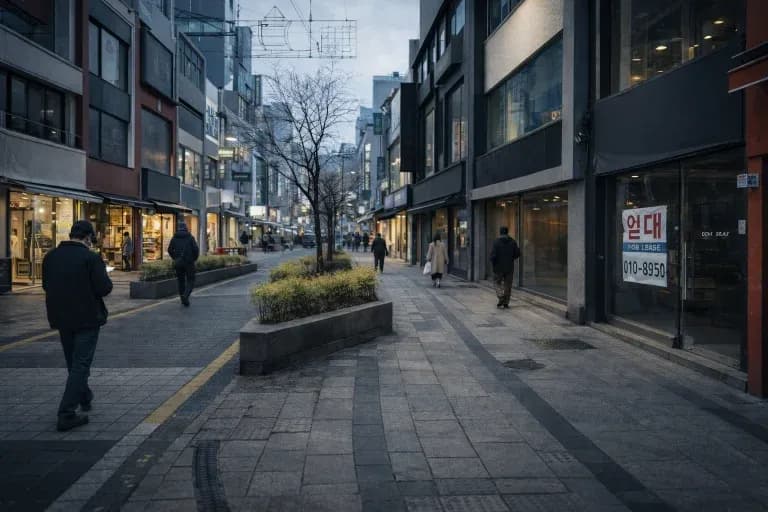
BUSAN — Busan’s retail market tightened in reverse through late 2025. In the fourth quarter, vacancies rose across medium-sized, small, and collective retail properties, and rents edged down in tandem. The shift did not stay inside the usual frame of “old downtown decline.” Lease banners now sit on street-level units along transit corridors and around large apartment complexes—places built on the assumption of steady, repeat footfall.
Demographics have narrowed the base. More than a quarter of Busan’s residents are now over 65. One-person households make up 37.2 percent of all households. That combination does not simply reduce spending; it changes where spending lands, how often it occurs, and which storefront formats can survive on it.
Housing has entered the same cycle. Multiple districts have adopted vacant-home maintenance plans, moving persistent residential underuse into formal administration. This is the point at which vacancy stops looking like turnover and starts looking like inventory.
What stands out is not a single shock but a cumulative loss of everyday density. Vacant ground floors last longer, tenant turnover slows, and rent negotiations cut deeper. The city’s commercial fabric is being tested in areas that used to be insulated—near stations, near new housing, on streets designed for daily routines rather than seasonal peaks.
The Commercial Threshold
Retail districts do not fail all at once. They weaken when the volume of routine transactions falls below the level required to sustain fixed costs—rent, labor, utilities, inventory. Once that threshold is crossed, vacancy no longer appears as an exception. It becomes part of the operating environment.
Busan’s recent data place pressure on that threshold from both sides. Vacancy rates increased across all major retail categories in the fourth quarter of 2025, while average rents declined. A falling rent in this context is not relief; it signals that expected turnover has softened. Landlords adjust because tenants calculate differently.
What distinguishes the current phase is dispersion. Vacancies are not clustered solely in aging commercial strips. They appear along transit-served corridors and within walking distance of large residential developments. These are areas designed around predictable daily demand—commuters, families, repeat customers. When units in such locations remain unfilled for extended periods, the issue moves beyond neighborhood management and into the arithmetic of demand.
Lease structures have also shifted. Shorter contract periods, flexible renewal terms, and incentives for new tenants have become more common. These adjustments reduce immediate vacancy but lower long-term revenue stability. The margin that once buffered commercial districts against demographic fluctuation has narrowed.
A retail ecosystem depends on circulation: people moving through space, returning frequently enough to sustain small margins across many storefronts. When household size contracts and age composition tilts upward, circulation changes. Fewer family-based purchases, fewer bundled errands, fewer high-frequency visits. The storefront count may remain similar for a time, but the turnover beneath it thins.
The adjustment is incremental rather than abrupt. Ground-floor vacancies persist longer, lease renewals occur at lower rates, and operating hours shorten in marginal locations. Blocks once characterized by continuous occupancy now contain intermittent gaps. In these conditions, retail performance is no longer measured by growth but by the ability to maintain baseline turnover.
Demographic Compression and Consumption Shift
Busan’s demographic profile has moved beyond gradual aging into structural compression. More than one quarter of the city’s residents are now over 65. Single-person households account for 37.2 percent of all households. The combined effect is a reduction in household scale and a shift in spending behavior.
Retail systems built on family-based consumption rely on bundled demand. Groceries, dining, tutoring, medical services, and discretionary purchases once moved through shared routines within multi-person households. Smaller households break that pattern. Purchases fragment. Visit frequency declines. Transaction size contracts.
Age composition further alters spending rhythm. Older consumers concentrate expenditures in fewer categories and fewer locations. Evening and late-night activity recedes. High-turnover formats such as casual dining and lifestyle retail lose the frequency required to sustain higher fixed rents.
The shift does not eliminate consumption; it redistributes it. A larger share of routine spending moves toward delivery, platform-based ordering, and consolidated retail formats. Physical storefronts that depend on repeated short-distance visits face lower pass-through traffic. The effect is cumulative. Each marginal reduction in frequency lowers the resilience of nearby tenants.
These demographic conditions differ from cyclical downturns. Inflation can reduce discretionary spending, but it does not permanently reduce household size. Recession can delay purchases, but it does not alter age structure. In Busan, the contraction in consumption density stems from composition rather than confidence.
Where aging and household fragmentation intersect with rising vacancy, commercial adjustment accelerates. The market response—shorter leases, flexible terms, lower rents—addresses symptoms. The underlying shift lies in who lives in the district and how often they transact.
Housing Surplus and Administrative Intervention
Vacancy is no longer confined to aging commercial strips. Ground-floor units offered for lease now appear along subway corridors and near large apartment complexes built within the past decade. These areas were designed around predictable daily circulation—station exits, pedestrian connectors, neighborhood arterials.
Transit proximity has not prevented longer vacancy durations. Residential density has not guaranteed tenant stability. Units located within short walking distance of stations remain unfilled for extended periods. In several districts, stretches of newly built frontage include intermittent gaps between operating stores.
Many of these properties were priced on projected absorption tied to steady household turnover and family-oriented demand. As household size contracts and age composition rises, turnover slows. Commercial space remains structurally present but functionally underused.
The pattern does not resemble concentrated decay. It appears as dispersion. Retail slack extends across multiple districts rather than remaining isolated in historically weaker zones. Corridors expected to anchor neighborhood activity now exhibit the same reduced occupancy intervals seen in older cores.
Essential services persist—convenience retail, pharmacies, clinics. Higher-margin discretionary formats rotate more frequently or shorten operating hours. The change unfolds without abrupt closure but with measurable gaps in continuity.
The Limits of the Recovery Mechanism
Commercial districts historically recovered through cyclical expansion. Employment growth restored disposable income. Household formation increased local demand. Retail turnover strengthened as spending frequency returned to pre-downturn levels. Vacancy contracted once daily circulation stabilized.
Those conditions depended on demographic replenishment. Younger households replaced older ones. Family formation sustained school districts, neighborhood services, and bundled consumption patterns. Lease structures assumed renewal cycles tied to stable foot traffic and predictable revenue.
Busan’s current configuration alters those assumptions. Population aging reduces replacement demand. Household contraction lowers aggregate transaction size per address. A higher share of consumption moves through consolidated or remote channels rather than dispersed storefront visits. Even when employment stabilizes, the composition of demand differs from prior cycles.
Inflation compresses margins but remains reversible. Monetary tightening delays investment but does not permanently alter age structure. Demographic compression, by contrast, accumulates. The median consumer grows older. The average household contains fewer members. Commercial formats designed for multi-person, high-frequency use face structural headwinds independent of short-term macroeconomic indicators.
Under these conditions, recovery does not follow automatically from growth. Employment gains may improve income, yet storefront turnover does not necessarily return to earlier levels. Lease negotiations reflect caution rather than expansion. Capital expenditure shifts from opening new outlets to consolidating existing ones.
The adjustment is not uniform across all sectors. Essential retail stabilizes first. Discretionary and experience-based formats adjust more slowly. What changes is the baseline expectation: districts operate with narrower margins of resilience, and recovery becomes partial rather than comprehensive.
A City Operating at Lower Density
Busan is not experiencing a singular commercial shock. It is operating under altered conditions of urban density. Retail vacancy, housing underuse, and demographic compression have advanced in parallel, reducing the volume and frequency of everyday transactions that sustain neighborhood-scale commerce.
The change is measurable less by closure than by duration. Units remain vacant longer. Lease terms shorten. Investment decisions defer expansion. Commercial districts continue to function, yet they do so with thinner margins and lower turnover. Activity persists, but continuity weakens.
Demographic structure anchors this shift. An older population and smaller households reshape demand in ways that cyclical growth cannot easily reverse. Economic expansion can restore income levels, but it does not automatically restore household size or age balance. Recovery, in this environment, improves conditions without reconstructing the previous density of use.
Housing policy has already begun to respond to persistent residential vacancy through formal maintenance plans. Commercial adjustment, however, remains largely framed as a temporary downturn. The distinction matters. If vacancy is treated solely as a business cycle outcome, intervention will focus on short-term stimulus. If it is understood as part of a broader density recalibration, policy and investment will shift toward adaptation rather than restoration.
Busan’s central districts are not empty. They are thinner. The difference is subtle but consequential. Urban systems built on routine proximity now operate with more selective circulation. What is at stake is not the survival of isolated storefronts but the long-term capacity of everyday corridors to sustain continuous activity under a smaller, older, and less concentrated pattern of demand.
Continue this reporting
Reporting on the same issue
Related coverage selected from the article's desk, topics and newsroom relationships.
 NewsSep 20, 2026
What It Takes for U.S. Navy Repair Work to Become a Busan Industry
HJ Shipbuilding has brought U.S. Navy maintenance work to Yeongdo. Whether it...
 NewsSep 17, 2026
Busan’s Finished Homes, Unfinished Projects
Busan’s unsold homes sit in one monthly total, but they belong to very differ...
 NewsSep 16, 2026
Busan’s Young-Adult Migration Turns Sharply at 25–29
Busan can still draw young adults into the city, but keeping them becomes far...
More from the author
More from this byline
Stay with the same line of reporting through more work from this byline.
 NewsSep 24, 2026
Taiwan’s AI Boom Is Surging, but Wealth Follows a Different Map

Editorial Record
Corrections, sourcing notes and newsroom disclosures remain part of the published record. View Newsroom Notes →
Reader Signal
Community readWhat did this report leave you with?
Choose the signal that best reflects your reading. Select it again to remove it.
One response per article
No response selected
A moderated conversation about the reporting.
One-level replies and newsroom moderation keep the conversation anchored to this article.
Discussion Status
Open
Please sign in to join the discussion.
Newsletter
Weekly reporting and context from Busan and Korea.