Gadeokdo New Airport and the Risk of Turnkey Speed
Turnkey contracting promises decisiveness at Gadeokdo New Airport. Offshore ground conditions demand patience. The distance between the two defines the project’s central risk.

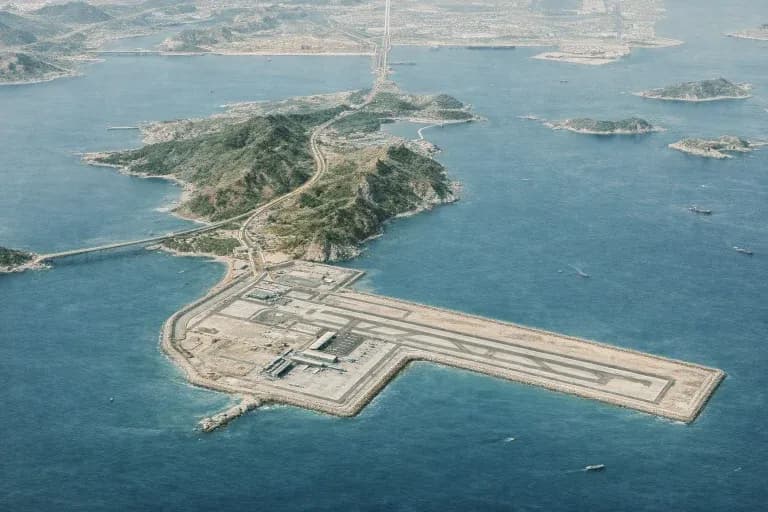
Busan, South Korea — Debate over Gadeokdo New Airport has accelerated along a narrow axis. After repeated bid failures and the emergence of a single viable consortium, local newspapers, regional politicians, and affiliated civic groups have converged on a common prescription: abandon further tenders, proceed with direct negotiation, and move construction forward without additional delay. In that framing, time is treated as the central variable, while delay itself is cast as the primary source of risk.
Bid failure, however, rarely occurs in isolation from project conditions. Gadeokdo New Airport is planned on offshore reclaimed land underlain by ultra-soft marine clay, where consolidation extends over years rather than months. Construction follows a fixed sequence—breakwaters, reclamation, ground improvement, preloading, and monitoring—governed by soil behavior rather than administrative resolve. Runway-grade performance requirements further narrow tolerance for residual settlement, raising the cost of late-stage correction. Under such conditions, procurement outcomes tend to reflect engineering exposure as much as procedural design.
Public discussion has nonetheless shifted away from physical constraint toward contractual expediency. Design–build procurement, commonly described as turnkey contracting, has gained prominence not through technical advantage but through institutional convenience. Combined responsibility shortens decision chains, concentrates accountability, and produces an immediate signal of progress. None of those attributes alter subsurface uncertainty. Ground response remains unchanged regardless of contractual form.
The resulting tension lies between physical duration and political impatience. Contract award offers visibility; consolidation does not. Groundbreaking delivers immediacy; monitoring demands time without spectacle. Where the latter is treated as hesitation rather than necessity, pressure accumulates to convert engineering uncertainty into contractual certainty. Projects shaped by geology rarely reward that conversion.
Where the Risk Actually Lies
Risk at Gadeokdo New Airport concentrates at stages where subsurface uncertainty meets irreversible construction. Comparable offshore airport projects encountered the same convergence—and the manner in which procurement responded largely determined outcomes.
At Gadeokdo, the first exposure point arises during consolidation under preload. The reclaimed platform rests on ultra-soft marine clay, where primary consolidation progresses slowly and non-uniformly. Settlement behavior cannot be extrapolated with confidence before field data accumulate. Monitoring periods therefore function not as administrative buffers but as verification gates. Compression of those gates elevates the probability that residual settlement migrates into the pavement phase, where correction becomes structural rather than geotechnical.
A parallel exposure emerged during construction of Kansai International Airport. Initial reclamation proceeded under optimistic consolidation assumptions, followed by runway and terminal construction before settlement rates stabilized. The result was long-term, uneven subsidence that required continuous jacking, resurfacing, and reinforcement. Japanese transport authorities later revised procurement practice for offshore aviation infrastructure, separating ground formation from superstructure delivery and extending monitoring horizons before final commitments. The change reflected experience, not theory: once pavement tolerances are breached, recovery options narrow sharply.
A similar lesson informed development of Hong Kong International Airport at Chek Lap Kok. Land reclamation and breakwater works were executed under public-sector control with segmented contracts. Terminal and airside structures followed only after settlement performance met predefined thresholds. Procurement avoided single, integrated responsibility precisely because subsurface behavior remained the dominant uncertainty. Speed was not eliminated, but sequence was enforced.
Turnkey delivery under comparable conditions has repeatedly concentrated risk rather than resolving it. Design–build structures assume that design assumptions can be validated during construction without destabilizing the schedule. In soft-ground reclamation, validation often arrives too late. Settlement trends observed after surcharge removal cannot be reversed without reopening completed works. Where design and construction advance in parallel, error propagation accelerates.
The second exposure point at Gadeokdo lies at the reclamation–runway interface. Runway pavement commits the project to geometric tolerances measured in millimeters. Differential settlement beyond those limits induces cracking, loss of load distribution, and long-term maintenance escalation. Remediation involves excavation and reconstruction, not adjustment. At that stage, delay becomes cumulative rather than recoverable.
This pattern shaped earlier procurement outcomes domestically. In 2024, the Hyundai Engineering & Construction–led consortium requested a schedule extension of roughly two years, grounded in consolidation sequencing and verification requirements. The request identified preloading and monitoring as the controlling path and warned against advancing pavement works before settlement stabilization. Negotiations stalled not over geotechnical logic, but over alignment with predetermined timelines. Withdrawal followed, marking a refusal to absorb risk without temporal recalibration.
International precedent suggests that such withdrawals function as market signals rather than anomalies. In large-scale infrastructure studies, contractor participation declines when unquantifiable ground risk is bundled into fixed delivery horizons. Subsequent single-bidder environments reflect rational avoidance, not diminished capability.
Revisions to the official construction period at Gadeokdo—from earlier targets to a 106-month framework—implicitly validated the technical position raised during that episode. The revision acknowledged consolidation and monitoring as unavoidable. What remains unresolved is the translation of that acknowledgment into procurement architecture.
Experience from offshore airports converges on a narrow conclusion. Ground behavior establishes minimum durations that contract form cannot compress. Turnkey structures shift uncertainty downstream, where correction is most expensive. Segmented delivery absorbs uncertainty upstream, where verification retains value. Projects governed by soil mechanics rarely reward consolidation of responsibility before consolidation of ground.
From Engineering Risk to Procurement Shortcut
Bid failure at Gadeokdo New Airport has been described as administrative waste. The description misses the mechanism. Participation collapsed because the contract configuration asked bidders to price and absorb uncertainty that cannot be priced cleanly in offshore soft-ground work. A market that anticipates uncontrolled exposure does not compete; it waits. Re-tendering under unchanged assumptions therefore reproduces the same outcome and then presents the repetition as a procedural problem.
The single-bidder environment followed a familiar sequence. A timetable was treated as a policy commitment rather than an engineering estimate. That timetable met a ground profile whose stabilization period is measurable only through time and instrumentation. The mismatch produced one rational response from serious contractors: demand an extension, or exit. Hyundai Engineering & Construction’s earlier insistence on a longer period did not introduce delay; it quantified a delay already embedded in consolidation and monitoring. Withdrawal did not “stop” the project. Withdrawal exposed the boundary between declared schedule and physical schedule.
The procurement response has been to simplify the transaction rather than align the schedule. Turnkey contracting consolidates design and construction under one entity. The attraction lies in governance. Combined responsibility compresses decision chains, makes blame assignment legible, and produces a visible milestone—award, mobilization, groundbreaking—without requiring resolution of subsurface uncertainty. Administrative clarity is purchased with technical ambiguity left intact.
In soft-ground reclamation, design–build does not operate as “faster design.” It operates as “design under construction.” Geotechnical design assumptions—settlement rate, drain performance, preload duration, bearing capacity gain—are tested after site work begins. Test results arrive as instrument readings, not as paper. When readings contradict assumptions, the project has two options: revise design and schedule, or force the schedule and accept downstream consequences. Turnkey structures intensify that fork. A single contractor absorbs the contradiction and then seeks relief through variation orders, claims, or scope adjustments. Risk is not reduced. Risk is monetized later.
Calls for direct negotiation amplify the same dynamic. Competitive tendering, when it exists, forces alternative methods and schedules into comparison. It compels bidders to expose assumptions—ground improvement strategy, preload staging, monitoring criteria, contingency allowances—because those assumptions determine price and duration. Negotiation removes that discipline at precisely the point where discipline matters most. A negotiated award can still be technically sound, but technical soundness then depends on robust external verification rather than market competition. Without independent scrutiny, negotiation simply locks assumptions into a contract before evidence accumulates to support them.
The political utility of speed further narrows the space for verification. Ground stabilization is not a dramatic phase. Breakwater progress is visible; pore pressure dissipation is not. Settlement curves do not translate into headlines. Award decisions do. The incentives are therefore asymmetric. Political credit accrues at commencement, while engineering liability emerges in mid-project corrections—often outside electoral cycles. Media logic compounds the imbalance. Counts of failed tenders and elapsed months produce simple narratives of waste. Consolidation time produces no equivalent shorthand. The result is a rhetoric in which verification is recoded as hesitation.
That rhetorical recoding matters because it changes what can be said publicly without penalty. A minister can defend acceleration. A contractor can defend schedule optimism. An engineer cannot defend the same optimism without evidence that only time provides. When pressure demands certainty on a physical system that has not yet revealed its response, certainty is produced where it is cheapest to manufacture—at the contractual level—while remaining expensive to obtain at the ground level.
A procurement loop forms. Engineering exposure discourages bidders. Reduced competition is framed as delay. Delay triggers demands for decisive contracting. Decisive contracting privileges turnkey and negotiation. Turnkey and negotiation reduce comparative testing of assumptions. Reduced testing increases the probability of mid-course correction. Mid-course correction generates the next round of delay, cost escalation, and public fatigue. The loop is not psychological; it is structural.
The core issue is not the presence of urgency. The core issue is the conversion of uncertainty into commitment before uncertainty is measured. Offshore reclamation allows progress, but only in sequence. Ultra-soft ground allows construction, but only with time-bound verification. Contracting can accelerate decisions; it cannot accelerate soil behavior. Where contracting is used to simulate acceleration, the simulation ends when pavement tolerances are breached and rework becomes the only remaining instrument of correction.
After the Decision
Conditions governing Gadeokdo New Airport have remained consistent throughout shifting debate. Offshore reclamation on ultra-soft marine clay imposes consolidation periods that cannot be shortened by administrative choice. Pavement work introduces irreversible thresholds where correction converts from geotechnical adjustment to structural reconstruction. Official extension of the construction horizon to 106 months acknowledges those constraints in practice, regardless of how frequently urgency is invoked in public language.
Acceleration operates on decisions, not on soil response. Contract award, mobilization, and groundbreaking deliver visibility and momentum. Settlement verification, pore pressure dissipation, and long-term stability deliver neither spectacle nor immediacy. Treating verification as delay converts a physical requirement into a political liability. Under that conversion, certainty migrates toward contracts and schedules while uncertainty remains embedded in the ground. Projects dominated by consolidation do not reward such inversions.
Procurement choices made under speed pressure tend to fix assumptions before evidence accumulates. Turnkey delivery and direct negotiation consolidate responsibility and shorten decision chains, yet neither alters the sequence that governs ground behavior. Where assumptions later diverge from instrument readings, recovery appears as redesign, rework, and time added downstream. Delay avoided at award reappears during construction, amplified by the cost of reversibility lost.
Regional development claims attached to the airport require similar ordering. Connectivity may be necessary for long-term competitiveness, but connectivity alone does not generate industry, employment, or retention. Airports amplify existing demand; they do not create it. Priority rests with industrial composition, job quality, and settlement conditions that determine whether movement produces staying. Without those foundations, an airport increases circulation more reliably than attachment.
Evaluation of leadership under such conditions benefits from precision rather than volume. Credible proposals specify sequence, acknowledge risk, separate political calendars from construction horizons, and describe conditions beyond ceremonial commencement. General promises of speed lack that content. What remains after commitment is not the declaration of progress, but alignment between physical constraint and institutional choice. Where alignment holds, time accumulates productively. Where alignment fails, time returns later as correction.
Continue this reporting
Reporting on the same issue
Related coverage selected from the article's desk, topics and newsroom relationships.
 NewsSep 20, 2026
What It Takes for U.S. Navy Repair Work to Become a Busan Industry
HJ Shipbuilding has brought U.S. Navy maintenance work to Yeongdo. Whether it...
 NewsSep 17, 2026
Busan’s Finished Homes, Unfinished Projects
Busan’s unsold homes sit in one monthly total, but they belong to very differ...
 NewsSep 16, 2026
Busan’s Young-Adult Migration Turns Sharply at 25–29
Busan can still draw young adults into the city, but keeping them becomes far...
More from the author
More from this byline
Stay with the same line of reporting through more work from this byline.
 NewsSep 24, 2026
Taiwan’s AI Boom Is Surging, but Wealth Follows a Different Map
Editorial Record
Corrections, sourcing notes and newsroom disclosures remain part of the published record. View Newsroom Notes →
Reader Signal
Community readWhat did this report leave you with?
Choose the signal that best reflects your reading. Select it again to remove it.
One response per article
No response selected
A moderated conversation about the reporting.
One-level replies and newsroom moderation keep the conversation anchored to this article.
Discussion Status
Open
Please sign in to join the discussion.
Newsletter
Weekly reporting and context from Busan and Korea.