Canadian Historian Walks 625 Kilometers From Gapyeong to Busan
Canadian military historian Guy Black completed a 625-kilometer walk from Gapyeong to Busan, honoring Korean War veterans and the UN soldiers buried at the United Nations Memorial Cemetery.

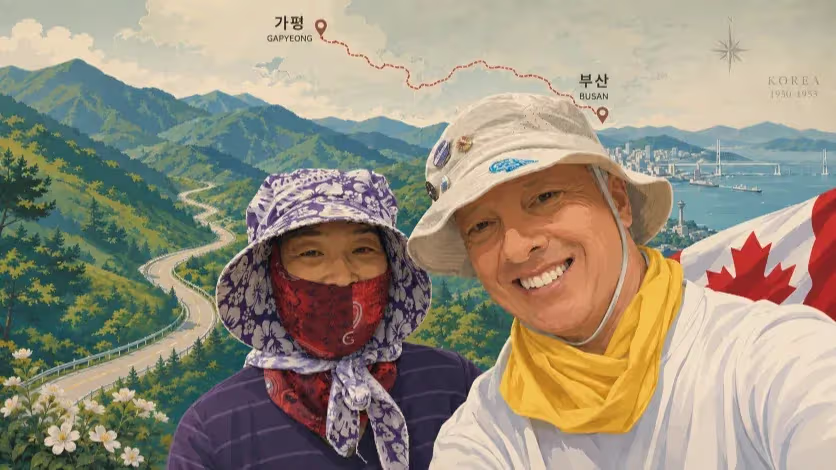
Guy Black’s 625-kilometer route from Gapyeong to the United Nations Memorial Cemetery follows a Canadian battle memory into the deeper history of invasion, armistice, anti-communist state power, democratic recovery and the vanishing generation that still gives the Korean War its human names.
Canadian military historian Guy Black entered the United Nations Memorial Cemetery in Busan at 3:10 p.m. on May 22, completing a 625-kilometer walk from Gapyeong County to the burial ground where soldiers from Canada and other UN member states remain buried more than seven decades after the Korean War.
The distance was chosen for June 25, 1950, the date South Korea uses to mark North Korea’s invasion and the beginning of open war on the peninsula. Black’s route followed a narrower line through that history: from the area associated with the Battle of Kapyong, the older English spelling preserved in Canadian and Commonwealth military records for the April 1951 battle fought around today’s Gapyeong, to Busan, where the international dead of the war are recorded by country, unit, name and grave.
Black began the project in Canada in 2021 by walking between memorials tied to Kapyong. This year he brought the route to Korea, moving from the former battlefield area northeast of Seoul to the United Nations Memorial Cemetery, where a ceremony hosted by the United Nations Korean War Allies Association was scheduled for the day after his arrival.
“It is the physical connection between the place where soldiers fought and where those who lost their life are buried,” Black told Breeze in Busan.
The ground between Gapyeong and Busan carries more than military distance. It passes through the history of a country where the twentieth century’s largest ideological conflict became a domestic war, an international intervention, an armistice system, a security state, a democratic struggle and, decades later, the background against which a globally visible South Korea now speaks about itself.
Kapyong and the Cold War on Korean ground
The Battle of Kapyong was fought in late April 1951 in the hills around present-day Gapyeong County, as Chinese forces drove south and UN positions north of Seoul came under pressure. In Korean, the place is Gapyeong, 가평. In Canadian and Commonwealth military records, it remains Kapyong, a wartime spelling preserved in regimental histories, memorial plaques and veterans’ accounts.
For Canada, Kapyong became one of the defining engagements of the Korean War. Canadian troops, alongside Australian, New Zealand and other Commonwealth units, held positions around Gapyeong after South Korean units had been pushed back during the Chinese offensive, helping block a further southward break in the line. More than 26,000 Canadians served in Korea and 516 died; at Kapyong, 10 Canadians were killed and 23 were wounded, according to Veterans Affairs Canada.
Black’s route began from that record rather than from a general memory of the war. It followed a battle remembered in Canadian military history for its terrain, isolation and losses, then moved south toward the cemetery in Busan where the UN campaign is marked in national plots, inscriptions and rows of graves.
Kapyong also places the Korean War inside the larger conflict that shaped the mid-twentieth century. The war brought together the aftermath of Japanese empire, Soviet and American occupation zones, rival Korean states, civil conflict, UN intervention, Chinese entry, Soviet backing and the first major Asian battlefield of the Cold War. Korean civilians and soldiers bore the destruction on Korean ground, while the command structures, weapons, ideology and consequences reached far beyond the peninsula.
The UN command behind that history was formed in the opening weeks of the war. After North Korea’s invasion, United Nations Security Council Resolutions 83 and 84 authorized member states to support South Korea, with Resolution 84 placing those forces under a unified command led by the United States. During the war and the reconstruction period after the armistice, 22 countries contributed combat forces or medical support under the UN flag.
The United Nations Memorial Cemetery in Korea calls itself the only UN memorial cemetery in the world. Its Wall of Remembrance lists 40,896 members of UN forces who died during the Korean War, and the cemetery holds about 2,300 graves of service members from 11 countries. Busan gives that international war a physical record: country names, grave markers, units, inscriptions and families still connected to soldiers who never returned home.
The armistice state
June 25 marks the North Korean invasion, yet the war entered a peninsula already divided by liberation from Japanese rule, Soviet and American occupation zones, rival governments and the hardening lines of the early Cold War. The fighting that began in 1950 destroyed Korean cities and villages, displaced families, drew foreign armies into Korean terrain and left civilian grief outside the boundaries of military record.
The war stopped in 1953 with an armistice rather than a peace treaty. South Korea then built its institutions under a condition that few states have carried for so long: a ceasefire without peace, a militarized border, mandatory service embedded in male citizenship, and a political language in which national survival and ideological loyalty were often made difficult to separate.
Anti-communism in South Korea began with invasion, mass death and a continuing military threat from the North. Its historical force cannot be dismissed as empty rhetoric. Under authoritarian governments, however, the same language hardened into a domestic instrument. It tested loyalty, policed dissent, disciplined labor and student movements, and narrowed the public space in which peace, reconciliation and historical responsibility could be discussed without suspicion.
That history gives June 25 its difficulty. The date carries the defense of South Korea against invasion and the sacrifice of soldiers who came under the UN flag. It also carries the memory of a state that used security to command obedience and define political opposition as danger. South Korea’s democratic transition later forced that state to yield through protest, labor struggle, regional resistance and the political rupture of 1987.
For the generation now inheriting the Korean War, the conflict arrives through textbooks, military service, films, memorial events, family fragments, partisan language and the armed border that still divides the peninsula. Black’s 625-kilometer route placed one Commonwealth battle record back inside that landscape, linking the anniversary date to the places where soldiers fought, died and were buried.
The late recovery of a forgotten war
The urgency behind Black’s walk also comes from the place Korean War veterans occupy in public memory. In many sending states, Korea stood between larger national narratives: the moral clarity attached to the Second World War and the political trauma attached to Vietnam. The Korean War ended without victory parades or a peace treaty, leaving veterans with service often honored first inside families, regiments and veterans’ circles before it was fully absorbed into national memory.
Veterans Affairs Canada describes the Korean War as long seen as a “forgotten war,” now recognized as an important chapter in Canada’s military history. The phrase reflects the distance between the soldiers who served in Korea and the public memory that later gave other conflicts a larger institutional place.
South Korea’s later rise changed that imbalance. The country that survived with UN assistance now invites veterans and families back, awards commemorative medals, supports descendants and preserves testimony because the war’s outcome can still be seen in the republic that grew from it. The Ministry of Patriots and Veterans Affairs says the Revisit Korea Program has invited about 34,000 UN Korean War veterans and family members since 1975, allowing them to return to battlefields, memorials and a country transformed by the decades after the armistice.
That late recovery of memory gives Black’s route its force. Abroad, the Korean War often faded between larger wars. In Korea, the same war never became distant history. It remained in the armistice line, military service, divided families, anti-communist politics and the democratic struggle against the security state. Black’s walk moved between those two forms of memory: the foreign veteran’s fear of being forgotten and Korea’s unfinished task of remembering war without turning it into a slogan.
Time now gives the work a sharper edge. In the United States, the Department of Veterans Affairs reported that more than one million Korean War Era veterans were still living in 2020, with a median age of 88. In South Korea, Korean War veterans are also rapidly disappearing; a 2024 report citing the Ministry of Patriots and Veterans Affairs put the number of surviving Korean War veterans at 38,548 as of April that year, with an average age of 93.
Black’s walk carried the Korean War out of anniversary language and back into a chain of verifiable ground: Kapyong, the Commonwealth battle record, the road south, the United Nations Memorial Cemetery and the Canadian grave of Private William Leslie Strachan.
War after the UN order
The Korean War came at a moment when the post-1945 order still allowed the United Nations to present collective security as a working legal framework. Security Council resolutions authorizing military assistance to South Korea gave the war an international mandate, and that mandate still shapes the cemetery in Busan, where soldiers from different countries lie under a UN memorial system rather than separate national war cemeteries.
The world around Black’s walk looks far less orderly. Wars now move through conventional invasions, regional strikes, proxy forces, drones, armed groups, criminal economies and displaced civilian populations. Europe has again seen large-scale conventional war. The Middle East has widened through cycles of strike, retaliation and conditional ceasefire. UCDP recorded 61 active state-based conflicts in 2024, the highest number in its data since 1946, a figure also reflected in PRIO’s long-term conflict overview.
The alliance structure that once gave the Korean War its UN command framework also carries more visible strain. The United States remains the central military power in the Western security system, but its guarantees are now debated more openly by allies, contested by domestic politics and weighed against the costs of long-term commitments. Europe’s defence-readiness plans and the EU’s proposed SAFE loans for defence investment point to a continent preparing for greater responsibility inside a less predictable American-led order.
South Korea’s own history gives that uncertainty a concrete form. The republic survived invasion, rebuilt under an armistice, endured authoritarian anti-communism, forced a democratic transition and became a technologically advanced, culturally influential state whose films, music, television and language now travel far beyond the peninsula. That global visibility rests on a condition left unresolved in 1953: a ceasefire without peace, a border without reconciliation, and a political culture still capable of turning security language into division.
That history makes the use of war memory especially difficult. When remembrance drifts away from graves, civilians and families, it can become a test of belonging: who is loyal, who is suspect, who can speak of peace without being treated as weak. South Korea knows that pattern from its own postwar state. Anti-communism began with invasion and real fear, then became, under authoritarian rule, a domestic grammar for disciplining dissent.
A mature public memory has to hold invasion, defense and sacrifice together with the damage done by states in the name of survival. It has to return the war to the dead, the civilians, the divided families and the institutions built under emergency. Once commemoration becomes slogan, it can reproduce the hostility it claims to mourn.
Black’s walk gains force in that context. It pulls the Korean War back to terrain, record and body: Kapyong, Busan, the UN cemetery, Private William Leslie Strachan, a sister’s memory, foreign graves and the armistice that still surrounds them.
A Canadian grave in Busan
Before reaching the cemetery, Black had already been drawn to one of its Canadian graves.
Several years earlier, he heard from Elizabeth, a woman in her 90s who was seeking recognition for her brother, Private William Leslie Strachan. Strachan enlisted in the Canadian Army, served with the Royal Canadian Regiment and died in Korea on May 30, 1951. He is buried at the United Nations Memorial Cemetery in Busan.
Elizabeth remembered the day the death notice reached home. Her mother was on the kitchen floor, crying after learning that her son had died in Korea. Her sister Shirley was six years old at the time and has tried to remember her brother, Black said, without being able to hold a clear image of him.
In that family, the Korean War did not remain as a campaign map or a diplomatic episode. It remained as a mother on the floor, one sister old enough to remember the day, another too young to remember the brother, and a grave in Busan still carrying the name William Leslie Strachan.
Black sees those family records disappearing with the veterans and immediate relatives who carried them.
“There are very few veterans still living,” he said. “When they are gone, it will make it even more difficult to remember what they did.”
In Canada, the concern has a specific historical weight. The Korean War has long stood behind the First and Second World Wars in public memory, despite the scale of Canadian service and death. In Korea, the same war has the opposite burden. It is present in official ceremonies, cemeteries, schoolbooks, military service and the unresolved border, yet its meaning is still vulnerable to political simplification.
The road south
The walk offered no neat measure of how Korea remembers the war. Much of the route was solitary, with long stretches through rain, heat and traffic. Some people passed without knowing why he was there. Others stopped cars or trucks to hand him water, iced coffee, energy drinks or food after learning that he was walking for Korean War veterans.
After hours in the rain one day, a woman parked her car and gave him a bag of snacks and coffee sticks. They hugged and took a photograph. She drove away, returned and gave him more food.
Another encounter came in Daegu, where descendants of Korean War veterans attended a ceremony. A woman appeared on behalf of her daughter, whose grandfather had served in the war. The daughter had read about Black and wanted to meet him, but could not come, so she sent a portable fan, arm covers against the sun and a pendant.
Black gave his Korean veterans association hat to the mother to pass back to her daughter. He attached the pendant to his waist pouch and carried it for the rest of the walk. He later said he cried while thinking about her.
The official architecture of commemoration remained present along the route: veterans’ associations, cemetery ceremonies, national anniversaries, diplomatic speeches and memorial walls. The more revealing moments came through smaller gestures — coffee in the rain, water from a truck window, a descendant’s gift in Daegu, a pendant carried south, a Canadian name waiting on a grave marker in Busan.
A recovered country, an unfinished war
South Korea’s achievement sharpens the burden of June 25. The country once defended by UN forces and governed for decades under the pressure of division has become a democratic, technologically advanced and culturally influential state whose films, music, television and language travel far beyond the peninsula. That rise did not retire the armistice. It placed global cultural confidence on top of a security order still shaped by the war.
The contrast is central to the way the Korean War should now be remembered. South Korea is no longer the ruined state that foreign soldiers came to defend, yet its prosperity and cultural reach grew inside a condition created by the war: permanent division, military readiness, ideological scars, bereaved families and a democracy built against the habits of an anti-communist security state.
Korean culture’s global presence can make the country appear fully postwar to outside audiences. Busan’s cemetery gives a different account. It places the contemporary republic beside the foreign soldiers who died before South Korea became secure, the families who kept names alive across oceans, the civilians and divided families left outside military rolls, and the armistice system under which South Korea built, disciplined, democratized and projected itself to the world.
Busan’s harder record
Black completed the walk on May 22, one day before the cemetery ceremony and about a month before South Korea’s annual June 25 commemorations. His route tied the anniversary to a chain of places and records: Gapyeong, Kapyong, the Commonwealth battle history, the UN Command, Busan, the United Nations Memorial Cemetery and the grave of Private William Leslie Strachan.
Busan’s place in that chain is substantial. The city served as South Korea’s wartime capital, absorbed refugees during the conflict and now holds the only UN memorial cemetery, where the Korean War’s international dead remain visible in national plots and grave markers. The anniversary is often spoken through Seoul’s state ceremonies and national broadcasts. In Busan, the war has a physical register of foreign names, family loss and unfinished armistice history.
As the Korean War generation disappears, the conflict will move more fully into archives, classrooms, military instruction, films, speeches, family records and places such as the cemetery. The public record can narrow quickly: June 25 as annual ritual, security slogan or debt of gratitude. The ground in Busan places that date beside individual names, foreign graves, Korean civilians, divided families, authoritarian anti-communism and the democracy built under the armistice system.
Black’s 625-kilometer walk ended at the cemetery because the Korean War remains there in its least abstract form: names on graves, countries on memorial walls, families still tied to soldiers who never came home, and a peninsula where the armistice has never become a peace treaty.
Each June 25 brings ceremonies, speeches and official language. Busan holds the harder record: Kapyong, UN command, foreign graves, Korean civilian loss, divided families, democratic recovery and the armistice system beneath South Korea’s cultural confidence. In a world where wars increasingly end in pauses rather than settlements, the cemetery keeps remembrance tied to its most difficult obligation: restraining power after the dead can no longer speak.
Continue this reporting
Reporting on the same issue
Related coverage selected from the article's desk, topics and newsroom relationships.
 NewsSep 20, 2026
What It Takes for U.S. Navy Repair Work to Become a Busan Industry
HJ Shipbuilding has brought U.S. Navy maintenance work to Yeongdo. Whether it...
 NewsSep 17, 2026
Busan’s Finished Homes, Unfinished Projects
Busan’s unsold homes sit in one monthly total, but they belong to very differ...
 NewsSep 16, 2026
Busan’s Young-Adult Migration Turns Sharply at 25–29
Busan can still draw young adults into the city, but keeping them becomes far...
More from the author
More from this byline
Stay with the same line of reporting through more work from this byline.
 NewsSep 24, 2026
Taiwan’s AI Boom Is Surging, but Wealth Follows a Different Map
Editorial Record
Corrections, sourcing notes and newsroom disclosures remain part of the published record. View Newsroom Notes →
Reader Signal
Community readWhat did this report leave you with?
Choose the signal that best reflects your reading. Select it again to remove it.
One response per article
No response selected
A moderated conversation about the reporting.
One-level replies and newsroom moderation keep the conversation anchored to this article.
Discussion Status
Open
Please sign in to join the discussion.
Newsletter
Weekly reporting and context from Busan and Korea.