Busan’s Tourist Boom Reaches the Booking Screen
Busan is drawing more foreign travelers as K-culture pushes tourism beyond Seoul. The BTS weekend shows where the city still has to earn that attention: airport access, lodging stability, late-night transport, local maps, payments and the smaller routines that turn a visit into a return.

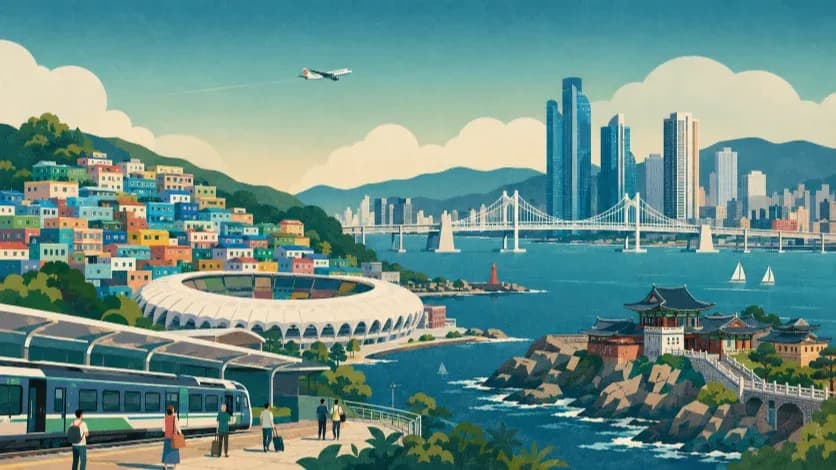
Foreign arrivals are rising and K-culture is pushing more travelers beyond Seoul. The harder question is whether Busan can turn beaches, festivals, airports, hotels, maps and late-night trains into a trip people want to repeat.
Busan enters the BTS concert weekend with record foreign tourism behind it, lodging complaints ahead of it, and a city tourism plan that already admits how much work remains in airports, payments, late-night transport and visitor movement.
The two-night concert at Busan Asiad Main Stadium will draw a stadium crowd to a city that has become more visible abroad. Foreign visitors reached 1.48 million through April, up 39.1 percent from a year earlier. City officials are no longer trying to solve the old problem of whether international travelers know Busan exists.
The problem has moved. Once visitors decide to come, Busan has to hold the trip together.
That work begins before the visitor reaches Haeundae, Gwangan Bridge or the stadium gates. It begins with the route into the city, the room that has to stay booked, the cancellation terms that have to remain clear, the map that has to make a restaurant legible, the payment step that has to work, and the train that has to carry people back after the encore.
BTS gives the question urgency, but the question is larger than BTS. Busan’s claim to be a major tourism city will not be decided by one crowded weekend. It will be decided by whether the city can turn one-time attention into an experience that feels stable enough to repeat.
Korea’s tourism boom still runs through Seoul
South Korea’s foreign tourism market has moved beyond recovery. In March, the country recorded 2.06 million foreign arrivals, a monthly record, and first-quarter arrivals rose 23 percent from a year earlier to 4.76 million. The Ministry of Culture, Sports and Tourism linked the surge to the global pull of Korean culture, while BTS’s return added a measurable spending effect.
That national boom is beginning to move outside the capital. More foreign travelers are entering through regional airports, and the share of visitors traveling beyond Seoul and the surrounding area has risen. That shift matters for Busan because it creates an opening the city has long wanted: a chance to become more than a second stop after the capital.
The opening does not erase Seoul’s advantage. Seoul has already turned K-culture into dense urban routines. A visitor can move from concert culture to beauty retail, from a pop-up store to a café district, from a clinic to a department store, from a fan site to a late-night restaurant, often inside a commercial map that already understands foreign demand. The capital’s tourism strength is not only the number of things to see. It is the way those things sit close together and reinforce one another.
Busan has its own assets, and they are not minor ones. The city has beaches, seafood, markets, film culture, ports, night views, festivals, hot springs, medical tourism potential and neighborhoods with a texture Seoul cannot copy. Its problem is different. Busan has to convert attractions into sequences.
A beach becomes part of a tourism economy when it connects to dinner, transport, payment, language, a safe return route and a reason to stay another night. A festival becomes more valuable when it sends visitors into local businesses rather than concentrating them at a venue. A neighborhood becomes more than a name in a guide when foreign visitors can find it, understand it, pay there and leave without needing local help.
That is the standard Busan now faces. The city is benefiting from the same cultural wave that has strengthened Korea’s tourism market. The next question is whether Busan can make that wave settle into the city as repeatable movement, spending and memory.
Busan has the numbers. The route map shows dependence.
Busan’s growth is real enough to change the argument. Through April, 1.48 million foreign visitors had reached the city, with Taiwan, China, Japan and the United States among the largest inbound markets. The city’s 2025 foreign visitor count also reached a record high, and official plans now aim to move beyond raw arrivals toward longer stays and higher spending.
The route map complicates the success. Through April, 44 percent of foreign visitors reached Busan after passing through another region. Gimhae Airport accounted for 42 percent. Busan Port accounted for 14 percent. The city is gaining demand as a destination while a large share of its arrival experience still begins somewhere else.
That matters because arrival is part of the product. A visitor who lands in Incheon and then builds the Busan leg through rail, bus, domestic transfer, luggage timing, hotel check-in and map apps has already spent time and attention before Busan appears. For some travelers, that transfer is efficient. For others, especially long-haul visitors or people arriving for a fixed event, the transfer is the first obstacle.
Gimhae Airport carries much of the present burden, but it cannot easily absorb the whole ambition. Its operating day is constrained by a nighttime flight restriction, and local reporting has described its slots as roughly 90 percent saturated. The airport remains weighted toward short-haul regional routes, which supports nearby Asian markets but limits the direct long-haul access that would make Busan more fully a first destination.
Gadeokdo New Airport is often presented as the future answer. In the present tense, it also reveals the weakness of the current gateway. A city does not keep invoking a future airport unless the existing map is insufficient for its ambition.
Busan’s own 2030 tourism plan recognizes the gap. Before Gadeokdo changes the map, the city says it will strengthen links between gateway airports, improve access from Incheon, expand cruise strategy, and reduce inconvenience in language, movement and payment. Read backward, the plan is a diagnosis. Every promised upgrade points to a part of the visitor experience that has not yet become routine.
A city aiming for millions more foreign visitors cannot leave arrival as background logistics. Arrival is the first chapter of the destination. In Busan’s case, that chapter still begins too often through someone else’s front door.
Places become experiences only when they connect
Busan does not lack places to show.
The city can put Haeundae, Gwangalli, Gamcheon Culture Village, BIFF Square, Seomyeon, Yeongdo, Gijang, Nampo, North Port, hillside neighborhoods and local markets into a visitor’s itinerary. The material is there. The harder work is turning those places into a trip that foreign visitors can use without the constant help of a local intermediary.
A place can be famous and still be partly absent from the visitor economy. If it cannot be found on the map service a traveler uses, read in a language the traveler understands, reached at the right hour, booked without help, paid for with a foreign card and left safely at night, it remains fragile as a tourism asset. Recognition does not make a place accessible by itself.
That is the more useful way to read Busan’s BE LOCAL campaign with Naver. The program introduces hundreds of restaurants, cafés and cultural spaces through the multilingual version of Naver Map, linking discovery to coupons, reservations, payment and visits. On the surface, it is a promotion tied to a busy tourism season. More deeply, it is a translation device for a city whose local experiences do not yet move automatically into foreign itineraries.
The campaign points to one of Busan’s central problems. The city wants visitors to move beyond a few familiar corridors, but movement does not spread by hope. It spreads through legible routes, reliable information, working payment steps and enough confidence to choose a neighborhood that is not already famous abroad.
A restaurant that cannot be found, reserved or paid for through the tools visitors use is only partly present in the tourism economy. A district that is beautiful in a city brochure can still remain distant if the last train is unclear, the taxi experience is uncertain or the return route feels risky after dark.
Busan’s 2030 plan uses the language of longer stays, higher spending, night tourism, cruise growth, smart tourism and a more valuable visitor economy. Those goals will be won in small, repetitive ways: one translated listing, one reliable transfer, one payment system, one evening route, one neighborhood that becomes easy enough for a foreign visitor to choose without local help.
That is how places become sequences. That is how sequences become memory.
BTS gathers the unfinished system into one weekend
The BTS concerts do not create Busan’s tourism weaknesses. They gather them into the same weekend.
Accommodation exposed the first fault line. A government-backed survey of 135 hotels, motels and pensions in Busan found that average room rates for the concert weekend were 2.4 times higher than the weekends before and after it. Some properties moved far beyond the average, with one case reaching 7.5 times its usual rate and more than a dozen properties charging at least five times their ordinary prices.
High prices around major events are familiar. The more serious damage begins when visitors question the stability of the booking itself. A canceled reservation, a changed condition, an excessive penalty or a room relisted at a higher price changes the relationship between traveler and city before arrival. The trip has not started, yet the destination has already become harder to manage.
Complaint data moved in the same direction. In May, Busan accounted for 185 of 368 tourism-related complaints filed nationwide, with foreign visitors making up most complainants. Lodging dominated the list. The city’s tourism boom was being measured not only in arrivals and spending, but also in disputes over the basic contract of travel: a room, a price and a condition that should hold.
Transport adds the second fault line. Before a concert, arrivals can scatter across the day. After the encore, the clock tightens. Thousands of people need exits, platforms, transfers and last trains in the same narrow window. Busan Metro is adding train runs, extending service hours and preparing crowd controls around Sports Complex and Sajik stations. Those measures are useful. They also reveal how much pressure a single event can place on an ordinary network.
The movement problem reaches beyond rail capacity. It becomes a language problem, a payment problem, a crowd-design problem and a staffing problem. A visitor who followed the itinerary all day still has to read the right sign, choose the correct direction, pass through the gate, avoid a bottleneck and make the next connection late at night.
Public labor sits behind that movement. Busan first considered assigning hundreds of city and district officials around the concert area, then shifted to a volunteer-based plan after resistance from public workers and union criticism. The dispute did not challenge the need for crowd safety. It clarified the balance sheet behind city branding. When a private concert becomes a municipal tourism opportunity, public systems are asked to carry part of the event’s weight.
That question will return whenever Busan builds tourism around major events. K-pop concerts, festivals, cruise arrivals, night markets and global cultural programs can all bring attention. Attention asks for workers, trains, notices, police lines, complaint desks, translated information and late shifts. The poster shows the performance. The city supplies the labor that makes the performance survivable as a visitor experience.
The next stage is accumulated experience
Busan’s tourism future will not be decided by a single concert weekend.
The more useful measure will appear after the crowd leaves: whether visitors remember a city that became easier as they moved through it, or one that required too much assembly at every step. That distinction will decide whether Busan becomes a repeat destination or an attractive add-on to a Korea trip still centered elsewhere.
A first visit becomes a second visit because the earlier trip held together. The airport route made sense. The room stayed booked. The train was understandable. The meal was findable. The payment worked. The late-night return did not feel improvised. The neighborhood beyond the famous beach felt reachable enough to try.
Busan already has the material for that kind of city. Its challenge is to turn material into pattern. Beaches must connect to evenings. Festivals must connect to restaurants. Cruise arrivals must connect to neighborhoods. Medical tourism must connect to hotels and translators. North Port, Yeongdo, Gijang, the old downtown and the western edge of the city must become more than names in a development plan. They have to become usable parts of a visitor’s memory.
That is why the word “global” deserves caution. A city government can put it in a slogan. Visitors give it meaning only through repeated use. The label becomes real when the city works in enough languages, at enough hours, across enough neighborhoods, with enough fairness that visitors can imagine coming back without the event that first brought them.
The BTS weekend will tell Busan how much attention it can gather. The more important lesson will come later, in the quieter accounting of returns. A tourism city is not built by arrivals alone. It is built by experiences that make arrival worth repeating.
Continue this reporting
Reporting on the same issue
Related coverage selected from the article's desk, topics and newsroom relationships.
 NewsSep 20, 2026
What It Takes for U.S. Navy Repair Work to Become a Busan Industry
HJ Shipbuilding has brought U.S. Navy maintenance work to Yeongdo. Whether it...
 NewsSep 17, 2026
Busan’s Finished Homes, Unfinished Projects
Busan’s unsold homes sit in one monthly total, but they belong to very differ...
 NewsSep 16, 2026
Busan’s Young-Adult Migration Turns Sharply at 25–29
Busan can still draw young adults into the city, but keeping them becomes far...
More from the author
More from this byline
Stay with the same line of reporting through more work from this byline.
Editorial Record
Corrections, sourcing notes and newsroom disclosures remain part of the published record. View Newsroom Notes →
Reader Signal
Community readWhat did this report leave you with?
Choose the signal that best reflects your reading. Select it again to remove it.
One response per article
No response selected
A moderated conversation about the reporting.
One-level replies and newsroom moderation keep the conversation anchored to this article.
Discussion Status
Open
Please sign in to join the discussion.
Newsletter
Weekly reporting and context from Busan and Korea.