Busan’s Maritime Capital Push Targets Global Shipping Power
Busan’s maritime-capital project is moving from slogan to execution. The city must now prove that HMM, Arctic routes, maritime finance and legal services can create real authority around its port

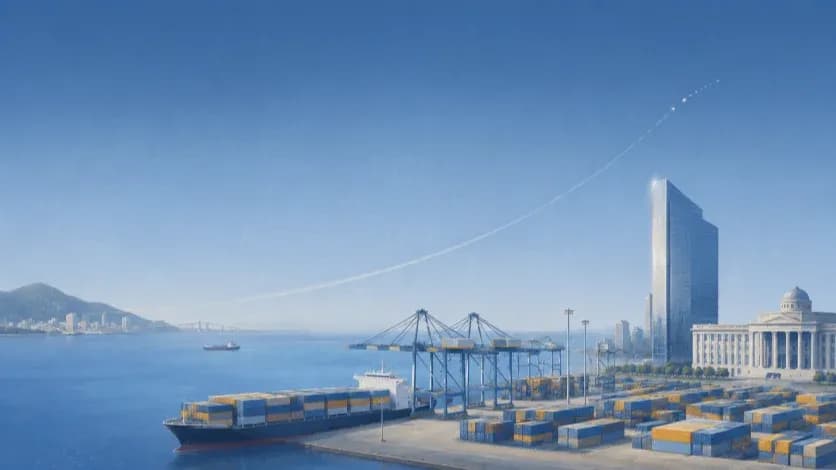
Busan has never needed a national ceremony to prove its maritime identity. The harbor has long carried that argument by itself, through the container stacks at New Port, the transshipment schedules linking Northeast Asia to global routes, and the industrial memory of a city shaped by docks, shipyards, ferries, warehouses and sea lanes.
The Day of Seas ceremony at Korea Maritime & Ocean University therefore carried a different weight. Coming after the relocation of the Ministry of Oceans and Fisheries to Busan, it placed the government’s maritime agenda inside a city already dense with port history and regional ambition. The significance lay less in the ceremonial stage than in the policy convergence surrounding it: a relocated ministry, a national maritime-capital strategy, HMM’s planned move south, a maritime commercial court scheduled for 2028 and an Arctic-route pilot connecting Busan to Rotterdam.
President Lee Jae Myung’s remarks framed shipping and port industries as national strategic sectors, not as a local development slogan or a narrow logistics concern. That framing expands the meaning of Busan’s maritime push. Sea lanes now sit inside larger questions of supply-chain resilience, export security, shipbuilding competition, energy movement and geopolitical pressure on global trade routes. A port city that once argued from geography must now argue from institutional capacity.
The government’s southern maritime capital region strategy assigns Busan the role of an international maritime business hub, while positioning Ulsan around green energy and South Gyeongsang Province around port logistics, manufacturing and artificial intelligence. On paper, the structure gives southeastern Korea a division of labor rather than a single-city development plan. In practice, its success will depend on whether the policy architecture produces a concentration of authority in Busan: corporate headquarters with real departments, courts with real cases, financial institutions with maritime capital, and shipping routes with commercial repetition.
That distinction should shape the debate. A ministry can relocate without moving an industry. A headquarters can change its registered address without shifting strategic command. A court can open without creating a legal market. A route can be announced without becoming a commercially durable corridor. Busan’s maritime-capital project now stands at the point where symbolic movement must become operational density.
The city already possesses the physical grammar of a maritime capital: harbor, terminals, logistics labor, maritime education, shipbuilding hinterland and geographic access to Northeast Asian trade. The unfinished work lies in the command system surrounding those assets. Cargo already moves through Busan at global scale. Maritime power requires contracts written in the city, disputes settled in the city, financing arranged in the city, data interpreted in the city and careers built in the city.
Port Scale, Limited Command
Busan’s claim to maritime importance does not rest on aspiration. The port already carries the numerical weight of a global logistics hub. In 2025, Busan Port handled 24.88 million TEUs of container cargo, with transshipment accounting for roughly 14.1 million TEUs, or about 57 percent of the total. The port’s place inside Korea’s maritime system is even more concentrated. In 2024, Busan handled 76.9 percent of the country’s container throughput and 97.2 percent of its transshipment cargo.
Those figures give the city an authority that few regional economies can claim. Busan is not merely one port among many in Korea. It is the country’s principal maritime gateway and its dominant transshipment platform, a place where cargo bound for other markets is sorted, transferred and redirected through networks that extend far beyond the Korean economy. Its terminals sit inside the operating logic of global shipping lines, alliance schedules, feeder routes and Northeast Asian port competition.
Yet the same figures expose the limits of port scale. Transshipment gives Busan global relevance, but it also ties the city to decisions made elsewhere: by carriers adjusting alliance networks, by cargo owners choosing routes, by insurers pricing risk, by terminal operators negotiating cost structures, and by governments responding to chokepoints, sanctions and geopolitical disruption. A transshipment hub can become indispensable to maritime movement without capturing enough of the higher-value work around that movement.
Cargo volume proves logistical capacity. It does not prove institutional command. Containers can pass through a city while shipping finance remains elsewhere, maritime contracts are negotiated elsewhere, disputes are litigated elsewhere, insurance is underwritten elsewhere, and route strategy is set elsewhere. A port can be busy without becoming the place where the business of shipping is governed.
Busan’s challenge therefore lies not in proving the scale of its harbor, but in changing the economic meaning of that scale. The city needs to convert throughput into clustered services: maritime finance, marine insurance, ship management, legal expertise, logistics data, port technology, risk analysis and executive decision-making. The value surrounding a container does not end at the quay. It runs through contracts, credit, fuel, maintenance, insurance, arbitration, customs systems, routing data and customer relationships.
The government’s maritime-capital strategy implicitly recognizes that gap. A port city becomes a maritime capital only when the industries surrounding the port thicken into an ecosystem. HMM’s relocation, the planned maritime commercial court, Arctic-route policy, green bunkering, ship MRO and AI logistics all point toward that thicker structure. Their importance lies not in individual symbolism, but in the possibility of turning Busan’s physical port power into a durable concentration of professional authority.
The risk is familiar to port cities. Global cargo can generate impressive throughput without producing enough local control. Cranes move, terminals expand and annual volume records climb, while finance, law, network planning and corporate strategy remain detached from the waterfront. Busan’s transshipment dominance gives the city leverage, but leverage must be converted into institutions, firms and careers before it becomes power.
The harbor has already given Busan scale. The next stage requires value to stay closer to the harbor.
Relocation and the Question of Authority
A headquarters can move faster than an industry. Corporate relocation carries political force because it is visible: a nameplate moves, an address changes, a city gains a symbol that can be photographed, announced and folded into a larger narrative of regional transformation. HMM’s planned move to Busan belongs to that category. As Korea’s largest shipping company, its relocation gives the maritime-capital project a centerpiece that government agencies alone could not provide.
Yet the substance of relocation begins only after the symbol. A shipping company does not exercise power through its registered address. Authority sits inside departments, personnel, contracts, operating rooms, financial decisions, legal strategy, network planning, risk management and relationships with cargo owners. HMM’s move will matter most if Busan gains not only a headquarters but the functions that make a headquarters consequential.
A narrow relocation would give the city prestige without altering the geography of maritime decision-making. A deeper relocation would place executive strategy, finance, legal affairs, global sales, route planning and operational control inside Busan’s daily economy. The difference is structural rather than administrative. One version adds a corporate sign to the waterfront. The other begins to anchor a maritime command system.
The same distinction applies to public institutions. The Ministry of Oceans and Fisheries gives Busan proximity to national maritime policy, but proximity alone does not guarantee local transformation. A ministry can move into a city while procurement, regulation, budget execution and industry formation remain distant from local firms and workers. Administrative relocation becomes economically meaningful only when policy authority begins to interact with nearby companies, universities, courts, financiers and technical specialists.
The government’s support measures for relocated institutions and companies acknowledge the difficulty of that transition. Office space, public assets, housing support and settlement incentives are not minor details. They shape whether relocation becomes a durable urban shift or a formal transfer resisted by workers, families and partner firms. Maritime industries depend on specialized labor, and specialized labor does not move by decree. Schools, housing, professional networks, spouses’ careers, airport access and the quality of the urban environment all become part of the relocation equation.
HMM’s move will also test whether related industries follow. Shipping headquarters rarely operate in isolation. Around a major carrier sit law firms, insurers, ship managers, port service providers, IT vendors, financial institutions, consultants, brokers and data platforms. Busan’s maritime-capital strategy gains depth only if relocation creates that surrounding field. Without supplier and service migration, the city may hold the corporate shell while the wider commercial ecosystem remains split across other centers.
The arrival of SK Shipping and H-Line Shipping in the same policy conversation strengthens the impression of a broader shift, but the same standard must apply to every announced move. The meaningful questions remain concrete: which departments relocate, how many employees move, which decisions are made in Busan, which service providers follow, which contracts are handled locally, and which new jobs enter the city’s professional market.
A maritime command economy cannot be registered into existence. It forms when repeated decisions gather in the same place: a route adjusted from one office, a financing package arranged nearby, a legal dispute prepared by local counsel, a risk model built by a local analyst, a customer contract negotiated by a local team. Busan’s opportunity lies in that accumulation. Its vulnerability lies in mistaking the first visible movement for the whole transformation.
The next phase of the maritime-capital project will therefore be measured less by the number of institutions announced than by the density of functions transferred. Names matter. Offices matter. Addresses matter. None of them matters enough without authority.
The Arctic Route and the Geography of Risk
The Arctic route gives Busan’s maritime-capital strategy its most ambitious international horizon. A Busan-Rotterdam pilot voyage would place the city inside one of the most consequential debates in global shipping: whether climate change, geopolitical disruption and supply-chain pressure will redraw the commercial map between Asia and Europe. The appeal is easy to understand. A northern corridor promises distance savings, strategic diversification and an alternative to routes exposed to conflict, congestion and chokepoint politics.
The harder truth sits beneath that appeal. An Arctic route is not opened by geography alone. A shorter line on a map becomes a viable shipping corridor only when vessels, insurers, cargo owners, regulators, ports and governments can make the route repeatable. Polar waters impose a different standard of navigation. Ice-class capability, crew training, search-and-rescue capacity, weather volatility, seasonal limits and environmental regulation all shape the cost of a voyage before a single container is loaded.
The government’s plan to test a Busan-Rotterdam voyage and pursue regular Korea-Europe Arctic operations by 2030 therefore carries two meanings at once. It is a statement of ambition, placing Korea’s southern port system into a future route architecture. It is also an exposure to a difficult operating environment where maritime strategy intersects with sanctions, Russian territorial waters, insurance pricing and the uncertain commercial appetite of cargo owners.
That complexity matters because global shipping has entered an era in which route choice no longer belongs only to logistics departments. The Red Sea crisis, disruptions around the Suez Canal, war-risk premiums, port congestion, climate regulation and shifting alliance networks have pushed shipping into the domain of national resilience. A route once assessed mainly by cost and distance now carries strategic meaning. Korea’s interest in the Arctic route reflects that wider anxiety: an export economy cannot remain indifferent to the vulnerability of its sea lanes.
Busan’s role in that strategy depends on more than being the point of departure. A pilot voyage can deliver symbolism; a durable route requires operational depth. The city would need carriers prepared to commit vessels, cargo owners prepared to accept risk, insurers prepared to price the corridor, legal teams prepared to manage exposure, port operators prepared to handle schedule uncertainty and public agencies prepared to sustain diplomatic and regulatory coordination. A single successful voyage would not prove that system. Repetition would.
The environmental dimension further complicates the promise. Arctic shipping is often described through the language of efficiency, especially shorter distance and reduced sailing time. Yet polar navigation also raises questions about fragile ecosystems, black carbon emissions, accident response and the contradiction of using climate-driven ice retreat as a commercial opportunity. A maritime capital built around future shipping cannot separate route strategy from environmental legitimacy. The Arctic route may offer a strategic opening, but it will not escape scrutiny from regulators, environmental groups, insurers and global customers under pressure to decarbonize supply chains.
The commercial question remains equally demanding. Cargo owners choose routes not only by distance but by reliability. A shipper moving goods between Asia and Europe values predictable schedules, insurance clarity, cost discipline, port connectivity and the ability to absorb disruption. Seasonal access and geopolitical exposure weaken the simplicity of the Arctic proposition. The route’s value will depend on whether it can offer a credible service pattern rather than an exceptional voyage.
This is where Busan’s broader maritime-capital project becomes relevant. The Arctic route would require precisely the high-value functions the city is trying to build: maritime law, insurance, risk analytics, ship finance, port data, vessel operations, environmental compliance and international commercial coordination. The route is not separate from the city’s institutional ambitions. It is a test of them.
A port can host a pilot. A maritime capital can manage the risks behind one. The distinction will decide whether the Arctic route becomes a strategic corridor in Busan’s future or another policy milestone remembered for its symbolism.
The Institutions Behind Maritime Power
A port becomes powerful through movement. A maritime capital becomes powerful through the institutions that govern movement. The difference lies in the invisible work around a vessel before it arrives and after it leaves: financing, insurance, chartering, compliance, litigation, arbitration, maintenance, fuel strategy, route analysis, customs data, cargo visibility and risk pricing. Busan’s maritime-capital project will rise or fall in that surrounding architecture.
The planned Busan Maritime International Commercial Court gives the city one of the most important institutional pieces. Its scheduled opening in 2028 places maritime civil cases, maritime administrative disputes and international commercial litigation inside the city’s strategic map. Yet a court alone cannot create a legal market. Jurisdiction gives Busan a forum. Market power requires lawyers, arbitrators, translators, expert witnesses, insurers, shipowners, cargo interests and foreign companies willing to bring disputes and contracts into that forum.
The challenge is not ceremonial access to maritime law, but professional density. Global maritime disputes move toward places with trusted judges, specialist lawyers, predictable procedure, enforceable outcomes, multilingual capacity and supporting arbitration culture. London, Singapore and Hong Kong did not become maritime legal centers through courts alone. They accumulated legal expertise, insurance markets, ship finance, commercial custom and international confidence over time. Busan’s court can become a starting point only if the city builds the professional field around it.
Finance presents the same test. Shipping is capital-intensive by nature. Vessels require credit, guarantees, refinancing, leasing structures, insurance cover, fuel-risk management and long-term investment judgment. A maritime-finance strategy cannot rest on buildings or institutional labels alone. It requires a working market in which banks, public finance agencies, insurers, law firms, brokers and shipping companies structure real transactions in the city.
Korea already possesses pieces of that system. The Korea Ocean Business Corporation gives Busan an institutional anchor in ship finance and maritime industry support. The Busan International Finance Center offers a physical and symbolic platform. HMM’s relocation could bring corporate demand closer to those institutions. The remaining question is whether those pieces begin to interact in daily commercial practice: loan negotiations, vessel financing, credit assessment, restructuring, insurance placement, investment review and risk modeling performed with Busan as the operating center rather than a branch location.
Marine insurance and P&I services belong at the center of that conversation. Shipping risk is not abstract. A vessel carries exposure to cargo claims, collision, pollution, sanctions, war risk, crew injury, port delay, weather disruption and contractual default. A city seeking maritime authority needs the capacity to price and manage those risks. Arctic-route ambitions make that need sharper. Polar navigation, sanctions exposure, environmental liability and emergency response cannot be handled by port infrastructure alone. They require insurers, lawyers, analysts and regulators working close to the commercial decisions.
Data now adds another layer to maritime power. Modern ports compete not only through berths and cranes, but through schedule reliability, cargo visibility, digital customs flows, berth planning, emissions tracking, predictive maintenance, autonomous systems and artificial-intelligence logistics. The government’s emphasis on AI-linked port logistics and manufacturing in the southern maritime region recognizes a shift already underway across global shipping. The port of the future is not merely a place where containers are stacked. It is a system where information determines speed, cost, reliability and trust.
Busan’s advantage is that these functions can reinforce one another. A shipping headquarters creates demand for finance, law, insurance and data. A maritime court increases the need for specialist legal services. Arctic-route operations require risk analytics and environmental compliance. Green bunkering needs energy finance, safety regulation and vessel-service expertise. Ship MRO connects port activity to maintenance, engineering and technical employment. The strategic value lies less in any single institution than in the chain formed among them.
The danger lies in fragmentation. A court without cases, a finance center without maritime transactions, a port without data governance, a relocation without strategic departments and an Arctic pilot without commercial repetition would leave Busan with impressive parts but no integrated system. Maritime capitals are not assembled through announcements. They are formed through repeated transactions that make one city the practical location of trust, judgment and coordination.
Busan’s harbor provides the physical base. Its next layer must be institutional. The city needs contracts drafted near the port, disputes prepared near the companies involved, financing arranged near the assets financed, insurance priced near the risks, data analyzed near the operations, and technical services tied to vessels that actually call. Only then does port activity become professional authority.
The measure of success will be visible in ordinary commercial habits. Where shipping companies seek counsel. Where banks structure vessel finance. Where insurers assess route exposure. Where cargo owners negotiate contracts. Where analysts interpret port data. Where young professionals choose to specialize in maritime work. A maritime capital is built when those decisions begin to point toward the same city.
Careers as the Final Test
A maritime capital that cannot create careers will remain an institutional label. The final test of Busan’s strategy will not be the number of agencies relocated, ceremonies held, or policy terms repeated in official documents. It will be whether the city can give young professionals a serious reason to build maritime lives there: in finance, law, insurance, logistics data, ship management, port technology, global sales, environmental compliance and route-risk analysis.
That test carries particular weight in a city still marked by youth outmigration. Busan’s economic challenge has never been only the absence of projects. The city has lived for years with a more difficult imbalance: major infrastructure, strong industrial memory and a globally important port on one side; the persistent departure of young workers seeking career ladders elsewhere on the other. A maritime-capital strategy that does not confront that imbalance risks becoming another development narrative layered over the same demographic loss.
The distinction between jobs and careers matters. Large public projects can generate employment during construction, administration and operations. A maritime capital requires something deeper: professional progression. A graduate should be able to enter maritime finance, move into ship investment or credit risk, work with insurers and lawyers, understand vessel operations, build expertise in emissions compliance or Arctic-route risk, and remain in Busan without accepting a ceiling on ambition. The city needs not only positions, but pathways.
Those pathways will depend on the density of the ecosystem described throughout this strategy. HMM’s relocation matters if it brings strategic departments and hiring pipelines. The maritime commercial court matters if it creates demand for young lawyers, translators, clerks, researchers and dispute specialists. Arctic-route policy matters if it produces work in risk modeling, insurance, environmental compliance and route operations. AI logistics matters if it connects port data with software, engineering and applied research. Maritime finance matters if banks and public institutions structure real transactions in the city, rather than treating Busan as a symbolic address for a Seoul-centered market.
Local universities sit at the center of that transition. Korea Maritime & Ocean University gives the city a natural training base, but the future workforce cannot be limited to traditional maritime disciplines. Busan will need lawyers who understand shipping contracts, engineers who understand vessel technology, data scientists who understand port operations, financiers who understand ship assets, and policy specialists who understand sanctions, climate rules and trade routes. Pukyong National University, Busan National University, Dong-A University and other regional institutions can become part of that labor architecture only if education, internships, recruitment and industry demand are deliberately connected.
The same logic applies to housing, mobility and urban life. Specialized workers do not remain in a city only because a strategy exists. They remain when jobs are credible, wages are competitive, families can settle, airports and rail links support professional travel, schools and neighborhoods are livable, and the city offers cultural and social confidence equal to its economic ambition. Relocation policy often focuses on institutions first. The success of relocation is usually decided by people.
Busan’s mayoral election gives this question immediate political weight. Competing visions of the city now use maritime language, global-city language and regional-growth language in different combinations. The useful standard is not rhetorical sharpness. It is execution. Voters should be able to ask how many jobs will be created, which fields will grow, which departments will move, which budgets are secured, which institutions are responsible, and what can be measured after one year, three years and five years.
The danger is a familiar separation between national strategy and local life. A ministry moves, a company announces relocation, a court opens, a route is tested, and the city receives the language of transformation. Yet young residents continue to leave if the new structure does not produce accessible careers, competitive salaries and professional identity. Maritime power cannot be claimed only at the level of government strategy. It must become ordinary enough to appear in job postings, university programs, internships, leases, office floors, legal briefs, loan documents and daily commutes.
The strongest version of Busan’s maritime future is not a city that merely hosts institutions. It is a city where maritime expertise becomes a normal career choice, where a young analyst can work on vessel finance near the port, a lawyer can specialize in shipping disputes before the local court, a data engineer can improve cargo visibility for terminal operations, a risk specialist can assess Arctic-route exposure, and a graduate can imagine an international career without first buying a ticket to Seoul.
That is the local meaning of maritime capital status. The harbor gives Busan history. The port gives Busan scale. Institutions may give Busan visibility. Careers will decide whether the strategy becomes a city.
Busan does not need to prove that ships pass through it. The harder test is whether authority, capital, law, data and professional ambition can remain there. The port is already visible. The next question is whether the power behind global shipping can take root in the city that has carried the cargo for generations.
Continue this reporting
Reporting on the same issue
Related coverage selected from the article's desk, topics and newsroom relationships.
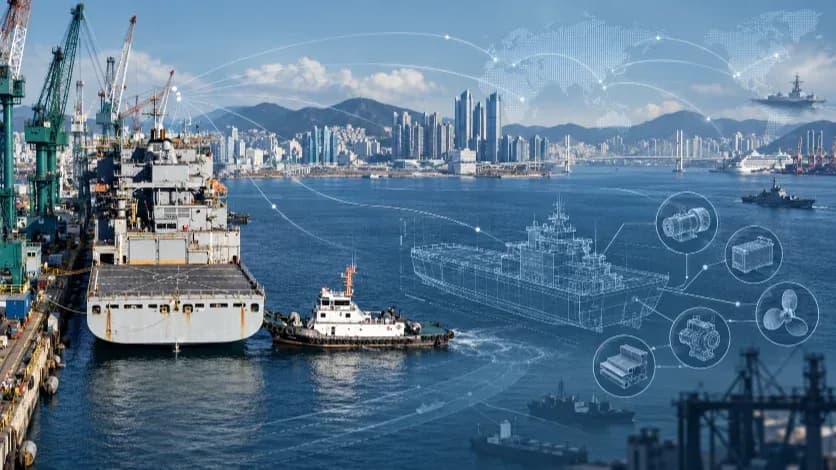 NewsSep 20, 2026
What It Takes for U.S. Navy Repair Work to Become a Busan Industry
HJ Shipbuilding has brought U.S. Navy maintenance work to Yeongdo. Whether it...
 NewsSep 17, 2026
Busan’s Finished Homes, Unfinished Projects
Busan’s unsold homes sit in one monthly total, but they belong to very differ...
 NewsSep 16, 2026
Busan’s Young-Adult Migration Turns Sharply at 25–29
Busan can still draw young adults into the city, but keeping them becomes far...
More from the author
More from this byline
Stay with the same line of reporting through more work from this byline.
Editorial Record
Corrections, sourcing notes and newsroom disclosures remain part of the published record. View Newsroom Notes →
Reader Signal
Community readWhat did this report leave you with?
Choose the signal that best reflects your reading. Select it again to remove it.
One response per article
No response selected
A moderated conversation about the reporting.
One-level replies and newsroom moderation keep the conversation anchored to this article.
Discussion Status
Open
Please sign in to join the discussion.
Newsletter
Weekly reporting and context from Busan and Korea.