Busan’s Mandeok–Centum Urban Expressway Opens Into a Bottleneck
Busan’s 9.62-km Mandeok–Centum Urban Expressway opened in February 2026 to ease east-west congestion, but early traffic data show worsening speeds near Mandeok Interchange, highlighting potential design bottlenecks.

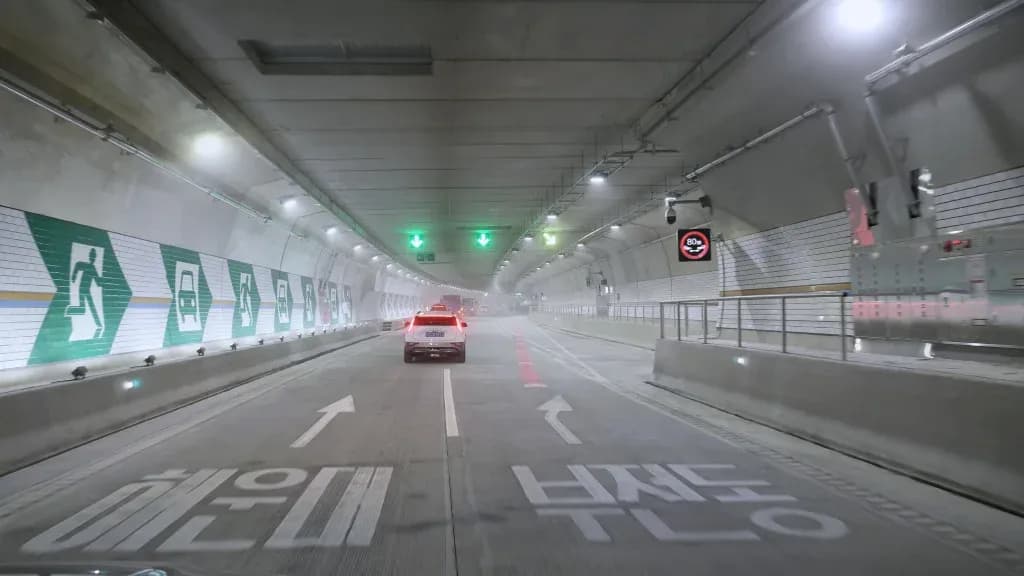
BUSAN — A month after opening, the Mandeok–Centum Urban Expressway is already testing the central claim behind Busan’s tunnel-first traffic strategy. The 9.62-kilometer underground expressway opened on Feb. 10 as the final missing link in the city’s inner ring road, with City Hall promising to cut travel time between Mandeok and Centum from about 42 minutes to roughly 11 minutes while easing chronic congestion on roads such as Mandeok-daero and Chungnyeol-daero. Tolls began on Feb. 19, including a peak-hour passenger-car charge of 2,500 won between Mandeok IC and Centum IC.
What has happened since is more revealing than the opening ceremony. According to traffic data disclosed by Busan Metropolitan Council member Kim Hyo-jung from the city’s traffic information system, average weekday morning speeds from Minam Intersection toward Mandeok fell from 20.6 kilometers per hour before opening to 11.3 kph afterward. On another nearby section, from Mandeok Sageori toward Gupo, speeds fell from 49.4 kph to 24.8 kph. Those figures do not prove that every problem on the corridor comes from one design choice alone. They do show something more immediate and harder to dismiss: at the very interchange where the tunnel is supposed to discharge traffic back into the city, conditions got markedly worse after the road entered service.
That matters because the Mandeok–Centum Urban Expressway project was never sold merely as a piece of engineering. It was sold as a solution — the city’s most ambitious attempt in years to bypass the old east-west choke points without forcing drivers through the familiar surface intersections of Buk-gu, Dongnae-gu and Haeundae-gu. Instead, the first month suggests that the project may have accelerated vehicles through the middle of the journey only to run straight into the physical limits of the network at the end of it. The issue is not whether the tunnel is fast underground. It is whether speed in the tube still counts as a mobility gain when the saving is then contested at the exits.
The Exit Problem Was Technical. The Consequences Are Political.
The pressure point is Mandeok IC. This is where tunnel traffic meets vehicles already moving through the older surface network, including routes tied to the Namhae Expressway and surrounding arterials. In traffic-engineering terms, the problem is not mysterious. The tunnel does not end in open capacity. It ends in a constrained merge, where multiple traffic streams must sort themselves out over a short distance, with lane-changing demand concentrated precisely where speeds and route choices are changing at once. That kind of geometry turns a high-speed facility into a bottleneck generator if the discharge node cannot absorb the volume being delivered into it.
Busan’s own pre-opening language now reads less like reassurance than foreshadowing. Before and at the time of opening, the city said it would continue monitoring traffic-volume changes and actively respond to traffic-system changes around Mandeok, Dongnae and Centum ICs. That was an implicit acknowledgment that the new road’s performance would depend not just on the tunnel itself but on what happened at the interfaces between the tunnel and the older road grid. Once the data around Mandeok turned negative, the argument shifted quickly from the speed of the tunnel to the handling capacity of the exits.
Critics say that shift should not have surprised anyone. Kim and other local critics have argued that earlier traffic-impact reviews in 2018 and 2019 had already flagged the Mandeok layout as a likely choke point. Yonhap reported that concerns about the interchange had been raised in those earlier reviews, and local reporting before opening described a short weaving section likely to carry heavy lane-changing demand. Public reporting also indicates that the city later reviewed ways to separate part of an approximately 376-meter stretch leading from the tunnel toward the Namhae Expressway. The full technical record has not been laid out in all its detail in public reporting, so a definitive engineering verdict should be treated cautiously. But the broad sequence is clear enough: the opening-month disruption occurred at the same kind of junction critics had already identified as vulnerable.
That sequence is what turns this from a routine opening-month traffic adjustment into a sharper policy problem. If a city builds an expensive bypass to escape surface congestion, and the first measurable result is a collapse in speed at the point where the bypass returns traffic to the surface, then the planning question becomes unavoidable. The issue is no longer whether the tunnel works in isolation. The issue is whether the project’s decisive constraint was pushed to the margin of the design — acknowledged, monitored and then left to operational fixes after opening rather than resolved before traffic was invited in.
Busan has already responded in the only way available once the road is open: by trying to repair the discharge point. In its first supplementary budget of the year, the city included funding for road-structure improvements at the starting and ending sections of the Mandeok–Centum Urban Expressway corridor. The English summary of the budget does not specify the detailed engineering package, but the move itself is telling. The city is now spending additional public money not to expand the tunnel, but to stabilize what happens after the tunnel ends. That is an admission not necessarily of negligence, but of mismatch: the tunnel’s promised mobility gain depended on junction performance that the opening month did not deliver.
A Premium Road Still Has to Prove Its Public Value
The fiscal structure makes that mismatch harder to defend. The Mandeok–Centum Urban Expressway cost about 793.1 billion won to build. It is a privately operated toll facility, with toll collection beginning on Feb. 19 and continuing for 40 years under the city’s public notice and project framework. Busan’s own promotional language stressed the road’s expected annual travel-cost savings, productivity effects and role in strengthening cross-city connectivity. In other words, the case for the project was not simply that it was big. It was that it would produce measurable public value by converting a chronically slow corridor into a faster and more reliable one.
That is why the toll issue cannot be brushed aside as routine opposition to user fees. A toll road asks drivers to pay not for asphalt in the abstract, but for a time dividend. If that dividend is undermined at the points where tunnel traffic is discharged back into the urban network, then the political economy of the project changes. The question is no longer whether motorists are paying 2,500 won. It is whether they are being asked to pay for a gain that is real, durable and visible in end-to-end travel rather than confined to the underground segment alone. In transport terms, the tunnel may still be efficient as a conduit. In public terms, that is not enough. A conduit that outruns its exits is not a congestion cure. It is a transfer point for congestion.
The same logic sharpens the criticism of Busan’s wider road-building posture. City Hall framed the expressway as both a traffic solution and part of a larger urban strategy, linking the project to a polycentric city model and even to 15-minute-neighborhood rhetoric. But the road’s immediate geography points in a different direction. It strengthens direct high-speed access from the north and west toward the eastern corridor of Centum and Haeundae — the very districts where traffic demand, commercial gravity and development pressure were already strongest. Critics therefore argue that the project has the practical effect of making it easier to funnel movement into the east without solving why so much movement must be funneled there in the first place. That is a bigger claim than one month of traffic data can fully prove. It is not, however, a speculative one. It follows directly from the project’s alignment, the city’s own stated connectivity goals, and the fact that the first serious failure point has emerged not in the tunnel’s center but where accelerated traffic is returned to a saturated edge of the existing urban system.
This is where the Mandeok–Centum Urban Expressway debate becomes more than a local traffic story. Busan did not just build a road. It built a theory of congestion relief: if the city could carve a fast, grade-separated corridor beneath its most constrained surface routes, it could preserve long cross-town movement without having to confront the limits of the old network above. The first month has not killed that theory outright. But it has exposed its weakest assumption. A city cannot tunnel its way out of a bottleneck if the bottleneck is waiting at the exit. That is why the additional 2.1 billion won now matters so much. It is not simply a follow-up expense. It is the first price of discovering that the tunnel’s hardest problem was never speed underground. It was geometry, capacity and urban demand at the point where the underground road ends.
For Busan, that leaves a more difficult question than the one the project was built to answer. The city knows how to move cars quickly through a deep tunnel. What it has not yet shown is that this automatically translates into systemwide relief once those cars are handed back to a congested surface grid. Until that is demonstrated, the Mandeok–Centum Urban Expressway will stand less as proof that Busan has solved east-west congestion than as evidence that the city’s most expensive mobility projects are now colliding with a more stubborn limit: not how fast vehicles can travel underground, but how little room the city has left to receive them when they come back up.
Continue this reporting
Reporting on the same issue
Related coverage selected from the article's desk, topics and newsroom relationships.
 NewsSep 20, 2026
What It Takes for U.S. Navy Repair Work to Become a Busan Industry
HJ Shipbuilding has brought U.S. Navy maintenance work to Yeongdo. Whether it...
 NewsSep 17, 2026
Busan’s Finished Homes, Unfinished Projects
Busan’s unsold homes sit in one monthly total, but they belong to very differ...
 NewsSep 16, 2026
Busan’s Young-Adult Migration Turns Sharply at 25–29
Busan can still draw young adults into the city, but keeping them becomes far...
More from the author
More from this byline
Stay with the same line of reporting through more work from this byline.
Editorial Record
Corrections, sourcing notes and newsroom disclosures remain part of the published record. View Newsroom Notes →
Reader Signal
Community readWhat did this report leave you with?
Choose the signal that best reflects your reading. Select it again to remove it.
One response per article
No response selected
A moderated conversation about the reporting.
One-level replies and newsroom moderation keep the conversation anchored to this article.
Discussion Status
Open
Please sign in to join the discussion.
Newsletter
Weekly reporting and context from Busan and Korea.