Busan’s Industrial Rebound Meets a Five-Year Slide in New-Business Registrations
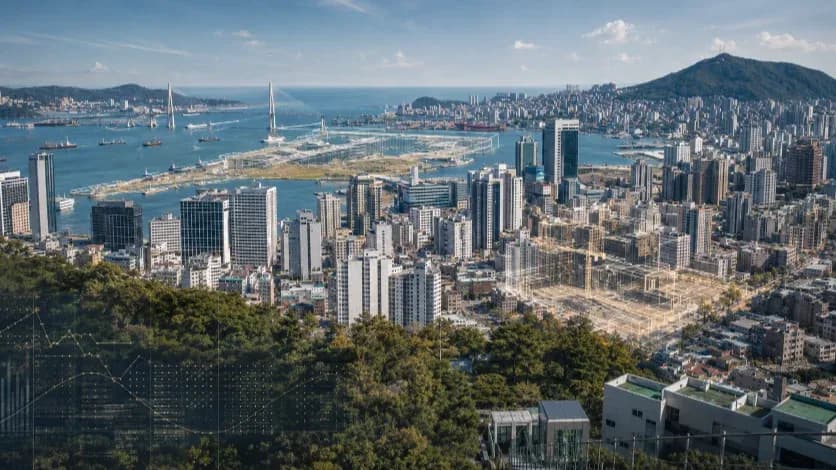
Busan’s factories, exporters and consumers are showing signs of recovery. Beneath those gains, fewer new businesses are entering the market, more established operators are leaving, and a shrinking, aging city is changing the commercial conditions confronting those that remain.


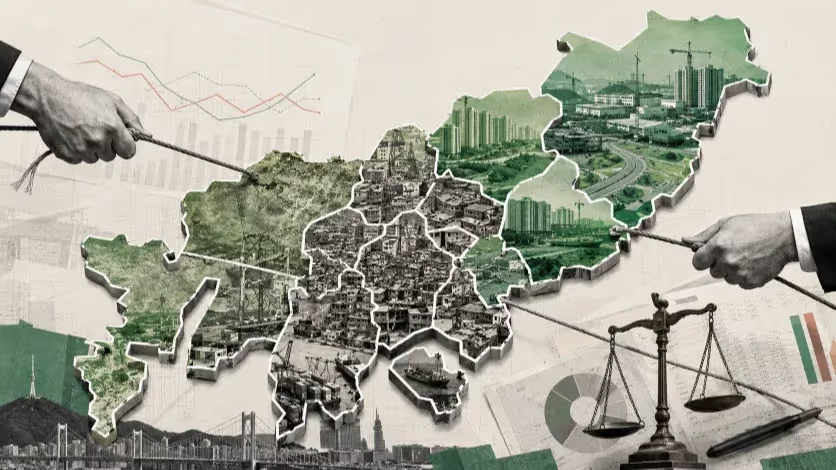
Production, exports and retail sales are rising again, yet new-business registrations have fallen for five consecutive years as more long-established operators leave the market. Much of Busan’s ₩1.378 trillion response is aimed at easing financing pressures, supporting local spending and repairing distressed balance sheets as that transition unfolds.
By mid-2026, Busan was producing the sort of numbers that ordinarily settle the argument over whether a recovery has begun. Industrial production rose 4.0 percent from a year earlier in the second quarter, service output gained 3.6 percent and retail sales increased 3.4 percent. Manufacturing accelerated further in June, climbing 12.3 percent, while exports jumped 28.5 percent and extended their year-over-year gains to a fourth consecutive month. The labor market followed a less orderly path: employment averaged 1.699 million in the second quarter, 15,000 below its year-earlier level, before recovering in July with 14,000 more people in work than a year before.
Even that July gain bypassed some of the industries most closely tied to spending at home. Wholesale and retail, accommodation and food services shed roughly 5,000 workers from a year earlier, as did construction, while manufacturers reported a widening gap between businesses serving overseas customers and those dependent on domestic demand. The third-quarter outlook index for export-oriented firms rose from 64 to 80; among domestically oriented manufacturers it fell from 71 to 61, leaving the broader manufacturing reading at 64, far below the 100 threshold separating net optimism from pessimism. Stronger production, exports and retail spending are part of the current economy, but they are advancing through a commercial landscape in which locally exposed businesses have yet to register the same breadth of improvement.
Busan ended 2025 with 593,221 active businesses, 0.5 percent more than a year earlier, a remarkably durable aggregate after the pandemic, inflation, elevated financing costs and years of weak domestic demand. Yet only 60,997 businesses were newly registered during the year, the lowest annual total since comparable regional data began in 2015 and the fifth consecutive decline. Another 20,134 businesses closed after operating for at least five years, the highest figure in regional records extending back to 2007.
With nearly 600,000 active registrations, Busan can absorb weaker entry for a considerable period before the headline stock begins to fall. Owners retire, businesses change legal form, weaker firms disappear and capital shifts between industries every year, while new ventures replenish part of what is lost. What has changed is the balance inside that turnover: new registrations have been receding for half a decade while departures have increased among operators that had already survived beyond their most vulnerable opening years. A stable year-end count can coexist with that deterioration because the stock of businesses and the flow replacing them move on different time scales.
The weakness is not uniform across every form of enterprise. The Busan Chamber of Commerce and Industry counted 4,383 newly established corporations in 2025, 2 percent more than a year earlier. Corporate formations and the National Tax Service’s broader business-registration series measure different populations and cannot be treated as interchangeable, but their opposing directions rule out the most sweeping interpretation. Busan has not stopped generating entrepreneurial activity; rather, the broad base of business entry captured in the tax data has been weakening even as some more formal corporate activity continues to expand.
One of the city’s most saturated consumer markets shows why neither strong demand nor a large business count guarantees commercial durability. Busan’s cafés nearly tripled in number between 2015 and 2024, from 3,071 to 9,182, while average annual café sales reached ₩150.9 million in 2024 and domestic card spending continued to increase through 2025. Demand, by those measures, remained substantial. Yet 1,375 cafés opened in 2024 while 1,470 closed, and only 43.7 percent survived for three years. The category cannot stand in for the entire small-business economy, but its economics expose a broader problem: rising expenditure can coexist with severe turnover when more operators divide the same market and rent, labor, financing and input costs consume too much of the revenue left behind.
Busan’s wider retail recovery carries a similar complication. Consumer spending is distributed unevenly across neighborhoods, industries, price points and sales channels, while location, competitive density, digital access and cost structures determine how much of each additional won ultimately remains with the operator. Higher aggregate consumption can support local commerce without producing an equally strong rise in sustainable earnings or in the number of businesses willing and able to enter the market. Commercial renewal depends on enough firms converting that spending into margins capable of financing wages, capital investment, debt service and another year of operation.
Fewer Entrants in a Smaller, Older Market
The commercial calculation confronting a new business has also changed because the city itself has changed. Busan’s population fell to 3.235 million in 2025, about 114,000 below its 2020 level, a 3.4 percent decline that was the steepest among Korea’s 17 provinces and metropolitan cities. Some 807,000 residents were age 65 or older, accounting for 24.9 percent of the population and giving Busan the highest elderly share among the country’s special and metropolitan cities.
Population loss does not produce an automatic decline in consumption; Busan’s 3.4 percent increase in second-quarter retail sales makes that clear, as does rising café spending during years in which the resident population was falling. Visitors can spend more, households can increase expenditure and demand can concentrate in particular districts or categories even while the number of residents declines. The composition of that demand, however, changes with age, income and technology. Older households distribute spending differently across necessities, health care, dining, culture and other discretionary categories, while younger residents matter not only as consumers but as workers, household formers and potential entrepreneurs. Online and platform commerce can shift transactions away from neighborhood storefronts without reducing household consumption at all.
A prospective restaurant, retailer or service provider therefore enters a market altered in both size and composition. Rent, equipment and staffing still require capital; early losses still have to be absorbed; enough recurring demand still has to be found to carry the firm beyond its vulnerable first years. Those commitments are now being made in a city with 114,000 fewer residents than in 2020, a substantially older population and a larger share of spending moving through digital as well as physical channels. Existing businesses face the same changes while competing for customers whose purchasing habits and locations are no longer distributed as they once were.
Recent Bank of Korea research on Korean self-employment approaches the national problem through much the same complexity, examining changes in markets, industrial composition, age and debt rather than reducing weakness among small businesses to a temporary shortage of consumer spending. The expansion of online commerce, shifts in the age structure of the self-employed and financial vulnerability among older operators form parts of the same structural adjustment, and Busan concentrates several of those forces within a single metropolitan economy.
Incheon offers a useful comparison because its demographic direction has been markedly different. Another major port and manufacturing city, it continued to add residents while Busan contracted. Housing, migration, industrial structure and labor markets differ too widely to treat the two as a controlled experiment, but their trajectories remove one easy assumption from the discussion: large Korean cities are not all entering this period of adjustment with equally weak population foundations. For Busan, the comparison matters less as a model to copy than as evidence that firms dependent on local demand are trying to renew themselves inside a market whose demographic base is changing faster than that of some comparable metropolitan economies.
None of this amounts to a city in economic retreat across every dimension. New corporations increased last year; service output and retail sales rose in the second quarter; cafés remain abundant and heavily patronized; manufacturing production and exports have strengthened sharply. Those gains make the five-year decline in broader business entry more consequential because they point toward economic reallocation rather than simple disappearance. Activity is moving between industries, places and business models while the broad process through which departing firms are replaced has become less vigorous, leaving a headline business count that can look stable long after the underlying flows begin to change.
The Headline Package Leans Heavily on Credit
Busan announced its July livelihood package at ₩1.3783 trillion, a figure large enough to resemble a massive fiscal injection until its composition is examined. Roughly ₩1.2 trillion of the headline value is associated with an expansion of low-interest policy financing, added to an existing ₩800 billion program and taking available small-business financing to ₩2 trillion. The largest component of the response is therefore credit capacity rather than an equivalent amount of money spent directly from the budget.
For an otherwise viable firm caught between incoming receipts and payroll, rent, inventory or other immediate obligations, that distinction does not make the support less valuable. A direct fiscal transfer increases income or reduces a cost without creating an equivalent repayment obligation, whereas policy lending supplies liquidity on favorable terms while requiring the borrower eventually to generate enough cash to service the debt. When a fundamentally sound business is facing a temporary mismatch in cash flow, cheap financing can preserve customer relationships, workers and accumulated capital that would be costly to rebuild after an avoidable closure.
Direct fiscal resources in Busan’s proposed third supplementary budget are aimed more visibly at current spending and operating costs. Of the ₩637.4 billion increase submitted to the Metropolitan Council, ₩274.7 billion is allocated to livelihood and local economic recovery, with additional Dongbaekjeon incentives, energy assistance and measures aimed at merchant fees, financing expenses and other immediate burdens accounting for a substantial part of the response. The proposal remains subject to the council process rather than representing money already fully enacted and spent.
Dongbaekjeon operates most directly on where local spending lands. Higher incentives have been associated with stronger payments at smaller participating merchants, allowing neighborhood businesses to capture a greater share of transactions already taking place within the local economy. Such redistribution can matter even without an increase in total consumption: moving an existing purchase toward a smaller merchant changes the distribution of revenue and may improve the cash position of an operator working on thin margins. It cannot, however, enlarge Busan’s population, raise the productivity of an individual firm or determine whether a prospective entrant will generate enough earnings over several years to cover wages, rent, financing and the capital committed at opening.
Debt exposes another layer of the problem. A National Assembly Futures Institute survey of 3,088 self-employed people found that sales recovered more strongly than operating profit after the pandemic as rents, input costs and other expenses absorbed much of the improvement. Debt was held by 44.7 percent of respondents and by 51.8 percent of those who had entered self-employment primarily out of economic necessity. A firm can therefore participate in a recovery in sales without repairing financial damage accumulated before it, particularly when higher revenue produces insufficient margin or free cash flow to reduce liabilities carried forward from weaker years.
Once accumulated debt becomes part of the constraint on the operation itself, new borrowing and business rescue cease to be synonymous. Busan’s current policy mix increasingly reflects that progression: new lending now sits beside debt adjustment and rehabilitation support, while closure, re-employment and business-transition programs provide another route when continued trading no longer produces a viable outcome. Digital-commerce and market-access initiatives address firms in a different position altogether — businesses that retain growth potential but need to adapt to the channels through which customers increasingly spend.
Financing works best when an economically sound operation needs time to bridge a liquidity gap; restructuring becomes relevant once accumulated liabilities impede recovery, while an orderly closure can preserve household capital and return labor to more productive use when further refinancing would merely postpone an exit that the underlying business can no longer avoid. These interventions address different points in the commercial life cycle, which is why the coexistence of large-scale credit, debt adjustment and transition assistance makes more economic sense than evaluating any one of them in isolation.
Seoul and Incheon employ much of the same policy toolkit, combining financing, local spending support, restructuring, digital transition and help with closure or business upgrading in different proportions. Busan is neither unusual for subsidizing credit nor deficient simply because immediate relief occupies a prominent place in its response. Most of the July package’s headline value comes from financing, however, while a substantial share of the proposed additional fiscal support is directed toward current transactions and operating costs; digitalization, market access, business transition and growth programs remain part of the broader structure but carry less of the emergency headline.
There is a defensible economic logic to that allocation when viable firms are exposed to temporary financial stress. Losing a business because it cannot finance payroll or inventory destroys accumulated knowledge, customer relationships and productive capital, while the disorderly failure of an overleveraged household can impose costs that extend well beyond the business itself. Credit, current-cost relief and restructuring can preserve economic capacity through such periods, but they operate on a different time scale from the creation of the firms that will replace businesses already leaving the market.
Busan finished 2025 with slightly more active businesses than it had a year earlier even after a fifth consecutive decline in new registrations and a record number of closures among businesses that had operated for at least five years. A stock approaching 600,000 firms can remain intact long after the flow replacing it begins to weaken, just as an industrial recovery can accelerate before the commercial base serving local demand begins to replenish itself at the same pace.
The broader economy now carries both movements at once. Industrial production, service output and retail sales were higher in the second quarter; manufacturing and exports strengthened further in June; employment improved in July. New businesses, meanwhile, are entering less frequently, more established operators are leaving, and the market confronting their replacements is being reshaped by population loss, aging, digital commerce, competitive density and accumulated debt. Busan has assembled substantial tools for the immediate pressures created by that transition, while the longer record remains less responsive to the rebound: recovery in production is already visible, but a comparable recovery in new-business registrations is not.
Editorial Context
"Independent journalism relies on radical transparency. View our full log of editorial notes, corrections, and project dispatches in the Newsroom Transparency Log."
Reader Pulse
The report's impact signal
Be the first to provide a reading pulse. These collective signals help our newsroom understand the impact of our reporting.
Join the discussion
A more thoughtful conversation, anchored to the story
Atlantic-style discussion for this article. One-level replies, editor prompts, and moderation-first participation are now powered directly by Prisma.
Discussion Status
Open
Please sign in to join the discussion.
The Weekly Breeze
Independent reporting and analysis on Busan,
Korea, and the broader regional economy.