Busan’s Dongcheon Revival Plan Faces a Harder Test Downstream
Busan has announced a new Dongcheon revival plan built on valley water and transport-linked groundwater. The project could reshape central Busan, but unresolved questions remain over downstream flow in the river’s lower tidal reach.

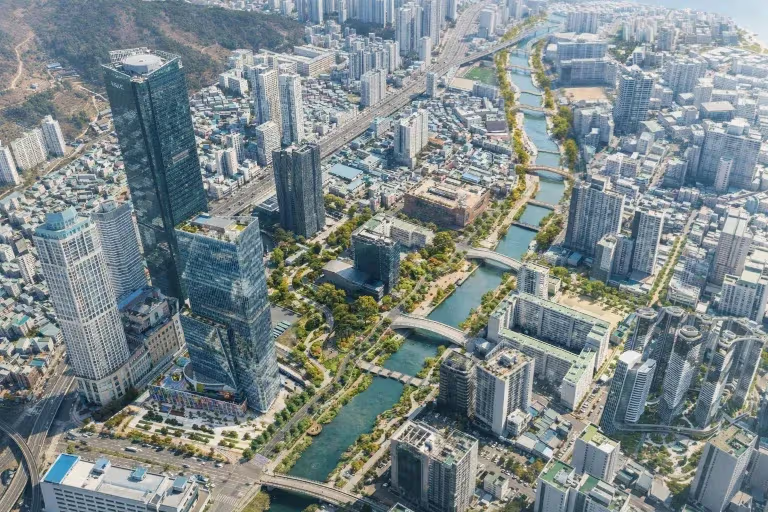
Busan says groundwater from transport megaprojects and redirected valley water can help revive Dongcheon, a stagnant urban river that has long resisted cleanup. But the city’s case depends on more than securing new inflow. In a tidal river, the harder question is whether the lower channel can flush — and who captures the gain if it does.
Busan says it has found a new way to revive Dongcheon, the stagnant urban waterway that cuts through some of the city’s most strategically important districts. The city’s argument rests on freshwater: valley water already being redirected into the upper system, and groundwater expected from the Sasang–Haeundae deep road section and the planned BuTX line. In its April 1 announcement, Busan said the road section could provide about 35,000 tons of groundwater per day, with BuTX expected to add a comparable amount, enough, officials argued, to meet the minimum maintenance flow needed to turn Dongcheon into a more stable waterfront corridor.
Yet Dongcheon’s condition has never been reducible to water alone. The river has already undergone years of intervention, including seawater diversion, dredging and repeated attempts at environmental recovery. Busan’s own account of its 2024 follow-up measures shows why the city is trying again: odor and poor water quality remained serious enough to require direct inflow from Seongjigok valley water, sewer separation works in upper Bujeoncheon, repairs to seawater-diversion pipelines and additional pollution-control measures. The implication is clear. Earlier intervention improved parts of the system without resolving the river’s lived condition.
That history changes the meaning of the latest announcement. Busan is not simply promising beautification or a cleaner stream. The city is making a more specific claim: that a new maintenance-flow regime can alter the operating condition of a river that older measures only partially improved. Read that way, the project becomes something more than a restoration pledge and something less than proof. It becomes a hydraulic proposition.
A Tidal River Does Not Flush on Volume Alone
Dongcheon is not simply a neglected urban stream. Research has treated it explicitly as a tidal river, and that fact should govern the way the project is read. A tidal river does not respond to added inflow the way an inland stream might. Residence time, downstream geometry, backwater effect and the interaction between incoming freshwater and lower-reach tidal conditions matter as much as the volume supplied from above. The city’s April 1 announcement is therefore strongest as an argument about inflow and weakest where it would need to prove full-system flushing.
Freshwater maintenance flow still matters. A river that lacks reliable clean base flow cannot be restored by design language, civic branding or a more attractive rendering. Busan’s 2024 intervention package makes that point indirectly. Redirecting Seongjigok valley water, separating sewer and stormwater flows and repairing diversion infrastructure were all attempts to rebuild minimum hydraulic conditions from the upper system downward. Those are not cosmetic works. They are attempts to stabilize how the river functions.
But the analytical hinge of the story lies elsewhere. Input is not the same as flushing. Added freshwater may improve upper and middle reaches by strengthening base flow, diluting pollutants and reducing odor pressure. None of those gains automatically demonstrates that the lower river can clear efficiently under tidal influence. The city’s own record makes that caution necessary. Busan has pointed to improved BOD figures after earlier intervention, yet still judged odor and quality problems serious enough to justify a new round of works in 2024. The right conclusion is not that earlier cleanup failed in every respect. It is that partial improvement did not settle the deeper hydraulic and environmental condition of the river.
Busan’s new plan therefore has to clear a higher bar than the announcement itself suggests. The relevant question is no longer whether more water can be secured. The harder question is whether more water can change the behavior of a lower reach that remains slow, constrained and governed by tidal conditions. Until that is shown, the project remains plausible but unproven.
Where the River Meets the City
The lower river is where the city’s argument meets its hardest conditions. Dongcheon does not empty into an abstract downstream space. It runs toward the port edge, into a zone where tidal behavior, engineered banks, redevelopment plans and long-standing physical constraints overlap. That is why the lower reach cannot be treated as a passive endpoint that will respond automatically once more water is pushed in from above. In a system like this, the decisive question is whether the lower channel can exchange and clear water efficiently enough for upstream input to matter across the whole river rather than only in selected reaches.
That is also where the 55th Supply Depot enters the story. The depot matters because it sits inside the spatial bottleneck of the river-port interface and inside Busan’s broader effort to reconnect the old downtown with North Port. Publicly available material supports the planning significance of that site. It does not yet provide hydraulic proof. Relocation of the depot may widen the room for redesign at the lower edge of the corridor, but no public evidence reviewed here quantifies how relocation alone would change Dongcheon’s velocity, residence time or flushing behavior. The distinction matters. A planning variable is not the same thing as a demonstrated hydrologic answer.
Dongcheon also runs through land that already matters. Seomyeon remains one of Busan’s core commercial districts. Munhyeon is tied to the city’s finance-center strategy. North Port redevelopment has been framed by Busan as a downtown-restructuring project. A cleaner, steadier Dongcheon would therefore alter more than water conditions. It would strengthen a corridor of urban value. That is why the distributional question belongs inside the story rather than at its edge. OECD work on land-value capture treats this mechanism as routine: public investment in infrastructure, public space or environmental improvement can raise surrounding land values, and governments either capture part of that uplift or allow it to accrue largely to private owners and redevelopment actors.
A restored Dongcheon, if it emerges, would almost certainly be read as a public amenity. It would also be legible as an infrastructure of urban value. The cleaner and more coherent the corridor becomes, the more likely it is that nearby land, commercial property and future redevelopment sites absorb part of the benefit. That does not make the project cynical. It makes the project intelligible. A serious feature should make that point visible without collapsing into allegation.
What Would Count as Proof
Busan no longer needs broader language. It needs narrower evidence. The city has already made the symbolic case and, to a point, the engineering case. Credibility now depends on demonstration. A serious public case would not stop at inflow volume. It would show how the river behaves after that water enters the system. That means modeled or observed changes in velocity, residence time and stage behavior across multiple reaches of the river under different seasonal and tidal conditions. A meaningful public test would show where the channel is expected to speed up, where stagnation remains and how the lower reaches behave under changing tidal states. For a river that research has already identified as tidal, a single inflow figure cannot carry the entire burden of proof.
Water-quality proof would also have to be more demanding than a headline number. Busan has already cited earlier improvement in BOD, and those gains should not be dismissed. But a serious restoration claim should be able to show a sustained change in the lived and ecological condition of the river: seasonal quality patterns, odor conditions, sediment interaction, and the effect of direct clean-water inflow and sewer separation on the more stagnant parts of the system. Operational proof matters just as much. Busan’s April 1 plan depends partly on groundwater linked to major transport infrastructure. Project delays, supply variability, cost changes and technical contingencies all affect whether the maintenance-flow proposition holds outside ideal conditions.
Nothing in the public record makes improvement impossible. Busan is addressing real weaknesses in the older model and trying to build cleaner maintenance flow into a river that has long lacked it. But narrative ambition is not hydraulic evidence. Dongcheon has already lived through years of management without fully recovering public confidence. That history argues against mistaking announcement for outcome. The deeper significance of the project lies in the number of urban systems now being asked to succeed at once: transport infrastructure, river engineering, central-city repair and corridor redevelopment.
Success would make Dongcheon one of the more consequential urban water stories in South Korea in years. A weaker outcome would still be revealing. The river may become cleaner without becoming dynamic. The corridor may gain value without the full lower system ever truly moving. The final test is therefore simpler than the city’s language and harder than its announcement: Busan has to prove that Dongcheon, long slow and only partially reclaimed, can actually be made to flow.
Continue this reporting
Reporting on the same issue
Related coverage selected from the article's desk, topics and newsroom relationships.
 NewsSep 20, 2026
What It Takes for U.S. Navy Repair Work to Become a Busan Industry
HJ Shipbuilding has brought U.S. Navy maintenance work to Yeongdo. Whether it...
 NewsSep 17, 2026
Busan’s Finished Homes, Unfinished Projects
Busan’s unsold homes sit in one monthly total, but they belong to very differ...
 NewsSep 16, 2026
Busan’s Young-Adult Migration Turns Sharply at 25–29
Busan can still draw young adults into the city, but keeping them becomes far...
More from the author
More from this byline
Stay with the same line of reporting through more work from this byline.
 NewsSep 24, 2026
Taiwan’s AI Boom Is Surging, but Wealth Follows a Different Map

Editorial Record
Corrections, sourcing notes and newsroom disclosures remain part of the published record. View Newsroom Notes →
Reader Signal
Community readWhat did this report leave you with?
Choose the signal that best reflects your reading. Select it again to remove it.
One response per article
No response selected
A moderated conversation about the reporting.
One-level replies and newsroom moderation keep the conversation anchored to this article.
Discussion Status
Open
Please sign in to join the discussion.
Newsletter
Weekly reporting and context from Busan and Korea.