Busan’s BuTX Hydrogen Express Faces a Harder Test Underground
The proposed rail link from Gadeokdo New Airport to Osiria is not just a hydrogen train project. It also has to prove that underground tunneling, soft ground, emergency passages and a 40-year private concession can work together in Busan.

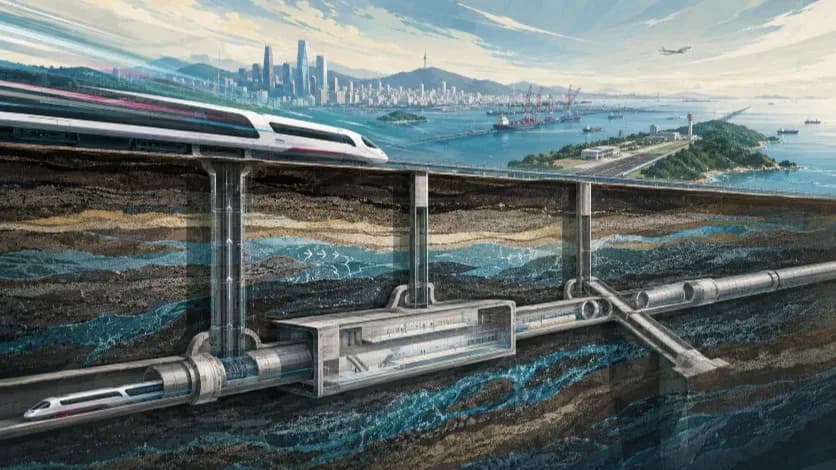
BuTX is framed as a hydrogen express railway, but public records still leave key questions about soft ground, groundwater, tunnel interfaces, emergency passages and a 40-year private operating model.
Busan wants to send a hydrogen express train from Gadeokdo New Airport to Osiria in 33 minutes.
The proposed BuTX line would run underground across the city, linking the airport, Myeongji, Hadan, North Port, Seomyeon, Centum City and the eastern tourism district with a 150 km/h-class hydrogen train. City officials have presented the line as a next-generation corridor for airport access, tourism and east-west connectivity. The harder test may lie below that promise.
Hydrogen trains can already move passengers. South Korea is also preparing 150 km/h-class hydrogen-electric train demonstrations. BuTX, however, is not a rural diesel replacement service on an existing non-electrified railway. The proposal would create a new airport express through a city where soft ground, groundwater and tunnel interfaces have already complicated major rail projects.
Busan has placed BuTX inside its long-term urban rail map, and the project has cleared a private-investment eligibility review. Those steps give the railway a formal path forward. They do not settle the engineering questions that will decide whether hydrogen propulsion, refueling logistics, tunnel ventilation, station excavation, emergency evacuation and a 40-year private concession can work together on the same line.
The question for BuTX is no longer whether hydrogen trains are possible. The question is whether a hydrogen express railway can fit this corridor, this ground and this operating model.
Approval moved BuTX into the rail map, not across the finish line
Busan has secured the planning status needed to move BuTX from campaign language into the city’s formal rail program. The Ministry of Land, Infrastructure and Transport has approved Busan’s second urban railway network plan for 2026 to 2035, a 10-year framework that places 10 selected routes, totaling 145.66 kilometers, inside the city’s next transport map. BuTX sits at the center of that map because it does more than add another rail line. The proposed corridor ties together Gadeokdo New Airport, western Busan, North Port redevelopment, Seomyeon, Centum City and Osiria.
Planning approval matters. Without it, Busan cannot move the line through the formal sequence of follow-up studies, environmental review, private-investment procedures and later design work. A railway plan, however, can confirm a corridor before engineers settle the most difficult parts of that corridor.
BuTX still needs answers on rolling stock certification, hydrogen refueling, tunnel ventilation, station excavation, groundwater control, emergency evacuation, fare policy and long-term maintenance. The project also has to show how those questions fit inside a private concession expected to last for decades.
Several tests are being packed into one corridor. Hydrogen propulsion brings questions about fuel-cell durability, hydrogen supply, refueling time and vehicle availability. Underground tunneling brings questions about geology, groundwater, tunnel interfaces and evacuation routes. A private operating model brings questions about fares, transfer discounts, maintenance risk and the allocation of cost overruns if the technology or ridership assumptions change after service begins.
Busan’s recent rail history makes the engineering gap harder to ignore. Delays on other underground rail projects have not come from a lack of ambition. Groundwater, waterproofing, construction interfaces and safety verification have all shaped schedules and costs. BuTX will have to pass through those same categories of scrutiny before the promise of a 33-minute airport-to-Osiria service becomes a railway that passengers can use.
The approval is a step forward. The harder phase begins after the announcement.
Hydrogen rail is real, but BuTX is a different use case
Hydrogen trains have left the prototype stage. Alstom’s Coradia iLint entered passenger service in Germany in 2018 and later demonstrated long-range hydrogen operation on non-electrified routes. The train’s strongest selling point has not been extreme speed. The iLint has been positioned mainly as a regional hydrogen fuel-cell train for non-electrified or partially electrified lines, where it can replace diesel service without the cost of full electrification.
That distinction matters for Busan. The best-known hydrogen rail examples show that hydrogen can make sense where conventional electrification is expensive, incomplete or unnecessary, especially on regional corridors that still rely on diesel trains. They do not prove that hydrogen is automatically the best propulsion choice for every new railway.
South Korea is moving toward the same technology from a later starting point. A national hydrogen-electric train demonstration program aims for a 150 km/h-class vehicle, bringing the technology closer to BuTX’s proposed speed range. The demonstration is designed to test hydrogen rolling stock, refueling and maintenance on existing non-electrified rail. BuTX would put the propulsion system into a more complicated setting: a new metropolitan airport express, a long tunnel environment, a limited number of stations and a 40-year private operating structure.
A 150 km/h headline does not capture the real operating challenge. BuTX would need high train availability, reliable refueling, controlled fuel-cell degradation, battery buffering, cooling, emergency recovery plans and depot operations. A train that reaches a target speed once is not the same as a railway that keeps a public timetable every day.
European research points to the same divide. The FCH2Rail project developed a bimodal demonstrator train that can use overhead power where electrification exists and hydrogen fuel cells where it does not. Its KPI work focused on fuel-cell durability, hydrogen consumption, system availability, range and refueling time — the same categories that would matter for any commercial hydrogen railway.
Busan therefore needs a narrower argument than the simple claim that hydrogen trains already exist. They do. The city has to show why hydrogen is the right propulsion choice for BuTX’s route, depth, service pattern and financial structure. A regional hydrogen train in Germany, a national demonstration train in Korea and an underground airport express in Busan belong to the same technological family. They are not the same engineering case.
Busan’s ground changes the engineering problem
An underground tunnel can reduce surface disruption. It can pass below roads, buildings and crowded districts without taking lanes away from buses or cars. For a dense and uneven city like Busan, that advantage is real.
Depth does not remove the ground from the project. BuTX would begin in western Busan, near the Nakdong River delta and the future Gadeokdo New Airport, before moving through Myeongji, Hadan, North Port, Seomyeon, Centum City and Osiria. The western section matters because the Nakdong River delta is not ordinary urban ground. The area has long been studied for thick soft clay layers, groundwater sensitivity and settlement risk, the same conditions that complicate roads, railways, reclaimed land and large underground structures.
A tunnel boring machine may drive through deeper and more stable layers. The railway still has to touch the city above it. Stations, vertical shafts, ventilation structures, emergency exits, drainage systems and cross-passages must connect the tunnel to the surface. Those interfaces can be more difficult than the main tunnel bore itself.
A long express line with a small number of stations looks simple on a map. In engineering terms, each station becomes a deep excavation. Each shaft becomes a path for groundwater, air, cables, people and emergency access. Each cross-passage becomes a separate ground intervention between two running tunnels. Each transition between soil and rock conditions becomes a place where design assumptions can be tested by the ground.
Western Busan makes those interfaces more important. Soft clay can compress. Sandy layers can carry groundwater. Under-river or coastal sections can face higher water pressure. Reclaimed or filled ground can behave differently from natural ground. An underground alignment may reduce surface impact along the running tunnel, but station boxes and shafts still require ground treatment, waterproofing, retaining walls, monitoring and emergency planning.
BuTX also adds speed and propulsion to the underground problem. A 150 km/h-class express train in a long tunnel raises questions about ventilation, pressure change, heat, emergency evacuation and service recovery. A hydrogen-electric train adds another layer: leak detection, fuel storage, pressure relief and depot safety have to be considered together with the tunnel’s ventilation and evacuation design.
Modern cities build underground railways through difficult ground. Busan itself has built extensive subway infrastructure across mountains, coastal districts and reclaimed areas. BuTX is not impossible because it goes underground. The project has to be judged by the ground it enters, the structures that connect it to the surface and the safety systems that would move passengers out of a tunnel when something goes wrong.
For BuTX, the underground is not a technical footnote. It is the project’s largest evidence gap.
Recent rail delays show where underground risk emerges
Busan does not need to look far for reminders that underground rail risk often appears away from the main promise of a project.
The Sasang-Hadan urban rail extension and the Bujeon-Masan double-track railway are different projects from BuTX, with different alignments, construction packages and operating assumptions. They do not prove that BuTX will fail. They show something more useful for the public debate: in Busan, underground railway risk often emerges through water control, ground interfaces, emergency links and construction management, not only through the main tunnel drive.
The Sasang-Hadan case points to the surface side of that problem. In May 2026, police referred eight people, including Busan Transportation Corporation officials, to prosecutors after investigating ground-subsidence incidents near the project. Investigators cited concerns including unqualified waterproofing quality inspection, improper injection of cutoff materials, unsuitable water-blocking methods and poor management of retaining works. The case under review involved the second construction section in Sasang, where heavy rain and construction conditions combined with a chain of alleged management failures.
For BuTX, the lesson is not that every underground project is unsafe. Shafts, station boxes, retaining systems, waterproofing works and groundwater control can decide the schedule as much as the tunnel alignment itself. An underground tunnel may pass below weak layers, but entrances, ventilation structures and emergency exits still have to cut through the ground above it.
The Bujeon-Masan railway shows the same issue from another angle. The 51.1-kilometer privately financed line was originally scheduled to open in February 2021. Work stopped after a March 2020 ground-collapse accident during construction of an emergency cross-passage at the Nakdong River under-river tunnel, even though the project had reportedly reached 99 percent progress. Years later, the Ministry of Land, Infrastructure and Transport was still reviewing the accident cause and the project’s safety.
The accident was not in a generic stretch of rail. It occurred at a cross-passage connecting two tunnel tubes. Published engineering accounts described the collapse near the Nakdong 1 Tunnel as a large ground-subsidence event, with soil and water entering the tunnel area during construction of an emergency cross-passage.
That detail matters for BuTX. Emergency cross-passages are safety infrastructure. They allow passengers to move from one tunnel to another during a fire, breakdown or evacuation. They are essential to an underground railway. They can also become difficult construction points because they cut sideways through ground that may behave differently from the main tunnel bore.
BuTX would need the same category of structures: stations, shafts, ventilation plants, emergency exits, drainage systems and cross-passages. The hydrogen propulsion system would add a separate safety layer, but the underground risk begins before hydrogen enters the discussion. Groundwater, waterproofing, retaining structures and emergency access would shape the project whether the trains used hydrogen, overhead wires or another power system.
Recent Busan rail projects sharpen the question rather than answer it. BuTX may be technically feasible. Modern tunnel engineering gives cities more options than they had a generation ago. Feasibility, however, is not routine execution. In Busan, the engineering proof will have to come from the details: geological profiles, borehole data, groundwater assumptions, station depths, shaft locations, cross-passage spacing, ground-treatment methods and the safety case for every interface between the underground railway and the city above it.
Busan needs to publish the numbers behind the promise
BuTX does not need another slogan before the next phase. It needs numbers.
The public record now contains the broad promise: a hydrogen express railway, limited stations, a 33-minute airport-to-Osiria trip, underground tunnels under Busan and a long private operating period. The missing record is more important for judging the project. Busan has not yet shown enough public detail to explain how hydrogen propulsion, underground construction, emergency evacuation and private finance would work together on the same line.
The first missing set of numbers is geotechnical. Busan should disclose the geological profile of the corridor, borehole data, groundwater levels, expected water pressure, station depths and tunneling methods by section. The western part of the route, including Gadeokdo, Myeongji and Hadan, requires particular scrutiny because soft ground and groundwater have shaped other infrastructure projects in the Nakdong River delta. A single line on a rail map cannot show where the route passes through clay, sand, weathered rock, reclaimed ground or higher-pressure water conditions.
The second missing set is structural. BuTX will not consist only of a running tunnel. Stations, vertical shafts, ventilation plants, drainage systems, emergency exits and cross-passages will define the railway’s safety and construction risk. Busan should show where those structures would be placed, how deep each station would sit, how passengers would evacuate from a disabled train, how far they would walk to a safe point and how cross-passages would be built in difficult ground.
The third missing set is hydrogen-specific. The city and the project proposer should explain the train’s hydrogen storage type, onboard storage volume, hydrogen consumption per train-kilometer, refueling time, refueling location, daily hydrogen demand and fuel-cell replacement assumptions. A hydrogen railway is not only a train purchase. It is a fuel supply chain, a depot system, a maintenance schedule and a safety case.
The fourth missing set is comparative. Busan has to show why hydrogen is the right choice for this corridor compared with conventional electrification, third rail, battery-hybrid operation or another electric system. Hydrogen technology may improve before BuTX reaches procurement. Fuel-cell stacks may last longer. Liquid-hydrogen storage may raise onboard capacity. Battery control may reduce stress on the power system. Lower-cost clean hydrogen may eventually reduce operating costs. None of those possibilities removes the need for a lifecycle comparison.
The fifth missing set is financial. BuTX is a private railway concession expected to run for decades. The city should disclose how fare revenue, transfer discounts, fuel-price changes, maintenance downtime, fuel-cell replacement costs and lower-than-expected ridership would be allocated between the operator, Busan and passengers. A technical risk can become a fare risk if the contract is not clear. A fuel-price risk can become a public-budget risk if the city absorbs it later.
Busan can still make a serious case for BuTX. A fast link between Gadeokdo New Airport, North Port, Seomyeon, Centum City and Osiria would redraw the city’s travel map. A successful hydrogen railway could also give Korea a visible test bed for rail decarbonization beyond trams and demonstration trains. But ambition does not settle the engineering.
Hydrogen trains can run. Underground railways can be built. Busan has experience with difficult underground work. The question is whether those conditions can be combined on this corridor, under this ground, with this propulsion system and this financial model.
Until the numbers are public, BuTX remains less a proven railway than a high-stakes engineering claim.
Continue this reporting
Reporting on the same issue
Related coverage selected from the article's desk, topics and newsroom relationships.
 NewsSep 20, 2026
What It Takes for U.S. Navy Repair Work to Become a Busan Industry
HJ Shipbuilding has brought U.S. Navy maintenance work to Yeongdo. Whether it...
 NewsSep 17, 2026
Busan’s Finished Homes, Unfinished Projects
Busan’s unsold homes sit in one monthly total, but they belong to very differ...
 NewsSep 16, 2026
Busan’s Young-Adult Migration Turns Sharply at 25–29
Busan can still draw young adults into the city, but keeping them becomes far...
More from the author
More from this byline
Stay with the same line of reporting through more work from this byline.
Editorial Record
Corrections, sourcing notes and newsroom disclosures remain part of the published record. View Newsroom Notes →
Reader Signal
Community readWhat did this report leave you with?
Choose the signal that best reflects your reading. Select it again to remove it.
One response per article
No response selected
A moderated conversation about the reporting.
One-level replies and newsroom moderation keep the conversation anchored to this article.
Discussion Status
Open
Please sign in to join the discussion.
Newsletter
Weekly reporting and context from Busan and Korea.