Busan Seeks to Expand Medical Tourism With AI Platform
Medical tourism in South Korea has expanded rapidly, but the industry remains centered in Seoul’s dense cluster of clinics and recruitment networks. Busan’s AI platform seeks to lower barriers for foreign patients, though structural advantages still favor the capital.

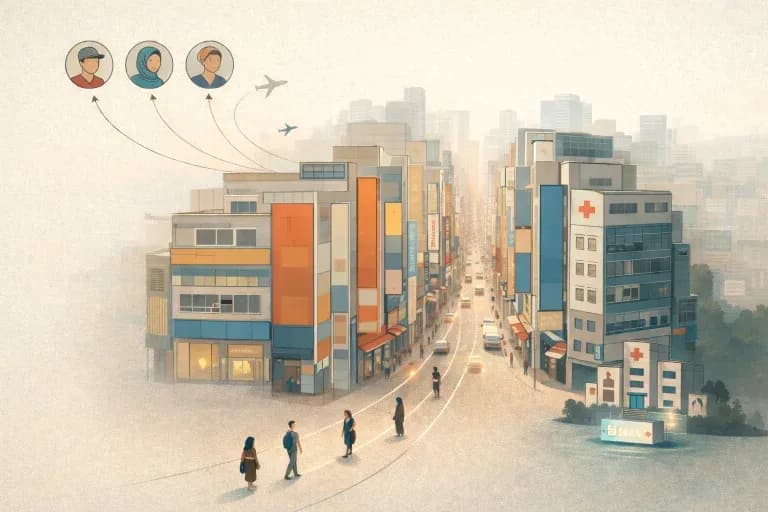
BUSAN — Busan officials this week announced plans to develop an AI-based platform designed to help foreign patients access hospitals across the city. The system, created in partnership with local medical institutions and a private technology firm, will offer multilingual translation and appointment services aimed at overseas visitors seeking treatment in Busan.
The project comes at a time when South Korea’s medical tourism industry is expanding rapidly. More than one million foreign patients now receive treatment in the country each year, many traveling for cosmetic procedures, dermatology treatments and comprehensive health screenings.
Yet the growth of the market has been heavily concentrated in Seoul. Over the past two decades the capital has developed dense networks of cosmetic clinics, patient coordinators and medical tourism agencies that channel international demand into a small number of districts, most notably Gangnam.
For regional cities such as Busan, the challenge is not only improving access to hospitals but competing with the industry networks that already determine where foreign patients go.
The Structure of Korea’s Medical Tourism Industry
South Korea’s medical tourism industry has grown steadily over the past decade. Government data show that more than 1.17 million foreign patients from over 200 countries received treatment in the country in 2024, the highest figure recorded since the government began tracking international medical visits in 2009.
The market is dominated by a small number of specialties. Dermatology accounted for more than half of foreign patient visits, followed by plastic surgery and internal medicine. Large hospitals attract a separate group of international patients seeking comprehensive health screening programs.
These services are concentrated in Seoul. Over the past two decades cosmetic clinics and dermatology centers have clustered in districts such as Gangnam and Apgujeong, where hundreds of private clinics operate within a few blocks.
Around them has formed a supporting industry that caters specifically to international patients. Medical tourism agencies recruit clients overseas, while patient coordinators and interpreters manage appointments, translation and follow-up care.
The result is a dense service network that allows foreign patients to arrange consultations, procedures and recovery within the same districts.
In practice, South Korea’s medical tourism industry functions less as a nationwide market than as a cluster centered in Seoul.
How Foreign Patients Enter Korea’s Medical System
Foreign patients rarely contact hospitals in South Korea directly.
Most enter the medical system through intermediary companies that specialize in arranging treatment for overseas visitors. Under Korean law these businesses are registered as foreign patient attraction agencies. They recruit patients abroad, coordinate treatment with hospitals and manage travel logistics once patients arrive in the country.
The agencies operate through a range of international networks. Some maintain partnerships with travel companies or medical coordinators overseas. Others promote cosmetic procedures and dermatology treatments through social media and online platforms targeting foreign audiences.
Once a patient decides to travel, the agencies typically arrange consultations and procedures in advance. Interpreters, accommodation and transportation are often organized as part of the same package.
Hospitals provide the medical services, but patient recruitment frequently takes place outside the hospital system. Agencies guide patients toward particular clinics and negotiate treatment arrangements on their behalf.
This structure means that patient flows in South Korea’s medical tourism industry are shaped less by hospital marketing than by networks of intermediaries operating across borders.
Busan’s Position in Korea’s Medical Tourism Market
Busan has long sought to expand its presence in South Korea’s medical tourism industry. The city hosts several large hospitals and hundreds of clinics registered to treat foreign patients.
Government records show that more than 400 medical institutions in Busan are registered to receive international patients. In addition, over one hundred businesses in the city are licensed as foreign patient attraction agencies.
Yet the scale of the market remains limited. While more than one million foreign patients received treatment in South Korea last year, only a small share traveled to Busan.
The structure of the industry in the city also differs from that of Seoul. In the capital, international patient recruitment is largely handled by specialized agencies that connect overseas demand with local clinics.
In Busan, many hospitals themselves register as foreign patient attraction agencies and attempt to recruit patients directly.
Without a large network of intermediary agencies or internationally recognized clinic clusters, the city’s medical tourism sector has developed more slowly than the one centered in Seoul.
The Limits of a Digital Platform
Busan’s latest initiative centers on a digital platform intended to improve access to local hospitals.
City officials say the system will provide multilingual translation and appointment booking services for foreign patients. The platform is being developed with local medical institutions and a private technology company.
Language barriers and administrative procedures can complicate hospital visits for international patients unfamiliar with Korea’s healthcare system. Translation and booking tools can help reduce those difficulties.
But access to hospitals is only one factor in the medical tourism industry.
Most international patients arrive through referral networks that operate outside the hospital system. Overseas agencies, medical coordinators and tourism operators typically arrange consultations and procedures before patients travel to Korea, directing them toward clinics that specialize in serving foreign clients.
Digital platforms may therefore make hospital visits easier once patients have chosen a destination. Their ability to influence where those patients decide to seek treatment is more limited.
For regional cities such as Busan, expanding medical tourism depends less on hospital accessibility than on building the international networks that bring patients into the system.
Busan’s digital platform initiative reflects an effort to strengthen the city’s position in South Korea’s expanding medical tourism market. Translation and appointment tools may make local hospitals easier for foreign patients to navigate.
But hospital access alone rarely determines where international patients seek treatment.
Over the past two decades South Korea’s medical tourism industry has concentrated in Seoul, where clinics, coordinators and recruitment agencies operate within dense service clusters that channel foreign patients into the capital.
For regional cities such as Busan, the challenge is therefore not only digital access to hospitals but building the international networks that bring patients in the first place.
Continue this reporting
Reporting on the same issue
Related coverage selected from the article's desk, topics and newsroom relationships.
 NewsSep 20, 2026
What It Takes for U.S. Navy Repair Work to Become a Busan Industry
HJ Shipbuilding has brought U.S. Navy maintenance work to Yeongdo. Whether it...
 NewsSep 17, 2026
Busan’s Finished Homes, Unfinished Projects
Busan’s unsold homes sit in one monthly total, but they belong to very differ...
 NewsSep 16, 2026
Busan’s Young-Adult Migration Turns Sharply at 25–29
Busan can still draw young adults into the city, but keeping them becomes far...
More from the author
More from this byline
Stay with the same line of reporting through more work from this byline.
Editorial Record
Corrections, sourcing notes and newsroom disclosures remain part of the published record. View Newsroom Notes →
Reader Signal
Community readWhat did this report leave you with?
Choose the signal that best reflects your reading. Select it again to remove it.
One response per article
No response selected
A moderated conversation about the reporting.
One-level replies and newsroom moderation keep the conversation anchored to this article.
Discussion Status
Open
Please sign in to join the discussion.
Newsletter
Weekly reporting and context from Busan and Korea.