Busan Moves Ahead With Royal Russell International School Project
The Royal Russell International School project moves ahead with public backing, positioning Busan as an early investor in demand that has yet to fully materialize.

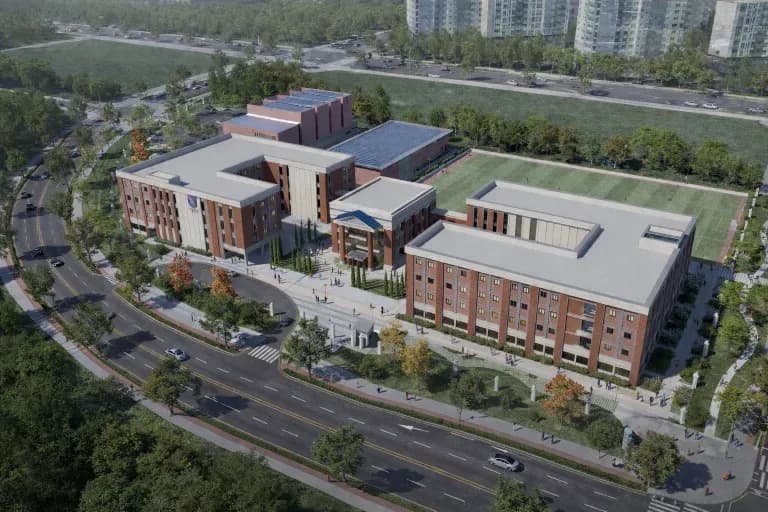
BUSAN — Busan has spent much of the past decade pursuing the idea of an international school as part of its broader redevelopment strategy for the city’s western districts. Multiple memoranda were signed with foreign institutions. None reached the construction stage. On February 13, that changed. With the approval of a building permit for Royal Russell School Busan, the project moved from agreement to implementation.
The campus is planned for Myeongji International City in Gangseo District, an area shaped in recent years by high-rise apartment complexes, new arterial roads, and large-scale land development tied to the Busan-Jinhae Free Economic Zone. The district was conceived as a growth corridor, linked to industrial clusters and the proposed Gadeokdo International Airport. It is not traditionally known as an expatriate enclave. It is, rather, a newly built residential zone intended to absorb domestic population movement toward the city’s western edge.
City officials describe the school as part of a longer-term strategy to strengthen Busan’s competitiveness as a regional hub. In official statements, the project is framed as essential infrastructure for foreign direct investment, intended to support globally mobile professionals considering relocation to the southeast industrial belt. The premise is that international education is a prerequisite for international capital.
The financing structure distinguishes this project from earlier attempts. The campus is to be built under a public development model involving the Korea Land and Housing Corporation (LH), with operations to be managed by the British institution once construction is complete. The school will charge tuition. Public-sector involvement, however, precedes private enrollment.
That sequence places the project within a broader policy debate. In a district defined primarily by domestic housing development, and in a city still working to expand its foreign resident base, the question is not whether international education has value. It is whether a publicly backed international school constitutes infrastructure in the same sense as transport links or industrial facilities—and how its public return is to be measured.
Public Capital and the Logic of Preemptive Investment
The Royal Russell Busan campus advances not simply as an educational initiative but as a strategic intervention in the city’s economic planning. Unlike previous attempts that ended at the memorandum stage, this project proceeds with construction capacity secured through a public development framework. The Korea Land and Housing Corporation is tasked with delivering the physical campus, after which the British institution will operate a tuition-based school. The distinction is structural: the public sector assumes initial capital exposure before enrollment materializes.
Publicly cited project costs vary across official references, ranging from figures under 100 billion won to amounts approaching 175 billion won, depending on whether disclosures refer strictly to construction or incorporate broader development components. Regardless of which figure is ultimately confirmed as comprehensive, the scale represents a substantial upfront commitment relative to the planned capacity of approximately 1,350 students. Even at the lower range of published totals, the implied capital allocation per projected student seat remains considerable for a facility that will operate under a private-fee model.
This sequencing reflects a deliberate policy choice. Busan is not responding to an established concentration of expatriate households in Gangseo District. Rather, it is positioning international education as a catalyst intended to precede and encourage foreign settlement. The premise aligns with supply-led development strategies commonly used in industrial planning, where infrastructure is constructed in anticipation of demand. In this case, however, the asset differs from ports or transit corridors. Access to the school will depend on eligibility criteria and tuition affordability, not universal civic use.
The financial and contractual terms governing the transition from public construction to private operation have not yet been fully articulated in public documents, particularly with respect to lease duration, rent structure, and risk allocation should projected enrollment fall short. In large-scale infrastructure projects, such provisions are central to evaluating long-term fiscal exposure. Here, the same clarity becomes essential in determining whether the initiative functions as economic infrastructure or as a publicly enabled educational enclave.
At issue is not the intrinsic value of international education. The question is whether the city’s preemptive capital commitment is matched by clearly defined mechanisms ensuring measurable public return.
Urban Context and the Question of Public Function
The strategic rationale for the school rests on Busan’s broader redevelopment narrative for its western corridor, where Myeongji International City has been shaped primarily by large-scale residential construction and land reclamation tied to the Busan-Jinhae Free Economic Zone. The district’s physical character today is defined less by expatriate settlement than by domestic apartment complexes accommodating middle-income households relocating within the metropolitan area. Unlike long-established foreign enclaves in global gateway cities, Gangseo does not yet exhibit the demographic density typically associated with international school demand. The project therefore operates within a forward-looking assumption that international mobility will expand in tandem with planned infrastructure such as the Gadeokdo airport and adjacent industrial zones.
This sequencing places Busan within a familiar policy framework: infrastructure built in anticipation of growth. In industrial development, ports, logistics parks, and transit networks are often constructed ahead of demonstrated volume. International education, however, occupies a different category. While it is frequently cited in investment promotion materials as a prerequisite for attracting globally mobile professionals, it is neither universally accessible nor inherently public in function. Access is determined by admission criteria and tuition structures rather than civic entitlement. The question, therefore, is not whether education supports competitiveness, but whether a tuition-based institution financed through public development can be classified as economic infrastructure in the same sense as transport or utilities.
International practice offers contrasting models. In parts of Europe, publicly supported international schools operate within regulated frameworks that define eligibility and maintain cost transparency, ensuring that government participation aligns with temporary expatriate demand rather than broad domestic substitution. In other cases, bilingual or international tracks are embedded within the public school system, preserving social integration while responding to foreign resident needs. These approaches reflect an underlying policy principle: when public funds are involved, international education is treated as a component of public service architecture rather than a standalone premium enclave.
Busan’s model appears to pursue a catalytic approach, positioning the school as a signal to multinational firms and internationally mobile families that the city is prepared to support long-term settlement. Whether such signaling translates into measurable demographic or corporate shifts remains an empirical question. The city’s foreign resident base, while growing gradually, has not historically concentrated in the western districts at levels comparable to established expatriate hubs in larger Asian cities. The effectiveness of a supply-led strategy in this context depends on the extent to which education alone can alter relocation calculus in the absence of an already mature international community.
The broader policy issue extends beyond enrollment projections. If the campus succeeds primarily in attracting domestic high-income households seeking alternative educational pathways, the school will function differently from the economic instrument described in official statements. In that scenario, the public investment would have supported a specialized service rather than expanded the city’s international economic base. Distinguishing between these outcomes requires predefined metrics, including the composition of the student body, the share of foreign corporate households served, and demonstrable links to new investment activity.
In urban policy terms, the project represents a test of whether international education can operate as a growth lever in a city that is still consolidating its global positioning. Its significance will ultimately depend less on architectural completion than on whether its public financing model produces outcomes consistent with its stated economic purpose.
Measuring the Return
The Royal Russell project is neither an anomaly nor an inevitability; it is a policy choice. Busan has elected to invest ahead of demonstrated demand, wagering that international education can function as an anchor for future economic positioning. That wager cannot be assessed at the moment of groundbreaking. It will be judged by outcomes.
If the campus contributes to measurable growth in long-term foreign residency, supports the settlement of multinational firms, and integrates into the broader civic fabric rather than operating in isolation, the public investment will align with its stated purpose. If, instead, enrollment is driven primarily by domestic substitution and remains detached from the city’s international economic base, the character of the investment will appear different from the one described in official narratives.
The permit answers the question of feasibility. The more consequential question concerns return. In the coming years, the value of this campus will not be determined by its architectural completion or its brand recognition, but by whether the public capital that built it generates public outcomes commensurate with its scale.
Continue this reporting
Reporting on the same issue
Related coverage selected from the article's desk, topics and newsroom relationships.
 NewsSep 20, 2026
What It Takes for U.S. Navy Repair Work to Become a Busan Industry
HJ Shipbuilding has brought U.S. Navy maintenance work to Yeongdo. Whether it...
 NewsSep 17, 2026
Busan’s Finished Homes, Unfinished Projects
Busan’s unsold homes sit in one monthly total, but they belong to very differ...
 NewsSep 16, 2026
Busan’s Young-Adult Migration Turns Sharply at 25–29
Busan can still draw young adults into the city, but keeping them becomes far...
More from the author
More from this byline
Stay with the same line of reporting through more work from this byline.

Editorial Record
Corrections, sourcing notes and newsroom disclosures remain part of the published record. View Newsroom Notes →
Reader Signal
Community readWhat did this report leave you with?
Choose the signal that best reflects your reading. Select it again to remove it.
One response per article
No response selected
A moderated conversation about the reporting.
One-level replies and newsroom moderation keep the conversation anchored to this article.
Discussion Status
Open
Please sign in to join the discussion.
Newsletter
Weekly reporting and context from Busan and Korea.