Busan mayor Park’s shaved head exposes political strain
The Busan mayor’s head-shaving demonstration was framed as a push for the Global Hub City Special Act, but it also exposed a more immediate reality: political strain at home and growing doubt over symbolic gestures.

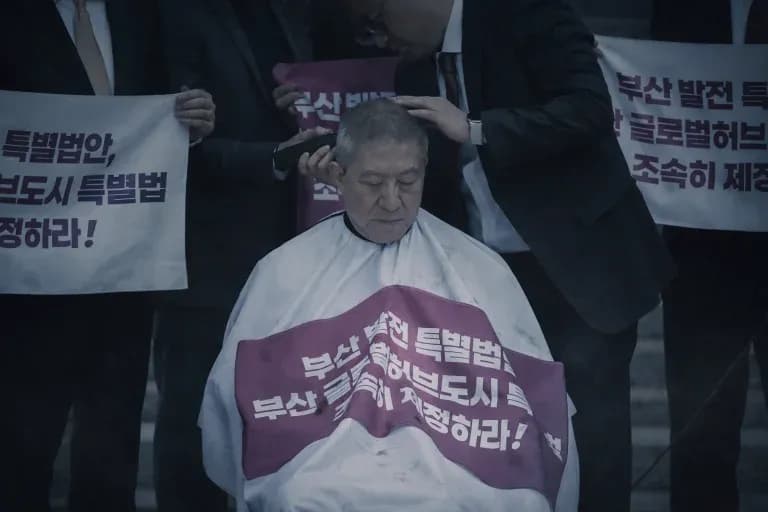
BUSAN — Busan Mayor Park Heong-joon shaved his head outside the National Assembly on Monday, bringing sudden drama to a bill that had already become politically overburdened. He said the act was meant to force movement on the Busan Global Hub City Special Act, legislation city officials have tied to Busan’s ambitions in logistics, finance and investment. But by the time the clippers came out, the bill had already ceased to function as a mere policy instrument. In Busan, it had become a vessel for pressure, timing and the increasingly exposed question of who still had the ability to move events on the city’s behalf.
That was why the scene felt less like a breakthrough than a disclosure. Park is not a mayor usually associated with bodily demonstrations or the older grammar of grievance politics. He has tended to govern through message control, administrative procedure and institutional poise. Monday’s scene cut against that history. It did not make him look more commanding so much as more pressed — a sitting mayor reaching for one of Korean politics’ most familiar symbolic escalations at precisely the moment his political room had begun to narrow.
That distinction matters because the most revealing part of the episode was not the act itself, but the conditions that produced it. The Global Hub City bill still matters as legislation. It also now sits inside a harsher political frame: a bruising nomination controversy inside Park’s own party, a primary race against Rep. Joo Jin-woo, a bill whose eventual credit could spread beyond Park’s camp, and a city whose appetite for grand gestures has been dulled by repeated disappointments in execution.
Why the gesture landed low
For politically attentive voters, the problem with Monday’s scene was not simply that it was dramatic. It was that the drama belonged to an older political repertoire. A head-shaving demonstration remains legible in Korean politics; it can still rally a base and generate instant images. For a sitting mayor, however, it also carries a cost. It invites the question Park would rather avoid: why a leader with office, staff, access and a city government behind him has chosen the language of bodily pressure over the language of negotiation, design and delivery.
That is where the gesture risks reading as a “low move” to many engaged voters rather than as proof of strength. The act may have been intended to advertise resolve. What it more clearly advertised was urgency on Park’s side — and not only urgency about the bill. It also advertised the strain of a mayor who no longer appears fully insulated inside his own party and who may have concluded that a vivid external display was preferable to letting the legislation drift into a conversation he no longer controlled.
That background matters. Media reports last week said People Power Party officials had considered cutting Park from the Busan mayoral race, a prospect he denounced as reckless. Days later, the party confirmed that the nomination would be decided through a primary between Park and Rep. Joo Jin-woo. Park was not shut out. But the episode made clear that his position inside the ruling party was no longer insulated from challenge.
The emergence of Joo Jin-woo as his primary rival sharpened that pressure. Park is not heading into June 3 as an uncontested incumbent simply waiting for a general election opponent. He is now fighting first to prove that he still has uncontested authority inside his own camp. In that context, Monday’s scene looked less like a spontaneous outburst than a defensive move by a politician who had decided he needed to seize back initiative in public view.
A bill carrying too much at once
Part of the reason the bill has become so politically charged is that Busan has spent years asking it to do too much at once. City officials present the Global Hub City Special Act as a legal framework for Busan’s long-term repositioning in logistics, finance, maritime business and investment, backed by regulatory and tax incentives. In official language, it is a growth framework. In local political language, it has become something larger: a way of gathering multiple unfinished ambitions under a single legislative name.
That breadth explains the bill’s appeal. It can hold logistics, finance, foreign capital, industrial development and Busan’s longstanding desire for a larger national role inside one frame. It also explains why delay has proven so politically corrosive. Once a single law is made to carry this much expectation, delay stops looking procedural. It starts to look like a judgment on Busan’s leverage itself.
Still, the bill’s political utility now exceeds the clarity of its practical effect. Supporters describe it as enabling legislation. A harder question remains unresolved. How much governing power would it actually shift, how much investment would it concretely unlock, and how much of Busan’s development model would it truly alter once the language of promotion gives way to the work of implementation? That is where the bill becomes less legible, and where its usefulness as political theater begins to outrun its demonstrated force as public policy.
The bill also presents Park with a specific political problem: it does not belong to him alone. It was reintroduced after expiring with the previous Assembly term, and it has been backed as part of a broader Busan agenda rather than as a purely one-party cause. That makes the fight around it as much about authorship as passage. If the measure eventually moves, Park is not guaranteed to emerge as its sole beneficiary.
That is why Monday’s demonstration can be read as a preemptive ownership play. A delayed bill can still be politically useful. It can be narrated as proof that Busan is being made to wait again. It can be used to argue that the city needs a tougher advocate. And it can be staged in such a way that future claims of credit have to pass through the image first. Park’s shaved head did not make the law more coherent. It made his effort to bind his own name to it more visible.
A colder audience in Busan
This is also why the city’s mood matters. Busan no longer receives large official language as easily as it once did. The white paper published last November on the failed 2030 Busan World Expo bid documented the full process of the campaign and included an analysis of the factors behind the setback. Even without turning the document into a weapon, the effect was clear: one of Busan’s grandest and most heavily promoted strategic projects had ended in a way that forced a formal reconsideration of how ambition had been organized and carried.
That memory hangs over the Global Hub City bill. Busan still knows how to speak the language of scale. It can describe itself as a logistics capital, a maritime center, a finance platform and a southern growth axis. What has weakened is public confidence that such language will survive contact with committee delay, administrative friction and the compromises of execution. In that environment, a dramatic gesture from the mayor does not automatically restore confidence. It can just as easily reinforce the impression that the politics around the bill have outgrown the policy underneath it.
North Port redevelopment helps explain why skepticism has hardened. The project was supposed to symbolize Busan’s transition into a more ambitious post-industrial waterfront city. Instead, the Busan Port Authority said in January that it would shift to a public-led model after the earlier private investment-dependent approach stalled. That change did not make North Port meaningless. It did underline a pattern Busan residents know well: major projects often arrive wrapped in expansive citywide language and then narrow, slow or get reworked once the financing and delivery questions begin.
That pattern shapes how the next promise is heard. In Busan, development language often begins with industry, mobility, culture or global status and ends in land, housing or a more familiar real-estate logic. The risk for the Global Hub City bill is not only that it could stall in Seoul. It is that even if it passes, the city could still struggle to persuade citizens that another grand framework will produce something sturdier than a fresh round of branding layered over older habits of development.
The regional question still waiting in the background
The bill also sits against a broader structural issue Busan cannot solve within city limits alone. On March 18, Busan, Ulsan and South Gyeongsang launched the Busan-Ulsan-Gyeongnam joint economic alliance headquarters, strengthening a cooperative framework meant to serve as a larger southern growth platform. The move reflects an obvious strategic truth: many of Busan’s economic and demographic challenges are metropolitan in scale, not merely municipal.
But a larger map does not solve a weaker governing model. Economic alliance, administrative integration and special legislation all promise scale. None of them guarantees delivery. That is what ties the regional question back to Monday’s demonstration. Busan’s problem is not that it lacks names for its future. It is that too many of those names still struggle to survive contact with institutions, funding, land and time.
What Monday’s head-shaving demonstration finally measured was not the urgency of the bill, but the fragility of the politics around it. Park may have wanted to project resolve. What the scene more clearly conveyed was pressure — the pressure of a delayed bill, a tightening election calendar, a bruising primary environment and the risk that the law’s eventual credit could drift beyond his control. In that sense, the gesture did not settle the argument over the Global Hub City Special Act. It exposed how thoroughly the bill has been absorbed into a struggle over standing, authorship and political survival.
That is why the episode is unlikely to strengthen Park across all audiences. To politically attentive voters, the problem was not simply that the act was dramatic. It was that the drama belonged to an older political repertoire, one that can still rally loyalists but can also make a sitting mayor look less commanding than cornered. Busan’s larger problem remains where it was before the clippers came out: not in stating ambition, but in persuading the public that ambition can survive delay, bargaining and implementation. Monday’s scene did not close that gap. It may only have made it easier to see.
Continue this reporting
Reporting on the same issue
Related coverage selected from the article's desk, topics and newsroom relationships.
 NewsSep 20, 2026
What It Takes for U.S. Navy Repair Work to Become a Busan Industry
HJ Shipbuilding has brought U.S. Navy maintenance work to Yeongdo. Whether it...
 NewsSep 17, 2026
Busan’s Finished Homes, Unfinished Projects
Busan’s unsold homes sit in one monthly total, but they belong to very differ...
 NewsSep 16, 2026
Busan’s Young-Adult Migration Turns Sharply at 25–29
Busan can still draw young adults into the city, but keeping them becomes far...
More from the author
More from this byline
Stay with the same line of reporting through more work from this byline.
Editorial Record
Corrections, sourcing notes and newsroom disclosures remain part of the published record. View Newsroom Notes →
Reader Signal
Community readWhat did this report leave you with?
Choose the signal that best reflects your reading. Select it again to remove it.
One response per article
No response selected
A moderated conversation about the reporting.
One-level replies and newsroom moderation keep the conversation anchored to this article.
Discussion Status
Open
Please sign in to join the discussion.
Newsletter
Weekly reporting and context from Busan and Korea.