After the spectacle, what does Busan’s global hub bill actually change?
The Busan Global Hub City Special Act has cleared its first real hurdle. The question now is whether a law this large can produce real coordination, money and credibility — before the symbolism around it overtakes the substance.

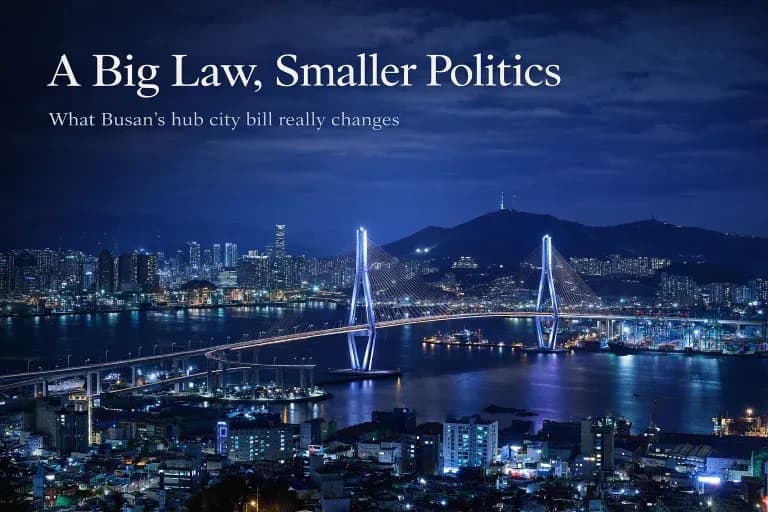
BUSAN — The Busan Global Hub City Special Act cleared the first real legislative hurdle on March 24, when a subcommittee of the National Assembly’s Public Administration and Security Committee approved it by bipartisan agreement. That was not a minor procedural step. After months of delay, the bill has finally moved from symbolic demand into institutional possibility. In its original form, the legislation is not a narrow local development measure but a wide framework: it sets out a prime minister-led committee, working-level implementation bodies, multi-year planning requirements, special zones for logistics and finance, investment-promotion districts, education and living-environment provisions, and legal grounds for fiscal support and a special municipal account. The scale of the design matters. This is a bill that tries to change not only what Busan can build, but how the state is expected to treat Busan.
That is why the political scene around it looked so much smaller than the law itself. A bill framed as a strategic vehicle for logistics, finance, advanced industry, education, culture and southern regional balance was quickly absorbed into a struggle over visibility. The public conversation narrowed before the institutional one had even begun. Instead of sustained debate over regulatory authority, budgetary force, policy sequencing and the difference between this bill and earlier special-zone frameworks, the immediate focus fell on gesture, timing and ownership. Your earlier draft already identified that tendency clearly: the law had begun to carry not only policy ambition but questions of standing, authorship and political survival. The subcommittee passage did not dissolve that tendency. It confirmed it.
The law itself deserves a harder reading than it has received. Its strongest provisions are not the grand phrases about becoming another Singapore or Shanghai. They lie in the institutional machinery: the attempt to create a central-state coordination structure under the prime minister, the possibility of linking Busan’s logistics ambitions to special-zone treatment, and the legal basis for fiscal backing rather than mere rhetorical endorsement. Those are the provisions that could matter if the bill continues through the remaining Assembly stages and survives into administrative design. The weakest parts lie elsewhere. Finance, education, foreigner services and cultural activation are not trivial, but they are harder to realize through statutory language alone. Without follow-up design, budget, implementing decrees and credible operating authority, they risk becoming the most attractive parts of the bill on paper and the least immediate in practice. Policy research around the measure has already pointed to gaps in operational structure and implementation detail, especially on the “global environment” side of the framework.
That is where the timing of the surrounding spectacle becomes harder to ignore. The problem with Park Heong-joon’s head-shaving was not only that it was dramatic. It was that it arrived when the bill was no longer motionless. The subcommittee session was already on the calendar. The legislative mood had visibly shifted. On the same day the bill passed, Rep. Jeon Jae-soo moved through the National Assembly meeting party leadership and the subcommittee chair to press for passage, while press coverage had already framed the bill as a live and immediate political issue rather than a frozen demand. In that setting, the gesture read less like a last resort and more like an attempt to seize the public image of urgency before the law hardened into someone else’s achievement. Public records do not prove that passage was guaranteed in advance. They do show enough to support a more restrained conclusion: the gesture came after the bill had already re-entered a plausible path forward.
That distinction matters because the bill is too large to be read through one politician’s need for visibility. The original proposal treats Busan not simply as a city seeking another package of local benefits, but as a southern anchor for national competitiveness and territorial rebalance. It asks whether the Korean state is prepared to give a non-capital city more than encouragement — whether it is willing to give it coordination power, institutional preference and fiscal backing at a strategic scale. That is the serious question inside the bill. The smaller question, though politically louder, is who managed to stand closest to it at the right moment. The first question is about state capacity. The second is about campaign-season positioning. The trouble is that Busan has seen too many large promises drift into the second category before the first one was ever tested.
So the meaning of the subcommittee passage is not that Busan has suddenly secured a new future, nor that one side has finally won the argument. It is narrower and more consequential than that. The bill has crossed from suspended ambition into formal legislative traction. That alone makes this an important moment. But it also sharpens the real test ahead. A law this broad will not be judged by how loudly it was defended. It will be judged by whether it can produce actual coordination across ministries, real fiscal commitment, credible investor signals and a policy structure distinct from the older development formulas that Busan has heard before. The bill has already generated spectacle. What it has not yet generated is proof.
What the bill actually tries to build
What the bill attempts to change is not one sector but the governing logic around Busan. Its core claim is that the city cannot move into a different tier of competitiveness through fragmented policy tools. That is why the legislation is built less as a single-purpose development law than as a layered framework of coordination, designation and exception. The first layer is institutional. The bill places a committee under the prime minister and allows for working-level bodies under both the central government and the city. That structure matters because Busan’s long-standing problem has not been a lack of slogans or local plans. It has been the absence of a durable channel capable of forcing multiple ministries, agencies and legal regimes into one direction. If that committee remains advisory, the law weakens quickly. If it becomes a real point of coordination, the law begins to matter in a different way.
The second layer is territorial and economic. The bill tries to translate Busan’s established strengths into legally recognized zones with special treatment. The logistics provisions are the clearest example. They imagine an international logistics zone linked to sea, air, rail and road, with the possibility of accelerated treatment under existing free economic zone and free trade frameworks, along with customs relief and forms of financial support. This is the part of the law that is easiest to understand in material terms. Busan already has a port, maritime infrastructure and a long-developed logistical identity. A law like this does not create those assets from scratch. It tries to give them a more coherent policy container. That distinction is important. The bill is not strong because it invents a new Busan. It is stronger where it organizes what already exists into something the state may be forced to treat more seriously.
The finance sections are more ambitious and more fragile. On paper, the proposal gives room for an international finance zone, legal exceptions and various forms of support for institutions and firms operating inside it. That sounds expansive, and in strategic terms it is. But finance does not move in the same way logistics does. Ports and corridors are partly physical. Finance depends on regulation, headquarters decisions, market depth, legal predictability, talent concentration and long-term confidence. That makes the finance side of the bill harder to assess and easier to oversell. A designated zone may help create a policy signal. It does not by itself create an ecosystem. This is one of the first places where the bill’s size becomes a risk. It is broad enough to promise transformation in sectors where legislation alone rarely produces immediate relocation or institutional gravity.
The investment-promotion provisions sit somewhere in between. They are not as visible as the logistics rhetoric and not as abstract as the finance vision. That may make them more important than they look. If Busan is to change its economic position in a durable way, it needs more than branding and more than central attention. It needs firms to choose sites, move capital, hire workers and stay. The investment-promotion district language is where the bill comes closest to that problem. Support for incoming firms, treatment for foreign-invested institutions and a clearer legal basis for inducement all point toward the practical question underneath the bill’s larger language: can Busan become a place where investment decisions are made differently because the state has altered the terms? That is the sort of effect a special act must eventually produce if it wants to be remembered as more than a gesture.
The education, living-environment and cultural sections show the bill at its most realistic and its most exposed. They are realistic because any city claiming global-hub status without schools, foreigner services, urban convenience and cultural infrastructure is not making a serious argument. They are exposed because these are the parts most likely to remain ornamental if the law is not followed by detailed policy design. Research on the bill’s policy architecture has already pointed to weaknesses in the operational side of this “global environment” agenda, including limits in management structure and implementation detail. That criticism should not be dismissed as technical hesitation. It goes to the center of the question. A global hub is not only a tax regime or a logistics diagram. It is also a lived urban system. If the law is weak precisely where daily international usability begins, then its grander claims become harder to sustain.
The fiscal sections may prove even more important than the headline-grabbing zones. The bill provides legal grounds for state financial support and for a special municipal account in Busan. That matters because many special laws in Korea sound larger than they perform, not because their language is insincere, but because their financial structure remains soft. A legal basis for support is not the same as money in motion. Still, without that basis, the rest of the law would risk becoming little more than mapped desire. This is where the measure becomes more than symbolic. It tries to establish a route, however incomplete, from legal recognition to budgetary possibility. The distance between those two points is still wide. But it is not imaginary.
That is why the bill should not be dismissed as a slogan, and should not be romanticized as a breakthrough either. It is more serious than the political performance around it suggested. It is also less self-executing than its supporters sometimes imply. Its strongest features are the ones that alter coordination, designate usable policy space and create a basis for financing. Its weakest features are the ones that speak in the register of total transformation without yet showing the operational density that such transformation would require. The practical question is not whether the bill contains enough ambition. It clearly does. The practical question is whether ambition has been translated into a sequence of powers, institutions and financial commitments that can survive contact with ministries, budgets and time.
Why a large law shrank into a political performance
The bill became politically overheated long before it was institutionally settled because it had already taken on more than one job. It was not only a legislative proposal. It had also become a vessel for stalled regional aspiration, an index of Busan’s standing in Seoul, and a campaign-season test of who could still claim to move the city’s agenda. That is what happens when a law is made to carry not just policy design, but accumulated frustration. Delay stops looking procedural. It starts looking like disregard. And once that shift occurs, the bill no longer belongs only to committees, ministries or statutory language. It becomes available for performance.
That helps explain why the public language around the bill was often thinner than the bill itself. The law contains difficult questions: how much central coordination power a prime minister-led committee would really have, whether a finance zone could generate actual institutional concentration, whether fiscal support would translate into durable spending, and whether the city’s education and living-environment provisions are robust enough to support global talent attraction. Those are slow questions. They require comparison with older special-zone frameworks, administrative realism and a willingness to distinguish legal form from practical capacity. None of that is politically efficient. A fight over ownership is. A dramatic gesture is. A claim of having “delivered” for Busan is. In that sense, the overheating did not distort an otherwise settled bill. It filled the space left by the difficulty of explaining what the bill would really require.
This is also why the timing of Park Heong-joon’s head-shaving mattered so much. The problem was not merely that it was theatrical. Politics is often theatrical, especially in the late stages of an election cycle. The sharper problem was that the gesture came when the bill was no longer inert. The subcommittee meeting was already approaching. The legislative atmosphere had shifted enough for the measure to be treated as a live item rather than a frozen grievance. On the day of passage, Rep. Jeon Jae-soo was openly moving through party leadership and the subcommittee chair to press for action. That does not prove that the outcome had been guaranteed in advance. It does support a narrower and more credible reading: the gesture arrived after the bill had already re-entered a plausible path to passage. That changed its meaning. It made the act look less like a final attempt to break a deadlock than an effort to occupy the image of urgency before someone else occupied the credit for movement.
That is where the bill’s political life becomes more revealing than the immediate credit war around it. Park did not need the law to be dead. He needed it to be moving just enough for symbolic intervention to pay off. If the measure had remained completely frozen, the gesture would have looked futile. If passage had already been formally secured, it would have looked transparently opportunistic. The narrow window in between was the useful one. It allowed him to appear combative without carrying the full burden of legislative uncertainty. That is what made the move feel small. Not because the law was small, but because the gap between the scale of the bill and the scale of the gesture was so obvious. A framework involving state coordination, special zones, budgetary grounds and urban competitiveness was briefly reduced to a performance calibrated for campaign visibility.
The deeper issue is that this pattern is not unique to one politician. It reflects a habit in Busan politics itself. Large strategic agendas are often narrated first through injury, urgency and representation, and only later — if at all — through implementation structure. That habit makes some sense. It is easier to mobilize public attention around exclusion than around administrative architecture. But it comes at a cost. When every major framework must first pass through a stage of public dramatization, the city becomes less practiced at sustaining open debate about sequencing, institutional design and long-term capacity. Politics begins to favor the person who can best embody the claim, not the person who can best explain the mechanism. The result is a recurring mismatch between the size of the promise and the quality of the public conversation around it.
That mismatch is especially dangerous for a bill like this one because the law’s success depends precisely on the things performance politics handles poorly. It depends on inter-ministerial discipline, fiscal follow-through, legally durable exceptions, investor confidence and administrative continuity after election incentives fade. None of those can be secured through a single gesture, however visible. They also cannot be secured by claiming the law early. A law this broad is most vulnerable not when it is attacked, but when it is celebrated before its operating logic has been tested. That is the point where political utility begins to outrun policy utility. Busan has seen that imbalance before. The real risk is not simply that politicians use the law. It is that the law begins to be understood mainly through the uses politicians find for it.
What would count as proof
What would count as proof is not another speech, another claim of credit or another dramatic image. Proof would begin with whether the bill survives the stages that still matter. The subcommittee passage was a real step, but not a finished one. The bill must still move through the full committee and the remaining Assembly procedure before it can become law. That distinction matters because many regional initiatives in Korea gain symbolic momentum at one stage and then thin out once attention shifts, political urgency fades or technical objections return. A first breakthrough is not meaningless. It is simply not self-completing.
The second test is institutional rather than legislative. Even if the bill advances, the central question will be whether the proposed structure has enough force to change bureaucratic behavior. A prime minister-led committee sounds weighty. That does not automatically make it decisive. Much depends on whether it becomes a real site of inter-ministerial coordination or a formal body that certifies plans already shaped elsewhere. The same is true of the working-level units under the central government and the city. If they do not acquire routine leverage over transport, land, finance, immigration, education and investment policy, the bill’s architecture will remain impressive in outline but weak in use. That is where many special frameworks begin to fade: not in the headline stage, but in the conversion from legal structure to governing habit.
The third test is financial. The bill’s supporters are right to stress the legal grounds for state support and a special municipal account. Without those, the law would risk becoming an elaborate statement of preference. But legal grounds are not fiscal facts. They create a path. They do not guarantee traffic on it. The law will only begin to prove itself when budget lines appear, when projects are funded in a sustained way, and when the city can show that its new status has altered not just eligibility but allocation. That is the harder threshold because it moves the bill out of language and into competition. Once money enters the picture, every promise meets other priorities, other regions and the state’s familiar reluctance to surrender discretion.
The fourth test is whether the law produces policy effects that are visibly different from earlier development formulas. Busan has lived for years with zones, designations and strategic plans that often sounded larger than their practical outcomes. That history matters. A new law does not escape it by declaring a larger ambition. It escapes it only by showing that central coordination is tighter, investor treatment is clearer, regulatory pathways are faster and institutional follow-through is more durable than before. The logistics side of the bill may have the best chance to show that difference early, precisely because it builds on assets Busan already has. If the law is going to demonstrate practical value in the near term, it will probably do so first through logistics coordination, industrial siting and investment inducement rather than through the more abstract promise of becoming a finance capital by legislative design alone.
That leads to the fifth test, which is credibility. A global hub is not created only by statute. It is created when firms, investors, institutions and skilled workers begin to believe that the city’s position has changed in ways that will last. The bill can help produce that belief if it signals durable state backing, predictable exceptions and a stable implementation structure. It can also fail to produce it if the law is treated as the end of the story rather than the beginning of one. Investor confidence does not grow from applause. It grows from evidence that the political system can protect a long project from short cycles. That is why this bill, if it is to matter, must survive not only the Assembly but the election calendar that has already begun to shape its public meaning.
The finance sections make that problem especially clear. They are among the most ambitious parts of the framework, but also the least likely to vindicate themselves quickly. Finance is not only a matter of designation. It is a matter of ecosystem density, legal confidence, institutional relocation, specialization and time. If the law moves forward, supporters will be tempted to point to the finance provisions as proof of historical scale. The stronger reading is more cautious. Those provisions may prove important later. They are unlikely to provide the earliest evidence that the bill is working. That evidence, if it comes, will probably emerge first in the less glamorous but more measurable fields of logistics integration, investment response, administrative coordination and budgetary commitment.
The same caution applies to the bill’s education, living-environment and cultural provisions. These sections are essential to the city’s larger claim. A place cannot seriously present itself as a global hub if daily life remains domestically narrow, institutionally inconvenient or culturally thin for foreign firms and internationally mobile workers. Yet these are also the provisions most dependent on patient follow-up. They require decrees, local ordinances, operating budgets, service design and administrative continuity. Research around the bill’s architecture has already suggested that this side of the framework is less fully developed in operational terms. That should not be read as a side note. It may turn out to be the real dividing line between a law that improves Busan’s international usability and one that only enlarges its official vocabulary.
So the next test is not whether the law can continue to generate emotional force. It already has. The next test is whether it can produce measurable changes in authority, budgeting, coordination and decision-making before the language around it grows larger than its effects. That is the standard the bill should now face. Not whether it sounded bold. Not whether it helped one side look more committed than another. Whether it changes how the state acts, how capital reads Busan and how the city organizes its own future. That is a harder standard. It is also the only one worth using for a law of this scale.
A serious law still waiting to become real
The Busan Global Hub City Special Act should not be dismissed as another inflated local promise. In its structure and reach, it is more serious than that. It attempts to give Busan something it has long lacked: not only a development slogan, but a formal claim on state coordination, legal exception and fiscal backing. That is why the bill matters. It is one of the clearest efforts in recent years to move Busan’s future out of promotional language and into an institutional framework, however incomplete that framework still is.
That is also why the politics around it have felt so inadequate. A law built around logistics, finance, investment, education, urban environment and national balance should have opened a harder public argument about power, sequencing and execution. Instead, it was briefly pulled into a smaller contest over gesture, timing and visibility. The problem there is not simply one of tone. It is that spectacle offers a shortcut where implementation offers none. A city can survive noisy politics. It cannot build a durable strategic position on noise alone.
The real question now is not who stood closest to the bill at the decisive moment. It is whether the law can survive the long conversion from legislative traction to governing force. If it does, this subcommittee passage may later look like the point at which Busan finally secured a more serious relationship with the state. If it does not, then the law will join the long list of large frameworks whose public meaning outran their practical effect. That is the risk facing the bill now. Not that it lacks ambition, but that ambition may once again be consumed before it is organized.
For that reason, the proper response to this bill is neither celebration nor dismissal. It is scrutiny. The law has earned that level of attention because it is large enough to matter and vulnerable enough to fail in familiar ways. Busan does not need another episode of symbolic ownership. It needs proof that a strategic law can still become a working one. Until that proof appears — in coordination, in budgets, in investor response, in administrative design — the bill should be treated not as a victory completed, but as a serious claim still waiting to be made real.
Continue this reporting
Reporting on the same issue
Related coverage selected from the article's desk, topics and newsroom relationships.
 NewsSep 20, 2026
What It Takes for U.S. Navy Repair Work to Become a Busan Industry
HJ Shipbuilding has brought U.S. Navy maintenance work to Yeongdo. Whether it...
 NewsSep 17, 2026
Busan’s Finished Homes, Unfinished Projects
Busan’s unsold homes sit in one monthly total, but they belong to very differ...
 NewsSep 16, 2026
Busan’s Young-Adult Migration Turns Sharply at 25–29
Busan can still draw young adults into the city, but keeping them becomes far...
More from the author
More from this byline
Stay with the same line of reporting through more work from this byline.
 NewsSep 24, 2026
Taiwan’s AI Boom Is Surging, but Wealth Follows a Different Map

Editorial Record
Corrections, sourcing notes and newsroom disclosures remain part of the published record. View Newsroom Notes →
Reader Signal
Community readWhat did this report leave you with?
Choose the signal that best reflects your reading. Select it again to remove it.
One response per article
No response selected
A moderated conversation about the reporting.
One-level replies and newsroom moderation keep the conversation anchored to this article.
Discussion Status
Open
Please sign in to join the discussion.
Newsletter
Weekly reporting and context from Busan and Korea.